

Building AdLume, an AI operator for ad accounts. Posting what breaks, works, and makes me question my life choices
Poland
Joined April 2025
- Tweets490
- Following73
- Followers46
- Likes85




Pinned Tweet
Paid ads are getting weirder.
Meta and Google keep adding automation, but account work is still full of exports, reports, broken tracking, weird recommendations, “why did this campaign suddenly die?” or "what should I do next?"
I’m building AdLume to turn that mess into an AI operator for ad accounts.
Not another AI SaaS, dashboard or chatbot - more like a teammate that lives inside your communication tools.
It reads what’s happening, explains what matters, and prepares the next action before someone wastes 2 hours inside Ads Manager.
I want to make it autonomous, so you don't need to think what to do next - it will just get it and actually move the work forward instead of giving you more data or a false sense of productivity.
I’ll be posting what works, what breaks, and what I learn building it.
From time to time, I’ll share a few resources for marketers that I use every day to really streamline my work with AI in performance marketing (the first one is coming today).
After three weeks, only $100 remained from my $1,000 API budget on Claude Code.
I switched from a subscription to the API, and the counter was ticking faster than I expected. The same usage on the Max plan would have been affordable. The difference is as much as 5–30 times, depending on the session and the task.
Claude Code via the API operates in an agent loop. A single request from you (e.g., “improve the copy”) results in a dozen or so API calls behind the scenes: reading files, planning, running tools, and checking results. Each call sends the full context from scratch.
With a subscription, this cost is hidden. The cache is effectively free within the limit, and the limit is generous enough that you won’t hit it with normal usage.
Conclusion: $20–$200 subscriptions don’t cover the actual costs. Anthropic, OpenAI, and Google are subsidizing every more intensive session because investors are funding market adoption. This will last for a while, but the math won’t hold up indefinitely.
We’re already seeing the first signs of this. In its latest move, Anthropic quietly tried to remove Claude Code from the Pro plan. They backed down after a wave of comments. Next time, they might not.
We’re setting up our businesses and habits based on current prices, as if this were the new normal. But that might not be the case for much longer.
How much do you value the current token prices?
Got an inquiry from a "big client" recently. $100k a month in ad spend, wanted us connected to their ad accounts.
My first thought was nice, high ticket 😅
Then my agent looked at the company and in less than a minute found stuff I wouldn't even think to check. Domain registered in January, owner in Sweden while they said US, and the whole site copied from another company with the name swapped.
Oh, and somewhere else in the thread the budget was $200k.
If you manage Google Ads or Meta Ads campaigns with Claude and keep hitting the usage limit, start with these 6 habits.
I read Anthropic's own help pages on usage limits and rewrote them for running ad accounts.
1. Give every account task its own chat.
Budget pacing in one chat, search terms in another, the weekly report in a third.
Conversation length counts against your limit, so one thread that does everything gets expensive fast.
2. Put your account facts into a Project once.
KPIs, targets, budgets, naming rules, which conversion counts as a sale.
Project content is cached, so it counts less against your limit each time Claude reuses it.
3. Keep that Project lean.
Remove last quarter's reports and briefs you no longer use.
Anthropic also suggests short project instructions, with task details kept in the chat itself.
4. Switch off connectors the chat doesn't need.
When you work on Google Ads, turn the Meta connector off for that chat.
Anthropic calls tools and connectors token-intensive and lists turning them off as a way to save usage.
5. Put all your questions in one message.
Why did CPA jump, which ad group drove it, what would you pause first.
One message with 3 questions saves 2 rounds of back and forth in the same thread.
6. Tell Claude when it doesn't need the web.
When you ask about your own account numbers, add "no web search" to the message.
Web search counts as tool usage, and tool usage eats into your limit.
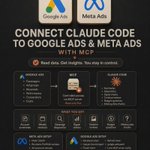
(How to connect Claude to Google Ads and Meta Ads is in the first comment.)
Save this for the next time Claude tells you you've hit your limit.
Meta verified my company in August, then banned us less than a week later.
It hit the account behind one of the ways my product connects client ad accounts. No reason, no appeal form. I couldn't even tell if it was the app, the business portfolio or my personal profile 🫠
Two Meta bans so far, one of them on my personal account.
So if you're wiring your own agent straight into Meta ads... I'd rather go through a tool that already has an approved app. Verified status clearly didn't protect me.
This CLAUDE.md file can turn Opus 5.5 into a senior media buyer for your Google Ads and Meta Ads accounts.
It takes 5 rules. I took them from the AGENTS.md and the principles file in my free paid ads skill pack.
Save it as CLAUDE.md in the folder you open in Claude Code. Claude reads it at the start of every session, so you stop re-explaining your KPIs.
Here's what this one tells Claude to do:
1. Judge every campaign by the business KPI at the top of this file: ROAS for a store, CRM-verified lead value for lead gen. Call nothing a winner when revenue or sales quality disagrees.
2. Fix measurement before efficiency. Check which conversion each campaign is set up to chase and whether one sale shows up twice.
3. Check date range, sample size, conversion lag and recent changes before naming a cause. Label thin evidence as a hypothesis.
4. Scale only with stable conversion volume and clear business value, and set what to watch and when to roll back before each move.
5. End every answer with one decision: scale it, fix it, monitor it, or get more data.
To write yours with your own KPIs, paste this to your agent:
🤖 "Interview me about my business, one question at a time. Ask what a sale or lead is worth to us, which KPI we are judged on, where that number comes from and where tracking is shaky. Then write a CLAUDE.md with my KPIs at the top and 5 rules: judge by the business KPI, fix measurement first, check evidence, scale with a rollback, end with one decision. When I can't give an answer, write needs_data. No guessing."
Save this before your next audit.

If you are weighing Fable 5.1 for your ad account, I have not tested it, so take this as opinion only
For running campaigns I see nothing it adds over Opus, and its output costs 2.5 times more
I like cheap tools and I like hearing they are enough, so weigh my bias
If your ads need about 40 days to turn a click into a real lead, a report on the last few weeks can make them look dead
In our simulation, a cafe owner clicks a tea brand's ad on his phone, looks around and leaves. Weeks later he types the brand name into Google and fills in the wholesale form. Sales marks him a real lead about 40 days after that first click
Sales notes from the brand said so in plain words. Every model got those notes. A model that skips that line sees clicks with almost no real leads. Then it calls good ads dead and tells you to cut them
Haiku missed the delay more often than it caught it. Opus caught it most often


An AI writing ads for a brand with banned phrases has to do two jobs at once
It must write strong lines and stay off that list
In our simulations, Sonnet won 58% of its creative pairs. Haiku lost more pairs than it won
Starting to wonder how many of us pick the biggest Claude model out of habit
Run one task on a smaller model and read both answers side by side before you set a default
In our simulations of ad work, judges picked the answer they would send to a client. Opus won fewer pairs than Sonnet in analysis, creative and strategy, at an average of $0.70 an answer
If you pay for the biggest Claude model to read your weekly ad reports, run one report through Haiku too
Read both answers side by side
In our simulations of ad analysis, Haiku won 58% of its pairs. A judge sees two answers and picks the one they would send to a client. That measures preference and says nothing about accuracy
Haiku and Sonnet are enough to run your ads. Opus is overkill for most ad work, and it costs 35 times more than Haiku.
In my test, Opus came first in only one job out of four.
Here's how the test worked.
I ran a few simulations of real ad work on 3 Claude models. Each model got the same big pile of material about one account: reports, exports, emails and meeting notes. Some important facts were buried inside, just like in a real account.
Then came the matchups.
A judge saw two answers to the same task, side by side. It didn't know which model wrote which. It picked the one it would send to a client.
Our judges were AI models from outside Anthropic, so none of them graded its own maker.
So "58 out of 100" below means this: in 100 matchups, the judge picked that model's answer 58 times. 50 is a tie.
→ Reading ad numbers: Haiku (2 cents per answer)
Haiku won 58 out of 100 matchups. Sonnet won 54. Opus (70 cents) won 38.
Example task: revenue fell and the CEO wanted more ad spend. Buried in the files were two real causes: the best product was out of stock for weeks, and one country got a higher free-shipping threshold.
→ Writing ads: Sonnet (39 cents)
Sonnet won 58, Opus 52, Haiku 40. Haiku lost more than it won here.
Example task: the brand had a list of phrases it may never use in ads. A good answer writes strong lines and stays off that list.
→ Planning a budget: Sonnet again
Sonnet won 56, Haiku 51, Opus 43. Haiku is a fair second pick.
→ Spotting a hidden trap: Opus
One account was a tea brand that also sells to cafes. A cafe owner clicks an ad, leaves, and comes back weeks later. Sales marks him a real lead about 40 days after that first click.
Its own sales notes said so in plain words. A model that misses it sees clicks with almost no leads and tells you to cut ads that work.
Opus used that note in 92 answers out of 100. Sonnet in 79. Haiku in 42.
One limit: these were simulations, so treat the results as a strong hint. And read every answer before it goes anywhere. Even Opus was ready to send without edits only 6 times out of 100.
So I'd go Haiku for the weekly numbers, Sonnet for ads and plans, and Opus when a mistake costs real money.
Want to sort your own ad work this way? Paste this to your agent:
🤖 "Ask me which ad tasks I give you every week. Sort them into 3 groups: reading numbers, writing ads or plans, and calls where a mistake costs real money. For each group, tell me if Haiku, Sonnet or Opus fits best and why."
Your top specialist just handed in his notice. Will your agency make it through this month?
If your answer is “I don’t know” or “It depends on who’s leaving”—you have a serious structural problem that most agency owners don’t recognize until it’s too late.
In recent months, I’ve spoken with dozens of performance agency owners and discovered a recurring pattern. I call it the “star paradox”—the better your specialists are, the more your business is at risk. Why? Because all the tactical knowledge, decision-making processes, and relationships with key clients are locked inside the heads of a few people, rather than being a resource for the entire organization.
This is a bottleneck that stifles growth. It leads to:
🟢 Inconsistent quality. Results depend on who’s leading the project, not on the agency’s standards.
🟢 Training a junior takes forever. New hires are at the mercy of a senior’s time and goodwill.
🟢 You can’t grow without adding staff. Every new client risks overburdening the “star” employee.
How can you fix this? Stop looking for more heroes. Build a system.
You need “exo-armor” for the entire team—a combat system that democratizes expert knowledge. A system that transforms the intuition and experience of your best person into a repeatable, disciplined thought process accessible to everyone.
I often hear the concern: “Won’t standardization kill our uniqueness?” Quite the opposite. A good system automates 80% of repetitive analytical tasks, freeing up the team’s time for the remaining 20% of deep work—that is, understanding the client’s business context and creating unconventional strategies.
The data is ruthless. The most profitable agencies (with net margins of 25–32%) are distinguished by one key metric—higher revenue per employee (RPE). They achieve this not by hiring more expensive “stars,” but through systems that boost the efficiency of every team member.
An agency without a system is not a scalable business, but rather a collection of one-person businesses under one roof.
What do you think? Do systems in an agency stifle creativity, or—on the contrary—do they unlock the potential of the entire team, allowing them to focus on what truly creates value?
If I could fix one thing in the accounts I audited, it would be tracking, so you know which ads convert.
I would use AI as a second pair of eyes. I would still check whether the sale or lead actually happened.
(A screenshot only shows what was on screen.)
For an account review, I’d use two passes:
1. I’d give AI the screenshots, export, or settings that are available.
2. I’d check the action against an event test, log, or sales record.
With enough detail in the material, AI could flag goals or campaign overlaps worth checking. It could list the formats shown and ask what was actually tested.
It cannot watch a customer pay from a screenshot.
That part needs a record outside the ad account.
This matters in two places:
→ Account structure:
I’d give AI a screenshot or export and ask which campaigns and ad sets appear to chase the same goal.
I’d then check whether the account matches the business action we are trying to create.
→ Creative testing:
I’d give AI the ads that are available and ask what formats are there: static, video, or carousel.
I’d then check whether those formats were compared, or whether more static ads were simply added.
------
I’d start with the screenshots.
I’d check the event against a record.
A screenshot can show what Meta was told.
A test or sales record can show what happened next.
AI can help read the first part.
I’d keep the final answer tied to the record.

There are 4 things you can hand to a Claude Skill for marketing.
A draft. A recording. Numbers. An offer.
I put 15 skills in one free, open source pack, and every one starts from something you already have.
A draft or a page
-> SEO Article Refresh
-> Landing Page Rewrite
-> Lead Magnet Polish
-> LinkedIn Asset Post
-> Competitor Message Map
-> Newsletter Issue Rewrite
A recording or a pile of calls
-> Recording to Assets
-> Customer Words to Copy
Numbers
-> Experiment Decision Memo
-> Weekly Report Decisions
-> Paid Ads Readout
An offer or a rough idea
-> Ad Angle Generator
-> Offer Sharpener
-> Resource to Demo Email
-> Creative Brief Writer
Most run on one thing you can paste in a minute.
Two take more gathering. Customer Words to Copy wants a real pile of calls, reviews or tickets. Competitor Message Map wants copy from five or so competitors.
Both are worth it. Neither is a one-minute job.
Each skill writes down what finished looks like before it rewrites anything.
Whatever it cannot verify gets marked instead of smoothed over.

Broken tracking and overcomplicated structure kept turning up in the accounts I audited.
Here’s one way I’d review an account:
1. I’d define the business outcome before I read the report. A form fill, a qualified lead, and a sale can all sit in the same report. They point to different moments. If the campaign is optimising for leads, I’d check that the recorded lead matches what the business calls a useful lead.
2. I’d check what tracking actually records. I would look at the event name, the settings, and any test or log that exists. AI could read screenshots or an export and give a provisional view. I’d compare that view with the available event test, log, or sales record.
3. I’d look at the account structure once that action is clear. Some accounts have so many campaigns and ad sets that it becomes hard to see what each part is doing. I’d ask what each part is for and whether repeated parts make the result harder to trace.
4. I’d look at the ads next. More than three static ads in one ad set is unusual in the reviews I see. I’d ask whether static, video, and carousel were compared, or whether static ads simply piled up.
In a sentence:
I’d name the outcome. I’d check the record. I’d simplify the account. I’d look for a real test.

"Why am I paying your agency tens of thousands,
when AI can do the same thing for $20?"
I recently shared a case study where I built myself an agent over the weekend to manage ad campaigns. I watched as Claude received a command in the console and tinkered with Google and Meta campaigns.
It doesn’t “analyze data.” It logs into the account, reviews campaigns, and changes settings. All on its own.
True, it doesn’t work perfectly or on autopilot yet, but we know it will only get better, and this is the direction things are heading.
The question above will come up more and more often in a few months, because solutions like this will simply start delivering results.
I’ve spoken with over 50 agency owners in recent months. Many of them make their money doing the same thing: clicking around the dashboard, setting up campaigns, and reviewing reports.
That’s exactly what AI is already doing today. Not in two years. Right now. (And for less than 100 zł a month.)
Many agencies will say, “But we have our secret sauce, our know-how, years of experience.” That’s fine, even if it’s true. But Google and Meta are striving for maximum automation: Performance Max, Advantage+, broad match with AI bidding. With every update, ad systems take away another piece of what used to be your competitive edge.
Even if your secret sauce works today, the question isn’t “if” but “when” it will stop being enough.
AI lowers the barrier to entry for execution. But it raises the bar for strategy.
And that’s the dividing line that will soon split the market between those who survive and those who’ll be looking for a new job.
Some of the people I’ve had the pleasure of speaking with have some really interesting ideas for building their competitive edge in this new reality, so I’m curious—how does your agency plan to build its moat in the age of AI?
A weekly account report written by an agent needs four things and nothing else.
What changed. Whether it matters. What I should do. What it could not check.
Number four is the one every dashboard leaves out, and it is the only part that tells me how much to trust the other three.
My assistant sat dead for two weeks. It read my ad accounts and answered with sentences that would fit any account on earth.
Turned out nothing was broken. My own safety rule deleted every answer containing a number unless it carried a receipt the system could almost never produce.
Two weeks of cheap sessions never found that. One weekend of expensive ones closed it.
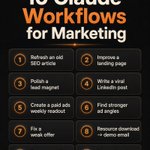
I made 10 Claude Workflows.
Free. Open source. Built for marketers.
Most AI tools are good at the first draft.
Write this post.
Improve this landing page.
Refresh this SEO article.
Give me ad angles.
The answer arrives fast.
Then you still need to fix the angle, tighten the CTA, add proof, remove generic filler, and decide if the asset is good enough to publish.
That is where the work usually stops.
So I turned Ralph Loop in Claude Code into 10 marketing workflows:
1/ Refresh an old SEO article
2/ Improve a landing page
3/ Polish a lead magnet
4/ Write a viral LinkedIn asset post
5/ Create a paid ads weekly readout
6/ Find stronger ad angles
7/ Fix a weak offer
8/ Turn a resource download into a demo email
9/ Scan competitor messaging
10/ Summarize a marketing experiment
Each workflow has:
- required inputs
- iteration limit
- completion condition
- review checklist
- human approval point before anything goes live
The point is simple:
Do not ask AI for one better answer.
Give it a clear finish line and let it take multiple passes.
Comment "WORKFLOW" and I will send the free setup guide.
