







Today, people have the same difficulty imagining that the internet could become unusable.

There’s only one other time I’ve seen the market this complacent in the face of an imminent, systemic risk. And I’m having déjà vu, because the risk around AI related cybersecurity has the same shape and setup as the pandemic risk in early 2020. Though it’s arguably worse.
Bearish market calls are a dime a dozen. But my threshold for making a public bearish call is extremely high. I’ve only done it once before…Feb 2020, weeks before the market fell 35% in a month.
By early Feb 2020 it was already clear to anyone paying attention that COVID was going to be a global pandemic. We had access to a lot of experts, and they were unanimous in their belief that a global pandemic was inevitable. And yet the public and the market treated it like another Ebola or SARS headline. When I warned people to prepare, I was told that we couldn’t have a global pandemic in this day and age. Today, people have the same difficulty imagining that the internet could become unusable. It’s so fundamental to how we live that its continued functioning is treated as a given.
In 2020, the market didn’t discount this risk until the evidence hit them right in the face. So the adjustment was violent and nearly instant.
In modern markets big tops are typically a process. They don’t tend to crash from all time highs. Economic data slows, breadth narrows, credit widens, etc. The market takes the signal piece by piece and distributes over months. But this one fell out of a clear sky, because an exogenous shock doesn't have to generate those kinds of signals in advance.
Quantitative models are good at extrapolating signals that have paid off in the past. That has increasingly become the backbone of financial markets, as well as betting and prediction markets. You can model a football game, or the weather based on data. But if a novel risk hasn’t shown up in the signals a model tracks, it doesn’t just estimate the odds poorly, it may not represent the risk at all. That’s why the market could sit at an ATH high in Feb 2020, with a catastrophe weeks away.
And its why the market currently sitting near an ATH doesn’t give me much reassurance. For a legible, datable risk it can discount ahead of time. It bids up vol into an election or a Fed meeting. But it struggles to price a novel exogenous tail because it has no reference class and no event date. It stays silent, right up until the repricing.
Today the cyber experts agree on the direction the way the epidemiologists did in February 2020. AI cyber capabilities now pose a risk to our entire digital system. And every day we get more evidence that we are nearing a tipping point. Our economy and livelihoods run on that system. The tail risk is a collapse, and its fatter than the market is pricing. I believe serious disruption is now a foregone conclusion, and only the magnitude and timing are still in question.
The market may wake up to this risk because of a single event that impacts the public in a visceral way, but that won’t be the underlying problem. That’ll just make it clear that the rules have changed. This is a paradigm shift in what attackers can do and how many systems they can target.
And like in 2020, the market can recognize the most obvious exposures without grasping how far the damage could spread. In the weeks before the 2020 crash the market did lightly discount the most direct, first order pandemic trades. The cruise lines, the airlines, a handful of others. But the fallout was never going to be contained to those names.
You can argue that the market is already discounting some risk, as the AI related trade has come under strain, credit markets are tightening, and there are other red flags under the hood. It’s hard to differentiate how much of that is due to cyber risks (and its second order implications), rather than fears over capex sustainability, large capital needs, valuations, etc. but the important point is that the market as a whole is still not pricing the scale of the risk.
Since the market tends not to slowly discount this type of risk, it means you can’t wait for confirmation. The opportunity is to position before the market recognizes what’s already qualitatively visible to experts. Which is what worked in February 2020.
But this isn’t an argument for fatalism, because the setup gives us an opportunity. Protection against an unpriced tail costs very little, because no one is bidding it. If the event never comes, you’re out a small premium. If it comes, you get paid from an undiscounted base, which is where the largest repricings in history come from.
That asymmetry means you only have to notice that the price of the insurance is cheap relative to the payoff.
I should say that the risk to this strategy is timing. A cheap convex bet is cheap per unit time but if that event takes longer then you can get eaten up by the carry. I think the timing of the market realization has now approached the point where my own qualitative analysis suggests that it is appropriate to take steps to protect your portfolio. But explaining the reasoning behind that assessment would take pages.
This isn’t financial advice. You should decide for yourself. I’m just making my own thoughts and logic public for anyone who cares how I am thinking at the moment.
I've never hoped more that I'm wrong.
12
software needs to move up the stack so that our code infrastructure is bullet-proof.
we are elevating
1
294


we’re coming up with new phrases to capture what we’re experiencing and learning with AI
meat proxy
is probably my favorite
12
the rust implementation details lost are fine when you then think higher-order. when a high-level task is broken up into small but still complex workflows
1
they’re mining all your “context” uploaded to the agents and will use it to train their next models
2
marek retweeted

literal hardest role to hire for rn and every ai startup wants someone
> chronically online (knows trends)
> has taste & can create (new media)
> understands ai & technical
> can execute with quality (operator)
such a small niche of folks who can do this

ive talked to many teams in the past few months who are thinking about this but dont know quite what to call it/have called it everything from brand marketing to comms to storytelling to special projects to content/social
4 high-profile startups in past ~2 weeks have explicitly told me they are stealthily looking to hire for someone in this sort of role
these roles are quietly and quickly exploding if your ear is to the ground!!
watch this
tldr: use linux for agents bc file system is much faster. xfs+vdo
xitter.cf/theo/status/2090528543…

Your Mac is slowing you down. Moving to Linux has exponentially improved performance for my agents, in particular on the file system side.
2
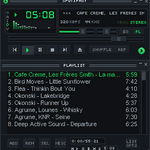
This is AI super use-case:
> MOG entire @spotify eng org with a better/faster/cooler version of their,
AND adds personality with OG winamp vibes
*chef's kiss*
much love @paolino


Spotifast 0.12 is out!
Spotify, fast, in 200MB of RAM, for all OSs.
It now consumes 0% CPU when idle.
spotifast.rocks/
6
It's 4PM
> "Hey Siri, set an alarm for six forty-five"
> Siri bubble takes forever, assume it's done - go do something else
> it's 6:45PM, no alarm
> go to sleep
> 6:45AM sleep disturbed by phone alarm
> Realize Apple *Not* Intelligence set alarm for 6:45AM
> AGI not coming
5

