
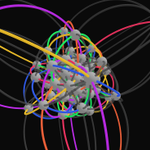
The U.S. flag packs 50 stars into a rectangle. I found a packing with stars 95% larger in diameter. It has central symmetry and is our best so far, though not proven optimal. I don't know if an optimal packing has central symmetry. AI-assisted search.
Last night I had a dream: I worked on a wireless communication problem with many antennas. The output at the i-th antenna was y_i=f_i(inputs). The problem is therefore named y_i,f_i, and pronounced WiFi.
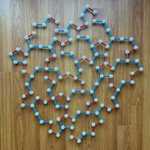
I built a non-coplanar physical Zometool approximation of the aperiodic Spectre tiling. Zometool cannot make 30-degree angles exactly, so this uses red/blue struts at about 31.7 degrees. The even/odd tile classes show up as a red/blue swap. Spot the odd one out?
Follow-up
xitter.cf/mananself/status/20376…
out of 43380 dodecahedron nets, exactly 74 also fold into the great dodecahedron (with faces passing through each other). That's fewer than 1 in 500.
All 74 nets:
github.com/nanma80/star-poly…
I built a paper model of a great dodecahedron from 12 pentagonal "flower" shapes. This net has a rare dual property: it also
folds into a regular dodecahedron. Folding the great dodecahedron requires weaving the faces through each other: messy in the middle, satisfying at the end
I made Lights Out 4D: the classic puzzle game, but on 4D polytopes. Click vertices to toggle rings. Turn them all off to win. Three shapes: 16-cell, 24-cell, 600-cell. Works on phone & desktop. nan.ma/lights_out_4d/
Still playing with the yellow Cairo tiles from my last post. Six tiles form a ring with a regular hexagon in the center. Fill it with a white hex tile and it becomes a flower; leave it open and it's a hollow hexagon. These larger hexagons can tile the plane.
Links to the previous posts for these two tiles:
xitter.cf/mananself/status/20250…
xitter.cf/mananself/status/19263…
I built a 2D coordinate-motion model based on the periodic Cairo tiling. Identical pieces move in and out together. There are two expanding motions, rotated 90° from each other — each opens half the triangular holes. Combined, they open all the holes uniformly.
Two puzzles I'm building:
🔴 12 pieces slide into a cube with coordinated motions in 2D abstract space.
🔵 30 pieces form a dodecahedron with 4D motions.
Inspired by John Kostick's designs. john-kostick.github.io/vzome…
My latest coordinated-motion model is flat and based on a hexagonal tiling, with all the identical pieces moving in and out simultaneously. The mechanism is the same as in the classic Magic Disc and my Blast-hedra puzzles. I can make as many pieces as I like this time.
My latest coordinate-motion model with 20 pieces, based on the compound of five tetrahedra. We can assemble the 20 identical pieces into five separate tetrahedra or into one large ball.
Assembling 12 identical pieces with coordinated motion simultaneously to form a soccer ball shape. It requires aligning all 12 pieces and move them inwards at the same time. I made two simpler models with 4 and 6 pieces. You may buy them here: nothingyetdesigns.com/collec…
Recently I designed and 3d printed a coordinated-motion model. There are 4 identical pieces. When we assemble them, all pieces move simultaneously towards the center to form an octahedron. Then I spin it to disassemble.
The AI roast bot took a long time to process my profile, and it finally came back. I'm very flattered to hear that I'm a human embodiment of a Rubik's Cube, hopefully it's the 4D version.
I improved my model of 30 pencils using colorful pencils. Now 5 pencils in each bundle have the same color, with 6 colors in total. @standupmaths if you can get the pencil manufacturer to make pentagonal pencils with 6 colors, you may make the ideal model.
Previously I made two pencil models, each with 30 pencils. John Kostick suggested that they can be combined together, because one fits into the gap of the other. Now I have a model with 60 pencils with the icosahedral symmetry.


