

Contract manufacturer and technology company building autonomous factories for final assembly (FATP) of robots, actuators, & complex electromechanical systems.
San Francisco Bay Area
Joined September 2025
- Tweets28
- Following21
- Followers263
- Likes70



📣 Calling all robotics startups in the Bay Area 🤖
We’re opening up a section of the non-production area at the Matter factory in Sunnyvale as a co-working and build space for robotics teams.
If you’re building something physical and need a place to work, you can get access to:
• Desks + high-speed internet
• Workshop and prototyping space
• Space to assemble, test, and iterate on hardware
• Feedback from the Matter team on DFM, manufacturing, supply chain, quality, and scaling
• A factory environment surrounded by other people building ambitious hardware
• Robotics/manufacturing happy hours on Fridays 🍻
No charge. No strings attached.
We’re building Matter around the belief that more hardware should be built in America 🇺🇸 — and we’d love for our factory to become a small hub for the Bay Area robotics community.
If you’re a Bay Area robotics startup and could use the space, request access here →lnkd.in/g9Mrqaxh
Come build with us. 🏭🤖
🤖 Made with AI

Matter retweeted

@makematterco is the solution to this exact problem. Be a strategic manufacturing partner for robotics companies from prototype to scale.

the bottleneck in robotics isn’t just intelligence.
it’s manufacturing.
we can build incredible robot demos today. building 10,000 of them reliably, cheaply, and repeatedly is a completely different problem.
where things get hard:
• actuators → motors, gearboxes, encoders, bearings. precision gets expensive fast.
• tolerances → a prototype can be hand-tuned. a production line can’t depend on someone with a file and screwdriver.
• supply chain → one unavailable sensor, chip, bearing, or connector can stop the entire line.
• assembly → robots have too many parts, cables, fasteners, calibration steps. every step adds labor and another failure mode.
• quality control → every actuator, sensor, joint, and pcb has variation. now make 10,000 robots behave the same.
• calibration → cameras, joints, force sensors, encoders. calibration at scale becomes its own manufacturing problem.
• testing → a robot that moves correctly for 10 minutes means nothing. you need thousands of hours of repeatable operation.
• serviceability → robots will break. design them so a technician can replace a module in minutes, not disassemble half the machine.
this is why prototype → production is such a brutal jump.
the robotics companies that win won’t necessarily have the coolest demos.
they’ll be the ones that figure out how to manufacture complicated machines like boring commodities.
robotics needs manufacturing engineering as much as it needs ai.

We’re excited to share that Matter has been named one of Business Insider’s 25 robotics startups to watch in 2026.
The physical AI era is here. As robotics moves from prototypes to products deployed at scale, manufacturing will become one of the most important bottlenecks to growth.
At Matter, we’re building the manufacturing infrastructure for this next generation of hardware: U.S.-based contract manufacturing powered by new age robotics and autonomous factories. Our goal is to make manufacturing faster, more flexible, and increasingly software-defined.
We’re grateful to @charlythuo (Matter's Co-Founder and Investor) and Business Insider for the recognition , and even more grateful to the Matter team making it real every day.
We’re just getting started !
businessinsider.com/robotics…

Matter retweeted

Physical AI needs a new industrial foundation.
@BusinessInsider's @ryajetha named Matter one of the 25 most promising robotics startups of 2026.
Incubated by Eclipse Partner and @makematterco Co-Founder @charlythuo, Matter is building autonomous factories to manufacture the next generation of robots, drones, and their components, turning the factory itself into a learning system.
Congrats to the Matter team on the recognition!
bit.ly/4wAaYi2

The future of robotics is increasingly becoming a matter of national security, not just technology.
Building a great robot is only half the challenge. Scaling production in the U.S. is the other half.
Matter is a U.S.-based strategic manufacturing partner for robotics, providing final assembly, test, and packaging (FATP). Our team has launched and scaled complex hardware across Tesla, Apple and Rivian.
If you're building the next generation of robotics and looking to manufacture in the U.S., we'd love to talk.
forbes.com/sites/johnkoetsie…

Today, we are sharing our approach to manufacturing hardware and software on the shop floor. In the age of Physical AI, we believe it is essential to have control over every element of your manufacturing stack, from design to production.
We are rethinking both hardware and software from the ground up with Physical AI in mind, integrating years of manufacturing best practices from companies like Tesla, Rivian, and Apple into the most flexible automation hardware available.
This video demonstrates our Sim to Manufacture software in action, showcasing production-ready code deployed instantly to the shop floor via our matterOS interface. Every axis, speed, and torque is under software control, ready to connect with the latest VLA models.
We are collecting real-world manufacturing data today, equipped with the tools to implement those models directly on the shop floor.
Our first neural net for autonomous manufacturing. This model will be utilized to enhance the design autonomy suite. A multi-modal network facilitates the generation of a design-to-process plan, automating the design process for manufacturability, assembly, automation, and sequencing the assembly towards the creation of a bill of process.
We firmly believe that autonomous manufacturing necessitates the automation of both physical and engineering workflows. Our previous post outlined our endeavors in data collection for the autonomy of precision equipment. Now we delve into the design and planning workflows. Weeks of work will be getting packed into a mere 60 seconds.
#EmbodiedAI #Robotics #Autonomoussystems
Physical AI is bottlenecked by data. Collecting real world interaction data at the scale required by modern policies is expensive and prohibitively slow. At Matter we are attacking this at its source. Our simulation platform generates hyperrealistic frames that minimize the sim2real gap: unlimited, diverse and physically accurate data on demand. Below is a real footage of our cell and our rendered simulation of the same task.
If you are working in physical AI let’s talk.
#PhysicalAi #Robotics #EmbodiedAI #AutonomousSystems
matterOS autonomy stack enables speed, scale, quality and flexibility for assembly manufacturing.

"Everyone asks how we compete in the United States at labor costs that high. My answer is speed is of the essence."
Foxconn Chairman Young Liu’s advice to American hardware founders:
"If a person who is able to do the project in one year can speed up by doing it in half a year, that means 50% of costs go down. Speed not just makes you competitive in the market, but also enables you to reduce the cost."
"First principles for manufacturing: number one is speed. Number two is quality. Number three is scale. You have to have those three in order to compete."
The Hill & Valley Forum 2026
@HillValleyForum @HonHai_Foxconn @UnderSecE @jacobhelberg
Matter is building autonomous FATP factories for delivering robotics, actuators and electro-mechanical assemblies on demand and at speed here in the US. Come check out our first factory in Sunnyvale, CA.

what we’re currently experiencing in hardware has to be as or more significant than the creation of the internet
hardware democratizing is going to have knock-on effects that we won’t understand for another five or ten years. it’s highlighting serious gaps that need to be filled
ten years ago, you simply couldn’t get parts made. today, there are ten options for CNC or 2D cutting. and this wasn’t even the hardest part, when I started, there weren’t affordable CAD options. you couldn’t even model the part to be made even if you had access to a cnc router or mill
what does this mean? i’ve already written about this, but i think machine shops will “go away” but not in the way you would think. they’ll specialize. i can see them becoming “handling” businesses in a lot of cases. IQC, OQC, specialized finishing etc. they’ll also house random processes like grinding or broaching that cnc can’t replace
the biggest impact will be felt in small to medium sized businesses. why pay a team of people to maintain a shop and equipment when you can get most of it made at sendcutsend? i think internal machine shops are going away, but external machine shops will grow substantially
an opportunity and gap i’m seeing: FATP (assembly). the US has neglected this because MBAs offshored the hardest part of manufacturing to make their PE businesses look good, but this is a serious gap in the market someone will need to address. i’ve considered building an on demand FATP but i’m not there yet. still much to do in my current work
the likes of Jabil can’t and won’t go on-demand. but someone will need to. we have a glut of part production, but the quiet part no one is saying out loud is that someone needs to put it together. this is the hard part
when tim cook said that china had skilled and not cheap labor, this is what he was talking about. china is better than us at FATP and it isn’t close
our eventual supremacy in it will look like our renaissance in part manufacturing: on-demand, fast and affordable
Something magical, and very real, is taking shape in the Bay.
Join us at Matter’s first factory in Sunnyvale for Atoms & Autonomy, an introduction to what we’re building, why it matters, and where robotics manufacturing is headed.
Matter is building the manufacturing platform for the robotics era, combining AI-native software, modular automation, and next-generation connected factories into a unified Physical AI stack. We partner with robotics and advanced hardware companies to move from design to production faster, with manufacturing systems built for speed, flexibility, and autonomy from day one.
This is a new production model for intelligent machines.
Join us for an evening of drinks, bites, and conversation with inventors, builders, and operators - rejoice, reflect and dream with us as we adventure to build America’s autonomous manufacturing infrastructure.
Invite-only event.

Come visit us to experience the future of autonomous manufacturing built in our American factory!

Vibe-manufacturing is coming to US.
Just watched @makematterco demo MatterOS - the entire manufacturing workflow on one seamless platform:
• Pre-SOP: DFM, process planning, simulation, sourcing,…
• Post-SOP: MRP, shop floor orchestration, cell config, genealogy, quality, Andon,…
The kicker? ZERO purchased software. No Dassault. No SAP. No Rockwell.
Built end-to-end in-house, in 5 months, by a handful of ninjas (Ex-@Tesla, @Rivian , @Apple , @GoogleDeepMind with deep domain expertise. This is what happens when the team building it has actually run factories.
MatterOS is built to enable autonomous manufacturing. The Tesla FSD playbook applied to manufacturing - and it’s already working.
@adiprasad27
Matter retweeted

Just spent a week in China deep diving the general-purpose robotics ecosystem.
Key takeaway: while we’re vibe-coding… China is vibe-manufacturing !
A few things that stood out:
1) China has cracked “vibe manufacturing”
Startups are spinning up hardware like we spin up code.
AGIBot (3 years old) has already built ~10,000 robots.
2) The entire stack is being built in parallel.
Every serious robotics company is full-stack: hardware + controls + foundation models.
3) Data factories are real and massive.
Hundreds to thousands of people teleoperating robots 24/7 to generate training data.
In some cases, the government is literally buying robots, generating data, and selling it back to companies.
4) The supply chain is overwhelming.
Foxconn, BYD, LYitech - everyone is plugged into the same dense, hyper-responsive manufacturing base.
This is why iteration speed is so high.
5) Structural paradox: Labor is both tailwind and headwind.
Cheap, abundant skilled labor powers the supply chain…
But it also makes automation harder to justify domestically.
→ Weak ROI for robotics inside China
→ Strong incentive to export
6) Hardware is impressive. Intelligence is not (yet).
Amazing kinematics—dancing, acrobatics.
But limited ability to execute simple instructions reliably.
7) Everyone is moving up the stack
Every major CM/ODM is building their own robots—humanoids + wheeled.
Today’s suppliers will be tomorrow’s competitors.
8) Dexterity remains unsolved
Lots of prototypes. Very few real demos.
So what does this mean?
Physical AI requires strength in both bits and atoms.
Right now:
China → dominates atoms (manufacturing, supply chain, scale)
US → leads in bits (models, autonomy, software)
We are dangerously behind in atoms.
If we want to compete, incrementalism won’t cut it.
We need to:
- Build depth and breadth across the electro-mechanical supply chain
- Scale CMs / ODMs / JDMs domestically
- Move 100x faster, think 100x bigger on scaling manufacturing infrastructure
Hats off to those doing their part to advance domestic manufacturing supply chain - @makematterco, @VulcanForms, @brightmachines, @thebotcompany @gs_ai_ , @MytraUS, @mind_robotics, @tesla_optimus, @atomic_inc, @Senra_Systems, @pathrobotics, @machinalabs_,@figure_robot, @HadrianInc , @agilityrobotics
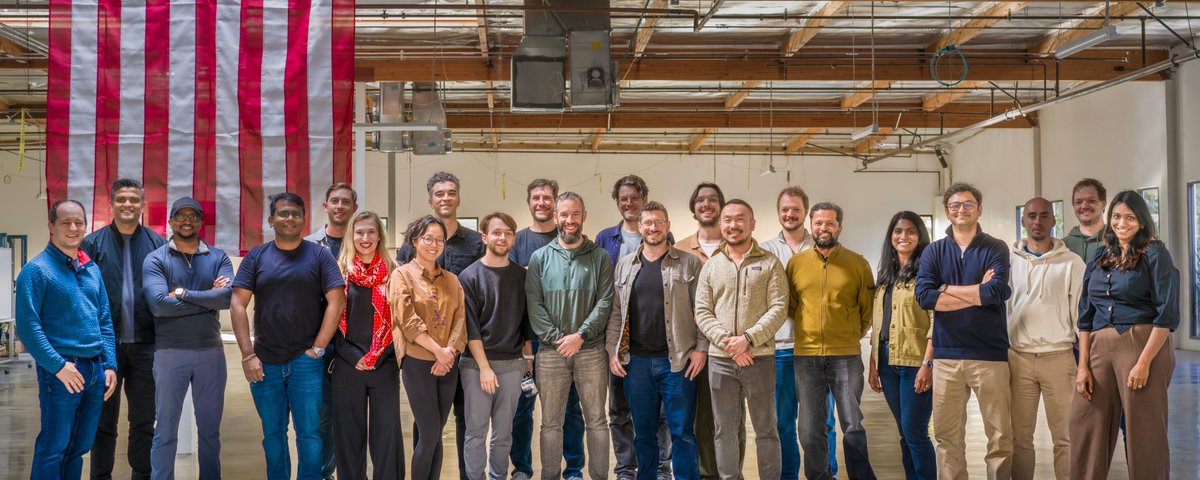
The era of software-plus-hardware is over.
You can’t build the future of manufacturing by bolting a dashboard onto a legacy machine or by throwing software at a fragmented shop floor.
AI layered on top of disconnected data is blind. The winners won’t be software firms or traditional hardware OEMs. They will be Physical AI firms.
At Matter, we believe the factory, the product, and the data model are a single organism.
🔎 The problem: SaaS proliferation has created "islands of data."
⛔ The bottleneck: Legacy ERPs are built for stability, not the rapid adaptation AI requires.
⚙️ The solution: A unified architecture where hardware and software are designed together, from the first concept sketch to the product in the customer's hands.
Physical AI isn’t a feature you add. It’s the operating principle of the modern factory. We aren’t building a stack of apps; we’re building a software-defined manufacturing system where intelligence is native and end-to-end.
The future belongs to those who treat the physical and digital as one.

Matter retweeted
Most people confuse automated factories for autonomous factories. There is a difference !
The physical world is entering its AI moment.
We’re building autonomous factories to re-industrialize America - faster, more flexible, and software-defined from day one.
New website is live 👇
makematter.co
