

CEO @bespokelabsai. RL/Envs/Posttraining/Agents. Created Generative Retrieval at @GoogleDeepMind.
Inside an RL Env
Joined February 2008
- Tweets4.9K
- Following1.6K
- Followers17.5K
- Likes6.1K






Mahesh Sathiamoorthy retweeted

Seeing generational levels of locked-in on the streets of SF
(face redacted to protect the innocent 🫡)

Mahesh Sathiamoorthy retweeted
"Additionally: ~40% of the issues found were already tracked in the upstream repo - including 21 tasks with outstanding fix PRs!"
Bespoke has found several issues using our internal QC agent, and has been working on improving Terminal Bench over the months.
Here are the 25 issues we filed, and there are PRs corresponding to them.
A subset of these were what @EpochAIResearch also used in their report: epoch.ai/benchmarks/terminal…
All of this shows that building RL envs is hard, and building a benchmark is harder
github.com/harbor-framework/… -> github.com/harbor-framework/…
github.com/harbor-framework/… -> github.com/harbor-framework/…
github.com/harbor-framework/… -> github.com/harbor-framework/…
github.com/harbor-framework/… -> github.com/harbor-framework/…
github.com/harbor-framework/… -> github.com/harbor-framework/…
github.com/harbor-framework/… -> github.com/harbor-framework/…
and more below


The @SnorkelAI team did an audit of these findings using our internal QC platform.
Tl/dr: We agree with many of the findings, but ~55% of the fixes from @preferencemodel had their own issues with reward hacking or over-prescriptiveness.
Additionally: ~40% of the issues found were already tracked in the upstream repo - including 21 tasks with outstanding fix PRs!
Building datasets like this - and maintaining ambitious open benchmarks around them - is hard. We believe it requires open, collaborative review with community maintainers and relevant domain experts to get right.
@terminalbench was one of the first community efforts to build an open, continuous benchmark, and drive a vision of how OSS contributes to the rapidly advancing frontier of AI. We hope that the community will invest in working collaboratively with benchmark maintainers and task authors to keep this vision alive.
---
Some takeaways + details of our preliminary audit:
(1) We confirm 100% of the reward hacking / verification gap findings using our QC system. However, we find that 17/44 (39%) of the corrected tasks are just as or more reward hackable. Additionally, we don’t yet see evidence that these verification gaps meaningfully affected benchmark rollouts within CIs, though our analysis here is still ongoing.
(2) Our preliminary review raises questions about the underspecification findings for 22/41 (54%) of the flagged tasks, including 7 explicitly marked by task authors as intentional design choices. These cases warrant expert peer review and adjudication: balancing over/under-specification is a critical and tricky design decision - much of human intelligence concerns dealing correctly with reasonable and realistic underspecification - and we believe these corrections made to the tasks are likely too over-specified, reducing realism and difficulty relative to spec.
(3) Around 40% of the issues found were already tracked in the upstream repo (including 21 tasks with outstanding fix PRs)! OSS projects require community efforts to correct identified open issues, and ideally audits like these are done collaboratively with task authors and maintainers directly, in the traditional community spirit that has kept OSS alive for decades.
Mahesh Sathiamoorthy retweeted


We are excited to announce that we post-trained NVIDIA Nemotron-3.5-Super-VL to be an autonomous ML researcher. We show that our post-trained model goes from 28% to 35% on AutoResearchExam, matching Qwen 3.8 Max, a model with 20× the total parameters.
The tasks are long horizon, open ended AI and ML research: building a faster executor for a transformer compute graph, training a RL control policy, creating new uncertainty quantification methods, etc. The model gets to submit once, and it doesn't see its score until the end.
We curated SFT data using Self-context distillation. This means that we let the Nemotron model to solve a problem with hints, then we SFT on these trajectories but without the hints. This gave us +11% on AutoResearchExam.
As a next step, we added reflection: We ask the Nemotron model to review its own past attempts and writes concrete lessons learned. Then we SFT on these reflections.
Surprisingly, training on these lessons improved the performance to +25% compared to the base model.
The hardest part was choosing the right data. We selected traces based on task scores, completion checks, and runtime, then refined the sampling across training rounds to address failures in the base and fine-tuned models. We removed hints and filtered out steps that relied on information available only in those hints. The goal was to teach decisions supported by the task and history the model would actually see at inference.
Full write-up:
bespokelabs.ai/blog/teaching…
Thanks to @NVIDIAAI for early access and collaborating on this.

Mahesh Sathiamoorthy retweeted

We developed a model reaching frontier-level multimodal performance, matching or exceeding Astra on 5 of 12 benchmarks, all with 17x lower token prices. The model is smaller and cheaper than Gemini 3.8 Flash while dominating it in real world vision workloads.
We achieved this by inventing a technique for visual reasoning, where the model is no longer restricted to text chain-of-thought. Conditioned on visual tokens, Glimpse can perform recurrent computation over latent internal representations and can even orchestrate subagents that send messages over internal visual states.
Really proud of what our small team and only hundreds of GPUs could accomplish.
elorian.ai/blog/introducing-…

Mahesh Sathiamoorthy retweeted

Official documentation from Google for MaxText (library for training/inferencing on TPUs) features Nimble.
maxtext.readthedocs.io/en/la…

Mahesh Sathiamoorthy retweeted

We’re giving away $1 million to agents.
Introducing Composio Instant: the easiest way for agents to pay for their own tools.
Claim your agent's share: composio.dev/instant
Mahesh Sathiamoorthy retweeted

Introducing DeepRSI, a new industry standard for measuring recursive self-improvement.
On preexisting benchmarks, tasks are contributor-based and short-horizon (~12 hrs). In DeepRSI, we push agents to work 48 hours on ML tasks actually derived from ongoing proprietary research.
Mahesh Sathiamoorthy retweeted

Introducing ChatGPT for Dishwashing
GPT-6 achieves state-of-the-art results on dishwashing benchmarks for long-running jobs and difficult stains.
The Navier–Stokes Millennium Prize Problem is a $1 million challenge about whether the equations describing fluid motion can break down. In this video, I accidentally found a counter-example while trying to optimize my dishwasher. But in reality, OpenAI used 10,000 AI agents to find a proof in 88 hours: openai.com/index/navier-stok…
Parody of the original GPT-6 Astra ad
@OpenAI #ChatGPT_Partner #chatgpt
Credits:
Written and Directed by Joma
Co-Writer - Henry Connor Coan IV @coan_henry
Production by Dauntlus Studios @dauntlus.studios
Producer/Co-Director - Marcus Liew @dauntlus
Camera Operator - Amos Lee @amoselijahlee
Art Director - Alethea Soo @aletheasoo
Art Assistant - Alicia Lim @aliciatkl_
Assistant Editor - GPT-6 Astra
Music: Tensions Run High by Soundridemusic
youtube.com/watch?v=Ly9H63SL…


Mahesh Sathiamoorthy retweeted

We are releasing AutoResearchExam, a benchmark on open-ended machine learning and engineering tasks. Our benchmark covers seven research areas including model training, data curation, AI safety and interpretability.
benchmarks.bespokelabs.ai/au…
In each task, we give agents 24 hours with a CPU or GPU machine to develop and improve their solutions through experiments and feedback. We measure both speed and quality with a combined score. Our benchmark has a unique feature: testing if agents create improvements that hold up on data they never see. We find that AI research agents often overfit as they try to improve.
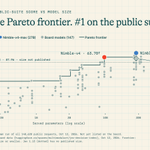
We see an interesting head-to-head comparison at the frontier: Astra starts the strongest and holds the lead for up to 19 hours but Fable 5.1 catches up and gets the top performing spot in the final hours.
Qwen3.8 Max, Gemini 3.8 Flash and Grok 4.6 all sit on the cost-performance Pareto frontier, giving strong options at lower API budgets.
Anthropic's Opus and Fable retain nearly all their validation performance on hidden tests, with gaps of 1.1% and 2.9%. Astra's improvement over Sol extends to generalization too, with that gap falling from 6.9% to 1.7%. (1/n)
Mahesh Sathiamoorthy retweeted

A benchmark that takes 24 hr to run per model? Yep. Turns out that testing long horizon performance requires testing performance over long horizons.
Super cool benchmark. Nice work @AlexGDimakis and team!
We are releasing AutoResearchExam, a benchmark on open-ended machine learning and engineering tasks. Our benchmark covers seven research areas including model training, data curation, AI safety and interpretability.
benchmarks.bespokelabs.ai/au…
In each task, we give agents 24 hours with a CPU or GPU machine to develop and improve their solutions through experiments and feedback. We measure both speed and quality with a combined score. Our benchmark has a unique feature: testing if agents create improvements that hold up on data they never see. We find that AI research agents often overfit as they try to improve.
We see an interesting head-to-head comparison at the frontier: Astra starts the strongest and holds the lead for up to 19 hours but Fable 5.1 catches up and gets the top performing spot in the final hours.
Qwen3.8 Max, Gemini 3.8 Flash and Grok 4.6 all sit on the cost-performance Pareto frontier, giving strong options at lower API budgets.
Anthropic's Opus and Fable retain nearly all their validation performance on hidden tests, with gaps of 1.1% and 2.9%. Astra's improvement over Sol extends to generalization too, with that gap falling from 6.9% to 1.7%. (1/n)

Mahesh Sathiamoorthy retweeted

We just had the one and only Alex @AlexGDimakis from @UCBerkeley and his co-founder Mahesh @madiator from @bespokelabsai taking about “Data Curation for Agents” in our office @fdtn_ai @CiscoAI


Mahesh Sathiamoorthy retweeted

Huge news for Terminal-Bench-Science!🚨
Only 5 days after launch, Terminal-Bench-Science 0.1 is the #1 featured benchmark on @AnthropicAI's new Claude Fable 5.1 release.
Incredible >2x performance jump:
Claude Fable 5 (24.7%) → Claude Fable 5.1 (52.6%)
Now it's on us to build an even more challenging set of tasks for v0.2.
anthropic.com/claude-fable-a…


We're releasing Terminal-Bench-Science: a benchmark for evaluating AI agents on research workflows across scientific domains.
An ongoing Stanford-led community effort, built by the team behind Terminal-Bench together with scientific domain experts at research institutions worldwide. v0.1 has 70 tasks. Claude Opus 5 solves only ~30%.
1/n 👇


Mahesh Sathiamoorthy retweeted

Introducing WikiSkill📚: compiling agent experience into persistent knowledge for skill evolution!
🧠 Persistent wiki + evolving skills
📈 Evaluated on 5 benchmarks & 5 models
📊 WikiSkill consistently maintain superior performance

Mahesh Sathiamoorthy retweeted
Tb4 is out. You may be thinking, what is the difference from Terminal-bench 3? Think of Tb4 as the same tasks as Tb3, but with a few task bug fixes and calibrations. We’re excited to contribute with bug fixes and continuing support to the open source benchmarking community.

Mahesh Sathiamoorthy retweeted

[1/7] 🚨 We're releasing LAION-BVD: a 10-million-hour open video dataset for multimodal pre-training.
- 1.3B video URLs from CommonCrawl
- 80M downloaded videos
- 10M video hours
- 55M captioned clips
- 300M frame-caption pairs
🌐: projects.laion.ai/bvd/
🧵👇

