

AI engineering, distilled. Agents, LLM systems, MLOps & infra architectures, papers, and tools worth your time.
Italy
Joined January 2016
- Tweets503K
- Following28.3K
- Followers171K
- Likes1.8K


Machine Learning FLX retweeted

How I organise a project knowledge base for AI coding on consulting projects: doc sliced into chunks, chunk is summarised, views per feature on top of summaries, specs written from views, and everything rebuilt by following links when a doc changes.

Machine Learning FLX retweeted

Job4Fit is worth a look - free while in beta:
• CV analysis with an ATS score and what to fix
• paste a job ad, get red flags, culture signals and growth outlook
• mock interviews with role-specific questions and feedback on every answer
job4fit.com

Machine Learning FLX retweeted

Happy 1024 & happy weekend, devs.
500M free tokens on ZCode: GLM-5.3 (200M) + GLM-5.3-Flash (300M). 200K packs, while they last.
Claim now. Use Oct 23 15:00 – Oct 26 01:00 UTC.
Update to the latest ZCode, claim in-app, then switch to Start Plan.
zcode.z.ai

Machine Learning FLX retweeted

Using a single Nano Banana image and Blender MCP, Gemini 4 Argon built a 3D Gothic cathedral in @Antigravity.
It iterates on the geometry, textures, and lighting to create the finished scene.
Machine Learning FLX retweeted

Microsoft open-sourced an app that watches you do a task once, then teaches your AI agent to do it for you. 4.3K stars.
How Skill Recorder works:
1. Hit record (⌘⇧R or Ctrl+Shift+R) and do the task normally. You can talk through it out loud too.
2. It captures your clicks, app switches, pages and terminal commands, all on your machine.
3. GitHub Copilot turns the recording into a list of steps you can edit.
4. One click turns it into a skill your agent can run, or an automation on a schedule.
It generalizes from one example, so recording yourself submitting one form teaches the agent to submit all of them.
Runs on Mac, Windows 11 and Ubuntu. Needs a GitHub account with Copilot access.
Install: copy the one-line command from the latest release:
github.com/microsoft/skill-r…

Machine Learning FLX retweeted

Anthropic 把 Claude Code 使用的沙箱运行时开源了,叫 sandbox-runtime。
macOS 用系统自带的 Seatbelt,Linux 用 bubblewrap,不需要额外启动完整容器,就能限制 Agent 对文件系统和网络的访问。
而且不只支持 Claude Code,自己的 Agent、MCP Server,甚至普通命令行程序都能用。
但这里有个很现实的问题:
Agent 写代码不只是改文件,还要装依赖、拉文档、访问 API。网络白名单收得太紧,任务可能跑不下去;放得太宽,沙箱的安全价值又会打折扣。
所以 Agent 沙箱真正难的,不只是把权限关起来,而是怎么在安全和可用性之间找到平衡。
开源地址:
github.com/anthropics/sandbo…


Machine Learning FLX retweeted

HOLY SH*T, ELON MUSK PUT SPACEXAI'S BEST ENGINEERS ON A LIVE STREAM TO SHOW EXACTLY HOW TO BUILD A COMPANY WITH GROK BOTS
they start from an empty github org and zero bots. 72 hours, live.
how to use grok bot, from their demo:
step 1: make one bot per job, not one chat per task
step 2: tell it the result you want, voice works too
step 3: set approval rules, e.g. ask me before sending any email
step 4: show it a task once on screen, it saves it as a skill
step 5: add a routine, e.g. every morning at 9 it sends you a summary
step 6: if it refuses or asks questions, teach it, it keeps that in memory
the parts worth watching:
11:29 - the first hires: which bots they pick
20:23 - building a bot from scratch with one voice prompt
22:54 - teaching a bot a task by doing it once
25:21 - setting up a 9 am routine
save this and study the article below, it has ready-made grok bot configs you can copy ↓


Machine Learning FLX retweeted

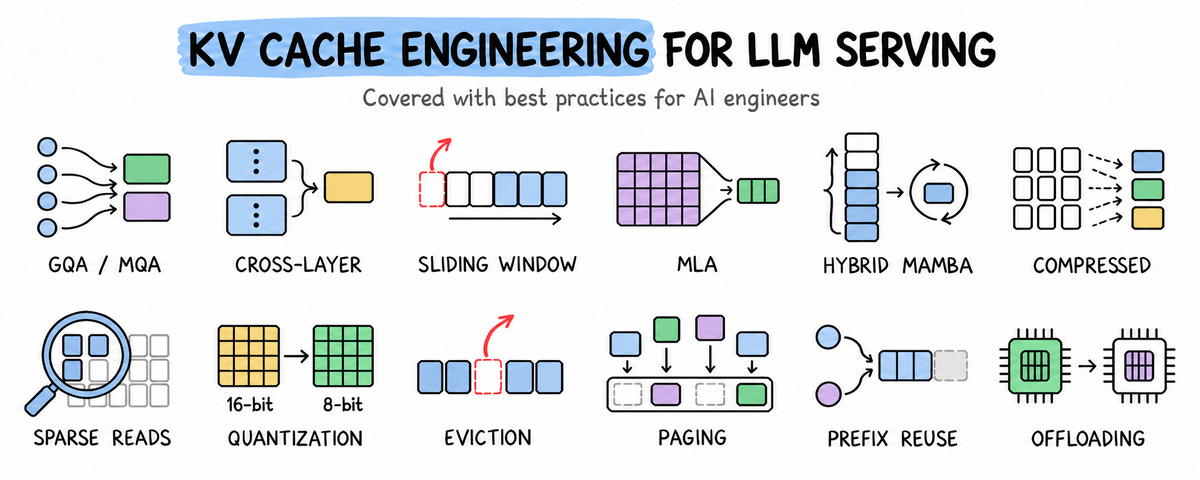
6 KV cache quantization approaches, explained visually:
Quantizing model weights doesn't automatically shrink the KV cache.
The cache stores activations generated during inference, and its memory grows with retained tokens and concurrent requests.
KV quantization reduces the bytes used to store those activations.
For instance, moving from 16-bit to 8-bit halves the raw KV payload, before scales, metadata, and any high-precision buffers.
The diagram covers six approaches. In practice, several approaches can be combined within the same implementation.
1. FP8 cache
The KV cache normally stores each number using 16 bits. FP8 reduces this to 8 bits, so the numbers take up half the space.
A scaling factor adjusts their range before storage. The serving engine needs an attention kernel that supports this format.
2. INT8 / INT4 cache
These methods convert cached numbers into 8-bit or 4-bit integers.
INT4 uses less memory, but has fewer values to choose from, so rounding introduces more error.
During attention, the kernel converts the stored integers back into approximate versions of the original numbers.
3. Quantization granularity
Quantization uses a scale to convert numbers into a smaller format. One scale can serve the whole tensor, or separate scales can serve individual channels, tokens, or small groups.
Smaller groups fit their numbers more closely. But each group needs its own scale, which also takes memory.
4. KIVI-style quantization
Keys and values don't have the same pattern of large numbers, so KIVI compresses them differently.
For keys, it groups numbers from the same channel across tokens. For values, it groups numbers within each token. This helps preserve accuracy even at 2-bit precision, without fine-tuning the model.
5. Mixed precision
This approach keeps recent tokens' keys and values at higher precision and compresses older entries.
Attention reads both parts. Keeping some entries uncompressed avoids rounding errors for those entries, but uses more memory than compressing the entire cache.
6. Non-uniform / outlier-aware quantization
Uniform quantization rounds numbers to evenly spaced levels. Non-uniform quantization changes the spacing to better represent the numbers that matter.
Outlier-aware methods handle unusually large numbers separately. KVQuant stores these outliers in a separate structure, so they don't force the remaining numbers into a range that's too wide.
A smaller cache can fit longer contexts or more requests on the same GPU. It doesn't guarantee faster decoding, because compressing and reading the numbers also takes work.
Compare each method against an unquantized cache to check how much memory it saves, whether decoding gets faster or slower, and whether answer quality drops.
If you want to dive deeper, I wrote a KV Cache Engineering article covering quantization and other ways to reduce cache memory, with code examples and their trade-offs.
Read it below.

Machine Learning FLX retweeted

MiniMax M3.1 Flash weights are now public. 428B parameters total, 23B activated per token.
Agentic performance: A generational leap in agentic tasks, coding, and cybersecurity — 76.2 on BankerToolBench, 73.7% on DeepSWE v1.1, 61.7 on OSWorld V2, 29.6 on Agents' Last Exam, and 82.2 on CyberGym.
Efficient by design: MiniMax Sparse Attention and DSpark speculative decoding improve inference efficiency.
Hugging Face:
huggingface.co/MiniMaxAI/Min…
ModelScope:
modelscope.cn/models/MiniMax…
API: platform.minimax.io
M Plan: minimax.io/m-planMiniMax
MCode for desktop: agent.minimax.io/download


MiniMax M3.1 Flash: Space Performance + Bunny Speed
🚀🐰 Yes, Space Bunny - which has topped global leaderboards with 200T+ tokens - was an earlier version of M3.1 Flash.
💰Redefining the performance economics of agentic AI. M3.1 Flash achieves frontier-level intelligence across key tasks such as Cowork (Automation-Bench: 62%; ALE: 30%), Coding (DeepSWE: 74%) and Visual Reasoning (BabyVision: 91%), at 1/3 the cost of M3 and 3x the speed.
API pricing (flat rate): $0.15 / $0.60 per 1M input/output tokens, with cache reads at $0.015 / 1M tokens.
Model weights will arrive on Oct 23.
API: platform.minimax.io
M Plan: minimax.io/m-plan
MiniMax Code for desktop: agent.minimax.io/download

Machine Learning FLX retweeted

STOP WASTING HOURS TRYING TO LEARN REA.
REA Team put together one practical roadmap with tutorials, real investigations, GitHub repos, books, research papers and free courses.
START HERE:
1. REA Official Repository github.com/morluto/rea
2. REA Official Website rea.tools
3. Installation & Agent Setup github.com/morluto/rea/blob/…
4. Your First REA Investigation rea.tools/first-investigatio…
5. REA Guides rea.tools/guides/
6. Guided MCP Prompts github.com/morluto/rea/blob/…
Install: npx rea-agents@latest setup
WATCH & FOLLOW ALONG:
1. How To Use REA To Clone Any Software In Minutes — youtube.com/watch?v=FnB9tHKB…
2. REA + Pi Coding Agent Tutorial datacamp.com/tutorial/revers…
3. Ghidra Tutorial for Beginners youtube.com/watch?v=OFAxXXcL…
4. Frida for Android Reverse Engineering youtube.com/watch?v=GHh9P-Dy…
5. pwn.college Reverse Engineering pwn.college/intro-re-pwn~593…
6. Malware Unicorn RE101 malwareunicorn.org/workshops…
REAL REA INVESTIGATIONS:
1. Notes Export rea.tools/first-investigatio…
2. Notion Clipboard rea.tools/showcase/notion/
3. DX-Ball Reconstruction rea.tools/showcase/dx-ball/
4. Aegis APK rea.tools/showcase/aegis/
5. TH04 Bullet Patterns rea.tools/showcase/th04/
GITHUB REPOS:
1. REA github.com/morluto/rea
2. Awesome Reverse Engineering github.com/morluto/awesome-r…
3. REA Gems github.com/sqwu/rea-gems
4. Awesome Reverse-Engineered github.com/alexgaoth/awesome…
5. Ghidra github.com/NationalSecurityA…
6. JADX github.com/skylot/jadx
7. Frida github.com/frida/frida
8. ILSpy github.com/icsharpcode/ILSpy
9. x64dbg github.com/x64dbg/x64dbg
BOOKS:
1. The Ghidra Book, 2nd Edition nostarch.com/ghidra-book-2e
2. Reverse Engineering for Beginners go.yurichev.com
3. Practical Binary Analysis nostarch.com/binaryanalysis/
4. Practical Malware Analysis nostarch.com/malware
5. The Android Malware Handbook nostarch.com/androidmalwareh…
6. Reversing: Secrets of Reverse Engineering wiley.com/en-us/Reversing%3A…
RESEARCH PAPERS:
1. LLM4Decompile arxiv.org/abs/2403.05286
2. AutoDecompiler arxiv.org/abs/2606.16162
3. SALT4Decompile arxiv.org/abs/2509.14646
4. Decomperson usenix.org/conference/usenix…
5. DIRTY usenix.org/system/files/sec2…
6. Automatically Attacking Software RE Agents arxiv.org/abs/2605.30667
7. Does Reverse Engineering Need a Bigger Model? rea.tools/blog/reverse-engin…
FREE COURSES & PRACTICE:
1. OpenSecurityTraining2: x86-64 Assembly p.ost2.fyi/courses/course-v1…
2. pwn.college: Reverse Engineering pwn.college/intro-re-pwn~593…
3. pwn.college: Reversing Hell pwn.college/reversing-hell/
4. Malware Unicorn RE101 malwareunicorn.org/workshops…
5. Nightmare github.com/guyinatuxedo/nigh…
6. RPISEC Modern Binary Exploitation github.com/RPISEC/MBE
7. OWASP Mobile Application Security mas.owasp.org
BEST ORDER TO LEARN:
install REA → Notes Export → Notion → CTF binary → Aegis APK → DX-Ball → then Ghidra, assembly and papers


REA hit #1 on GitHub trending, and most people still run it inside a single chat
Split it into 4 subagents and one command takes a program you own from sealed binary to a tested rebuild with a match rate
Set it up once, aim it at the next one:

Machine Learning FLX retweeted

Available now: NVIDIA Nemotron 3.5 Bolt E4B 4GB ⚡️
Our newest small open model is built for local assistants, interactive characters and robots that can carry on a conversation and use tools to get things done.
Watch Reachy Mini chat and move, with Bolt handling conversation and NVIDIA Cosmos handling vision. Both models run locally on Jetson Orin Nano 8GB.
Learn more: research.nvidia.com/labs/nem…
Machine Learning FLX retweeted

10 GitHub repos to turn you into a design/motion studio. 550K+ stars total
1. impeccable (85K stars)
Anti AI-slop design skill with 62 rule-based checks github.com/pbakaus/impeccabl…
2. UI UX Pro Max (139K)
Generates a full design system (pattern, palette, type) from a project brief. github.com/nextlevelbuilder/…
3. MCP for Blender (32K)
Connect Blender to any LLM. Prompt-driven modeling and scenes.
github.com/ahujasid/blender-…
4. img2threejs (19K)
Rebuilds the object in a reference image as code-only, animation-ready Three.js. github.com/img2threejs/img2t…
5. video-shotcraft (13K)
Captures your real pages, picks from 150 shot recipes, renders a promo in Remotion. github.com/Vincentwei1021/vi…
6. HyperFrames (70K)
Write HTML, render MP4, built for agents. Has a /figma skill that pulls brand tokens into video. github.com/heygen-com/hyperf…
7. Penpot (62K)
Open-source Figma alternative with an MCP server, so agents can read your design files. github.com/penpot/penpot
8. Remotion (67K)
Videos in React. The official skills repo teaches your agent how to use it.
github.com/remotion-dev/remo…
9. lemo-opuscar (6K)
59 film styles made entirely in code, no video model. github.com/lemomo-ai/lemo-op…
10. diagram-design (60K)
Agent skill that outputs diagrams as one HTML+SVG file, onboarded to your brand's colors and fonts. github.com/cathrynlavery/dia…
Save this. Which one should I stress-test first?

Machine Learning FLX retweeted

New on our Frontier Red Team blog: using Claude to formally verify software at large scale.
Formal verification can prove that code is free of certain bugs, but historically it has only been feasible for small codebases (or required a lot of expert time).
With AI models, however, this is beginning to change. In collaboration with @theoremlabs, we used Claude to prove security properties in over one hundred real-world open-source libraries over the span of a few weeks.
Read our research in full here: anthropic.com/research/forma…

Machine Learning FLX retweeted

We’re adding support for MCP Tasks and Elicitations in Claude.
Tasks let Claude give plugins long-running jobs such as deep research and report back when they’re done.
Machine Learning FLX retweeted

Introducing Kimi K3.1 Pro: our most capable 3T-class open-weight model.
🔹 1M-token context, 2.8T total / 104B active params (MoE), Multimodal.
🔹 Full-project coding: games in Unreal, Unity & Godot.
🔹 Excels at parametric 3D modeling in Blender & CAD.
🔹 More reliable at finance work: Accurate modeling with hallucination down by 65%.
🔹 Matching the strongest proprietary models across coding, agentic and knowledge benchmarks.
Kimi K3.1 Pro and K3.1 Pro Highspeed (2–3× faster) are now live on Kimi.ai, Kimi Work, Kimi Code, and the Kimi API.
Open weights by Nov 4, 2026.
🔗 API: platform.kimi.ai
🔗 Tech blog: kimi.ai/blog/kimi-k3-1-pro

Machine Learning FLX retweeted

Turn documents into Agent-Friendly data!
OXR is a 1.3B open-source document parsing model that turns PDFs and document images into structured Markdown or JSON.
Instead of extracting text alone, it recognizes 13 different document elements including tables, formulas, figures, code blocks, footnotes, and chemical structures, while preserving reading order and layout coordinates.
That makes the output much more useful for RAG and agents, where knowing what the text says is only one part of the problem. You also need to know what is a table, where a formula belongs, which caption maps to which figure, and how the document should actually be read.
The technical part I found interesting is how OXR was post-trained.
It uses a recursive self-improvement loop where OXR first parses unlabeled documents, then a general VLM reviews the outputs for errors and uncertainty.
Disagreement across multiple OXR rollouts helps surface uncertain examples, those failures are grouped by cause, and the VLM generates targeted training data for the next round.
So instead of manually labeling new data for every iteration, the model’s own parsing failures help decide what it should train on next.
The architecture is also different from the usual parsing pipeline.
Layout analysis stays independent and pluggable, while recognition and content-aware reading order run in parallel inside the main model. That means teams can replace the layout model for their own document structure without replacing the rest of OXR.
And the results are strong for a 1.3B model.
OXR ranks #1 on olmOCR-Bench, OmniDocBench, and DocParsingBench. In the reported 100-page speed test on a single RTX PRO 6000, OXR finished in about 101 seconds vs. 161 seconds for DeepSeek-OCR-2.
The full model is open source.


Machine Learning FLX retweeted

Claude Security now keeps up with your code as it changes.
Connect your repositories once. Claude runs a deep first scan, then re-scans as changes land, so findings stay close to the current state of your code.
In public beta on Claude Enterprise.

Machine Learning FLX retweeted

Run Flint locally on 24GB RAM via Unsloth Dynamic GGUFs!
Flint is the strongest MoE model under 50B parameters.
Recursive’s Apache-2.0 model has 39.8B parameters (2.5B active). Run at 125 t/s on Mac, 150 on RTX Spark
GGUF: huggingface.co/unsloth/flint…
Guide: unsloth.ai/docs/models/flint


Introducing Flint, @Recursive_SI’s first model: a fast local coding model built with our automated research system, the Eureka Machine.
• Best-in-class fast local coding
• Up to 2x faster than comparable models: 125+ tokens/sec on a MacBook Pro, 150+ on RTX Spark
• Built from scratch in under 4 months
Private, unmetered intelligence on your own machine. Open weights available now on @huggingface, run it locally on your favorite framework or try it for free on @opencode or @pidotdev.