

Christian | Solution Architect | P. M | Street Poet | DevRels & Web3 Community | 10x Builder @tricodepro
Abuja, Nigeria
Joined June 2010
- Tweets1.9K
- Following2K
- Followers1K
- Likes13.9K





Luke retweeted

The future of AI coding might not live in the cloud. It might live on your laptop.
Recursive just released Flint, a 40B coding model built to run locally at high speeds.
125+ tokens/sec on a MacBook and 150+ on an RTX Spark at short contexts.
Your code stays on your hardware. No per-token API bill.
The wildest part? Recursive's Eureka Machine helped build Flint in under four months.
AI helping build better AI. We're entering a new era.
🤝 Paid partnership

Introducing Flint, @Recursive_SI’s first model: a fast local coding model built with our automated research system, the Eureka Machine.
• Best-in-class fast local coding
• Up to 2x faster than comparable models: 125+ tokens/sec on a MacBook Pro, 150+ on RTX Spark
• Built from scratch in under 4 months
Private, unmetered intelligence on your own machine. Open weights available now on @huggingface, run it locally on your favorite framework or try it for free on @opencode or @pidotdev.
Luke Okagha 🇳🇬 | Lagos, Nigeria.
Builder, technical leader, entrepreneur, and street poet. Passionate about tech, AI, business, and building things that matter. Always learning, scaling, and growing.
Looking to connect with founders and builders in the Netherlands 🇳🇱

Earlier this year i went through a toughest period of my career due to my partners action which broke our relationship of over 4 years. I started sharing my experiences and challenges as a mental recovery from depression and self resilience.
Today i am 10X better
Luke retweeted
🎵 Just minted "Real Life (Scars)" on MintJara - the Web3 music revolution on SUI. Own the culture. 🔥 #MintJara
mintjara.app/nft/nft-scars

Luke retweeted

If I had to become an AI engineer in 90 days, I would not start with courses.
I would build projects from these 10 GitHub repos.
1. LangChain
The LLM application framework on almost every AI engineer JD. If you want to build production LLM apps, start here.
repo → github.com/langchain-ai/l…
2. LangGraph
Stateful agents as graphs. The repo JDs mean when they say "agentic workflows."
repo → github.com/langchain-ai/l…
3. LlamaIndex
The go-to framework for RAG and document agents. Every "retrieval pipeline" JD points here.
repo → github.com/run-llama/llam…
4. CrewAI
Multi-agent teams with roles and tasks. Used in production by enterprises across the Fortune 500.
repo → github.com/crewAIInc/crew…
5. Qdrant
A production vector database written in Rust. JDs name it alongside Pinecone, Chroma, and FAISS.
repo → github.com/qdrant/qdrant
6. Ragas
The standard framework for evaluating RAG pipelines. Hallucination, faithfulness, relevancy, all measurable.
repo → github.com/explodinggradi…
7. Ollama
Run open-source LLMs locally in one command. JDs ask for local inference for cost and privacy reasons.
repo → github.com/ollama/ollama
8. Awesome MCP Servers
Model Context Protocol is the newest skill on JDs. This repo indexes every production MCP server out there.
repo → github.com/punkpeye/aweso…
9. Awesome LLM Apps
100+ end-to-end templates for RAG, agents, multi-agent teams, voice agents, and MCP. Real working code.
repo → github.com/Shubhamsaboo/a…
10. AI Agents for Beginners
Microsoft's free 12-lesson curriculum covering the full AI agent stack. No paywall, no signup.
repo → github.com/microsoft/ai-a…
AI engineer job descriptions in 2026 keep asking for the same things: RAG, agents, vector databases, evals, MCP.
These 10 repos teach all of it.
Pick one. Build one project. Push it to GitHub. That's how you start.
100% free. 100% open source.


Luke retweeted

A cheat sheet for understanding Trace:
▸ Each Trace registration creates an auditable record
▸ Those records persist as data moves between parties
▸ It doesn't store underlying data
▸ The data is never public
Think of it as a ledger for data.
Luke retweeted

how to claim $4000 credits for $0
gmail gets rejected they want your own domain and matching work email
domain is ~$10. email is free. one site, three more applications
> buy the domain + get the email
- grab a .com on cloudflare domains (~$10)
- turn on whois privacy
- set up free email (zoho free works)
- add mx/spf/dkim
- create [email protected]
- make a simple 1 page site that loads and explains what you actually build
> google cloud start tier = $2,000
> go to: cloud.google.com/startup/pre…
- founded in last 24 months
- working mvp + clear business model
- planning to seek vc
- website domain, email domain, and billing account email must all match
- have your 18 character billing account id ready
- 12 months. a few business days (longer if manual)
> aws activate founders = $1,000 (select up to $5k)
> go to: aws.amazon.com/startups/cred…
- self funded, pre series b, founded last 10 years
- make a builder id with your professional email
- link an aws account on the paid plan (free tier doesn’t qualify)
- they ask about product, funding stage, company profile
- 5 - 10 business days
> deepgram = $1,000 starter (up to $100k possible)
> go to: deepgram.com/startup-program
- live or launching within 6 months
- make a deepgram account first
- keep your project id handy
- ~1 week review, then 24 - 48 hrs to land
- 12 months
> extra ones worth stacking
- azure self serve: $1k now + $4k after business verification (new azure account)
- cloudflare for startups: bootstrapped tier still exists (~$5–10k range)
- oracle for startups: $500 + 70% off for 2 years
- claude for startups: open to bootstrapped, but the free team + $1k credits are currently over capacity
> things you need to know
- 2k + 1k + 1k = $4k base. azure can push it higher
- google is discretionary. no agencies, consultancies, personal blogs, crypto mining, or token projects against local rules
- aws: count on the $1k. the extra up to $5k is select only
- credits expire. google + deepgram are 12 months. aws dates show in billing
> what not to do
- don’t apply from gmail or free email
- don’t fake a company or park a domain with no site
- don’t apply as an agency, dev shop, or consultancy
- apply != approved. these are for real products, build real products
one domain. matching work email. working site. stack the rest
bookmark this. terms change often. read each page before you apply. good luck.

Luke retweeted

Andrej Karpathy spent 8 years at OpenAI and Tesla
Last week, he condensed everything he knows into one free 2-hour lecture
Agents → Loops → Harness → Self-Improving Systems
People pay $14K for bootcamps that teach less than this
This lecture beats most paid AI engineering courses
You probably don't have 2 hours right now
Don't let this disappear from your feed
Watch it
Then read the article below


Luke retweeted

Collected a few DESIGN .md sites that are actually useful.
- typeui.sh
- designmd.me
- designmd.supply
- styles.refero.design
- getdesign.md
- collectui.com
- designmd-store.com
- niblet.com
Drop more if you have them.

Luke retweeted

OpenAI. said. this. publicly.
their own engineers just proved one idea on themselves, in writing:
stop telling AI what's wrong. hand it the whole broken thing and let it find out
they gave GPT-6 Astra a slow test build of their own coding tool. one cause found, a memory bottleneck, one allocator swapped, every turn 25× faster
this is GPT-6 Astra, the layer that fixes the cause instead of the symptom, $0 on top of the ChatGPT plan you already pay for:
- open ChatGPT or Codex, pick GPT-6 Astra, hand it the whole thing: the folder, the file that takes a minute to open. it works in apps with no API and reads your screen
- type one sentence: find the one cause, prove it, fix it, do not patch around it
- leave the room. it asks without stopping, keeps working on what does not need your answer, waits only where the answer changes the outcome
- keep it in one Codex session with the experimental notes setting on: it remembers across context windows why an earlier fix failed
- expect the first pass to land: handed a program with no source, it worked out how it runs 88% of the time first try, 99.2% within four
you never find out what was broken. it gets fixed anyway
the catch is on the same page. roughly 30% more memory for that speed, and the safety checks can pause a long job until you approve the next step
describing the problem was the expensive half of fixing it. that half just ended
every hour you spend explaining the symptom to a chat window, someone else has handed theirs over whole
bookmark this before the next thing breaks, the playbook for handing a whole job to an AI worker is in the piece below ↓


Luke retweeted

I open-sourced ThreeUI, my library of three.js components and landing pages.
160+ are free, and the tool is free too. It includes procedural 3D hero sections, icons, and motion designs. Copy the prompt or source, give it to your agent, then change the theme, lighting, motion or layout.
Live site: threeui.com
Repo: github.com/MengTo/threeui
I'm adding a lot more soon. Pro comes with 50+ extra components, MCP, and skills. Early adopters get 50% off right now.

I'm building a library of three.js templates with variants and customizations. They're all copyable as prompts.
These components are 100–200 KB each and written entirely in procedural js. They also come with skills your agent can use to customize them while keeping them looking amazing.
I've spent so many hours fine-tuning each one with sunrise and sunset themes, plus different locations. I've been using them for all my recent landing pages.
Let me know if I should open-source the tool with both free and paid templates. I've spent so many tokens on this.
Luke retweeted

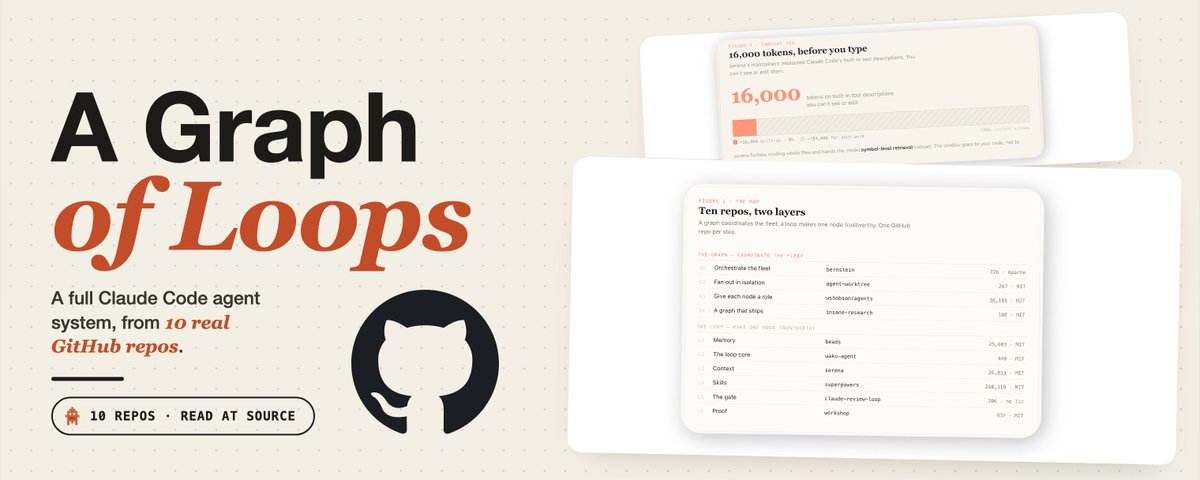
A Chinese developer just explained the shift from Loop Engineering to Graph Engineering better than anyone.
most people are still building agents the way that's about to be obsolete.
> why single-agent loops break and go "goal blind"
> the 4 parts of a graph: nodes, edges, state, policy
> 3 topologies that run everything: diamond, supervisor, pipeline
> Anthropic's 5 official workflow patterns
the punchline: it's not how many agents you run. it's the determinism you build with verifiers, code fallbacks, and reality anchors.
I broke the same architecture down with Kimi K3. Full A-Z guide below.


Luke retweeted

el fundador de una empresa china de IA valorada en más de $20,000,000,000 acaba de dar una clase de 40 minutos sobre enjambres de agentes
la explicación más clara que he visto sobre sistemas de IA a gran escala
cámbiala por tus 2 horas de Netflix de esta noche
