

DeFi Protocol Architect ($1B+ TVL shipped) | Ex-Neon | Author of 3 Rust & Zig books | Breaking down MEV capture, lending mechanics, liquidity vaults & why proto
Portugal
Joined July 2011
- Tweets1.1K
- Following2.3K
- Followers750
- Likes7.1K







Luis Soares retweeted

this is pure f*cking treasure
Andrej Karpathy has been inside Anthropic since May, and the two pieces you need to build a loop like his are already public
barely anyone has opened either of them:
> Anthropic's cookbook that turns your documents into a knowledge graph with Claude
> Karpathy's autoresearch loop, which ran 700 experiments in 2 days and found 20 optimizations with no human steering
one gives the agent a memory it can reason over. the other keeps it working while you sleep
i wired the graph half into my own stack
the very first reply changed: Claude dropped the stock answer and actually worked through the problem
your feed is still typing prompts into a blank chat. the few who build this now get to explain it to everyone else later
open the cookbook first, then read the article below ↓


Luis Soares retweeted

Join us on the quest to decentralize AI!
If you’re building an open weight, specialized model that you’d like to list on agentic(.)market, contact us using this form in the replies.
(Agentic Market is where agents discover services)

To decentralize AI and preserve freedom, we need a coordination layer: a market economy where agents communicate and cooperate through prices.
Teams of specialized open-weight models can outperform frontier models, just as a team of skilled people can outperform any single person. When those teams form companies, specialize, and coordinate across an entire economy, you get civilizational progress.
Coinbase is building the financial rails and accounts for the agentic economy. We’re also building the marketplace where agents can find, hire, and pay one another (see follow on post below).
Every company can now sell its own specialized open-weight model, trained on its proprietary data, that beats the frontier on narrow, high-value tasks. Builders can shop the marketplace and assemble teams of these specialized agents in minutes.
Freedom of choice and real competition in the agentic market will create far better outcomes for everyone.

Luis Soares retweeted

RedStone is now part of DTC's tokenization working group, bringing a perspective on private pricing for onchain markets.
Its CAPS standard for Canton is designed so the data provider can't see who reads its feeds.
Congratulations to @RedStone_DeFi.

RedStone has joined the DTC Digital Assets Solutions Industry Working Group (IWG), convened by @The_DTCC.
The IWG is a forum convened to support discussion, feedback and alignment around the DTCC Tokenization Service and widespread digital assets-related developments.

Luis Soares retweeted
Good visualization of my current AI workflow (image by @heymakio)
We still need the Brain to gain more knowledge, as many of the PRs still require major changes, and create a heavy tax on the team to review and modify. If we can capture these lessons in the Brain, the number of required edits should decrease over time, not just for me but all employees.


Luis Soares retweeted

Here's 7 steps to run an uncensored AI with no GPU (or a 6-year-old one):
every local AI post I make gets the same reply: "cool, I don't have a Mac Studio or a 5090"
FAIR, this one is for you... I tested it on a 2019 laptop with no dedicated GPU
By the end, you'll know how to:
- run an abliterated model on CPU and 8GB of RAM
- make it usable on a GTX 1060 / 1650 / any old card
- do it for $0, no API key, no account
So, let's go step by step:
1. Install Ollama
curl -fsSL ollama.com/install.sh | sh
Windows: download the installer from ollama.com, no WSL needed. Ollama runs on CPU automatically if there's no usable GPU. if you have an old Nvidia card it puts what fits in VRAM and the rest on CPU, no config
2. Pick the right size for your box (this is where people fail)
- 4GB RAM or 4GB VRAM: Gemma 4 E2B. ~3GB. dumb but runs anywhere
- 8GB RAM, or 6GB VRAM (GTX 1060 / 1660 / RTX 2060): Gemma 4 E4B. ~5GB. the sweet spot
- 12GB+ VRAM: skip this post, run the 12B from my earlier one guide
the mistake is pulling the 12B on 8GB and concluding "local AI is unusable". it was never going to fit (I see in comments how people arguing for it lol)
3. Pull the model
ollama pull hf.co/igorls/gemma-4-E4B-it-…
same author and method as the 12B heretic. ~5GB, runs in 5GB RAM. KL 0.055 from the original, refusals ~98% → ~21% on the hardest adversarial set with thinking on, near zero with thinking off
Gemma 4 is Apache 2.0, so no license homework on this one
4. Turn off thinking
ollama run hf.co/igorls/gemma-4-E4B-it-…
/set nothink
on a GPU thinking costs tokens. on CPU it costs minutes. and the abliteration targets non-thinking mode anyway
5. Keep context small
/set parameter num_ctx 8192
CPU speed is memory bandwidth, nothing else. every token re-reads the whole model from RAM. the KV cache grows with context and competes for the same RAM. 8k is plenty for chat, drafts, critique. 32k on CPU is self-harm
6. Three settings that make the difference (optional, worth it)
restart Ollama with:
OLLAMA_FLASH_ATTENTION=1 OLLAMA_KV_CACHE_TYPE=q8_0 ollama serve
flash attention + q8 KV cache halves what the context costs in memory, with no real quality loss. on a 6GB card this is often the difference between "whole model on GPU" and "half of it spilled to CPU"
if Ollama runs as a service, setting this in your shell does nothing. on Linux: sudo systemctl edit ollama, add Environment="OLLAMA_FLASH_ATTENTION=1" and the KV line, restart
old card note: flash attention wants RTX 2000 or newer. on a GTX 1060 it may not engage. skip this step, it still runs
7. Check it's actually using what you have
/set verbose ← prints tokens/sec after every answer
ollama ps ← in a second terminal
ollama ps shows "100% GPU", "100% CPU", or a split like "60%/40%". if you have a card and it says 100% CPU, your driver isn't loaded. nvidia-smi should list the card. fix that before touching anything else
What to expect:
- CPU only, modern laptop: ~8-15 tok/s. reading speed, not typing speed
- GTX 1060 6GB / 1660: whole model on GPU, ~25-40 tok/s
- GTX 1050 4GB: split. faster than CPU, slower than you'd like
- a 2020+ Mac with 16GB: just works, ~20 tok/s
honest take:
- E4B is a 4B-class model. good for writing, chat, drafts, roasts, critique. bad for hard reasoning and agentic coding. don't plug it into Claude Code, you'll hate it
- 10 tok/s feels slow for 2 minutes and then it doesn't. you're not paying anyone
- if you can get 12GB VRAM used for $150, do it. the 12B is a different league
- there's no secret trick after this. the rest is buying RAM
*IMPORTANT: don't use it for anything illegal or harmful. that's on you, not the model
next: how I run the 12B on an 8GB card without it spilling to CPU
save it so you don't lose it

Luis Soares retweeted

I built a high quality GTA game that runs in your browser using only AI: Claude for the code and @tripoai for the 3D models.
Full Beginner Tutorial: youtu.be/8wzditI0yto?si=RUiL…
🤝 Paid partnership
Luis Soares retweeted

Anthropic has a 27-page guide on how top startups ship their products
They talked to teams like Higgsfield, ClickHouse and Harvey, and they shared the actual Claude Code setups they use every day.
There are a lot of insights inside. Seven tips worth adding to your own workflow, even if you build alone:
1. If you keep pasting from a tool into Claude, connect that tool. And if it already has a good CLI, like gh or psql, let Claude use the CLI. It can cost fewer tokens than MCP
2. Split your instructions in three. Root CLAUDE.md for what can never change. A CLAUDE.md inside a folder for the conventions of that folder. Skills for procedures you only need sometimes
3. Use hooks for anything that must happen every time. A hook runs no matter what the model decides. Block a commit until the tests pass, or strip secrets before anything leaves the sandbox
4. Use /goal on long tasks. On those Claude can call the job done too early and drift from what you asked
5. Say "fan out multiple subagents". Claude splits a large analysis across parallel agents, or sends one agent to pick apart another agent's work
6. Start any rewrite in plan mode (Shift+Tab). Claude reads the codebase and proposes the approach before writing a line. It is the cheapest place to catch a bad direction
7. Rebuild in a git worktree. You get v2 running next to v1 and merge only when the new one wins
There is a one-page checklist at the end with the practical steps.
Here's the PDF

Luis Soares retweeted

HIS IS ACTUALLY DANGEROUS. SAPPER was just released as an open-source AI tool that runs autonomous pentesting using a swarm of AI agents.
A lead AI commander directs multiple agents that run real hacking tools in the background.
WHAT MAKES IT DIFFERENT?
→ An AI commander plans and coordinates the entire operation.
→ Multiple agents work together to execute tasks.
→ It uses real tools like Nmap and Nuclei.
→ It includes a specialized hacking knowledge base.
→ It integrates with Claude Code and Codex.
→ It runs directly inside a Kali Linux environment.
According to its developers, it competed against 634 teams in a Tencent attack and defense competition and ran for 8 hours straight without any human intervention.
And its code is completely open source.
ONE COMMANDER → MULTIPLE AI HACKERS → A FULLY AUTOMATED RED TEAM.
This shows just how far cybersecurity automation has come.
Use it only in authorized labs and CTF environments.
REPO BELOW.

Luis Soares retweeted

Thank me later, security engineers
roadmap.sh/cyber-security
portswigger.net/web-security
cheatsheetseries.owasp.org
attack.mitre.org
book.hacktricks.wiki
Bookmark & repost!


Luis Soares retweeted

If I had 6 months to break into AI Cybersecurity, I wouldn't waste time collecting certificates. I'd build the skills to attack, defend and secure real AI systems.
First, master the new attack surface. Learn prompt injection, jailbreaks, data exfiltration, MCP vulnerabilities, tool poisoning and agent identity security. AI agents introduce risks that traditional application security was never designed to handle.
Next, go deeper into offensive security. Combine LLM-guided fuzzing, exploit analysis, adversarial machine learning and automated red teaming. Learn to uncover vulnerabilities, test model defenses and understand how attackers exploit AI-generated code and dependencies.
Then learn to defend systems at scale. Build AI-powered threat hunting, log analysis, incident response and threat intelligence pipelines. Master SIEM, SOAR, YARA, OAuth2, SPIFFE and zero-trust architectures. Add privacy-preserving techniques like differential privacy and trusted execution environments.
Finally, publish your work. Find real vulnerabilities, contribute to open-source security tools, write technical breakdowns and pursue responsible CVE disclosures. Tutorials teach you concepts. Real-world exploits, defenses and public security research prove you can do the job. Builders get hired.
Luis Soares retweeted

Today we’re launching Shield: AI-native defense against offensive agents.
Attacker agents probing your site? Don’t block them. Deceive them.
We pointed ARTEX — the autonomous AI pentester the FBI just warned about—at our own prod. 5 minutes in, it pulled /.env and /.git/config (200 OK) with credentials inside.
Shield turned ARTEX attack surface into a synthetic maze with fake endpoints, decoy credentials, and poisoned responses that hijacked its agent memory.👇
Luis Soares retweeted

RAG is officially cooked.
Researchers proved you can stuff 1 billion triple knowledge graph directly into an LLM using only 20GB of VRAM.
no vector DB, no Pinecone bill, no chunking nightmares.
Researchers introduced AtlasKV, and it makes the entire RAG pipeline look ancient.
Instead of bolting an external search engine onto an LLM, AtlasKV integrates billion-scale knowledge graphs directly into the model's inherent attention mechanism.
Using two new methods (KG2KV and HiKVP), it translates knowledge graph triples straight into the AI's internal memory with sub-linear time and memory complexity.
And the numbers are ridiculous:
• 1 billion knowledge triples integrated at scale
• Runs on less than 20GB of GPU VRAM
• Zero external retrievers
• Zero bloated context windows
• Zero retraining required when you add new knowledge
It maintains strong grounding and generalization without paying the latency tax of searching and reading massive prompts.
We spent years building clunky, fragile retrieval pipelines just to help AI look things up.


Luis Soares retweeted

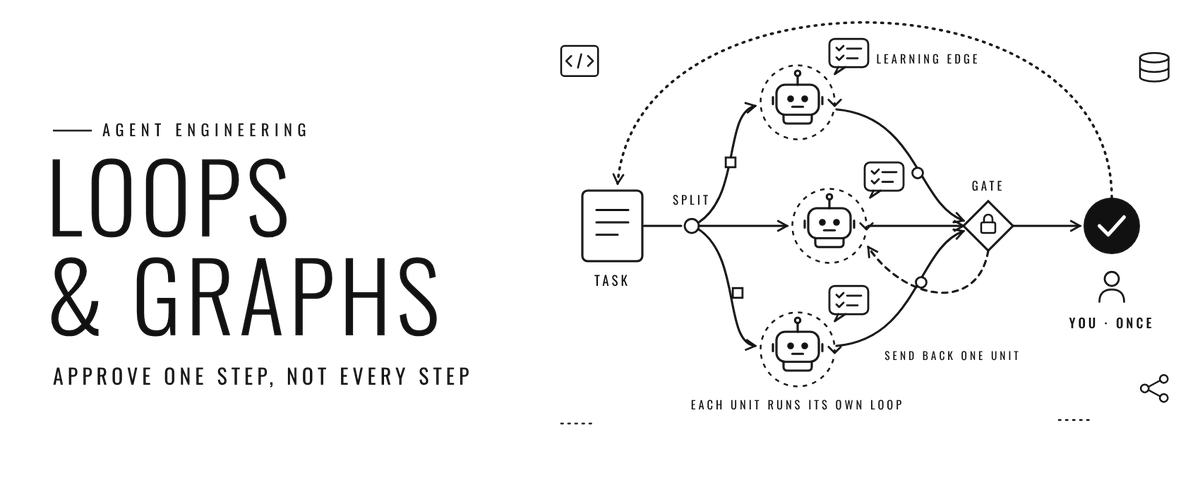
This is f*cking insane. Andrej Karpathy:
"Prompting is going away.
Delete everything, keep Graph."
In 1 hour he explains how to build Graphs, and why it's the only thing left standing at the end
LLMs → Prompts → Agents → Graphs
a prompt hands you one answer and forgets the job
an agent finishes the job and forgets what it learned
a graph keeps every finished job and makes it the starting point for the next one
watch it today
then read the article below ↓
Luis Soares retweeted

🚨RANSOMWARE GROUP CLAIMS IT BREACHED NVIDIA!
The ransomware group known as The Gentlemen has listed Nvidia on its leak site, claiming it hacked the company and will publish stolen data soon.
The listing shows no sample files, no data volume, and no proof of access.
@nvidia has not confirmed any breach.
Cyber trackers are treating the claim as pending verification.
Luis Soares retweeted
If you’re building on the frontier of agentic finance, reach out to @cbventures!

New @cbventures market map alert! 🚨
AI agents are moving from talking about markets to trading in them. But as agents get easier to build, where will lasting value accrue?
My new post maps the agentic trading stack through that lens. Here’s where I’m focused:
• Agentic trading harnesses and terminals that turn a user’s goal into an ongoing strategy, with real retention.
• Market reasoning models and data assets that give trading agents a real edge.
• Identity, audit trails, and performance verification infra built for non-human, financial decision makers.
I care less about shiny demos and more about products that get harder to copy as they grow.
If you’re building here, I’d love to hear from you.
