

CRO @AllocationsInc. SPVs and fund admin for private markets. Allocations: $5B+ assets transacted, 1,800+ private funds.
Joined November 2024
- Tweets233
- Following28
- Followers9.4K
- Likes1.8K






new fund manager:
> emails subscription docs as PDFs
> tracks wires in a spreadsheet
> chases KYC one LP at a time
> sends K-1s whenever they're done
smart fund manager:
> e-signs docs and KYC in one flow
> tracks commitments and wires from one dashboard
> runs capital account statements and K-1s on one platform
> uses @AllocationsInc
4
18
$NVDA @nvidia Q3 FY27:
• Revenue: $115.8B, +103% Y/Y and +20% Q/Q.
• Data Center: $107.6B, +110% Y/Y.
• Edge Computing: $8.2B, +42% Y/Y.
• Gross margin: 74.8% GAAP, 74.9% non-GAAP.
• GAAP operating income: $77.5B, +115% Y/Y.
• GAAP EPS: $2.70, +108% Y/Y.
• Non-GAAP EPS: $2.68, +111% Y/Y.
Revenue grew $19.6B in a single quarter and gross margin still held near 75%. Scaling at that pace usually costs margin.
Q4 is guided to another $14.2B step up, to $130.0B, with no China Data Center compute assumed at all.

capital call notices are one of the easiest ways to build LP trust.
a great one has:
> the amount
> the due date
> what the money is for
> wire instructions LPs can confirm through a second channel
clear notices save everyone a round of follow-up emails.
anything you'd add?
before any first LP call on an SPV, I want 3 things ready:
> a one-page deal memo
> fees and carry in plain numbers
> a target wire date
logistics settled up front means the whole call stays on the deal.
what's on your list?
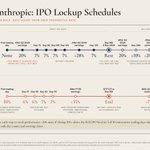
.@AnthropicAI S-1 spreads its lockup across 23 release dates over one year.
How it works:
> non-founder directors, officers, employees and consultants: 10% on the first trading day, another 35% after FY26 earnings
> certain 180-day holders: four steps of 6% to 7% between days 27 and 76
> the seven co-founders: 29% at day 180 or Q1 FY27 earnings, the rest at day 365 or Q3 FY27 earnings, whichever comes first
> certain 365-day holders above 0.5%: 21 steps of 1.8% to 7.0%, then the rest at day 365 or Q3 FY27 earnings
Every step is tied to a day count or an earnings release, so the whole sequence is set out in advance.
For anyone holding pre-IPO exposure through an SPV, that kind of clarity is a gift.
Which date are you watching?

SpaceX and Anthropic took opposite paths on IPO lockups.
@SpaceX (SPCX, listed 12 jun 2026), 180-day holders:
> 20% after Q2 2026 earnings
> 7% each on days 70, 90, 105, 120 and 135
> +28% after Q3 2026 earnings
> the rest on 8 dec 2026 (day 180)
@AnthropicAI (ANT, IPO pending, trading expected 19 nov 2026):
> 23 release dates, tied only to day counts and earnings
> 10% on day one for non-founder directors, officers, employees and consultants
> full release at day 365 or Q3 FY27 earnings, whichever comes first
for SPV investors, a clear calendar makes liquidity planning much easier.
which approach do you prefer?

Luis Brecci retweeted

the investment i think about most is one i never got to make.
2019:
> @OpenAI was a research lab
> @ChatGPT was 3 years away
> i emailed Sam Altman asking to invest
> his reply: "not taking new investors"
honestly, it stung. it still does every time i open ChatGPT.
i was early and right, and it didn't matter because i couldn't get in. that's a big reason i built @AllocationsInc.
what's your "one that got away"? :)
(the email, which i've kept for 7 years)

Luis Brecci retweeted

🇬🇧 @Revolut is now worth 1.5x Barclays. On just 15% of its revenue 🤯
$115 BILLION vs. $79 BILLION.
A FinTech founded in 2015 is now valued higher than a British banking giant with over 330 years of history.
Here's how they compare:
Valuation: $115B vs. $79B
Annual revenue/income: 6Bvs.~39B
Retail customers: 80M+ vs. 40M+
Pre-tax profit margin: 38% vs. 31%
But there's an important distinction.
Revolut's valuation comes from a private secondary share sale, while Barclays' market capitalization is determined by public markets.
And while Barclays generates significantly more income, investors are pricing Revolut for its future global growth.
Is Revolut's $115B valuation justified, or are investors getting ahead of themselves?
Thanks for the inspiration and data points provided by @luisbrecci / @AllocationsInc follow these accounts for more great insights 👌

In a 72-hour home sprint, @neuralink hooked a prototype Grok agent to thought
A study participant ran laptop tasks by thinking "Hey Neuralink"
Thought-to-speech also went into live iPhone calls
Speech decoding started and stopped on its own
Seven other features were built in the same sprint
Blindsight is ready on the engineering side and waiting on regulators, Elon Musk said
The devices remain investigational
Each software drop raises the value of implants already in the field. That is how the business scales while Blindsight sits with regulators.
My LinkedIn reached 1.3M impressions last week on private funds and SPV content.
Building the same niche on X.

The IPO filing from @AnthropicAI is out. The $80.7B net loss for H1 2026 is the line everyone will quote.
A few other lines from the same statements:
1. Revenue went from $41M in 2023 to $4.6B in 2025.
2. H1 2026 revenue alone hit $16.3B, vs $1.2B in H1 2025.
3. Reported net loss for H1 2026: $80.7B.
4. $72.4B of that came from fair-value charges on convertible notes, derivatives, and SAFEs, marked higher as the company got more valuable (non-cash).
5. Actual operating loss for H1 2026: $693M.
6. Operating cash flow for H1 2026: +$3.9B.
From the deal side, I would put operating cash and operating loss higher in the memo than the fair-value charges on the converts.
Defense startup @anduriltech is being valued at $90B in an open employee tender, 62.5% of the market cap of @LockheedMartin.
That sits on $2.2B of 2025 revenue, under 3% of the contractor's $80B to $82B 2026 sales guidance.
That is 41x sales against 1.9x for the F-35 maker.
The startup's value has roughly tripled since mid-2025, while revenue more than doubled last year.
Backlog at the contractor hit a record $292B in Q3.
At 41x, buyers in this tender are paying today for factories that are not fully running yet.
If Pentagon orders keep coming, that call looks smart.

Compute bills from @AnthropicAI to @SpaceX will reach about $3.1B a month once all GPU capacity arrives, expected in December
The deals total up to $120.5B with terms into 2029; its public filing for a Nasdaq listing shows
For comparison, its Amazon cloud commitment is at least $110B through April 2036
After lock-ins end in January and March 2027, either side can cancel on 90 days' notice
Renting GPUs to a rival lab gives the rocket company a large revenue line besides Starlink and launch. Once the initial terms end, that income has to be won again every quarter.

A $3 billion investment from @nvidia will go into the equity offering @Meta launched to support AI infrastructure investment.
The overall plan now totals about $97.5 billion, after the common stock sale was upsized to $25 billion.
That includes a planned at-the-market program of about $60 billion.
The social media giant also intends to expand Vera Rubin and Vera CPU deployment.
For comparison, it expects $135 to $145 billion of capital expenditures for 2026.
I think a chip supplier buying into a customer's stock sale ties the two stocks closer together than most holders expect.

More than 130 companies joined the early-access phase of @SpaceXSI's Grok partner network.
Quoted partners include @nvidia, @BainandCompany and @databricks.
Engineers at more than 30 organizations have been trained through its Forward Deployed Engineer accreditation program.
Transformation Partners deploy the platform enterprise-wide. Marketplace Partners build plugins for tools customers depend on.
Partners already help customers from startups to Fortune 20 companies.
I think big consultancies often shape which AI stack large clients adopt, which is where this network could move revenue.

The first production-quality @Tesla_Optimus robots are now coming off high-volume lines in Fremont
Fremont is at early ramp, and Texas is under construction
Elon expects at least a year, maybe longer, to reach 20,000 units a week, about 1 million a year
Outside customers should get units around the end of 2027
He puts the self-play training fleet at roughly 10,000 to 20,000 bots
The company now calls its process fit for a commercial product, so the risk shifts from building robots to making them useful. The end-2027 date rests on reliability, usage life and AI for open-ended tasks.

Jensen showed AI agents on a laptop training a 25 cm robot duck at the GTC Berlin keynote.
The laptop runs on @NVIDIARTXSpark, with 1 petaflop of AI compute and up to 128GB of unified memory.
The agents used Isaac Lab, Hermes Agent and Nemotron 3.5 Bolt 74B to train the @huggingface Microduck, and Isaac Lab runs thousands of GPU-parallel simulations.
The robot carries a camera, an 8x8 time-of-flight sensor and 2 IMUs, and it gets back up after a fall.
Training a robot on a laptop lowers the cost of starting a hardware company. I expect a lot more of them to start.