




One thing that always frustrated me with AI UGC was maintaining consistent characters across different poses and scenes.
I'd get irritated and eventually abandon the project.
Now, I think the models are finally good enough to solve this. The trick is prompting for a full character and scene, not just a face swap.
My current workflow:
> 1. Use Kie AI for image generation.
> 2. Use Codex to build a reference library of poses, expressions, and scenes.
> 3. Branch and merge images using HeliosGen to maintain consistency.
> 4. Turn those images into videos using HeliosGen's reference-based workflow.
The results are getting surprisingly good.
Now I'm trying to figure out the best ways to grow and monetize these AI UGC characters.
Still experimenting, but the production side is finally starting to click.

Total W by @SDDFounder.
Been playing around with this all morning and I'm genuinely impressed.
> Love how it's built and how easy it is to work with.
> Character consistency is surprisingly good.
> Results look crisp without endless prompt tweaking.
Been a while since I found something this good for generating consistent AI characters.

Formula of work happiness:
1. At least 3 remote jobs
2. Claude and Codex subscriptions
3. Key - move to a different continent

I’m literally gonna scrape all of his dudes video transcripts and ask Claude if any of the tactics could be applied to my app.
On top of that just use the REA repo to do the actual planing.

You can literally build an AI influencer from scratch and turn it into a distribution channel.
And it's easier than you think.
As Alex Hormozi says, attention is the new currency. Here's how I'd approach it:
> 1. Find an open-source image/video generation tool. I'm using HeliosGen (github.com/SegFault42/Helios…).
> 2. Get an API key from kie.ai to power image and video generation.
> 3. Use Codex or Claude with browser access, or have it build a CLI so you can automate the entire workflow.
> 4. Go on Pinterest, collect reference images for poses, outfits, lighting, and scenes. Build a small knowledge base.
> 5. Create your own original AI character. Generate multiple reference images until you get consistent results across different poses and environments.
> 6. Connect those images into video sequences. Keep branching into new poses, scenes, and emotions until you find what works.
> 7. Start posting. Learn to write compelling hooks, test formats, and double down on what gets attention.
> 8. Monetize through clipping programs, affiliate offers, or digital products linked in your bio.
Start small and compound.
The real skill isn't generating AI content. It's learning how to capture attention and convert it.
Once you figure that out, you can promote pretty much anything.
Just be transparent that your character is AI-generated.
I'm sharing the JSON prompt I use to turn reference images into consistent AI characters in the first comment. 👇

Total W by @SDDFounder.
Been playing around with this all morning and I'm genuinely impressed.
> Love how it's built and how easy it is to work with.
> Character consistency is surprisingly good.
> Results look crisp without endless prompt tweaking.
Been a while since I found something this good for generating consistent AI characters.
{
"meta": {
"aspect_ratio": "3:4",
"output": "One realistic clean identity portrait"
},
"identity": "Create an original fictional adult character based on the attached visual references. Gender: [GENDER]. Age: [AGE, 18+]. Face structure: [FACE SHAPE AND FEATURES]. Eyes: [EYE COLOR AND SHAPE]. Eyebrows: [EYEBROW DESCRIPTION]. Nose: [NOSE DESCRIPTION]. Lips: [LIP DESCRIPTION]. Skin: [SKIN TONE AND TEXTURE]. Hair: [HAIR COLOR, LENGTH AND STYLE]. Build: [GENERAL BODY TYPE]. Maintain a consistent facial identity across all future generations.",
"framing": "Head and shoulders, full hairline and chin visible, face nearly frontal, direct eye contact, [FACIAL EXPRESSION].",
"styling": "[CLOTHING DESCRIPTION]. [ACCESSORIES OR NO ACCESSORIES]. [MAKEUP OR GROOMING DETAILS].",
"lighting": "[LIGHTING TYPE] beside [BACKGROUND DESCRIPTION], [COLOR TEMPERATURE], fine natural skin texture and crisp irises.",
"photography": "Natural smartphone portrait perspective, realistic proportions, no facial reshaping, no plastic smoothing, no collage or text."
}
Total W by @SDDFounder.
Been playing around with this all morning and I'm genuinely impressed.
> Love how it's built and how easy it is to work with.
> Character consistency is surprisingly good.
> Results look crisp without endless prompt tweaking.
Been a while since I found something this good for generating consistent AI characters.


And there is an abundance of people who can only do that and when they open Claude it looks like an SpaceX rocket to them.
They got their market and thanks to content creators and their “how to make money with AI” videos people believe it’s easy

With recent trouble with getting apps approved on the App Store I’m wondering if it’s just smart to buy existing app and have it transferred to my account.
Less headaches with getting it approved and I just focus on rebuilding it.
Actually did it with two apps already and review is just faster.
Any experience with that?
I look at it like compound interest.
> Invest in paid ads over time, optimize, and work toward break-even.
> As your user base grows, organic rankings and App Store visibility can improve.
> Eventually, you want a flywheel where organic growth reduces your reliance on paid acquisition.
At $10k MRR, you might realistically keep $2-$4k after ads, store fees, and other costs.
But even that isn't necessarily take-home profit. Ideally, you're reinvesting most of it into growth.
And with App Store payout delays, cash flow matters.
$10k MRR is a milestone, not a $10k monthly salary.

When people say they make $10k/m, is that the revenue they see on RevenueCat or what they actually take home?
Like if you make $10k/m but spend $7k on ads, you're only left with $3k right?
If I want $10k to actually hit my bank account, how much MRR should I aim for?
Basically, how much are y’all spending on ads to hit $10k/m? asking so i can allocate my budget lol


Go on TrustMRR.
> Find a product launched this year that's showing decent growth.
> Check their SEO and identify keyword gaps.
> Use OpenSEO + DataForSEO to target keywords they're probably ignoring.
> Get organic traffic and convert it into paying users.
> Reinvest the profits into Google and Meta Ads.
> Rinse and repeat.
You don't need to reinvent the wheel. You need distribution.


If you’re in your early 20s, here’s what I’d do:
Stack 2-3 part-time remote freelance gigs where nobody gives a fuck what you do, as long as you deliver.
Work on your own side project in parallel.
Move to Bangkok.
Your schedule looks something like this:
09:00 - Wake up, work on your own project.
14:00-15:00 - Europe wakes up. Switch to freelance work.
15:00-21:00 - Get your client work done, keep building your own shit in between.
Somewhere in there, hit the gym or do whatever keeps you sane.
Weekends? Go out, have a few Singhas, be a degenerate, or go meditate in a temple. Whatever works for you.
Do this for 6 months and see how much your life changes.
Yes, you’ll work a lot. Who gives a fuck? It’s not meant to be easy, bro.

The timing couldn't be funnier 😂
On a day when everyone on X is talking about Apple terminating developer accounts, I get an email welcoming me to the App Store Small Business Program.
Not quite the Apple email I was expecting after reading all those horror stories today.
I'll happily take the 15% commission instead of 30%, though.

Scary AF! Just when I started to gain traction on my own app this stuff started to pop up more and more. Think I’ll have to clean up my own portfolio and just lay low and hope this storm passes and I survive.
In the meantime I’ll just switch focus to pure web apps where I can enjoy daily dispute and potential lawsuits.
WHAT A TIME TO BE ALIVE!
With all the recent reports of Apple banning developer accounts, I'm starting to wonder if it's time to give Google Play more attention.
I've been so focused on iOS that I've barely explored Android properly.
The market is massive, and surely there's room to build a decent subscription business there too.
Anyone here monetizing Android apps successfully? Curious how the economics compare to iOS.

Scary AF! Just when I started to gain traction on my own app this stuff started to pop up more and more. Think I’ll have to clean up my own portfolio and just lay low and hope this storm passes and I survive.
In the meantime I’ll just switch focus to pure web apps where I can enjoy daily dispute and potential lawsuits.
WHAT A TIME TO BE ALIVE!

405K Google clicks. 3.42M impressions. All organic, in one of the most saturated app niches.
And it all started with a pretty basic SEO setup.
Here's what I did:
1. Fixed the fundamentals
I initially hooked up my entire project to Claude and had it audit the website.
> technical SEO issues
> metadata and page structure
> sitemap and indexing problems
> performance improvements
> missing internal links
The goal was to clean up everything that could prevent Google from properly crawling and understanding the site.
2. Built my own content workflow
I created a custom writing skill to help produce content that actually answers what people are searching for, rather than pumping out generic AI articles.
Started with just one quality blog post per week.
Nothing crazy, but I made sure every article targeted a specific search intent and was relevant to the product.
3. Then @openseo_so came along
This was probably one of the biggest improvements to my workflow.
I connected it to Claude/Codex through MCP, and it helped me understand and implement SEO practices I had previously overlooked.
> keyword clustering and topical authority
> finding low-difficulty keywords with decent search volume
> building proper internal linking structures
> identifying content gaps
> improving existing pages instead of constantly creating new ones
> tracking rankings and technical issues
A lot of this is standard SEO, but having an agent analyze my actual website and explain what needed fixing made it much easier to execute.
4. Kept publishing and monitoring
I continued publishing relevant content, tracking indexing in GSC, and improving pages based on what was actually ranking.
One thing I learned is that publishing doesn't mean Google will automatically index or rank your content.
So I started paying much more attention to:
> which pages were indexed
> which keywords started gaining impressions
> which articles needed improvement
> where internal links could help
> what was actually bringing users into the product
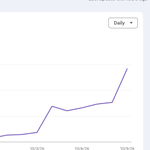
And eventually the graph started looking like this.
The interesting part is that growth wasn't linear at all.
Months of relatively flat traffic, followed by a jump, another period of slower growth, and then a much bigger spike.
I'm still figuring things out, and traffic has pulled back from its recent peak.
But going from almost no organic visibility to 405K clicks has completely changed how I approach building apps.
I now treat SEO as part of product development from day one, not something to think about after launching.
And the best part? The traffic is actually converting into paying customers.

Luc retweeted

I run 3 Codex agents in my browser at the same time...and im 3x more productive
They do research, write outreach and build landing pages while I talk to them.
Here's the full playbook, prompts included

Luc retweeted

I was successful at Brokering Traffic because I worked as an Affiliate Manager for a few years before branching off and doing my own thing
This allowed me to get paid a salary + commission while learning mainly the major mistakes most Affiliate Networks make & how I would want to do things differently if I had the power
I gave all these suggestions & opinions to my Bosses at my old job, they told me to STFU & sit at my desk, so I did while mentally making notes on everything & plotting what I would do "one day"
You can do this same thing in any industry, who cares about Non Compete Contracts
You know the last thing my Old Boss did to me is threaten me with my Non Compete Contract when I quit?
I was legit scared and contacted a lawyer about it who told me the Boss was an idiot and the contract wasn't worth the piece of paper it was signed on, he gave me this advice for free which I appreciate so I have now passed it on to you.