
Living the life in Urbana-Champaign
Joined May 2013
- Tweets2.9K
- Following128
- Followers1.2K
- Likes455




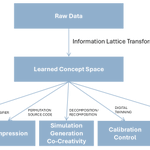


Kocree is building AI that unlocks a company’s R&D knowledge: learn the rules behind existing results, combine them under new constraints, and create candidates that R&D teams can test.
For Kocree, explainability is more than a reporting feature. It is a way to make scientific knowledge actionable—and turn a company’s accumulated research into an asset that grows exponentially more valuable with use.
Lav Varshney retweeted

🧵[1/N] Are large language models more creative than humans at combining ideas? 🤔
Combinatorial creativity involves combining familiar ideas in unfamiliar ways, and is central to scientific discovery and technological innovation.
In fact, breakthrough scientific work is often associated with more distant combinations of methods, techniques, and concepts.
Here, we introduce Kombine, a new benchmark of combinatorial creativity for LLMs.
TLDR:
- LLMs are more combinatorially creative than the average human.
- However, conceptual blending is the hardest task for LLMs, and even frontier models struggle.
- LLMs also tend to homogenize, inventing concepts with the same properties across separate models.
- Moreover, humans and LLMs combine in distinct regions of semantic space.
- As a result, we anticipate greater conceptual diversity can be unlocked through human-AI collaboration. 🗣️
Thread below🧵⬇️

Lav Varshney retweeted

How much do LLMs’ watermarks distort your output? 🔍
We present SimpleMark: a fast multi-bit text watermark that bounds the distortion of every token to a chosen f-divergence budget. Our watermark’s text distribution stays statistically close to what the model would have written without a watermark while remaining competitive in all benchmarked performance categories.
Full transparency, traceability, attribution, and therefore credit is what we're building at Kocree! Drawing on our novel information lattice learning AI, integrated with trust technologies. Scientific creativity, enterprise creativity, and artistic creativity.

i once asked a bunch of deep-tech researchers on why they wouldn’t use chatgpt for serious research, especially after openai launched Prism tool around a workflow researchers already know well: LaTeX. Their responses were surprisingly consistent: they were afraid that putting genuinely novel, unpublished ideas into chatgpt or any other llms could expose or compromise their research originality.
Whether or not that fear is technically justified, the perception itself is a problem. If OpenAI wants researchers to trust these tools with high-stakes research, there needs to be much more explicit transparency around who can access conversations, how research data is retained, whether it is used for training, and what protections exist for unpublished IP.
i assume frontier labs can access at least ~70% of user conversation details internally, even if PII is stripped or access is tightly controlled?
Congrats @ai and team! Kocree is happy to be building with Canonical.

When I started Canonical, the mission was simple: back technical founders building core mission-critical infrastructure before it's obvious.
Today, I'm extremely proud to share that Canonical has been selected for the 2026 @raiseconference Select cohort alongside an incredible group of emerging fund managers.
To our portfolio founders, LPs, and community partners - thank you for trusting us.
Looking forward to connecting with LPs & GPs at The Presidio in SF on Oct 22, 2026. Drop a DM if you'll be there!

This problem of traceability, attribution, and credit is super central to the research enterprise.

Lav Varshney retweeted
Say your goal is to steer an LLM to make it more creative — should you do this in weight space or in activation space? 🤔
🚨Excited to share our new work (CreativityNeuro), accepted at #COLM2026, which finds that weight space steering of creativity tends to generalize further OOD than activation steering! Thread below 🧵

Lav Varshney retweeted

Questions about the future of human mathematics are fundamentally about higher education and not about AI producing proofs.

Lav Varshney retweeted

Is brainstorming with AI as good as with a person? Our controlled study: yes on average; but human traits help differentially, and "seeding" with good ideas helps. At Creativity & Cognition 2026 in London next week. arxiv.org/abs/2607.07522
- with @AnitaKeshmirian @lrvarshney

Lav Varshney retweeted
New chapter (Springer Nature Handbook of Hybrid Intelligence): "Collective Cognition in Hybrid Groups: A Network Science Synthesis"
We ask which network-science findings survive or arise when humans & AI share a network
arxiv.org/abs/2607.05593
- with @lrvarshney, @RazanBaltaji
Lav Varshney retweeted
My research on the science of creativity will be featured at #ICML2026. Check out both posters on July 11 at the Human-AI Co-Creativity Workshop!
📓Paper #1 (arxiv.org/abs/2607.01433) presents a method to steer language model weights to improve divergent thinking.
💡Key insight: weight-space steering of creativity tends to generalize further OOD than activation steering.
📓 Paper #2 (arxiv.org/abs/2605.13450; extended version) conducts a large-scale study assessing whether semantic distance tests are actually good predictors of machine creativity.
💡Key insight: some tests predict general capabilities rather than creativity, and moreover, existing semantic distance tests are poor predictors of scientific creativity... but see our new test that solves this! 🧠
Huge thanks to all co-authors and collaborators: @corefpark @flxsosa @lrvarshney @AlexiGlad @jonahablack @hengjinlp @compulsi0n
