

CEO @Graphistry @louie_ai https://xitter.cf/t.co/uJAdxr0KMn https://xitter.cf/t.co/b2ZLJyww3f Makers of https://xitter.cf/t.co/fo6XK5JU6a, GFQL, GPU dataframes, PyGraphistry
San Francisco
Joined July 2008
- Tweets11.7K
- Following458
- Followers2.8K
- Likes5.5K








Everyone is a genius in a bull market - selling inference, data, sandboxes, browser use . Similar to apps , ICOs, etc. I think it's a lot easier to ride demand to be near-term profitable $ than being generational or even just enduring, but: runway buys optionality, many folks just want a quick flip, and it all speeds up the cycle, so not necessarily a bad thing.

Is there a real moat for all of these sandbox companies? Feels like everyone is pivoting and the product is always the same???
- Fast boot time
- High clock speed
- Scale up and to zero
But like beyond lightweight microVMs it feels like the technical depth is fairly shallow? Like everyone is running on the same CPUs, and you can't really optimize the actual workloads because its just random agent-generated code at runtime.
Aside from race-to-the-bottom on pricing, how do you compete?

Been experimenting, afaict $20-40/day of GLM 5.3 flash + a limited amount of top tier model replaces a $200/mo subsidized frontier subscription
So 10-30x subsidy claims are true in the sense of assuming fixed workload
From a user view, $100-500/mo unsubsidized via optimizing hybrid orchestration can replace it, but currently a PITA

the big discount on intelligence
arunabhdastidar.substack.com…
“We stopped the individual engineering subscriptions to Claude and Codex on the engineers’ Macs, and routed all engineering work through the API. The team and backlog didn’t change, and we didn’t ask the engineers to work more.
Before this, five engineers collectively paid $800 to $1000 per month for Max and Pro plans.
After this, the bill was approximately $1000 per day for the same work. So in one fell swoop, the cost went up thirty times.”
Next year will be wild: open weights on single-node servers will be able to self-plan
Using glm 5.3 flash for serious agentic coding loops has been like time traveling back to summer/fall 2025. That was when ai coding started becoming much more accepted, yet forced an explosion of rube goldberg machines to manage them.
Self-planning over swarms -- what lets OpenAI autonomously hack HuggingFace, and goal loops that clone software from a short prompt -- are not far off for open weights. Democratization follows and price collapses similar to the 80% Luna cuts for major markets.
Even without personal/corp self hosting, a much sooner switch is a hybrid era of proprietary frontier orchestrators, incl. non-western licensed by neo clouds, and guiding harnesses for commodity-priced worker models. Opus-tier will be able to do it, and like Luna, price will drop as it becomes volume-based at this tier. Smarter models will help smooth, but be invoked much less.
Exciting to be living & building through this next transition!
Feel like coding agent subscriptions are getting over-nerfed. I run max2 on both OpenAI and Anthropic, generally stay at opus/sol loops to avoid the Astra/Fable overconsumption issue.. but exhausted both in 1-2 days this week instead of 2-4.
Guessing toxic combo of:
- uncapped swarming & harness slop
- model misalignment
- sub plan nerfs
Pretty great
All can be true
Interesting to think as models & harnesses keep improving, which pieces become implementation details that are the agent's job, and which abstractions stay
Bar goes up, not down

Before joining a team or starting a project, it's important to know which tribe of agentic engineering you're choosing:
- The software engineers: Treat agents like another software engineering problem. Borrow ideas like Map-reduce to enable parallel agent swarms. Build pipelines, workflows, and focus on modularization.
- The ML practitioners: Agents are just another ML system. Regularization techniques work whether it's in weight or token space (e.g. clipped gradients vs skill-opt). Good evals are meant to be hill-climbed on. E2E agents are preferred.
- The management experts: Agents behave roughly like a human, so all human organizational principles apply. Consulting terms like MECE (@wulfie_bain_) finally have a chance to breathe in technical work.
GFQL -- open source CPU/GPU cypher graph queries on dataframes, no DB needed -- keeps getting better!
Indexes aren't just for databases. This GFQL release further increases our CPU+GPU mode speedups over neo4j, memgraph, & kuzu on even more benchmarks, both for low-latency search and big OLAP compute. GFQL is special in being able to do on-the-fly multi-stage graph pipelines too, and indexes work there now too.
Throughout all this, a key focus of GFQL is designing it so AI coding agents can automate leveraging all this stuff for you.
Finally, this wouldn't be possible without the amazing @PyData ecosystem: @ApacheArrow , @datapolars + @pandas_dev , @nvidia @RAPIDSai
Go team!

Your dataframes can now anwser graph queries in milliseconds, without a graph database.
A Cypher query across 50 account IDs went from 2.7 seconds to 5 milliseconds. Searching 30M timestamps went from 40 seconds to 101 ms.
The latest GFQL release adds property indexes, so you can jump straight to the nodes and edges you care about, follow their relationships, and keep the whole workflow inside pandas, Polars, or cuDF. No database to deploy. No separate import pipeline.
And these aren't just faster lookups. You can build indexes inside multi-stage graph pipelines and inspect which indexes each query actually uses.
Full article below, with benchmarks and runnable examples. pip install graphistry

DM if we're intersecting to chat agentic investigations or graphs!
Also not listed, I'll be in San Diego and then DC/VA/MD for a couple days each
Exciting to be able to share more of what we've been up to :)
We’re about to spend most of October on the road, and we’d like to meet you at one of these stops.
Here’s where we’ll be:
Oct 17: BSidesNYC, New York
Oct 19 to 24: BSidesAugusta week, Augusta, GA
Oct 27 to 29: [un]prompted II, San Francisco
Oct 29 to 30: LASCON, Austin
Augusta is the big one. On Oct 21 and 22, Leo Meyerovich and Sindre Breda are teaching a two-day hands-on class on AI agents for security investigations. It’s $595 and registration closes Oct 14.
Then on Oct 24, Leo gives a talk on two years of SOC CTF evals for investigation agents.
If you’re a SOC analyst, an engineer building agents, or just someone who likes graphs, come find us. Bring a hard investigation, a strong opinion about AI agents, or both. We learn more from what’s breaking for you than from anything we’d put on a slide
If you’ll be at any of these, message us and we’ll make time.

Latest botsbench on Astra vs Fable 5.1 is out! Astra is quite the leap, though still better to do an investigation harness on older models than using a coding model and (incorrectly) hoping that paying more wins
Also, newest D&D model cards: both got a Lawful Neutral rating, very important ;-)
GPT-6 Astra and Claude Fable 5.1 are out, and they're pretty compelling if you have the budget.
But put them into a real investigation harness, and things get interesting.
On CyBT-CTF, 59 incident-response cases worked in Splunk, Astra reaches 69% and Fable 5.1 reaches 61%.
GPT-5.6 Sol, an older and smaller model, reaches 76% when running through Louie.
The same GPT-5.6 Sol scores just 58% in Codex.
Astra is the strongest coding agent we've measured, but only gets to 69% at high thinking effort, at $2.34 per solved case. Fable 5.1 gets 61% at both high and low effort, at $1.19 per solved case.
So far, the choice of agent seems to matter at least as much as the choice of model.
We haven't run Astra or Fable 5.1 through Louie yet.
That's the test we're most interested in next.

I've given my share of AI talks where the frontier labs had already paralyzed many people with fear. The machines are taking our jobs, they will kill everyone, etc. Our standing-room-only event at @BSidesCbr was a vibes shift, and I'm guessing others are feeling it too:
120 folks ranging from security program leaders to curious engineers to working analysts went hands-on. By the end, they were kicking off agentic investigations that automatically and reliably timelined incidents in minutes that used to take senior folks hours. Goodbye FUD, and hello awareness, curiosity, determination, and a lot of smiling.
That was also a surprise scale test for us. We were standing room only with double the participants of our popular Black Hat training with @Cyb3rWard0g last year. Thankfully, Sindre and the @louie_ai investigation harness took it in stride: the only real issue was event space wifi.
Even when people get past the fear, this stuff is hard. We started our agentic investigation training because hundreds of thousands of analysts need to learn it, and our experience onboarding users to agentic coding is that it takes weeks and months rather than hours and days. I do claim a little credit for our team here: the training keeps getting smoother, and the harness keeps getting better at making agentic investigations easier, more transparent, more automated, and more accessible.
Onboarding hundreds of thousands of analysts into agentic investigation best practices used to feel intimidating. That is a lot of people, and with the frontier labs marketing FUD, it meant reaching not just their minds but spirits. It feels very doable now!
Next up:
- trainings at @BSidesAugusta + online
- lessons learned on AI-powered investigations at @unpromptedconf (#sf) , @BSidesNYC , @LASCONATX (#austin)
Links below + DM me to meet while we're in town!


And the links:
- BSides August 2-day training: bsidesaugusta.org/training/
- Online 2-day training (EU): louie.ai/trainings/ai-agent-…
+ DM to catch up in SF/Augusta/NYC/Austin

Cool to see anthropic now blessing glm 5.3 as the most cyber-capable open weights . We recently announced it as the new open weights king in botsbench & why we picked it for the base of our cyber quant
Worth noting, while anthropic seems to want it to go away because it isn't refusing enough to their taste, one reason our quant is interesting to Louie users is defenders not wanting these companies to break defensive automations & investigations with refusals as they did when HuggingFace failed to use Anthropic during the OpenAI incident
So, instead of a call for regulation, here is our quant that lets you run glm 5.3 flash with top cyber scores and half as many GPUs:
botsbench.com/cybt-ctf-glm53…
graphistry.com/blog/glm-5-3-…
anthropic.com/research/glm-5…
lmeyerov retweeted

Dimitris has been proving you can do important AI basic research with a few GPUs and some agent max subscriptions. Some examples: ECHO paper, looped transformers, open mementos for context management come in mind.

Cardinal rule of data science is still: not looking at the data
LLM as judge, synthetic data, coding loops, etc did not change this. Big part of what it means to own your evals is curating the data and yes, looking at it
Kind of shocking to occasionally pair with senior data scientists nowadays and realize they haven't. Bad qa pairs, buggy eval code, etc. remain data 101 realities.
Related: a lot of our customer work is helping build the muscle and automation here so the new toys they connect into Louie work in practice vs just cherry picked demo. Thankfully it's interesting work and the rewards are high!

Latest botsbench has a couple surprises for LLMs for investigations, and interesting for our trajectory in a couple ways:
- glm 5.3 flash means an open weight model in our top 5 (!)
- glm 5.3 w4afp8 (our quant) cuts GPU reqs in half and only loses a few %: so top scoring at high token rate on an old 2 x H200 has arrived
GLM 5.2 was the first time we measured an open weight model to be 'good' for investigations, and with our quant, affordable for regular small teams. We still prefer APIs for simplicity, but sometimes our users need self-hosting. My guess is we will have top scoring on single GPU by end of year.
The quant is also the first time we are releasing a public model. It's half the size of the next open quant, general vs expert-pruned (aikido), and as mentioned, only loses a few % points. We have more planned here as well, so stay tuned.
See article for more!
The latest botsbench results on the release of GLM 5.3 family are newsworthy not in intelligence for agentic AI investigations, but cost. Run on cybt-ctf, our 59 task SIEM investigation benchmark, we see that Z.ai’s effective answer to OpenAI’s Luna is GLM 5.3 Flash. Also, the story on quants makes GLM 5.3 Flash more interesting as well.
As a reminder, just a few months ago, Z.ai’s GLM 5.2 release was the first time we measured an open-weight model performed at frontier levels on botsbench.com investigation tasks. Despite that, OpenAI’s 80% price cuts on GPT-5.6 Luna meant we still preferred OpenAI Luna over GLM 5.2 as both smarter and cheaper. With the new GLM 5.3 family, we are not seeing smarter results on botsbench: the important story is that GLM 5.3 Flash pricing means frontier open-weight AI has effectively caught up to GPT-5.6 Luna in quality and cost.
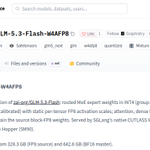
GLM 5.3 Flash means surprisingly little hardware goes a long way. It also gives an extended shelf-life to older GPUs. For the first time, we’re reporting a quant on botsbench: our own GLM 5.3 Flash W4AFP8 that makes it more manageable on older GPUs. Out-of-the-box, GLM 5.3 Flash ships as a 643 GB BF16 release, which typically requires 8 x H200s to run inference. We squeezed to 177GB to run on 2 x H200, with little impact on botsbench scores.
For those who are curious, we quantized the routed MoE experts to int4, paired with static float8 activations, and left attention, shared experts and the dense layers at block-float8. The int4 experts are 88% of the weights, so compressing those while leaving the precision-sensitive paths alone cut the size to 177 GB. The main reason we picked this approach was to avoid requiring the small floating-point units only available in recent GPUs, as many of the teams we work with that self-host have GPUs that are a few years old. On GPQA-Diamond the quant scores 90.9% against 91.2% published for the full-precision model. On botsbench, it scored 35/59, compared to 36/59 unquantized.
Note that we avoided any cyber-specific fine tuning or abliterations, which bring concerns of overfitting and testing for more unexpected loss of function. Our quant shows general open-weight models are running at quality levels cyber teams would have loved from frontier models last year, and require only a couple older GPUs.
Also of note, the top botsbench investigation scores are still from combining the Louie harness with proprietary models - and those lead with a sizeable margin. However, Louie with GLM 5.3 Flash breaks into the top 5 of the global leaderboard, and lands noticeably ahead of regular coding agent harnesses with other models: GLM 5.3 Flash is both good and cheap.
