

Discover the nearby universe. Astronomy news - mainly stars, exoplanets, astrophysics, space telescope images. Only verified sources.
earth
Joined October 2019
- Tweets1.1K
- Following50
- Followers355
- Likes352


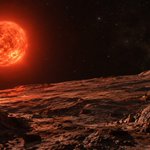


🪐TOI-1518 b is an intensely heated gas giant whose orbit passes nearly over its star’s poles. Measurements reveal rare europium and tungsten, detected for the first time in any exoplanet
📄stellarcatalog.com/news/toi-…
#space #spacenews #science

36
🪐 WASP-12 b is an exoplanet slowly spiraling towards its star. New observations suggest the tidal forces appear to have aligned the star's surface with the planet's orbit, while slowing the star's rotation
stellarcatalog.com/news/obse…
#space #spacenews #science #astronomy

2
38
Hubble has detected clear spectral features in the atmosphere of the cold sub-Neptune exoplanet TOI-6478 b. Strong signals point toward methane as a likely component of the atmosphere

Hubble has detected clear spectral features in the atmosphere of the cold sub-Neptune exoplanet 🪐TOI-6478 b. Strong signals point toward methane as a likely component of the atmosphere
📄stellarcatalog.com/news/atmo…
#space #spacenews #science #sciencenews

52
Hubble has detected clear spectral features in the atmosphere of the cold sub-Neptune exoplanet 🪐TOI-6478 b. Strong signals point toward methane as a likely component of the atmosphere
📄stellarcatalog.com/news/atmo…
#space #spacenews #science #sciencenews
Rocky exoplanets 🪐LP 890-9 b and 🪐LP 890-9 c show transit variations unexplained by a two-planet model. Adding third planet into system could explain them
📄stellarcatalog.com/news/tran…
#space #spacenews #science #sciencenews

6
45
🪐 HAT-P-70 b’s ultra-hot upper atmosphere is depleted of over 90% of its water as extreme heat splits water molecules apart. Thermal emission also reveals vaporized iron, magnesium or silicon
📄stellarcatalog.com/news/atmo…
#space #spacenews #science #sciencenews

34
Infrared observations with the JWST indicate that warm rocky planet LTT 1445 A b has no substantial atmosphere
Infrared observations with the JWST indicate that warm rocky planet 🪐LTT 1445 A b has no substantial atmosphere. Its surface pressure is about 0.1 bar or less. Measurements of its sibling 🪐LTT 1445 A c, are less conclusive
📄 stellarcatalog.com/news/ltt-…
#spacenews #science
84
Infrared observations with the JWST indicate that warm rocky planet 🪐LTT 1445 A b has no substantial atmosphere. Its surface pressure is about 0.1 bar or less. Measurements of its sibling 🪐LTT 1445 A c, are less conclusive
📄 stellarcatalog.com/news/ltt-…
#spacenews #science
The atmosphere of super-Jupiter Epsilon Indi Ab has a deuterium-to-hydrogen ratio similar to Uranus and Neptune pointing to formation in extreme cold
The atmosphere of super-Jupiter 🪐 Epsilon Indi Ab has a deuterium-to-hydrogen ratio similar to Uranus and Neptune pointing to formation in extreme cold
stellarcatalog.com/news/epsi…
#space #spacenews #astronomy #sciencenews #JWST

124
The atmosphere of super-Jupiter Epsilon Indi Ab has a deuterium-to-hydrogen ratio similar to Uranus and Neptune pointing to formation in extreme cold
The atmosphere of super-Jupiter 🪐 Epsilon Indi Ab has a deuterium-to-hydrogen ratio similar to Uranus and Neptune pointing to formation in extreme cold
stellarcatalog.com/news/epsi…
#space #spacenews #astronomy #sciencenews #JWST
65
The atmosphere of super-Jupiter 🪐 Epsilon Indi Ab has a deuterium-to-hydrogen ratio similar to Uranus and Neptune pointing to formation in extreme cold
stellarcatalog.com/news/epsi…
#space #spacenews #astronomy #sciencenews #JWST
🪐TOI-4129 b is a low-density Neptune-like planet that orbits its star in 3.27 days. This orbit places it at the inner edge of the Neptune ridge - a distance where Neptune-like planets are mysteriously common
stellarcatalog.com/news/toi-…
#space #spacenews #science #astronomy

2
54
JWST images of bright young star ⭐️Altair found no confirmed planets; apparent candidates were background stars. The sensitivity of this approach is to planets below Saturn's mass beyond 10 astronomical units
📄 stellarcatalog.com/news/jwst…
#space #spacenews #science #stars #JWST

Models that allow gradual changes in composition inside 🪐K2-18 b and 🪐TOI-270 d reveal a much wider range of possible interiors. That means current measurements may tell us less about these planets’ ingredients than simpler models implied
📄 stellarcatalog.com/news/inte…
#space

🪐TOI-2298 b is a sub-Neptune about three times Earth's size, orbiting in its orange dwarf star's conservative habitable zone every 146.58 days
📄 stellarcatalog.com/news/toi-…
#space #spacenews #science #astronomy

50
JWST observations of lava planet TOI-561 b point to an atmosphere that reflects much of its star’s energy and moves some heat around the planet
JWST infrared observation of lava planet 🪐 TOI-561 b points to an atmosphere that reflects much of its star’s energy and moves some heat around the planet. Models suggest silicate clouds near the day-night boundary might explain the reflective atmosphere
stellarcatalog.com/news/toi-…

106
JWST observation of lava planet TOI-561 b points to an atmosphere that reflects much of its star’s energy and moves some heat around the planet
JWST infrared observation of lava planet 🪐 TOI-561 b points to an atmosphere that reflects much of its star’s energy and moves some heat around the planet. Models suggest silicate clouds near the day-night boundary might explain the reflective atmosphere
stellarcatalog.com/news/toi-…
52
JWST infrared observation of lava planet 🪐 TOI-561 b points to an atmosphere that reflects much of its star’s energy and moves some heat around the planet. Models suggest silicate clouds near the day-night boundary might explain the reflective atmosphere
stellarcatalog.com/news/toi-…
⭐️ HD 281229 is the youngest star known with a detected and modelled pattern in gravity-driven waves, which travel through its interior. The pattern indicates near-core rotation of 1.317 ± 0.05 times per day, offering a way to study very young stars
📄 stellarcatalog.com/news/hd-2…

34