

🗣️ Teaching you about the science and diversity of language 📰 Sign up for my newsletter at https://xitter.cf/t.co/s7SfPpkdES! Danny Hieber, Ph.D.
Joined December 2020
- Tweets5.7K
- Following221
- Followers16K
- Likes1.5K



Pinned Tweet
Hi! 👋 Linguistic Discovery teaches you all about the science and diversity of language—a field known as linguistics.
I (Danny Hieber, Ph.D.) post daily about how language works and the incredible diversity of the world’s languages.

A new book on the history of punctuation came out in August! Here’s the description:
You know the lively exclamation mark, the controversial semicolon, and the often-omitted apostrophe, but would you recognize a percontation point? How about an obelus? In this irreverent and delightfully intellectual book, Florence Hazrat argues that all punctuation marks, from the most forgotten to the most ubiquitous, are worthy of our attention. After all, the history of punctuation is the history of humankind.
The first punctuation mark was a triangular symbol pressed into clay somewhere in Mesopotamia. Spaces between words were unknown for millennia, until a group of Irish monks pioneered them in the eighth century. Across ages and cultures, amid technological revolutions and radical changes in communication, these dots and dashes have reshaped the societies that created them. From the papyruses of the ancient world to our sprawling internet ecosystem, one thing has remained constant: Punctuation is powerful. These tiny marks can move markets, shift elections, topple political systems, and decide the fate of a precious human life on death row.
Weaving together anthropology, the history of writing, the philosophy of language, psychology, literature, and more, *On the Mark* masterfully proves that punctuation is at the heart of human communication.

Get your own copy at the links:
Amazon: link.amazon/B0gic8u3e
Bookshop: bookshop.org/a/110785/978154…

A recent study found that large language models are homogenizing writing styles, leading to a decrease in variation in written complexity, and an erasure of many of the written cues that convey information about a writer’s identity—age, gender, personality, empathy, moral values, or political affiliation.
nature.com/articles/s41562-0…

🤖 Large language models are shrinking linguistic diversity
🇺🇸❌🇬🇧✅ Many loathed “Americanisms” are actually British coinages
🦧 How habitat shapes the vocal repertoire of primates
🔤 The Canadian English dictionary gets a new update
🗞️ Here’s what happened this week in language and linguistics!
linguisticdiscovery.com/post…

Spreadsheets are at least 4,000 years old, btw
datafix.com.au/BASHing/2020-…
#NationalSpreadsheetDay


Want to learn more about how cuneiform evolved? Check out this (free) issue of the Linguistic Discovery newsletter:
linguisticdiscovery.com/post…


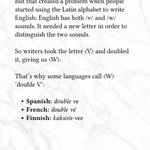
There aren’t very many /θ/ vs. /ð/ pairs because /ð/ is typically restricted to use in function words, while /θ/ is typically restricted to content words.
If you enjoy posts like this, you’ll love the Linguistic Discovery newsletter! Topics include:
⚙️ how language works
🌍 grammatical diversity in the world’s languages
ℹ️ explainers of concepts in linguistics
🗣️ language profiles
🗞️ latest news and research
Sign up at the link in bio ⬆️
#English #pronunciation #spelling #linguistics #language
The Herculaneum scrolls are speaking again: Breaking news from Naples reveals two new ancient books not seen in 2,000 years
Using virtual unwrapping, high-resolution scanning, AI and papyrological interpretation, researchers have recovered substantial readable text from unopened carbonised scrolls found in Herculaneum.
open.substack.com/pub/lifein…


Caesar would have pronounced his own name /ˈkai.sar/. His name is also where the words “czar” and “kaiser” come from.


We Americans have some pretty weird sounds in our language. The American English /r/ is extremely rare and unusual across the world's languages, for instance.
Here's a guide to American English sounds from the Rosetta Stone blog:
blog.rosettastone.com/englis…

If you want more of the latest news, research, and interesting articles in language and linguistics, check out my free weekly digest!
linguisticdiscovery.com/curr…
