

I’m a PhD researcher @MSFTResearch @Caltech @RPI, prev @NECLabsAmerica @AsariAILabs working on LLM-agents, reasoning, RL, test-time scaling, and code generation
San Francisco, CA
Joined June 2023
- Tweets337
- Following899
- Followers925
- Likes1K




Pinned Tweet
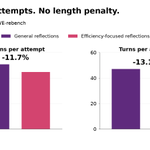
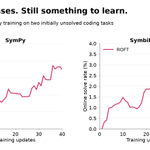
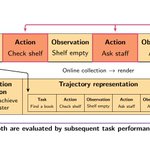
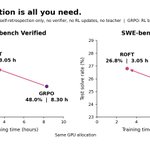
We trained an AI agent on its own explanations, not its code.
It got better at coding.
No teacher. No verifier. No RL updates. No extra context at test time.
Here's how. Links below. 🧵

Jonathan @COLM retweeted

We at @bespokelabsai have a solid blog post for you guys with details on how to train a model towards becoming an autonomous ML researcher.
We curated high quality RL envs and used some new post-training techniques to improve Nemotron Super to be as good as a model 20x the size.
Details: bespokelabs.ai/blog/teaching…
We partnered with @NVIDIAAI for this work: developer.nvidia.com/blog/nv…


We are excited to announce that we post-trained NVIDIA Nemotron-3.5-Super-VL to be an autonomous ML researcher. We show that our post-trained model goes from 28% to 35% on AutoResearchExam, matching Qwen 3.8 Max, a model with 20× the total parameters.
The tasks are long horizon, open ended AI and ML research: building a faster executor for a transformer compute graph, training a RL control policy, creating new uncertainty quantification methods, etc. The model gets to submit once, and it doesn't see its score until the end.
We curated SFT data using Self-context distillation. This means that we let the Nemotron model to solve a problem with hints, then we SFT on these trajectories but without the hints. This gave us +11% on AutoResearchExam.
As a next step, we added reflection: We ask the Nemotron model to review its own past attempts and writes concrete lessons learned. Then we SFT on these reflections.
Surprisingly, training on these lessons improved the performance to +25% compared to the base model.
The hardest part was choosing the right data. We selected traces based on task scores, completion checks, and runtime, then refined the sampling across training rounds to address failures in the base and fine-tuned models. We removed hints and filtered out steps that relied on information available only in those hints. The goal was to teach decisions supported by the task and history the model would actually see at inference.
Full write-up:
bespokelabs.ai/blog/teaching…
Thanks to @NVIDIAAI for early access and collaborating on this.

Excited to see Bespoke Labs build on our ROFT work for autonomous ML research!
Their recipe combines context distillation, self-generated retrospections, and action replay -- improving Nemotron’s AutoResearchExam score by ~25% vs. base.
Learning to explain → learning to do 🧠
We are excited to announce that we post-trained NVIDIA Nemotron-3.5-Super-VL to be an autonomous ML researcher. We show that our post-trained model goes from 28% to 35% on AutoResearchExam, matching Qwen 3.8 Max, a model with 20× the total parameters.
The tasks are long horizon, open ended AI and ML research: building a faster executor for a transformer compute graph, training a RL control policy, creating new uncertainty quantification methods, etc. The model gets to submit once, and it doesn't see its score until the end.
We curated SFT data using Self-context distillation. This means that we let the Nemotron model to solve a problem with hints, then we SFT on these trajectories but without the hints. This gave us +11% on AutoResearchExam.
As a next step, we added reflection: We ask the Nemotron model to review its own past attempts and writes concrete lessons learned. Then we SFT on these reflections.
Surprisingly, training on these lessons improved the performance to +25% compared to the base model.
The hardest part was choosing the right data. We selected traces based on task scores, completion checks, and runtime, then refined the sampling across training rounds to address failures in the base and fine-tuned models. We removed hints and filtered out steps that relied on information available only in those hints. The goal was to teach decisions supported by the task and history the model would actually see at inference.
Full write-up:
bespokelabs.ai/blog/teaching…
Thanks to @NVIDIAAI for early access and collaborating on this.
Jonathan @COLM retweeted

We saw the exact same. SFT on insights and direct-transfer rollouts with removed insights arxiv.org/abs/2609.37633. Another work around @lightetal found +/- the same arxiv.org/abs/2609.35741. Nice to see that several labs find this concurrently and independently. We're up to sth :)


Jonathan @COLM retweeted

New MIT paper says give your agent its own history and prompt as code variables it can search and pass to subagents, and a plain agent loop beats purpose-built memory and self-improvement systems at lower cost.
Agents lose instructions when they copy context into subagents by hand, and passing the prompt and history by reference let JAZ beat dedicated memory and self-tuning systems.
Long-term memory and self-improvement usually need extra systems like Letta or ACE, which add cost and break when tasks don't fit their design.
JAZ keeps only the loop. The model writes Python, calls itself as a subagent, and sees its prompt and full history as variables it can pass along without loss.
On StuLife tasks that needed facts from over 50 tasks earlier, JAZ passed 69.9% against 61.8% for Letta, at less than half the cost. Improving itself across 417 AppWorld tasks, it completed 74.2% against 69.9% for ACE, again for less.
– arxiv. org/abs/2609.26891
Title: "Harness as a Language: A Minimalist Agent Framework With Maximal Expressivity"

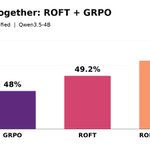
Want credit assignment over long-horizon agent tasks?
Your model can do it for itself. No per-turn labels. No value model. No RL.
Train it only on its own reflections, and its correct turns gain likelihood more often than its incorrect ones. GRPO barely tells them apart.


Jonathan @COLM retweeted

What I read at #COLM2026: the 5 papers I liked most, ranked by community likes:
1. IdeaScientist: agents trained with RL to generate grounded research ideas. @Jiarui_Liu_
xitter.cf/Jiarui_Liu_/status/210…
2. LLM-as-a-Verifier: a weaker model checking a stronger one’s work. @Azaliamirh
xitter.cf/Azaliamirh/status/2108…
3. CORAL: autonomous multi-agent evolution for open-ended discovery. @ao_qu18465
xitter.cf/ao_qu18465/status/2108…
4. Actor-Curator poster. @lightetal
xitter.cf/lightetal/status/21082…
5. GitSwarm: inference that builds on itself across long tasks. @veds_12
xitter.cf/veds_12/status/2108605…
My overall impression is that verification is now the bottleneck for both agents and reasoning. Which COLM paper did I miss?

Excited to share IdeaScientist, our research from my internship at Meta! 🚀
Can AI agents learn to generate novel, grounded scientific ideas?
We introduce IdeaScientist, a framework that trains specialized agents to identify research gaps, discover useful connections across scientific domains, and turn them into concrete research proposals.
🔍 Key findings:
• +14% overall performance over open autoresearch baselines
• 25% improvement in novelty, showing that explicit training can improve scientific ideation
• 75–92% human preference win rates against six open baselines in blind evaluations
• Cross-domain retrieval substantially improves the transfer of ideas between research fields
We also introduce Svalbard Idea Vault, a collection of 2.77M decomposed research ideas for training and evaluating scientific ideation.
📄 Paper: arxiv.org/abs/2610.04074

Our Actor-Curator poster at #COLM26
in case you missed it yesterday :)

Post-training LLMs is like mixing a cocktail:
Too much easy data → no learning
Too much hard data → instability
Wrong balance → collapse
And today, we mix it by hand.
What if the data mixture could be learned instead of hand-tuned?
arxiv.org/abs/2602.20532
🧵👇

Jonathan @COLM retweeted

At #COLM2026? Care about RL and Curriculum Learning for Agents? Do bandit research?
Come chat with us about Actor–Curator this afternoon! 🕟 Today, Oct 7, 4:30–6:30 PM PDT
📍 Poster #100, Franciscan C Hilton San Francisco Union Square

Actor-Curator does self-curriculum design for post-training, by dynamically choosing task difficulty instead of hand-mixing data. Yields up to 80% faster convergence compared to vanilla post-training.
Awesome work by @zhengyao_gu @lightetal @ihazelye @zou_henry43378
Jonathan @COLM retweeted

Shockingly Simple Self-retrospection Improves Agentic Models Without RL
"Can a language-model agent improve its future actions by training only on explanations of its own experience? We investigate this question by studying Retrospection-Only Fine-Tuning (ROFT), a minimal online procedure designed to isolate the effect of explanation-only training on subsequent behavior. The agent attempts a task, observes available feedback, generates a retrospective explanation, and is fine-tuned with a next-token prediction loss on the explanation tokens alone."
link: arxiv.org/abs/2609.35741

At #COLM2026? Come chat about Actor–Curator this afternoon! Happy to talk curriculum learning, bandits, and RL post-training, or just say hi 👋
🕟 Today, Oct 7, 4:30–6:30 PM PDT
📍 Poster #100, Franciscan C
Hilton San Francisco Union Square
Post-training LLMs is like mixing a cocktail:
Too much easy data → no learning
Too much hard data → instability
Wrong balance → collapse
And today, we mix it by hand.
What if the data mixture could be learned instead of hand-tuned?
arxiv.org/abs/2602.20532
🧵👇
