

Scalable Liberty Open Source Everything Currently @powerhousedao ex makerdao
ethereum
Joined August 2014
- Tweets1.3K
- Following4.7K
- Followers1.1K
- Likes27.5K



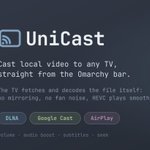




While using Omarchy I found myself needing to cast some videos to my TVs. I found no tool that helps me do that, so in the spirit of the We Can Fix Everything, I build a plugin to do just that.
If anyone else has the same need, feel free to use it.
plugins.omarchy.org/plugin.h…


Liberuum retweeted

Linux communities had 35 years to make what Omarchy did in a month.
Think about it.

Built with ❤️ by Powerhouse

Just build an alternative to defiunited.world: defiunited.web3.berlin/
The core is based on the @PowerhouseDAO stack and comes with document models which include the business logic, a synchronization protocol between nodes and a nice graphql interface for retrieving data.

Back to the roots

Honestly, "DeFi" fucking blew it and isn't decentralized. We need to reset to first principles and use formal methods to build contracts from spec, prove the lemmas of the intermediate states, prove the invariants, and then build the code from those specs. Then test the resulting bytecode against the specs, then unit test, fuzz, and invariant/stateful fuzz everything.
Also, agentic security auditing is the new proof-of-work. Your protocol should have auditable compute from the latest frontier models red teaming the entire thing. If you can’t outspend your potential attackers, you lose.
Finally, no humans in the final deployed products, just protocols and the promise of lego building blocks. No fucking multisigs, no governance, no trust based human failure modes. Just permissionless, immutable, decentralized code the way God intended.

This is our knowledge graph. Hundreds of atomic claims connected by meaning across 17 topic clusters, all radiating from a single hub.
Each note is an atomic claim. Each link has a type and a reason. AI-powered search understands meaning, not just keywords.
Built on @PowerhouseDAO document models — event-sourced, local-first, collaborative. Every edit is an immutable operation with full audit trail.
The hub diamond connects 17 Maps of Content: architecture, design systems, legal, platforms, tooling. Each MOC pulls its notes into visible clusters.
The vault lives on a Switchboard where team members and AI agents query, push, and connect knowledge. A central knowledge hub for the organization — powered by the Powerhouse stack with document-level authorization, full provenance tracking, and cryptographic signatures on every change.
Why this matters:
- New team members onboard by searching, not asking
- Decisions are traceable — every claim links back to its source
- AI agents answer questions from structured knowledge, not hallucinations
- Knowledge survives people leaving — it's in the graph, not in someone's head
- Contradictions surface automatically — the system flags when claims conflict
- The graph grows smarter with every note — more connections mean better search results
Not documentation. A living, queryable institutional memory for humans and AI agents.

The graph is just one view. Behind it sits a full app interface built on Powerhouse Connect:
Search tab — type a question in natural language and get ranked results powered by semantic embeddings. "How does authorization work?" finds the right notes even if you don't know the exact terms. Switch between hybrid, semantic, or keyword modes.
Notes tab — browse all knowledge claims as cards with status badges, topic tags, and link counts. Click any card to open the full editor with markdown preview, typed links to other notes, and provenance info.
Graph tab — the visual map you see above. Drag MOC clusters around, hover to see connections, click to navigate. Positions persist across sessions.
Activity tab — a live feed of every change across the vault. Who edited what, when, and what they changed. Filtered by type: content edits, new links, status changes, topic additions.
Then there's the AI layer. A Claude Code plugin connects agents directly to the vault through the Switchboard CLI. The agent can:
Seed a source (article, transcript, doc) and extract atomic claims automatically
Find and create typed connections between notes
Synthesize Maps of Content from topic clusters
Run quality checks — flag orphan notes, missing descriptions, broken links
Answer questions by searching the graph semantically
The human builds knowledge through the app. The AI accelerates it — ingesting sources in minutes that would take hours manually, finding connections across hundreds of notes that no person would spot, and maintaining quality at scale.
This is why it matters: knowledge systems fail when they depend on one person's discipline. This one doesn't. The structure is enforced by document models. The connections are suggested by AI. The quality is maintained by automated health checks. And the whole thing is queryable by both humans and machines through the same API.
One vault. Two interfaces. Human creativity meets AI scale.
Document Models as the building block. Event sourced, append only changes. Complete operation history. You can travel in time and see what you + your agent thought.
You can track your intelligence! – at Oeiras, Portugal


