




🛡️ Hack The Box Sherlock Completed — Remote_Access_Regret! 🔍
Another enjoyable digital forensics investigation completed.
This Sherlock focused on investigating a technical support scam involving malicious browser redirects and unauthorised remote access through AnyDesk.
The investigation involved examining a .raw FAT16 filesystem image, extracting forensic artefacts, and reconstructing activity through Chrome browsing history and AnyDesk connection logs.
A great practical exercise in DFIR, browser forensics, remote-access investigations and evidence analysis.
The CyberForge | Digital Forensics & Cybersecurity Research
#HackTheBox #HTB #DigitalForensics #DFIR #CyberSecurity #IncidentResponse #Autopsy #ThreatHunting #TheCyberForge

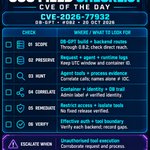
🔥 CyberForge CVE of the Day #082
🚨 CVE-2026-77932 — DB-GPT: when a mock identity reaches real execution tools
An agent that can write code is useful only when the authority to run it is real. Here, the identity check was a mock, while the tool execution was real.
The VulnCheck CNA describes DB-GPT through 0.8.2 accepting unauthenticated access to /api/v1/chat/react-agent. Its authentication helper grants an admin role, and the ReAct agent can reach unsandboxed Python and shell tools. Lasso reports root execution inside the webserver container in its research setup.
Check who reaches the backend, which identity authorises tools, and what those tools can access.
🎯 THE QUICK HIT
What failed: get_user_from_headers returns an admin-role user rather than validating credentials. The affected ReAct route depends on that helper; exposed execution tools then turn an unauthenticated conversation into an operating-system capability.
Who should check: owners running DB-GPT through 0.8.2, including the dbgpt-app package, with the relevant backend route and execution tools available. Record the actual deployed commit/image and runtime, not just a UI version or a repository checkout.
What was shown: Lasso describes laboratory execution in a containerised setup and, in one run, access to the bundled database using default credentials. That is researcher evidence, not a verified malicious campaign or proof every deployment's database was accessed.
Start with: restrict untrusted access to the backend and preserve request, agent and runtime evidence. No fixed release is verified at this cutoff. The latest returned GitHub release and PyPI dbgpt-app version are still 0.8.2, within the CNA's affected range.
Follow: request identity and route → conversation/tool-call context → child process → actual container/host identity, mounts and network → relevant database or credential activity.
Escalate when: unauthorised tool execution is supported by request and process evidence, or subsequent access is corroborated. Mere route traffic or the word admin in an application record is not enough.
Keep this boundary: root inside the reported webserver container does not establish a host escape. A model failing to emit a tool call is also not an authentication or isolation control.
🔑 KEY DETAILS
• Product: eosphoros-ai DB-GPT; CNA package identity pkg:pypi/dbgpt-app.
• Affected range: through 0.8.2 inclusive, according to the VulnCheck CNA. Do not infer that a hypothetical next version is fixed.
• Weakness: CWE-306, Missing Authentication for Critical Function.
• Published CVSS v3.1: 9.8 Critical, VulnCheck CNA.
• Exact v3.1 vector: CVSS:3.1/AV:N/AC:L/PR:N/UI:N/S:U/C:H/I:H/A:H
• Published CVSS v4.0: 9.3 Critical, VulnCheck CNA.
• Exact v4.0 vector: CVSS:4.0/AV:N/AC:L/AT:N/PR:N/UI:N/VC:H/VI:H/VA:H/SC:N/SI:N/SA:N
• Access model: network; no prior privileges or user interaction in the published vectors.
• NVD: Deferred. The v3.1 metric is labelled Primary but sourced to [email protected]; v4.0 is Secondary from the same source. Primary does not make it independent NIST scoring.
• Documented route: /api/v1/chat/react-agent. The pinned source declares /v1/chat/react-agent; the CNA supplies the public /api prefix. Confirm actual proxy/base-path mapping locally.
• Reported execution: Python/bash tools under the application runtime; root in the research webserver container. Inspect actual deployment permissions rather than assuming host root.
• Permanent fix: no fixed release verified in the checked advisory/release/package records.
• Researcher proposals: real authentication/authorisation, isolated execution paths and narrower network/mount permissions. These are recommendations, not proof an upstream patch shipped.
Status at the cutoff:
Lasso publishes a lab reproduction narrative. Its structured “Known exploit: No” label does not erase that narrative or establish a field campaign. Its availability display also says None, while both CNA vectors rate vulnerable-system availability High; retain the CNA's exact vectors rather than rewriting them from the page tile.
No malicious in-the-wild exploitation was verified in this bounded review. CISA KEV has no exact match in the retrieved 2026.10.16 catalogue, released 16 October and predating the 20 October CNA publication. An older catalogue's non-match is not reassurance. No CISA SSVC assessment was present in the returned CVE record.
FIRST returned total 0 and data []. EPSS is unavailable at the lookup, not zero. There is no returned probability, percentile or score date to invent.
🧬 WHAT ACTUALLY WENT WRONG?
The intended boundary is caller identity → permission to invoke an agent → permission and isolation for each execution tool.
At the CNA-referenced source revision, get_user_from_headers constructs an admin-role user whether the optional user header is supplied or omitted. A claimed user identifier is not a credential check. That means an application record showing admin may describe a manufactured identity rather than an authenticated administrator.
The pinned ReAct handler uses that helper. The reviewed Python tool starts a child interpreter, and the shell tool directly creates LocalRuntime. Lasso describes the latter bypassing the separate sandbox opt-in guard. A component named sandbox, or a sandbox setting elsewhere, does not prove these particular execution paths are isolated.
The high-level sequence is:
1. An untrusted caller can reach the affected backend route.
2. The mock identity function grants an admin role without credential verification.
3. The ReAct agent can select an execution tool.
4. The tool runs under the application's effective runtime authority rather than a proven separate security boundary.
5. The research setup produced container-root execution; one run also reached its bundled database.
The missing authority boundary is outside the model. Prompt filters, model reluctance and chat-interface login do not establish backend authentication or tool isolation.
📦 WHICH DEPLOYMENTS BELONG IN SCOPE?
The CNA lists DB-GPT through 0.8.2 and pkg:pypi/dbgpt-app. Confirm actual application code/route wiring: development images, source mounts and rebuilt containers may differ from a tag. Record owner, deployment mode, build/commit, immutable image identity where available, listeners and tools.
Map gateways, direct backends and internal reachability. Front-end authentication does not prove origin enforcement. Use approved configuration evidence first; no endpoint was actively tested here. Non-container deployments need their actual process/host authority assessed; the lab setup is not universal.
GitHub's latest returned release is v0.8.2, dated 26 August; PyPI also returns 0.8.2. Its separate Jinja2 RCE changelog item does not establish repair of this CVE. A newer repository push is not a security release.
The repository advisory API returned []; the global database has unreviewed GHSA-5vjv-vw3m-qpqp with no package/fixed-version entries. Neither certifies safety. Obtain an approved correction and acceptance evidence for authentication and both execution tools before reopening exposure.
🕰️ EXPOSURE WINDOW AND TIMELINE
18th October: CNA datePublic and Lasso database listing. 19th October: VulnCheck advisory page date. 20th October: CNA publication 00:46:11 UTC; NVD 01:17:19 UTC; GHSA 03:32:45 UTC. These are publication events, not first-attack dates.
Lasso describes a v0.8.1-related lab source/image arrangement. The CNA separately lists through 0.8.2 and references another source revision. This run did not reproduce each release.
Bound the local hunt by affected deployment and backend/tool exposure through verified restriction/correction. Reconstruct past ingress/runtime state; retain missing intervals explicitly. Disclosure is not the start of every exposure.
🧭 SOC INVESTIGATION TRAIL
Objective: trace possible unauthorised tool execution and the authority reached. Agree assets, UTC bounds, read access and collection health. These are Forge methods, not CVE signatures.
C01 — ESTABLISH THE REAL BACKEND
Action/location: match active code/package/image to the affected range; review ingress, direct listeners and authentication through owner-approved deployment/configuration records. Do not send code-execution requests.
Signal/correlation: link available tools and untrusted reachability to the same serving instance and historical policy. A front-end login does not prove backend enforcement.
Benign causes/limits: stale inventory, an inactive image or a documented custom correction can explain a version hit. A new rebuild alone proves no repair.
Escalate unresolved exposure for restriction and owner review; activity evidence is needed for a compromise finding.
C02 — PRESERVE THE EXECUTION TIMELINE
Action/location: retain available proxy/access, application/agent and existing host/container records before rotation or redeployment. Verify actual schemas/retention; complete tool auditing is not promised.
Signal/correlation: preserve UTC bounds, instance/container ID, image/build and available request/conversation/tool/process IDs. Keep native originals, collector/time and protected working copies.
Benign causes/limits: streaming, truncation, missing history and clock skew can break the trail. Receipt is not execution. Prompt content/output may be confidential.
Escalate gaps that prevent checking a credible lead. Urgent containment may precede ideal collection; record the loss rather than treating the new container as old evidence.
C03 — JOIN TOOL CALLS TO PROCESSES
Action/location: review the documented route and verified local mapping, then join candidate requests to tool invocation and retained process evidence using actual schemas.
Signal/correlation: code_interpreter or shell_interpreter matters when linked to an unauthorised caller, conversation and child process. Distinguish tool selection, execution and returned output; HTTP success alone settles none.
Benign causes/limits: legitimate analysis uses these same tools. Names, Python and shell activity are not unique IOCs; compare the owner, job and action.
Escalate unexplained execution with supporting records. A model failing to select a tool does not establish protection.
C04 — VERIFY IDENTITY INDEPENDENTLY
Action/location: correlate application identity to existing gateway/identity-provider, routing and approved-use records where available.
Signal/correlation: the mock can produce admin without valid credentials. Establish who authenticated, where, and whether that control covered this backend request. A caller-supplied user header is not authoritative identity.
Benign causes/limits: shared accounts, proxies and missing IDs complicate attribution. Verify the trust chain for forwarded source data and account for ingestion delay.
Escalate supported unauthorised use. Do not assign a tool action to a named administrator merely because the application recorded that label.
C05 — BOUND CONTAINER AND DATABASE EFFECTS
Action/location: review approved runtime configuration plus preserved process/file/network and database evidence. Establish actual UID, mounts, capabilities, daemon access and reachable services.
Signal/correlation: join executed code to resources it could access, then corroborate subsequent sessions/operations. Lasso's default-credential database leg was one lab run, not every deployment.
Benign causes/limits: normal queries, mounted data and maintenance can look similar. Container root is not proof of host root; a risky mount is not a demonstrated escape.
Escalate corroborated effects and scope recovery/credential work accordingly. Keep secret values out of shared evidence summaries.
C06 — VERIFY RESTRICTION AND CORRECTION
Action/location: confirm effective backend restrictions; for an approved repair, verify real credential checks, tool permissions and isolation of BOTH execution paths through owner-approved code/configuration and controlled acceptance work.
Signal/correlation: tie proof to every active build, route and change time. A protected proxy can be bypassed by an open origin; a sandbox service does not prove tools use it.
Benign causes/limits: image freshness, version labels and changed model behaviour do not establish repair. No fixed release was verified.
Escalate alternate backends, missing acceptance, boundary failures or meaningful telemetry gaps. Containment, permanent repair and incident closure remain separate.
ANALYST HANDOVER
Record asset/owner → build/runtime and routes → UTC window → source/record IDs → request/tool/process correlation → identity confidence/resources reached → restriction/repair proof → gaps and next owner.
Classify exposure established, suspicious indicator, validated compromise or telemetry unavailable/insufficient. No matches needs defined assets, interval, source health and query limits. No findings are not proof of a clean system.
🔎 INDICATORS AND OBSERVABLE BEHAVIOUR
The route and tool names are capabilities/locations, not unique malicious IOCs. The demonstration marker is a lab artefact, not a campaign signature. No malicious IP/domain/hash set or field campaign was verified in the reviewed sources.
Forge lead: correlate untrusted request, actual tool invocation, process and unexplained effects. Check legitimate analysis and model/tool formatting failures. Prompt text alone does not prove execution. If only access logs or tool intent remain, state that limit; newly enabled logging cannot recreate the past.
🧰 TOOLS AND BOUNDED CHECKS — PLAIN LANGUAGE
A — INGRESS AND APPLICATION CONFIGURATION
Use the existing reverse-proxy, gateway and deployment interfaces with authorised read access. Map the documented route to its actual backend and check direct listeners and historical policy. Confirm where credential validation occurs and whether tools require an independent permission decision. A route behind a pretty login page is not sufficient evidence. Record owner, scope and gaps without sending execution requests.
B — EXISTING SIEM, AGENT TRACES AND EDR
Scope host/container identities and the UTC interval first. Inspect retained request and conversation/tool records, then correlate to available process and network events. Use real schemas; record caps, ingestion delay and missing fields. Prompt content and tool output may be sensitive. Names alone are not IOCs, and a first page of results is not a complete investigation. These are source-reviewed methods, not a detector tested against a live service.
C — CONTAINER RUNTIME AND DATABASE AUDIT INTERFACES
Where deployed, use the owner's supported Docker/orchestrator read views and existing database audit facilities. Review selected identity, image, mount, privilege and connectivity fields rather than dumping full environment configuration. Daemon access is powerful even when the intended operation is inspection; use the existing authorised route. Compare historical and current runtime state. Root UID in a container does not independently establish host root, and a database connection is not proof of theft.
🩹 REMEDIATION AND VERIFICATION
1 — Restrict untrusted access to the actual backend and its alternate routes. Lasso recommends removal from untrusted networks or effective authentication. Implement through the owner's change/incident process, considering the service impact. Restriction reduces opportunity; it does not erase earlier access.
2 — Preserve relevant existing evidence before replacement, rotation or redeployment where feasible. Record container/build identity and previous route policy. Do not let a new image silently replace the historical timeline.
3 — Obtain an approved correction. No fixed release was verified; GitHub and PyPI still return affected 0.8.2. Real authentication and authorisation must replace the mock, and both code and shell execution must use the intended isolated runtime. Researcher suggestions are not a released vendor repair.
4 — Reduce authority deliberately: least-privilege runtime, constrained mounts, restricted network access and protected secrets appropriate to the workload. Review the standalone sandbox API if deployed; its authentication is a separate surface. A variable named sandbox or a changed model does not prove the tool boundary.
5 — Verify every active instance and recovery/deployment source. Establish credential validation, caller/tool permissions and effective isolation through approved code/configuration review and controlled acceptance work. This publishing run did not perform those tests. Reopen access only with accountable evidence, not an optimistic version comparison.
6 — Resolve historical compromise from evidence. Corroborated execution may require containment, trusted recovery and scoped credential work based on what the application could access. A model update, restart or access restriction alone does not establish eradication.
🧾 EVIDENCE SEPARATION
CNA facts: affected range, route, missing authentication, interpreter capabilities, published vectors and reported container-root consequence.
Researcher evidence: lab reproduction and one bundled-database leg. Static source inspection corroborates mock admin assignment, the route dependency and execution paths; it is not a fresh reproduction or proof of a deployed patch.
Forge analysis: correlate request, tool and process evidence; assess real runtime authority; restrict bypass paths and demand repair acceptance. These are defensive methods, not observed victim findings.
Unknown: a verified fixed release, complete current-main remediation, malicious campaign, victim scope, every deployment's runtime UID/database exposure and historical activity where telemetry is absent. No EPSS probability or CISA SSVC value is supplied by the returned records.
🔥 CYBERFORGE VERDICT
DB-GPT's lesson is concrete: identity, permission and execution isolation must be enforced outside the model's discretion. A mock admin decision followed by real interpreter access makes an exposed agent a server-side execution surface.
For applicable deployments, restrict the backend, preserve the timeline and investigate the request-to-process trail. Keep container-root research evidence distinct from host compromise, and keep a containment decision distinct from a verified permanent repair.
💜 A capable agent needs a real identity boundary before it gets a real execution tool.
🔗 SOURCES AND FURTHER READING
CVE Program / VulnCheck CNA:
cveawg.mitre.org/api/cve/CVE…
CNA advisory:
vulncheck.com/advisories/db-…
Researcher advisory, reproduction context and recommendations:
lasso.security/vulnerability…
NVD source-attributed metrics:
nvd.nist.gov/vuln/detail/CVE…
Upstream release and package state:
github.com/eosphoros-ai/DB-G…
pypi.org/project/dbgpt-app/
Pinned authentication source:
github.com/eosphoros-ai/DB-G…
GitHub global advisory, unreviewed:
github.com/advisories/GHSA-5…
Dated KEV lookup / FIRST response:
cisa.gov/sites/default/files…
api.first.org/data/v1/epss?c…
Container inspection / security / logging context:
docs.docker.com/reference/cl…
docs.docker.com/engine/secur…
docs.docker.com/engine/loggi…
#CyberSecurity #CVE #DBGPT #AgentSecurity #BlueTeam #ThreatHunting #SOC #CyberForge
🤖 Made with AI


lee1981 retweeted

Business continuity is not a binder or a subscription. Compare in-house, managed, and co-managed models by scope, ownership, testing, evidence, and provider dependency.
pierson-tech.com/blogs/f/bus…
#Cybersecurity #InfoSec #BusinessContinuity

🔥 CyberForge CVE of the Day #081
🚨 CVE-2026-106931 — SiteGuard Server Edition: preserve the evidence before repairing the statistics feature
A web application firewall helps protect a server. Its own statistics processing must also respect the host's privilege boundary.
EG Secure Solutions and JVN confirm exploitation of an OS command injection vulnerability in SiteGuard Server Edition. The documented consequence is potential execution of operating-system commands as root or SYSTEM on the affected server.
The first defender action deserves attention: the vendor warns that updating or patching can erase attack traces. Download and preserve diagnostic information before the change where feasible, then apply the correct platform's repair.
🎯 THE QUICK HIT
What happened: statistics processing contains CWE-78, OS command injection. Statistics is enabled by default; the public notices do not disclose a complete trigger sequence.
Who should check: SiteGuard Server Edition owners on Apache httpd, Nginx or IIS, including the separate FreeBSD branches. Match platform/build and historical statistics state; preserve the IIS exception.
Prerequisites matter: published vectors say local access, low privileges and no user interaction. The reviewed sources do not establish an unauthenticated Internet endpoint. A WAF's deployment inside a web server does not establish that route.
Start with: owner, active build/feature state, then diagnostic download BEFORE update or patch where feasible. Urgent containment can take precedence; record resulting collection gaps.
Follow: installation/feature history → diagnostics → host/process evidence → identity/change context → verified serving repair.
Escalate unexplained privileged activity with corroboration. Vulnerability presence requires remediation; suspicious activity also needs investigation.
Keep the source conflict: official notices confirm exploitation. No KEV match and CISA's dated SSVC “none” do not cancel that confirmation.
🔑 KEY DETAILS
• Product: EG Secure Solutions Inc. SiteGuard Server Edition, a host-based WAF integrated with a web server.
• Affected component: statistics processing, enabled by default.
• Weakness: CWE-78, improper neutralisation of special elements used in an OS command.
• JPCERT CNA / JVN assessment: CVSS v4.0 8.5 High.
• Exact v4.0 vector: CVSS:4.0/AV:L/AC:L/AT:N/PR:L/UI:N/VC:H/VI:H/VA:H/SC:N/SI:N/SA:N
• Additional published assessment: CVSS v3.0 7.8 High.
• Exact v3.0 vector: CVSS:3.0/AV:L/AC:L/PR:L/UI:N/S:U/C:H/I:H/A:H
• NVD status: Deferred. Its v4.0 and v3.0 metrics are Secondary, attributed to JPCERT; no separate NIST assessment is present in the returned record.
• JVN's headline says Critical and the vendor labels its notice urgent. Those advisory labels do not change the published High CVSS scores or their versions.
• Vector prerequisites: local, low privileges, low complexity, no user interaction. v4.0 AT:N does not remove feature/access conditions.
• Potential impact: OS commands with root or SYSTEM privileges on the server running the affected product. A particular site's compromise, persistence or data theft is not established by that capability statement.
• Fix: Ver8.00 Update 5 for Apache httpd, Nginx and IIS outside FreeBSD; Ver7.00 Update 6 for Apache httpd/Nginx on FreeBSD.
• Alternative: the vendor provides a statistics-processing file-replacement patch, including for end-of-life versions. Obtain the package and verification instructions matched to the installation.
• Temporary workaround: JPCERT/CC says disabling statistics avoids the vulnerability's effect. Use the vendor's supported procedure; do not treat a workaround as evidence of historical safety.
Exploitation and prioritisation:
The 14th October vendor/JVN notices confirm exploitation; JPCERT-AT-2026-0032 recommends considering compromise investigation. The notices do not publish a victim count, initial attack date or actor.
CISA KEV: no exact CVE match in catalogue 2026.10.16, released 16th October at 17:15:48.8752 UTC, retrieved 19th October. The official feed and official GitHub mirror agree. This is a dated catalogue lookup, not evidence that no attacks occurred. No KEV-specific deadline is assigned here.
CISA ADP SSVC 2.0.3: exploitation none / automatable no / technical impact total, assessed 16th October at 15:15:38.574629 UTC. That conflicts with the official exploitation statements; it does not overrule them or establish that the threat has ended.
FIRST EPSS: 0.006620000 = 0.662% predicted exploitation probability over the next 30 days; percentile 0.506620000 = 50.662nd percentile, score date 18th October. The rank is not a second probability, and neither value estimates whether your host was already compromised.
🧬 WHAT ACTUALLY WENT WRONG?
The documented boundary is between statistics processing and privileged OS command execution. CWE-78 identifies insufficient neutralisation when data enters an OS command. It does not identify this case's exact input field, command, schedule, file path or transport.
The supported sequence is short: applicable installation with statistics enabled → access modelled as local with low privileges → command injection in statistics processing → possible root/SYSTEM execution. Official sources confirm exploitation without publishing the complete incident sequence.
Forge interpretation: investigate the processing context and any earlier access that made exploitation possible. An existing foothold is a timeline question, not a proven first stage or a reason to invent a second CVE. Diagnostic download is a preservation route; it does not identify the vulnerable endpoint. A web-server deployment does not establish an unauthenticated Internet exploit.
📦 WHICH DEPLOYMENTS BELONG IN SCOPE?
Statistics must be enabled; its default is enabled. The lower affected boundary is Ver2.20.
Apache httpd/Nginx outside FreeBSD: Ver2.20 to before Ver8.00 Update 5; named fix Ver8.00 Update 5.
IIS: the same upper boundary, but Ver3.10 through Ver4.00 Update 4 are NOT affected by this CVE. The affected range resumes at Ver4.00 Update 5 and ends before Ver8.00 Update 5. Do not flatten this into every IIS version below 8.
Apache httpd/Nginx on FreeBSD: Ver2.20 to before Ver7.00 Update 6; named fix Ver7.00 Update 6.
Retain complete product labels and Update numbers. The CNA encodes ranges and IIS status changes; use the readable vendor matrix rather than a shortened numeric comparison.
Inventory each serving installation and any older copy capable of returning to service. Record host, platform, edition/build, owner and time. Check replicas/recovery images where they exist. A fixed build or disabled setting today does not establish the historical state; reconstruct configuration and repair times where records permit.
🕰️ EXPOSURE WINDOW AND TIMELINE
29th September: the vendor says direct-support customers were notified of the issue and countermeasures. This is neither a first-exploitation date nor proof that customers installed a repair.
14th October: public vendor/JVN/JPCERT notices, confirmed exploitation and remedies. CNA publication: 04:45:07 UTC; NVD publication: 05:16:42 UTC.
16th October: dated CISA SSVC and retrieved KEV catalogue. 18 October: returned EPSS score. 19th October: this review.
Set the local hunt window from the earliest supported affected installation, enabled statistics and relevant access through verified correction/workaround. Disclosure is not the start of every exposure. Record uncertainty and preserve older evidence where retention allows.
🧭 SOC INVESTIGATION TRAIL
Objective: investigate unexplained privileged activity on applicable hosts while proving repair coverage separately. These are Forge defensive hypotheses, not vendor-published signatures. Agree assets, UTC bounds, read access and collection health first.
C01 — ESTABLISH APPLICABILITY
Action/location: confirm full SiteGuard edition/build and historical statistics state through the supported management view, inventory and change history. Internal configuration paths are not disclosed by the notices.
Signal/correlation: match the affected platform and release with enabled statistics on the same serving host and dates. Retain the IIS exclusion and separate FreeBSD branch.
Benign causes/limits: stale inventory, an inactive installation or a correctly matched patch can explain a version hit. A ticket alone does not prove patch application. Current feature state does not prove historical state.
Escalate unresolved exposure to service/vulnerability owners; additional suspicious evidence is needed to classify an incident.
C02 — PRESERVE BEFORE REPAIR
Action/location: use the authorised web administration route to download diagnostic information before update or patch where feasible.
Signal/correlation: keep the original export, host/build, acquisition time, collector and hash; match them to the change record and retained host/external evidence. Work on protected copies.
Limits: a readable export proves a collection exists, not that it contains every required event. The complete diagnostic schema is not disclosed. A post-repair export may have lost earlier traces.
Escalate failed, corrupt, late or incomplete acquisition as a collection gap. Urgent containment may precede ideal preservation; record the reason and loss.
C03 — HUNT HOST/PROCESS EVIDENCE
Action/location: review existing EDR, process audit and relevant system records in the agreed window. Establish the actual statistics-processing identity and executable context with the owner/vendor; do not guess a service name.
Signal/correlation: unusual privileged execution or file changes become leads when ancestry, account and time connect them to that context. Windows 4688 or Sysmon process creation helps only if enabled and retained. Unix system logs are not complete process histories.
Benign causes/limits: patching, diagnostics and approved maintenance can produce privileged actions. Missing process data is a gap, not a negative result.
Escalate unexplained correlated activity with native records and coverage limits; a generic interpreter name is not a CVE-specific IOC.
C04 — CORRELATE IDENTITY AND CHANGE
Action/location: join candidate host events to retained authentication, remote administration, network and change records in existing SIEM/EDR/source systems. Confirm each schema and permission boundary.
Signal/correlation: use host identity, UTC time, account and available process/session identifiers. Unexplained privileged activity outside an approved change deserves review. PIDs can be reused; clock skew and ingestion delay can distort order.
Benign causes/limits: support sessions, automation and shared accounts require owner/ticket checks. A proxy-observed address is not automatically the originating actor.
Escalate credible unauthorised outcomes to incident response with supporting records and alternatives. One ambiguous event remains suspicious, not proven compromise.
C05 — CHECK PRIVILEGED EFFECTS
Action/location: where suspicion exists, review authorised evidence of changes or access within the server's real authority: application content, configuration, relevant credentials and connected resources. Do not collect secrets merely to fill a checklist.
Signal/correlation: link unauthorised changes or subsequent account use to host/process evidence, times and maintenance. Root/SYSTEM capability justifies these questions; it does not prove theft, persistence or lateral movement.
Benign causes/limits: deployments and legitimate administration can explain changes; expired retention can hide context.
Escalate corroborated findings for scoped containment, recovery and credential decisions. Avoid automatic rebuild/rotation from a version hit; do not close an evidenced incident solely because the vulnerable code was patched.
C06 — VERIFY THE CORRECTION
Action/location: obtain vendor-approved proof of the fixed running build or installation-matched replacement patch. The public alert supplies no universal verification command, patch-file hashes or activation promise.
Signal/correlation: connect acceptance evidence to each active host, complete build/platform, change time and required activation steps. Check service health and intended protection. For disabled statistics, record the effective setting and a repair plan.
Benign causes/limits: stale inventory, copied installers, incomplete rollout and restored images may mislead. Downloading a fix is not completion; every relevant serving copy needs verification.
Escalate old instances, missing patch proof, continuing anomalies or important gaps to an accountable owner. Repair coverage and historical compromise remain separate conclusions.
ANALYST HANDOVER
Record asset/owner → platform/build and feature history → UTC window and basis → evidence/record IDs → check, cap and result → confidence/gaps → repair proof → next owner/time.
Classify exposure established, suspicious indicator, validated compromise or telemetry unavailable/insufficient. “No matches” needs defined assets, interval, source health and query limits. No findings are not proof of a clean system.
🔎 INDICATORS AND OBSERVABLE BEHAVIOUR
No CVE-specific IP/domain/hash/detection-rule set or working public reproduction was verified in this bounded primary-source review. That does not contradict confirmed exploitation.
The host/process checks are Forge behavioural leads, not CVE signatures. Generic interpreter or directory names are not IOCs. Correlate each lead and test legitimate explanations. Ask the vendor for supported triage; do not invent a payload, endpoint or log path to compensate for undisclosed mechanics.
🧰 TOOLS AND BOUNDED CHECKS — PLAIN LANGUAGE
A — PRODUCT ADMINISTRATION
With authorised access, confirm host/build and statistics state, then obtain the vendor-described pre-change diagnostic download. Record source, acquisition time and readability in approved storage. This establishes inventory and available evidence, not complete telemetry or absence of exploitation. Protect potentially sensitive exports; the service owner and incident lead own the handoff.
B — EXISTING EVENT VIEWER, EDR OR SIEM
Scope hosts and UTC interval before reading retained events. For applicable Windows hosts, event 4688 needs process auditing; command-line detail requires separate configuration. Sysmon event 1 is useful only where already collected. Review named fields/event versions; correlate ancestry, identity and maintenance. Record result caps, denied access, missing fields and retention gaps. Split dense windows or use approved full collection instead of treating the first page as complete. Other host platforms need their existing audit/EDR schema. These checks were documentation-reviewed, not run on a SiteGuard host.
C — APPROVED EVIDENCE/HASHING TOOLS
Hash preserved originals and working copies with the team's established tools. Record algorithm, object size, acquisition method/time and collector. A matching digest supports copy consistency, not authenticity, malware status or export completeness. Keep native formats in approved storage; do not upload client evidence to public services. Reads can consume resources and leave audit traces. The case owner must connect results to the investigation question.
🩹 REMEDIATION AND VERIFICATION
1 — Confirm full platform/build and statistics history, retaining the IIS exclusion. Follow incident procedures for active harm; catalogue absence does not cancel confirmed exploitation.
2 — Preserve diagnostic information before update or file-replacement patch where feasible. Retain relevant existing host/external records too; document collection gaps and containment trade-offs.
3 — Apply Ver8.00 Update 5 for non-FreeBSD Apache/Nginx/IIS, or Ver7.00 Update 6 for FreeBSD Apache/Nginx. Alternatively obtain the vendor's installation-matched statistics patch. An EOL patch does not restore general support.
4 — Verify the serving state and health on each relevant host. Ask the vendor for replacement-patch proof rather than assuming the product version alone covers that route; a file replacement need not imply a changed overall version label. Follow required activation instructions without inventing a restart-free or reboot requirement.
5 — Investigate earlier access separately. Evidence of privileged compromise may require further containment, recovery or credential work. A fixed build does not establish eradication.
Temporary control: JPCERT/CC says disabling statistics avoids this vulnerability's effect. Use the vendor's procedure, verify the effective state, record lost statistics functionality and plan a supported repair. It does not clear earlier activity.
Completion requires accountable repair/control proof and a bounded investigation conclusion, with remaining gaps visible.
🧾 EVIDENCE SEPARATION
Official: statistics-feature command injection; local/low-privilege vectors; potential root/SYSTEM execution; platform fixes/IIS exclusion; pre-change preservation; confirmed exploitation.
Conflict: CISA's dated SSVC “none” disagrees with the advisories. NVD Deferred is a record status; urgent/Critical headlines are distinct from High CVSS ratings.
Forge analysis: preserve diagnostics and correlate existing host, identity and change evidence. These methods are not observed victim findings.
Unknown: complete trigger/input/endpoint, preliminary access path, process/file names, patch-file hashes, diagnostic schema, actor, victim count and a reproduction verified here.
🔥 CYBERFORGE VERDICT
Applicable SiteGuard Server Edition hosts deserve prompt attention: official sources confirm exploitation and the potential outcome reaches root/SYSTEM.
Confirm the real branch and statistics state, preserve diagnostics before repair removes traces, then verify the correct correction is serving. Keep historical compromise tied to evidence; a completed patch is not an incident conclusion.
💜 Preserve the trail, repair the right branch, and verify the state in service.
🔗 SOURCES AND FURTHER READING
Vendor alert, affected/fixed versions and pre-change preservation:
eg-secure.co.jp/siteguard/ne…
JVN#88474777, English:
jvn.jp/en/jp/JVN88474777/
JPCERT-AT-2026-0032, workaround and investigation context:
jpcert.or.jp/at/2026/at26003…
CVE record / authoritative machine-readable record:
cve.org/CVERecord?id=CVE-202…
cveawg.mitre.org/api/cve/CVE…
NVD attribution/status:
nvd.nist.gov/vuln/detail/CVE…
CISA KEV catalogue used for the dated lookup:
cisa.gov/sites/default/files…
FIRST EPSS response:
api.first.org/data/v1/epss?c…
Windows event collection / 4688 prerequisites and schema / Sysmon:
learn.microsoft.com/en-us/po…
learn.microsoft.com/en-us/pr…
learn.microsoft.com/en-us/sy…
#CyberSecurity #CVE #SiteGuard #BlueTeam #ThreatHunting #IncidentResponse #SOC #CyberForge
🤖 Made with AI


🔥 CyberForge Weekly CVE Rundown #006 — The Sunday Debrief
🗓️ 12–17 October 2026
Six days. Six CVEs. One defender-focused debrief.
A signed token, a CI/CD expression and a guest's network packet all arrive with assumptions attached. This week's six Forge editions asked whether those assumptions survive the next processing step. Alongside them came three exploited appliance vulnerabilities, where applying a repair and investigating historical access need separate evidence. Let us put the week to work. 💜
📚 The six-day rundown
1️⃣ Monday — CVE-2026-108860
BotSharp — default signing-key trust
A reachable WebStarter API still trusting the published default key can accept forged user identities, including known administrators.
⚠️ Why it made the list: Valid signatures can conceal exposed trust.
🛡️ Defender move: Replace that trust across every serving verifier.
📌 Status: Monday found no verified fixed release; Sunday's advisory lists through 5.2.0.
🔗 Full post / primary source:
VulnCheck advisory - vulncheck.com/advisories/bot…
2️⃣ Tuesday — CVE-2026-97229
GitLab CE/EE — CI/CD regex compiler overflow
Under certain conditions, an unauthenticated user could execute code on the GitLab server through crafted CI/CD expressions.
⚠️ Why it made the list: Configuration compilation crosses a security boundary.
🛡️ Defender move: Patch affected branches to 19.2.8, 19.3.5 or 19.4.2, respectively.
📌 Status: Fixes rechecked 18 October; exact public trigger remains unverified.
🔗 Full post / primary source:
GitLab release - docs.gitlab.com/releases/pat…
3️⃣ Wednesday — CVE-2026-104935
Ivanti Connect Secure — authentication bypass
Unauthenticated command execution threatens affected appliances. The reported root escalation is a separate stage.
⚠️ Why it made the list: Disk checks cannot clear memory-only activity.
🛡️ Defender move: Preserve memory and external logs; follow model-specific repair guidance.
📌 Status: Exploitation confirmed; KEV membership rechecked 18 October. Vendor page unavailable in this refresh.
🔗 Full post / primary source:
Ivanti advisory - hub.ivanti.com/s/article/Sec…
Volexity findings - volexity.com/blog/2026/10/13…
4️⃣ Thursday — CVE-2026-76519
Cisco Secure Email Gateway — attachment processing
Vulnerable AsyncOS, policy-assigned File Reputation and outdated scanner tools permit unauthenticated root commands through email processing.
⚠️ Why it made the list: No recipient click required.
🛡️ Defender move: Verify Content Scanner Tools 25.3.0.5525+; preserve evidence before disruptive recovery.
📌 Status: Known exploitation; guidance rechecked 18 October.
🔗 Full post / primary source:
Cisco advisory - sec.cloudapps.cisco.com/secu…
5️⃣ Friday — CVE-2026-102764
BeyondTrust Remote Support — message-origin validation
Improper validation permits appliance file operations; observed escalation to root followed initial access.
⚠️ Why it made the list: Preserved external evidence matters after compromise.
🛡️ Defender move: Verify BT26-05-RS on eligible 24.3.1–26.2.3; older versions need upgrading first.
📌 Status: Confirmed exploitation; Sunday verifies a 16 October KEV addition.
🔗 Full post / primary source:
BeyondTrust advisory - beyondtrust.com/trust-center…
6️⃣ Saturday — CVE-2026-99999
Linux kernel PwnEscape — guest-to-host boundary
Guest-controlled virtual-network metadata can corrupt host processing; this is not ordinary Internet packet reception.
⚠️ Why it made the list: Deferred checksum work changes validated headers.
🛡️ Defender move: Apply supported host-kernel backports, reboot and verify the running kernel.
📌 Status: Research demonstrations; no malicious field campaign established in the checked sources, 18 October.
🔗 Full post / primary source:
Linux announcement - lists.openwall.net/linux-cve…
🔄 Since the original posts
Updated recap: Sunday's focused review checked CNA/NVD records, selected vendor guidance, CISA KEV and FIRST through 18 October, 09:24 UTC. Detailed daily investigation trails retain their original dates; Ivanti's vendor page returned an application shell.
BeyondTrust: CISA's retrieved 16 October catalogue now includes CVE-2026-102764, added after Friday's early snapshot, with a 19 October due date and forensic-triage guidance. This supplements already-confirmed exploitation. NVD also now carries a separate NIST CVSS v3.1 9.8 assessment alongside BeyondTrust's v4.0 9.3.
CISA feed - cisa.gov/sites/default/files…
NVD record - nvd.nist.gov/vuln/detail/CVE…
Ivanti and Cisco remain in that retrieved catalogue. BotSharp, GitLab and PwnEscape have no matching entry there; absence does not establish safety. FIRST returns all six EPSS rows, dated 16 October, filling five earlier gaps. These are prediction scores, not observations of compromise.
FIRST response - api.first.org/data/v1/epss?c…
🏆 This week's Forge honours
🚨 Most Severe — CVE-2026-97229, GitLab
GitLab's CVSS v3.1 10.0 is this selection's highest comparable v3.1 assessment. BotSharp and BeyondTrust also carry v4.0 scores, which remain separate. The server-execution impact matters; so does the vendor's “under certain conditions” qualification. A score does not establish current exploitation.
🧩 Most Interesting Attack Chain — CVE-2026-99999, PwnEscape
Virtual-device metadata passes through the VMM into host networking, where later checksum completion can invalidate earlier header checks. Vercel reports production host-memory disclosure; host crash and administrator execution were demonstrated on researcher-owned matching hosts. Those evidence settings must stay distinct.
Vercel findings - vercel.com/blog/findings-fro…
🛡️ Most Defender-Relevant — CVE-2026-76519, Cisco Secure Email Gateway
For affected mail operators, an exploited vulnerability in routine attachment processing deserves immediate attention. The useful check joins AsyncOS, policy state and the independently updated scanner package. A passing version check establishes repair coverage; external telemetry and the incident trail answer the separate compromise question.
💜 CyberForge Pick of the Week
Lee's choice: CVE-2026-97229 — GitLab
The Forge favourite returns us to a place developers rely on every day: CI/CD configuration. GitLab's compiler issue makes that configuration part of the server's attack surface. The public description supports conditional server execution; it does not establish one universal endpoint or automatic root access.
Forge interpretation: Investigate the serving application alongside CI/CD activity, with the instance's actual deployment and logging in view. Treat unexplained application-process activity as a lead requiring correlation. A runner-only hunt could leave the server side of the question unanswered.
🧠 What connected the week
BotSharp asks who controls accepted identity. GitLab asks what happens when configuration becomes compiler input. PwnEscape asks whether validation survives deferred processing. The appliance cases add another lesson: repair the vulnerable path while preserving enough independent evidence to understand earlier access. These are connected defender questions, not evidence of a shared campaign.
🛡️ The defender's Monday shortlist
1️⃣ Verify application trust: Confirm the GitLab application branch and serving patch; retire BotSharp's default signing trust across every verifier and fallback.
2️⃣ Join appliance repair to investigation: Match Ivanti's model guidance, Cisco's scanner state and BeyondTrust's named patch. Preserve external records; assess historical credential exposure when compromise evidence warrants it.
3️⃣ Check the running host: For self-managed affected virtualisation, confirm the distribution's kernel repair after reboot. Guest updates and a newer VMM alone do not establish host coverage.
AWS guidance - aws.amazon.com/security/secu…
🔥 CyberForge closing thought:
An accepted action still deserves context. Carry the trust decision, processing path and evidence trail into Monday, then close each question with evidence that answers it.
> Verify what serves, preserve what happened, and follow trust to its final effect.
#CyberSecurity #CVE #WeeklyRundown #ThreatHunting #BlueTeam #CyberForge
🤖 Made with AI

🔥 CyberForge CVE of the Day #080
🚨 CVE-2026-99999 — PwnEscape: when guest networking reaches the Linux host boundary
A microVM has its own kernel, but its virtual network still crosses host Linux code. PwnEscape targets that part of the isolation boundary.
The flaw involves checksum metadata influencing a deferred write after an IPv4 header has already been validated. Published research demonstrates host-memory disclosure and, on researcher-owned hosts, a chain to administrator execution.
For defenders, the first question is practical: which HOST kernel is running, what vendor evidence proves the fix, and which guests used that host before it was repaired?
🎯 THE QUICK HIT
What happened: Linux could complete a checksum using metadata that allowed the operation to modify an already-validated IPv4 header. Later code trusted the changed state. The accepted fix checks checksum start before completion at the affected IPv4 consumers.
Who should check: owners of self-managed Linux hosts running untrusted guests/microVMs through the relevant virtio-net, VMM and TAP networking route. Establish the actual backend and workload access; a product label alone does not settle exploitability. The CNA describes a guest/local virtual-device path, not an ordinary Internet receive path.
What was demonstrated: Vercel confirms host-memory disclosure against production sandboxes. Crashes and administrator-level execution were demonstrated on the researcher's own matching KVM/Firecracker machines. Keep production disclosure, lab crashes and lab execution separate. Vercel reports no findings showing access to customer files, secrets or application data.
Start with: the running HOST kernel, distribution/product stream, current vendor advisory and guest-to-host placement history. A guest update or newer VMM package does not establish that the host networking fix is active.
Follow this trail: host identity and boot → guest/VMM lifecycle → virtual-interface/backend mapping → existing kernel/crash/network evidence → vendor package and running-kernel verification.
Escalate when: unexplained host faults correlate with guest activity, or evidence supports unauthorised cross-boundary disclosure/access. Mere vulnerability presence goes to remediation; a single warning is not confirmed compromise.
Keep this limit visible: memory disclosure can occur without a crash. Quiet kernel logs cannot clear historical exposure, and ordinary packet captures may not contain the virtual-device metadata needed to explain the path.
🔑 KEY DETAILS
• Product/component: Linux kernel, IPv4 checksum completion and related consumers. The CVE title is “ipv4: validate checksum_start before completing checksum”.
• State: PUBLISHED, Linux CNA.
• Severity: Linux CNA CVSS v3.1 9.3, Critical.
• CNA vector: CVSS:3.1/AV:L/AC:L/PR:N/UI:N/S:C/C:H/I:H/A:H
• NVD: Received; Secondary metric supplied by the Linux CNA, not an independent NIST score. No v4 score was verified in the current records.
• Additional assessments: Amazon Linux 8.8 / Important; Red Hat 8.8 / Important, with Red Hat's API score marked draft.
• Amazon/Red Hat vector: CVSS:3.1/AV:L/AC:L/PR:L/UI:N/S:C/C:H/I:H/A:H
• Weakness: Red Hat supplies CWE-787, Out-of-bounds Write. The CNA does not supply a problemTypes field.
• KEV: no exact match in the fetched 2026.10.16 catalogue of 1,748 entries. No entry-specific deadline is inferred.
• CISA SSVC 2.0.3: exploitation none / automatable no / technical impact total, assessed 16 October at 15:49:03 UTC. Retain that dated assessment alongside the research demonstrations.
• FIRST EPSS: 0.002110000 = 0.211%; percentile 0.106550000 = 10.655th percentile; score date 16 October 2026. These are model/ranking values, not a local incident verdict.
The privilege difference matters. The CNA's microVM scenario models a workload transmitting through its assigned virtual interface without host credentials or capabilities. AWS describes privileged access inside the guest. Preserve the source-specific assumptions; do not turn either into a blanket claim that every unprivileged process in every guest can exploit every host.
Research exploitation is supported. Malicious in-the-wild exploitation was not independently verified in the primary evidence reviewed here. KEV absence and a dated SSVC value cannot prove that no attack has occurred anywhere.
🧬 WHAT ACTUALLY WENT WRONG?
Checksum offload defers work using metadata describing its start and destination. The security question is whether those instructions remain safe as the packet changes representation.
Here, less-trusted metadata could authorise a write into an already-interpreted IPv4 header. Later fragmentation processing trusted the changed state.
The sequence is: guest/local metadata → host networking → IPv4 validation → deferred write changes header state → later consumers trust it. Disclosure/corruption are supported; the owned-host execution chain required further work beyond observing a leak.
The accepted upstream change adds an IPv4 guard before completion at five consumers, with a shared helper in a sixth file. Upstream describes it as defence in depth. It does not certify that every related input-validation or transport-field consistency question is solved.
“KVM escape” describes the security boundary crossed in the research. The defect is in host Linux networking; the label should not direct the entire patch effort toward the KVM/VMM binary while leaving an old host kernel running.
📦 WHICH DEPLOYMENTS BELONG IN SCOPE?
Inventory self-managed HOSTS: OS/stream, kernel flavour/package, running build, architecture, VMM/backend and workload metadata access. Include standby/replacement nodes and boot images that can recreate the old state.
The upstream record traces introduction to Linux 2.6.27. Its listed stable fixed boundaries are:
• 5.10 → 5.10.272
• 5.15 → 5.15.223
• 6.1 → 6.1.190
• 6.6 → 6.6.159
• 6.12 → 6.12.113
• 6.18 → 6.18.57
• 7.2 → 7.2.11
• Original-fix boundary → 7.3-rc7
Interpret stable floors within their own branch. The RC entry is source history, not a production recommendation. Linux recommends supported kernel release updates; its CVE team does not recommend or support isolated cherry-picking as the normal repair route.
Distribution backports change the decision. A vendor package with an older-looking base version can contain the fix. Match exact product stream, package revision and advisory instead of comparing every kernel against one upstream number.
Amazon Linux's current direct tracker marks the relevant package rows Fixed, and the seven linked ALAS advisories identify their packages. Four exact revisions differ from the overview bulletin. For example, current ALAS2KERNEL-5.15-2026-117 lists kernel-5.15.221-157.262.amzn2, while the bulletin lists kernel-5.15.220-156.256.amzn2. Preserve both statements and use the current applicable advisory for package selection.
Red Hat's captured API lists affected product/package rows without a fixed package/erratum in that record. Ubuntu shows Medium priority, displayed CVSS 9.3 and Needs evaluation for standard linux rows, with flavour/release-specific exceptions. A “Not in release” entry for one package does not clear the whole host. No missing distribution fix is invented here.
AWS's bulletin describes its self-managed KVM/virtio-net scope as unpatched 4.4–6.18. That is not a replacement for the upstream introduction/fix history. AWS states managed compute/container services including EC2, Lambda and Fargate are not affected; that statement does not clear a separately self-managed virtualisation layer.
🕰️ EXPOSURE WINDOW AND TIMELINE
The researcher dates net-tree acceptance to 8 October and mainline merge to 14 October. Use current vendor records for supported packages.
Vercel's findings response is dated 14 October. It still contains historical pre-publication patch/CVE language. Today's CNA, kernel announcement and distribution advisories supply the current fix information.
The CNA published this CVE on 15 October at 12:19:22 UTC and updated it on 16 October at 15:49:17 UTC. CISA's SSVC assessment is dated 16 October. The EPSS row also has a 16 October score date. These dates answer different questions; none establishes when a particular customer was first exposed.
For your hunt window, join actual vulnerable-host service dates, guest placement, retained telemetry and repair/boot times. A guest may have moved or been destroyed by the time you investigate. Current placement cannot stand in for historical placement, and disclosure day is not an automatic start date for an incident.
🧭 SOC INVESTIGATION TRAIL
C01 — SCOPE: which host and virtual-device route were involved?
Action/location: obtain running-host kernel/vendor proof, VMM/backend configuration and historical guest placement from approved inventory/control-plane records.
Signal/join: host → running build → vendor fix proof → guest/VMM → virtio-net/TAP route → UTC interval. Installed and running kernels are separate states.
Limits: backports, stale inventory, inactive nodes and guest migration explain mismatches. A KVM label alone cannot prove the route.
Escalation: affected or uncertain hosts need platform repair. Additional behaviour/outcome evidence is required for an incident finding.
C02 — PRESERVE: what survives reboot or guest teardown?
Action/location: retain existing kernel/boot records, VMM lifecycle, interface mappings, central logs and configured crash evidence before disruptive change where feasible.
Signal/join: stable host, boot ID, guest start/stop/migration, backend mapping and UTC/clock offset. Preserve original exports and custody; sensitive dumps belong in the restricted response process.
Limits: non-persistent journals, rate limiting and retention create gaps. New logging cannot recover an old window. Coordinate preservation with urgent patching.
Escalation: missing records remain an IR/risk gap. Do not trigger a crash or replay packets to generate evidence.
C03 — HUNT: are there unexplained host faults?
Action/location: review bounded existing kernel journals, crash reports and health events for checksum/IPv4-fragmentation faults. Published skb_checksum_help and ip_do_fragment names are code-path leads, not unique attack signatures.
Signal/join: host/boot/time → original fault/stack → guest/network activity → maintenance/driver history.
Limits: unrelated bugs, hardware, maintenance and ordinary malformed traffic may look similar. Packet checksum anomalies can reflect normal offload behaviour.
Escalation: unexplained corroborated host faults need platform/IR review. A disclosure-only path may leave no crash.
C04 — CORRELATE: which workload used that host then?
Action/location: reconstruct guest → VMM → TAP/backend → host from authoritative lifecycle/network records, including migrations and teardown. Use libvirt only where deployed; custom/Firecracker platforms need their own mapping.
Signal/join: stable guest/domain ID, host/boot, time window and backend association. Preserve original mapping records.
Limits: interface names/addresses are reused; autoscaling changes placement. Wire telemetry may omit the relevant metadata.
Escalation: supported unauthorised cross-boundary access or correlated failures warrant triage. Validate scope and alternatives before tenant attribution.
C05 — REMEDIATE: does the package fix this host's stream?
Action/location: match current vendor advisory/backport proof to host product, package revision and architecture; coordinate supported update/drain/reboot through change control.
Signal/join: host/stream → advisory/CVE → package → activation → running kernel, with UTC change records.
Limits: older base versions can be backported; a new installed package can leave an old kernel running. Unresolved distro rows stay unresolved.
Escalation: uncertain mapping, unsupported releases or absent fixes need vendor/platform review. Admission restrictions reduce exposure but are not a verified kernel fix.
C06 — VERIFY: is the repaired state active and repeatable?
Action/location: verify post-change running host kernel/boot, vendor proof, replacement images, standby capacity and restored monitoring/service health.
Signal/join: host/new boot → expected running build → fixed vendor revision → launch image and collection coverage. Record exceptions, owner and next action.
Limits: reboot may select the wrong kernel. Fixed images do not repair existing nodes, and old images can recreate vulnerable capacity. Healthy service does not rule out earlier disclosure.
Escalation: keep running-build and historical gaps visible; separate current repair, incident assessment and monitoring coverage.
The analyst handover
Hand over host/stream/running build/vendor proof; dated guest/backend mapping; boots/windows; original evidence/custody; findings/alternatives; driver/maintenance context; gaps; repair state; and owner/next review. Keep tenant data and memory artifacts private.
🔎 INDICATORS AND OBSERVABLE BEHAVIOUR
No verified malicious IP, domain or file-hash IOC set was established in the primary sources reviewed for this edition. Commit hashes identify source fixes; they are not malware indicators.
Code-path names, checksum/fragmentation faults and unusual guest-related host failures can guide a bounded review. They are not unique proof of this CVE. A packet capture showing an incorrect checksum can reflect offload behaviour, and a normal wire capture may never contain the virtual metadata involved.
There is no verified universal detector here. Join host state, workload placement and actual outcome evidence, and record what your collection cannot see. Memory disclosure can be silent from the perspective of ordinary crash monitoring.
🧰 TOOLS AND BOUNDED CHECKS
Check A — what kernel is running on the HOST?
Use approved inventory/package records and GNU uname to capture the running kernel release/build in the host context. Pair that with OS/product stream, package revision, architecture and the vendor's CVE advisory/backport evidence.
Expected result: a traceable host → running build → fixed vendor package relationship. Output from inside a guest describes the guest. An installed package list alone does not show which kernel booted, and a base version alone cannot settle distribution backports.
Check B — what does the existing journal actually cover?
On a systemd host, use journalctl's supported kernel/boot views with a bounded window or line count. Record available boots, timezone, permissions, persistence and collection limits. Use already-retained crash material through the approved process rather than enabling new dumps as if they could recover an old event.
Expected result: original records tied to host/boot/time, or a documented evidence gap. Code-path matches need surrounding context and platform review. A zero-result search or an inaccessible journal is not a clean-host finding.
Check C — which guest used which backend and host?
Use the platform's supported read-only inventory and lifecycle history. Where libvirt applies, its domain/interface views can assist; on Firecracker/custom orchestration, use the relevant authoritative records instead. Join historical mapping with the host evidence before making attribution claims.
Expected result: a time-bounded placement/network map. Current interface state cannot reconstruct a deleted/migrated guest by itself. No packet generator, exploitation tool or host modification is needed for these collection questions.
🩹 REMEDIATION AND VERIFICATION
1. Prioritise applicable or unresolved self-managed hosts carrying untrusted workloads. Confirm the actual virtual networking route and responsible platform owner. Keep provider-managed service statements within their published scope.
2. Select the supported host distribution update. Use upstream branch floors as reference, with current vendor backport/package proof. The release-candidate entry is not a production target, and isolated cherry-picking is not Linux's recommended update route.
3. Coordinate preservation and urgent repair: existing off-host logs, boot/guest lifecycle, mappings and approved crash artifacts. Restrict sensitive evidence through the response process. Do not replay the issue to establish exposure.
4. Drain and reboot through the vendor-supported change process, then verify the running host kernel. Update boot/launch images and replacement capacity as well as the nodes currently serving workloads.
5. No reliable universal workaround was verified. AWS says no workaround; Red Hat says mitigations are unavailable or fail its criteria. Admission restrictions/workload isolation are analyst risk-reduction options, not certified fixes. Do not present a generic firewall or checksum-offload toggle as a proven repair.
6. If evidence supports host compromise or disclosure, involve platform/vendor/IR teams. Scope affected hosts, tenants, credentials and historical windows using placement and outcome evidence. Rebuild, relocation and credential actions are incident decisions; patch presence alone cannot settle them.
🧾 EVIDENCE SEPARATION
Linux CNA/announcement establish the upstream defect, scenario and fix boundaries. PWN.AI supplies primary research; Vercel supplies its programme's production/lab distinction. Distribution sources supply package-specific status. CISA/FIRST supply dated prioritisation data. Forge supplies the investigation joins and operational handover.
The CNA-linked uppercase researcher URL returned 404; the canonical lowercase URL was readable. Source links and access limitations are recorded. Detailed packet geometry, reproduction code and write-chain instructions are outside this publishing package.
Local exploitability, malicious field activity, production detector efficacy and historical customer impact remain unestablished. A source's maximum demonstrated capability is not a finding about your estate.
💜 THE CYBERFORGE VERDICT
PwnEscape belongs on the priority list for self-managed Linux virtualisation hosts running untrusted guests through the affected route. The reported isolation failure is serious; the response needs an accurate host/kernel/vendor view rather than a generic guest patch ticket.
Prove the running host fix, preserve guest/backend history and investigate supported cross-boundary evidence. Keep memory disclosure separate from crashes, lab execution separate from production findings, and a completed repair separate from historical incident closure.
🛡️ Patch the host. Verify the boot. Preserve the boundary evidence.
🔗 PRIMARY SOURCES AND FOLLOW-UP
Linux CVE announcement and upstream fixed branches:
lists.openwall.net/linux-cve…
CVE Program:
cve.org/CVERecord?id=CVE-202…
NVD:
nvd.nist.gov/vuln/detail/CVE…
PWN.AI / Paulos Yibelo research:
pwn.ai/blog/pwnescape
Vercel's production/lab account:
vercel.com/blog/findings-fro…
AWS scope, fixes and reboot guidance:
aws.amazon.com/security/secu…
Amazon Linux tracker and current ALAS links:
explore.alas.aws.amazon.com/…
Red Hat:
access.redhat.com/security/c…
Ubuntu:
ubuntu.com/security/CVE-2026…
CISA KEV:
cisa.gov/known-exploited-vul…
FIRST EPSS:
first.org/epss/
#CyberForge #CVEOfTheDay #CVE202699999 #PwnEscape #Linux #KernelSecurity #KVM #SOC #BlueTeam #IncidentResponse
🤖 Made with AI


lee1981 retweeted
A security program is not a tool stack. It is ownership, evidence, and action when a control fails. This story covers the sequence from patching and restore testing to monitoring, MFA, and incident response.
pierson-tech.com/blogs/f/how…
#Cybersecurity #InfoSec #SMBSecurity

🔥 CyberForge CVE of the Day #079
🚨 CVE-2026-102764 — BeyondTrust Remote Support: file operations and an exploited appliance trust boundary
A remote-support appliance connects people, credentials and managed endpoints. An investigation must follow both the box and the support activity it brokers.
BeyondTrust has disclosed an origin-validation flaw in internal Remote Support messaging. The vendor describes appliance file operations; Mandiant documents an intrusion that progressed from an upload to a web shell, later root escalation and persistent access.
Prove the named patch is applied, and preserve evidence to review activity before that repair.
🎯 THE QUICK HIT
What happened: internal RS components did not sufficiently validate where messages originated. Under suitable conditions, an attacker could perform file operations on the appliance. The published CVSS base vector models network access without privileges or user interaction. Exact triggering messages and request mechanics are withheld.
Why defenders should care: BeyondTrust and Mandiant report exploitation in late August. Mandiant's investigated chain used SAWFLY under an unprivileged site service account before later root escalation. Privileged persistence, credential access and unauthorised support activity are follow-on concerns; they are not interchangeable descriptions of the initial primitive.
Who should check: Remote Support through 26.2.3 without verified BT26-05-RS application. The named patch supports 24.3.1–26.2.3. Older releases need an eligible supported upgrade first, then that patch. A base-version screenshot or automatic-update enrolment alone does not prove completion.
First action: agree the site identity, build and patch receipt with the owner. Coordinate urgent repair with preservation of independent syslog, network and session records. Escalate suspected exploitation to BeyondTrust with a Sev 1 request citing BT26-05.
An empty IOC search, closed alert or current patch receipt cannot clear earlier exposure. The research includes log tampering and reboot-surviving persistence.
SaaS distinction: BeyondTrust says all RS SaaS was patched by 9 October. Mandiant's credential and configuration follow-up remains relevant to historical compromise review. Provider patch completion and customer incident closure answer different questions.
🔑 KEY DETAILS
• Product: BeyondTrust Remote Support, formerly Bomgar.
• Advisory: BT26-05; CVE Program status PUBLISHED.
• Weakness: CWE-290, authentication bypass by spoofing; internal message-origin validation.
• Severity: BeyondTrust CNA CVSS v4.0 9.3, Critical.
• Vendor/CNA vector: CVSS:4.0/AV:N/AC:L/AT:N/PR:N/UI:N/VC:H/VI:H/VA:H/SC:N/SI:N/SA:N
• NVD: Received; the displayed Secondary v4 metric comes from BeyondTrust, not independent NIST scoring. No v3 score or SSVC assessment was verified in the retrieved records.
• KEV: no exact entry in the fetched 2026.10.15 catalogue of 1,746 entries. Its release time predates the CNA publication that evening. This is not evidence against reported exploitation.
• EPSS: FIRST returned HTTP 200 with no row. Score, percentile and score date are unavailable, not zero.
🧬 WHAT ACTUALLY WENT WRONG?
The confirmed weakness is trust in an internal message's origin. BeyondTrust deliberately withholds the exact technical trigger; do not fill that gap using a different appliance CVE.
Mandiant's account adds observed stages: upload, SAWFLY in the site service context, later escalation, persistence and tunnelling. Those later capabilities are not guaranteed direct effects of this one CVE.
Separate documented capability, behaviour in the published intrusion and your own findings. An affected appliance warrants action; it does not prove that entire intrusion chain occurred there.
The staging web-shell path is a post-exploitation lead, not an initial exploit endpoint. Distinguish scans, failed requests and a functioning planted script using outcome and context.
📦 WHICH DEPLOYMENTS BELONG IN SCOPE?
Inventory relevant sites/appliances, standby members and recovery images. Record build, model, owner, named patch state and historical access using approved management evidence; a banner cannot prove this patch is installed.
For RS 24.3.1–26.2.3, verify BT26-05-RS application. If the base release is older than 24.3.1, use the supported upgrade route before applying it. Do not invent a successor base build as the fixed release. When records are missing or a build is outside the published matrix, ask BeyondTrust for the current supported path.
The CNA's coarse affected range ends at 26.2.3, with default unaffected status; it does not encode the separate security patch. Keep the vendor's named-patch qualification alongside it.
For SaaS, retain provider/tenant patch evidence and review historical identity, configuration and sessions where warranted. Self-hosted installation instructions do not create a customer SaaS patch action.
PRA needs careful wording. BeyondTrust says Privileged Remote Access shares affected code, but its testing found no exploitable path; it recommends a precautionary patch. That does not establish confirmed PRA exploitation or provide a PRA build matrix for this edition.
🕰️ EXPOSURE WINDOW AND TIMELINE
BeyondTrust reports 29 August exploitation of one hosted RS instance and one self-hosted appliance. Mandiant independently describes late-August zero-day use in its response case. Do not treat those bounded reports as a current global victim count.
The vendor's hunt found the hosted event on 28 September; its 27-minute containment interval starts at detection. Fix validation followed by 30 September, shipment on 8 October and stated RS SaaS completion on 9 October.
Disclosure was on 15 October: CNA publication 20:30:32 UTC, NVD 21:17:00 UTC. The vendor supplies advisory calendar dates without an exact displayed time.
Investigate from the earliest plausible exposure supported by records, extending where findings lead. Disclosure, patching and first suspicious activity differ; record any interval that predates retention.
🧭 SOC INVESTIGATION TRAIL
C01 — SCOPE: which deployment was exposed, and when was it repaired?
Question: can the owner show the exact RS site/build and BT26-05-RS installation result for the appliance you are reviewing?
Evidence: approved inventory, patch/update history, ownership and perimeter changes. Use a stable appliance/site identifier across exports, rather than matching display names alone.
Join: asset identity → base build → named patch receipt → effective UTC time → historical network access. Separate active and standby members, aliases and restored copies where they matter.
Interpretation: missing/failed patch evidence remains unresolved. Verified application supports repair at that time, leaving earlier exposure to review. Reachability is not exploitation; an exploit probe is unnecessary to check the owner's patch record.
C02 — PRESERVE: can the trail survive appliance changes?
Question: which original records and independent copies cover the suspected window before update, reset, rebuild or normal retention removes them?
Evidence: off-device syslog, proxy/WAF, firewall, identity, session/file-transfer and alert records. Request protected host evidence through BeyondTrust/IR. Mandiant's access, syslog, messages, thin-scc, brain and SSL evidence came from protected storage; do not assume customer root or decryption access.
Join: appliance/site, source system, original timezone, clock offset and collection interval. Preserve raw exports and acquisition/custody details before parsing. Where feasible, Mandiant recommends a VM snapshot including memory and disk; B Series and SaaS evidence require the supported collection route.
Interpretation: privileged access may leave local logs manipulated or incomplete. Check independent delivery/retention too. Missing evidence remains a response gap, not a clean result. Coordinate preservation without indefinitely delaying urgent repair.
C03 — HUNT: do the published tooling leads have meaningful context?
Question: do authorised evidence copies contain the reported SAWFLY/BARECLAW artifacts, request paths or related unexpected service behaviour?
Evidence: published indicators/rules, supported acquisition, access/proxy records and available service/process telemetry. Hunt unrecognised web-directory scripts or a web service spawning shells where collected; ordinary RS exports may not contain those host events.
Join: the full observed artifact or request, appliance/site, content hash, timestamp, account context and subsequent session/activity. Keep raw and normalised URI forms if your proxy decodes them; document the transformation rather than silently changing the indicator.
Interpretation: content hashes carry more weight than basenames, but neither proves initial entry through this CVE. Rule matches need triage; negatives miss unrecovered/modified files and acquisition gaps. Preserve suspected artifacts before removal.
C04 — CORRELATE: did privilege or support activity change without approval?
Question: can the service owner explain the actor, permission change and downstream session as a legitimate authorised action?
Evidence: Mandiant's examples include successful login records, user_changed events, and Jump Item/Team permissions raised from No Access to Administrator, followed by support-session activity. Useful example fields include who, who_ip, target and status. Verify your local release/parser schema before building a production query around those names.
Join: site → actor → source address → affected permission → session → endpoint/file transfer → UTC. Compare tickets, expected admin access and pre-window configuration. A VPN/residential address alone cannot attribute an actor.
Interpretation: unapproved privilege/session changes or session-bounded log gaps warrant review, especially with corroboration. BeyondTrust says third-party triage closed real privilege-escalation alerts as false positives. Preserve original alerts/dispositions and hunt beyond the open-alert queue.
C05 — REMEDIATE: can you close the entry weakness without losing the case?
Question: is the deployment on the supported patch path, and does the incident evidence require more than routine patching?
Evidence: vendor eligibility, exact BT26-05-RS installation result and owner/support response plan. Use the supported appliance interface; the authenticated KB procedure was unreadable here. Obtain exact installation/restart steps from BeyondTrust.
Join: appliance identity → approved change → installation result → subsequent service state. Keep collection, patching, containment and rebuild decisions time-stamped separately. If compromise is suspected, involve BeyondTrust and IR before destructive changes where feasible.
Interpretation: patching does not remove unknown persistence or rotate credentials. Researched persistence survives reboot/configuration reset. Mandiant recommends clean redeployment for confirmed or unresolved compromise; that is an incident decision, not a version-number conclusion.
C06 — VERIFY: what has been established, and what is still unresolved?
Question: can the owner show the patch receipt, reviewed permissions/sessions and healthy independent logging for every relevant deployment?
Evidence: patch records, supported post-change checks, configuration/access review, authentication/session monitoring and confirmed log ingestion. Include standby members and restore images that could reintroduce the old state.
Join: the same site across change, role, credential and monitoring records. Assign an owner/review time to unresolved intervals or missing evidence. Current delivery cannot recover events never forwarded.
Interpretation: distinguish four outcomes in the handover: current vulnerability repair; historical compromise assessment; credential/configuration recovery; and restored monitoring coverage. Each needs its own evidence and limits. No single “patched” checkbox can carry all four.
The analyst handover
Hand over site/model/build/patch evidence; exposure and collection windows/timezones; original evidence/custody; correlated findings and alternatives; retention/parser gaps; containment; and owner/next action. Keep customer identifiers and raw logs private.
🔎 INDICATORS AND OBSERVABLE BEHAVIOUR
GTIG/Mandiant published these file leads on 15 October. They describe post-exploitation tooling, not universal initial-entry signatures.
SAWFLY — mangoapi.php
SHA-256: dc14e215269a93fdbc4c1a80b984c23faf7af0911c6dbb85309796a6f2ae95fb
BARECLAW — ingredi_ws
SHA-256: 1f19b9a27d79c11bda00a1e8faf74a7fdd683d38ccef1b60df2fd0307e3aa462
Staging lead — app_84304470%2Ephp. The file was not recovered; no hash is supplied. Do not replace that absence with the hash of a different web shell.
Other reported leads include the WebSocket URI /uidchanarge, the artifact /usr/bin/dbus-authd and a persistence location under /home/bomgar/sbin/post_boot.d/zz-root-persist. The research also identifies sudoers and HAProxy configuration templates for review. Preserve and compare with legitimate baselines through the supported acquisition route; these are not instructions to modify the appliance.
No verified actor IP/domain set was extracted for this edition. BeyondTrust says infrastructure rotates between victims. Combine content indicators with permission/session behaviour and off-device evidence rather than allowing a clean static search to end the hunt.
🧰 TOOLS AND BOUNDED CHECKS
Check A — does your SIEM have the records the hunt assumes?
Use supported exports and the SIEM to confirm site, source types, timestamps, parser fields and continuity. RS syslog documentation covers login/appliance/console events, up to three forwarding servers and local0. Confirm actual transport/format settings.
Expected result: documented coverage and reliable login/change/session joins. Absent records require a collection/parser/activity explanation; a zero-result query cannot supply one.
Check B — does an acquired file match the published artifact content or rules?
On an authorised acquired copy, use a trusted SHA-256 utility and YARA with the published G_Hunting_Webshell_SAWFLY_1 and G_Hunting_Backdoor_BARECLAW_1 rules. Retain source, rule version/hash and scope. No live sample is needed for this workflow.
Expected result: a reproducible content comparison or named rule match tied to that copy. SAWFLY's rule requires all its strings and a file smaller than 20KB. BARECLAW has two condition branches, and its byte-pattern/three-string branch is not restricted to ELF. Preserve the published logic; do not assume every match is a confirmed executable backdoor.
Limits: tooling patterns do not establish CVE entry or appliance integrity. Variants, collection gaps and string collisions affect results. Report the artifact, acquisition context, match and corroboration.
Check C — what did the remote-support service actually broker?
Use session reports, identity and endpoint/network records to review target, operator, approval and time. Check accounts authenticating outside expected managed sessions and unexpected MFA registrations with the identity owner.
Expected result: explained sessions or bounded downstream leads. Appliance compromise warrants reviewing its reach; it does not prove every managed endpoint was compromised.
🩹 REMEDIATION AND VERIFICATION
1. Prioritise supported repair. Confirm BT26-05-RS for eligible RS releases; upgrade older-than-24.3.1 deployments first. Automatic-update enrolment is only a setting: retain the actual installation result. If the patch is unavailable or ambiguous, ask BeyondTrust for the correct path.
2. Preserve before destructive recovery where feasible, without indefinitely delaying the urgent patch. Coordinate protected evidence, VM memory/disk collection and independent logs with support/IR. Preserve the original alert disposition history and the periods in which forwarding stopped.
3. If evidence suggests compromise, use a Sev 1 support case citing BT26-05. Coordinate isolation with operations. Perimeter restrictions can preserve local configuration evidence; account for required patch, licensing and logging connectivity. End active sessions and disable affected access paths/accounts rather than deleting audit-relevant objects.
4. Resolve integrity with the response team. Mandiant recommends clean, fully patched redeployment for confirmed or unresolved compromise, using a pre-exposure configuration backup where available. A newer backup should be reviewed while isolated before reconnection. Reboot or configuration reset alone does not establish trust.
5. Rotate relevant credentials after patch/rebuild. Coordinate administrators/users, API and identity bindings, stored/brokered secrets, integrations and target-system/session credentials in dependency order. Review certificate/client/Jumpoint/console renewal with support. Fresh credentials placed into a still-controlled appliance can be exposed again.
6. Recheck permissions, session policy, API access, security providers, Jump Items/Teams, logging destinations and downstream activity against approved baselines. Prove current log delivery and keep unresolved historical gaps visible. SaaS patch completion does not replace this separate follow-up when incident evidence warrants it.
🧾 EVIDENCE SEPARATION
Vendor/CNA establish the initial capability, score and repair scope. Mandiant supplies primary intrusion observations and defensive artifacts. CISA supplies a dated catalogue snapshot; FIRST supplies a no-row response. Forge's check order, joins and handover are defensive analysis, not customer incident findings.
Direct vendor captures returned 403, while the current web-rendered advisory/blog were readable and reviewed. The authenticated KB procedure remained a login/application shell. Access limitations are recorded; no missing content is treated as a negative finding.
Exact trigger, full escalation, local compromise, current infrastructure and real detection efficacy remain unestablished. Publisher attribution to ARMORY CASTLE, formerly UNC5221, cannot be proved by a filename hit.
💜 THE CYBERFORGE VERDICT
Prioritise unverified Remote Support patch state now. Reported field exploitation and the platform's privileged role justify an evidence-led review even when catalogue or IOC lookups are empty.
Prove the named patch. Preserve the independent session trail. Explain permission changes and downstream activity. Give historical integrity and credential recovery their own owners and evidence, so a successful repair does not silently close questions it cannot answer.
🛡️ Verify the patch. Preserve the session trail. Restore the trust.
🔗 PRIMARY SOURCES AND FOLLOW-UP
BeyondTrust advisory and named patch:
beyondtrust.com/trust-center…
Vendor incident/timeline and defensive guidance:
beyondtrust.com/blog/entry/b…
GTIG/Mandiant investigation, indicators and YARA:
cloud.google.com/blog/topics…
CVE Program:
cve.org/CVERecord?id=CVE-202…
NVD:
nvd.nist.gov/vuln/detail/CVE…
RS syslog guide:
docs.beyondtrust.com/rs/docs…
CISA KEV:
cisa.gov/known-exploited-vul…
FIRST EPSS:
first.org/epss/
#CyberForge #CVEOfTheDay #CVE2026102764 #BeyondTrust #RemoteSupport #SOC #BlueTeam #ThreatHunting #IncidentResponse
🤖 Made with AI


🔥 CyberForge CVE of the Day #078
🚨 CVE-2026-76519 — Cisco Secure Email Gateway: attachment processing to arbitrary file writes and root commands
An email does not need to reach a user's screen to become an intrusion path. Cisco has disclosed an exploited flaw in Secure Email Gateway's Advanced Malware Protection processing that can turn a crafted attachment into operating-system file writes and root command execution.
Cisco CNA rates it Critical, CVSS v3.1 9.8. Check AsyncOS, File Reputation policy assignment and running scanner on every node; the scanner can be corrected separately from an OS upgrade.
⚠️ Preserve evidence before recovery where feasible: Cisco warns root access can hide evidence and upgrading a compromised instance destroys logs/forensics. Repair and recovery need separate evidence.
🎯 THE QUICK HIT
What happened: improper email-attachment handling in the AMP File Reputation path can permit unauthenticated remote file writes and root commands. The published path requires no recipient click. Exact attachment format, written path and payload are not disclosed in the reviewed advisory.
Who should check: physical and virtual Secure Email Gateway on vulnerable AsyncOS, with File Reputation enabled and assigned to a mail policy, AND Content Scanner Tools earlier than 25.3.0.5525. A product name or global feature label alone does not settle applicability.
What can close the entry: Content Scanner Tools 25.3.0.5525 or later is the vendor's component fix for licensed supported releases, without a product restart for that package update. AsyncOS fixes are 15.5.5-014 and 16.5.0-780; the 16.0 train must migrate.
Why act now: Cisco PSIRT reports active exploitation in October 2026, and the exact CVE is in CISA KEV. A missing EPSS row does not make this zero risk. No public working exploit was independently verified in this bounded review; that does not negate field exploitation.
Start with: all-node release/package evidence, effective incoming/outgoing AMP policy and the time each condition was present. An automatic-update checkbox or “check requested” response does not prove the running scanner is fixed.
Follow the trail: per-node System Security scan results, mail and AMP records, plus independent firewall/network history. Join message/connection context to node and UTC time, with normal analysis uploads and maintenance considered.
Escalate: Cisco's suspected-indicator or incomplete-scan outcomes, corroborated unexplained transfers, and material integrity or cluster-key gaps. A no-indicator result is bounded evidence; missing output is not a completed negative scan.
🔑 KEY DETAILS
• CVE-2026-76519 — Cisco Secure Email Gateway / AsyncOS.
• Component: Advanced Malware Protection, File Reputation and Content Scanner Tools.
• Weakness: CWE-23 — Relative Path Traversal.
• Cisco CNA: Critical, CVSS v3.1 9.8.
• Base vector: CVSS:3.1/AV:N/AC:L/PR:N/UI:N/S:U/C:H/I:H/A:H.
• Network, low complexity, no prior privileges or user interaction; high confidentiality/integrity/availability impact.
• The advisory displays CVSS:3.1/AV:N/AC:L/PR:N/UI:N/S:U/C:H/I:H/A:H/E:X/RL:X/RC:X. The optional suffix values are unspecified; retain the source's wording rather than inventing a new assessment.
• NVD API: Undergoing Analysis. Its rendered page says Undergoing Enrichment. The score is Cisco-sourced Secondary, not independent NIST scoring. No published v4.0 score was present.
• Advisory: cisco-sa-esa-afw-zqYJkjxp, v1.0 Final, first published 14 October 2026 at 16:00 GMT. Cisco bug: CSCwu56223.
• KEV: exact match, catalogue 2026.10.14, 1,745 entries; added 14 October, recorded due date 17 October 2026; ransomware use Unknown; forensic triage Yes.
• CISA ADP/SSVC 2.0.3: Exploitation active, Automatable yes, Technical Impact total. This assessment is separate from CVSS and any local incident finding.
• FIRST EPSS: HTTP 200/OK, total 0, empty data. Probability, percentile and score date unavailable, not zero.
• Cisco confirms Secure Email and Web Manager and Secure Web Appliance are not vulnerable to this flaw. Keep adjacent product roles and this affected product distinct.
🧠 THE BOUNDARY THAT FAILED
The gateway examines untrusted attachment data before a recipient needs to open it. The processing should keep attachment-controlled names and structure inside their intended file-handling boundary. Cisco identifies relative path traversal and improper attachment handling, with arbitrary files and root commands as the possible result.
Management restrictions alone do not remove the mail-processing route. Acceptance, quarantine or an unscannable verdict does not prove a successful file write or command.
Root is this CVE's published impact; no separate escalation prerequisite is established. Exact attachment format, destination, persistence and reproduction sequence remain undisclosed here.
The linked September hardening and separate SQL-injection flaw do not establish a companion chain. Their SQL patterns, signature IDs and configuration claims are not this CVE's evidence.
📦 APPLICABILITY — THE RUNNING COMPONENT MATTERS
Record all three conditions together:
1. Physical or virtual Secure Email Gateway on vulnerable AsyncOS.
2. File Reputation enabled and assigned to the mail policy handling the relevant traffic.
3. Content Scanner Tools earlier than 25.3.0.5525.
Inspect incoming and outgoing AMP policies: confirm Enable File Reputation and the policy handling the traffic, rather than a global label alone.
The scanner is separately updated. An older supported AsyncOS deployment may already have the fixed component. Record the actual running package, observation time and node rather than deciding from a software inventory label alone.
Cisco's repair choices are specific:
• Scanner package: Content Scanner Tools 25.3.0.5525 and later contain the fix, distributed to licensed supported AsyncOS releases. This package update requires no AsyncOS upgrade or product restart.
• AsyncOS 15.5: first fixed release 15.5.5-014.
• AsyncOS 16.0: migrate to a fixed release; do not invent a 16.0 hotfix.
• AsyncOS 16.5: first fixed release 16.5.0-780. Cisco recommends this destination for customers running earlier than 16.5.
Automatic-update users need no further update action once applied. Otherwise follow Cisco's manual procedure. An acknowledgement, download or scheduled job is not running-version proof.
The CNA lists 23 affected builds, default unknown. It does not encode full policy/package prerequisites or certify unlisted releases. Its missing 16.5 entry does not override the advisory's 16.5 fix.
A fixed component does not establish support for an obsolete AsyncOS release or resolve other hardening issues. Track current CVE repair, supported lifecycle and historical integrity separately. Cisco publishes no workaround for this vulnerability.
🛡️ THE SOC TRAIL — SIX CHECKS TO KEEP WITH THE IMAGE
01 — SCOPE: identify the processing that is actually in scope
Work with the mail-security owner to map every appliance, cluster member, mail route and deployment type. Capture supported AsyncOS/scanner views and effective incoming/outgoing policy settings, with node and observation time.
Join vulnerable release, enabled/assigned File Reputation and package below the floor. Establish when those conditions held historically as well as now. Include standby, restored or independently serving copies that could return to service.
Stale inventory, updated packages, cached views and policy mismatches can explain apparent exposure. Resolve node attribution; escalate affected processing, unknown package coverage or unsupported repair to an owner.
02 — PRESERVE: keep all-node and independent evidence
Preserve supported system_logs, mail_logs, AMP, updater, authentication/CLI audit and configuration-history exports where available. Retain relevant messages/quarantine material through the approved evidence process without opening or replaying suspect attachments.
Keep independent network records, original offsets, node, retention, collection health and acquisition time. Restrict originals and working copies: messages, configuration and cryptographic material can contain secrets.
Cisco warns that upgrading a compromised instance destroys forensic data/logs. Make the evidence and containment decision with IR/TAC before recovery changes where feasible. Urgent containment may still precede ideal collection; record why and what evidence was lost.
Rotation, disabled subscriptions, clock drift, partial exports and missing attachment-name logging can explain gaps. Escalate material loss or contradictions; unavailable records are not clean findings.
03 — HUNT: read the vendor's scan outcome correctly
Review System Security messages in system_logs on every cluster member. Keep the complete message, node, timestamp and scan context. Cisco supplies three outcomes with different next steps.
The suspected-compromise-indicator outcome routes to Cisco's compromise recommendations. Treat it as an urgent response finding and preserve evidence for TAC/IR. The incomplete-scan outcome requires TAC support; it is not a negative result.
The no-compromise-indicator outcome says the scan found no indicator. Cisco also warns that root-level attackers can hide or remove evidence. Preserve that limitation alongside the result instead of treating it as universal clearance.
No matching output is different again: the scan may not be represented in retained logs. Old scans, copied research text, mixed node exports or different runs can mislead a simple text match. Resolve provenance and time, and escalate suspected/incomplete results or unresolved scan coverage.
04 — CORRELATE: connect mail processing to independent effects
Use mail logs, available AMP records and message tracking to identify the processing context. Cisco documents MID as the message identifier and ICID as the injection-connection identifier; DCID can help with delivery. Scope these identifiers by node and time.
Follow generated or rewritten message lineage instead of assuming one MID covers every stage. Confirm which attachment metadata and hashes were actually logged. A sender-controlled Message-ID, filename or subject is supporting context, not a trusted global join key.
Compare appliance-originated uploads/downloads and other relevant activity with off-device firewall, flow or proxy history. Join node/address, direction, destination and a bounded UTC window to the available mail/AMP context. NAT, clock drift and delayed ingestion need explicit handling.
Normal AMP file-analysis uploads, reputation/service updates, admin transfers and message-extraction failures can explain leads. A malicious-file verdict or extraction error alone does not identify this CVE's exploitation. Escalate corroborated unexplained activity with the competing explanations checked.
05 — REMEDIATE: choose repair and recovery with the right trigger
The appliance owner should apply the supported scanner-package or AsyncOS route and record actual completion for each member. Confirm compatibility and support; the package floor is not a promise that every historical release can run a supported fix.
For suspected compromise, follow Cisco's physical, virtual or cloud recovery guidance with IR. An in-place update cannot be treated as proof that compromised configuration, secrets or privileged state were removed.
One compromised cluster member triggers Cisco's recommendation to restore every member to a secure configuration. Its reason is potential access to private SSH keys used between members. That risk justifies the recovery scope without proving all members were already compromised.
Escalate a failed update, affected remaining member, blocked restoration or unowned key/credential action. Keep package repair, OS migration, forensic investigation and recovery status as separate tasks with evidence.
06 — VERIFY: prove the running repair and bound the conclusion
Recheck running scanner and AsyncOS state, effective policies, cluster coverage and ordinary mail/security operation through supported owner checks. A successful request or automatic-update setting is not the acceptance evidence.
Reconcile per-node scan results with independent history, recovery work and potential credential/cluster-key exposure. State the analyst, sources, retained time window and coverage gaps for the investigation conclusion.
No indicators in retained records can be a useful bounded result. Missing logs, incomplete scans and absent cloud CLI are not negatives. A fixed package and restored mail flow do not alone prove eradication or recover unavailable historical evidence.
Escalate continuing anomalies or material integrity gaps to the incident owner/TAC. Close each task against its own evidence: exposure, entry repair, recovery, credentials/cryptographic material and follow-up monitoring.
🔎 THE VENDOR INDICATORS — AND THEIR LIMITS
The reviewed advisory supplies scan-result strings and behavioural follow-up, rather than a verified actor-specific IP/domain/hash set for this CVE. Do not promote example addresses or hashes from general logging documentation into attacker indicators.
Preserve Cisco's meaning: suspected indicator → follow compromise recommendations; scan incomplete → TAC; no indicator → a bounded scan result and repair if applicable. An empty search is not a fourth successful scan outcome.
Corroborate node, scan time, package history, message context and independent effects against approved work. A shared string or time is not a complete causal chain.
Cisco's evidence-hiding warning supports external corroboration; it does not prove local log deletion, theft or persistence.
🧰 THREE USEFUL DEFENDER CHECKS
Build and policy check: use supported Cisco management/status views to capture the full scanner package and AsyncOS build, then inspect incoming/outgoing AMP policy assignment. Confirm installed state on each member. Preserve the raw observation and time; a shortened inventory field can hide relevant detail.
Scan-result check: an authorised operator can use Cisco's documented System Security log review on every member. Keep each outcome and its timestamp/source. Read-only access still needs the appropriate appliance role and available subscription. Cloud users without CLI should obtain results through supported Cisco channels.
Evidence correlation check: use existing mail/AMP exports, message tracking and SIEM/network records. Confirm MID/ICID meanings, rewritten-message lineage, offsets, actual field coverage and retention before building a join. Attachment names may not be recorded; normal AMP analysis uploads can explain egress.
The private guide retains vendor read-only checks and a saved-text helper. The helper compares a scanner field with the floor and lists scan-message occurrences; it cannot evaluate policy, support, chronology, execution or compromise.
This edition stays script-free. No agent, arbitrary shell or crafted message is needed. Documentation review and benign saved-text controls do not establish live Cisco behaviour or detection effectiveness.
🩹 RECOVERY DEPENDS ON THE DEPLOYMENT
Physical appliance, suspected exploitation: contact TAC for supported investigation. Any support access belongs to the authorised owner/Cisco process; none was enabled here.
Virtual appliance, suspected exploitation: preserve forensic information first where feasible, deploy a new VM on a fixed release, and rebuild configuration without importing previous configuration files. Cisco then recommends renewing credentials and cryptographic materials installed on the appliance and continuing monitoring.
Do not silently replace that rebuild guidance with “upgrade and restore the old configuration.” Where one cluster member is compromised, follow the all-member restoration recommendation and coordinate the affected inter-member keys. If restoration is not possible, contact TAC.
Cloud Gateway: Cisco says the fixed scanner is deployed and customers need no update action. It also says it contacted customers with possible compromise indicators and is engaged in recovery. Contacted customers still have coordinated credential/cryptographic renewal and access-control work where possible. Update status and historical incident status are different questions.
Vendor hardening: separate mail/management interfaces, restrict management access and retain off-device logs. These measures are not a verified workaround; Cisco states none is available.
📆 STATUS, TIMELINE AND HANDOVER
PSIRT names October 2026 exploitation, without an exact first day, actor or victim count. Advisory publication was 14 October, 16:00 GMT; publication is not an intrusion start time.
KEV catalogue 2026.10.14 was released 14 October at 19:27:28.0105 UTC. The official feed and official mirror agree. The entry records 17 October as due and references BOD 26-04 and forensic triage. Organisations must check applicable requirements; the recorded date is not a universal deadline imposed on every reader here.
The 15 October CVE update includes CISA enrichment, not proof of an installed fix. Its assessment timestamp is not an exploitation start time.
Hand over node/build/package proof, policy and exposure interval, scan context, mail/AMP joins, independent evidence and approved work checked. Give gaps an owner and consequence.
Track support/migration, repair, incident findings, cluster restoration and credential actions separately. A single “patched” status cannot carry them all.
🧾 EVIDENCE SEPARATION
Vendor/CNA supply capability, applicability, fixes, exploitation and recovery; CISA supplies KEV/SSVC. NVD displays Cisco's score; FIRST returned no row.
Forge's collection order, joins and handover are defensive analysis, not observations from a customer intrusion.
Exact payload/path, actor infrastructure, victim count, local compromise and detection efficacy remain unestablished. The focused GitHub query returned no results; that does not establish no exploit exists.
Primary advisory/CSAF were readable. Direct mirror/logging-guide captures returned 403; logging facts were web-reviewed and recorded separately. Access failure is not empty content.
💜 THE CYBERFORGE VERDICT
Prioritise affected Secure Email Gateway processing now: root execution is documented, active exploitation is confirmed by Cisco, and the exact CVE is KEV-listed.
Prove the effective policy and running scanner on every member, preserve the independent trail, then use the supported repair and deployment-specific recovery. The restart-free scanner fix is valuable; it is not a substitute for resolving historical integrity or exposed cluster keys.
🛡️ Verify the component. Preserve the mail trail. Recover the trust.
🔗 PRIMARY SOURCES AND FOLLOW-UP
Cisco advisory, fixes and recovery:
sec.cloudapps.cisco.com/secu…
CVE Program record:
cve.org/CVERecord?id=CVE-202…
NVD:
nvd.nist.gov/vuln/detail/CVE…
Cisco AsyncOS logging guide:
cisco.com/c/en/us/td/docs/se…
CISA KEV:
cisa.gov/known-exploited-vul…
FIRST EPSS:
first.org/epss/
#CyberForge #CVEOfTheDay #CVE202676519 #Cisco #SecureEmailGateway #AsyncOS #SOC #BlueTeam #IncidentResponse
🤖 Made with AI


lee1981 retweeted
APT tradecraft is not limited to espionage. Criminals use stolen credentials, native tools, remote access, and backup footholds. See which SMBs face greater risk and how to make persistent access harder to keep.
pierson-tech.com/blogs/f/wha…
#Cybersecurity #InfoSec #APT

🔥 CyberForge CVE of the Day #077
🚨 CVE-2026-104935 — Ivanti Connect Secure: unauthenticated command execution at the VPN edge
Your VPN gateway can still be serving users while an earlier intrusion remains unresolved. Ivanti confirms exploitation of this Connect Secure flaw affecting a limited number of customers, and CISA has added the exact CVE to KEV.
Ivanti CNA rates it CVSS v3.1 8.6 High. Urgency also comes from confirmed exploitation, exposure and the appliance's trusted connections. Repair the applicable branch and platform, preserve independent evidence and follow the trail into authentication and directory records.
⚠️ A clean Integrity Checker Tool (ICT) result cannot clear the memory-only activity described in the original field research. Root access in that case required a separate escalation; keep the entry CVE and the wider chain distinct.
🗓️ Case status checked: 14 October 2026, 09:06:03 UTC / 10:06:03 BST. This is a source review and defender guide; no appliance was tested here.
🎯 THE QUICK HIT
What happened: Ivanti identifies authentication bypass by spoofing, allowing a remote unauthenticated attacker to execute arbitrary commands on affected Connect Secure appliances. The reported entry began in the cgi-server service context.
Who should check: owners of affected 22.8 and 25.1 deployments. Record the actual running branch, build, physical or virtual model, reachable VPN address and active/standby roles before selecting a repair. An upgrade target must fit the platform.
Where the fixes land: the vendor names 25.1.1.2, 22.8R2.5 and the compatible 25.1.3.0 / 25.1.3.1 path. These are branch/platform choices, not interchangeable instructions. Keep the current migration guide beside the advisory.
Why urgent: confirmed exploitation, KEV and CISA's active assessment. Missing EPSS is not zero risk; scoring does not replace local exposure and incident decisions.
Why difficult: reported memory-only changes, restored configuration and selected log removal. Healthy service or quiet logs can leave an evidence gap.
Follow the trust: compare gateway activity with appliance-associated accounts, authentication, directory access and later credential use. The reported LDAP, LAPS and BitLocker outcomes belong to one observed chain, not every affected installation.
Track entry-path repair and earlier appliance/identity integrity separately, each with evidence, owner and confidence.
🔑 KEY DETAILS
• CVE: CVE-2026-104935; product: Ivanti Connect Secure (ICS).
• Weakness: CWE-290 — Authentication Bypass by Spoofing.
• Ivanti CNA: High, CVSS v3.1 8.6.
• CNA vector: CVSS:3.1/AV:N/AC:L/PR:N/UI:N/S:U/C:H/I:L/A:L.
• Network reachable, low complexity, no prior privileges and no victim interaction in that assessment.
• Rendered Ivanti advisory: also 8.6 High, but prints CVSS v3.0 and CVSS:3.0/AV:N/AC:L/PR:N/UI:N/S:U/C:H/I:L/A:L. Retain that source/version difference.
• NVD: Analyzed; its v3.1 metric is Secondary and attributed to Ivanti's CNA. No independent NIST score or published v4.0 score was present.
• Vendor exploitation statement: limited customer exploitation confirmed at disclosure.
• KEV: exact CVE listed in catalogue 2026.10.13, containing 1,741 entries. Added 13 October; recorded due date 16 October 2026.
• KEV ransomware campaign use: Unknown. Forensic triage: Yes. Neither field certifies a particular customer's incident status.
• CISA ADP/SSVC 2.0.3: Exploitation active, Automatable yes, Technical Impact total. This is CISA's assessment, separate from CVSS and local findings.
• FIRST EPSS: HTTP 200/OK, total 0, empty data. Probability, percentile and score date unavailable, not zero.
• Original research: Volexity's 13 October field report; activity reconstructed from 3 October, investigation beginning 5 October.
• Published indicators reviewed: one exploitation IP and two YARA rules with different purposes. No public exploit was executed in this review.
🧠 THE FAILURE IN PLAIN TERMS
Public request handling and protected work should agree about what an unauthenticated visitor may reach. In the reported entry, those decisions diverged: a request admitted through public handling reached protected processing, resulting in command execution.
That establishes an intrusion point, not universal root access or compromise of every connected account.
Volexity describes an additional escalation involving a separate appliance component before root access. At the research's 13 October publication, a fix for that separate issue was being prepared. This bounded review did not establish its current independent identifier or repair status. Do not present yesterday's statement as proof that every part of the chain remains unpatched today.
Runtime changes, restored configuration and selected log removal made familiar checks less decisive. No first-stage webshell or backdoor was identified in the reported case; its absence is not a clearance condition for this pattern.
Commands and returned results were carried in the exploitation HTTPS traffic in the reported case. A hunt that requires a separate command-and-control domain could miss that evidence. Begin with available request, connection, appliance and identity records, with the limits of each made explicit.
📦 THE VERSION AND PLATFORM CHECK
Keep the vendor's branch matrix intact:
25.1.1 branch: 25.1.1.1 and prior are directed to 25.1.1.2, released 5 October. The advisory names physical ISA6000/ISA8000 and virtual ISA4000/ISA6000/ISA8000 for that path.
25.1.2 branch: 25.1.2.2 and prior are directed toward the compatible 25.1.3.0 / 25.1.3.1 route. Confirm the source model, current version and supported method rather than treating that destination as an automatic in-place upgrade.
22.8 branch: 22.8R2.4 and prior are directed to 22.8R2.5, released 12 October, when immediate compatible migration is not possible. Ivanti prefers migration to a compatible 25.1.1.2 or later release. Treat 22.8 as a bridge with a migration owner.
Vendor exclusions for this CVE: 22.7R2.14 and prior, and 25.1.3.0 and later. An exclusion for this identifier does not certify an older appliance against other vulnerabilities or historical intrusion.
The 25.1.3 family uses ISA4500/ISA6500/ISA8500 platforms. Existing ISA6000/ISA8000 appliances and existing virtual deployments cannot simply be assumed to support a direct 25.1.3.0 upgrade; migration or a new deployment can be required. The migration guide limits direct upgrades to supported hardware/source combinations and requires vTPM for virtual deployments.
Clusters need their own plan. Direct 22.8R2-to-25.x cluster upgrades are not supported in the reviewed guide; use Ivanti's individual upgrade and cluster recreation procedure where applicable. Include active, standby and any independently serving node in the repair evidence.
The guide has duplicated table headings; confirm the exact supported route rather than infer a universal upgrade promise.
There is also a source gap: the CNA's custom-version record defaults to affected and explicitly lists 25.1.3.0, 25.1.3.1, 22.8R2.5 and 22.7R2.14 as unaffected. It omits 25.1.1.2, although the rendered vendor advisory explicitly names that backport. Preserve both facts and use the vendor matrix for that repair decision.
Do not sort these mixed release strings into a single “everything below 25.1.3.0” rule. The backport, excluded older branch and platform requirements make that shortcut misleading. Ivanti also states a 31 January 2027 end-of-life date for 22.7/22.8; lifecycle migration is a separate task from today's entry-path repair.
🛡️ THE SOC TRAIL — SIX CHECKS TO KEEP WITH THE IMAGE
01 — SCOPE: establish the actual exposure
Work with the VPN owner to record every serving ICS node, running version, appliance model, deployment type, VIP, external route and relevant administrative path. Use inventory and supported appliance views; a banner, DNS name or planned upgrade ticket is supporting context, not complete build evidence.
Compare inventory to the matrix, including standby/restored instances and old templates. Record each vulnerable node's exposure interval.
Shared addresses, stale inventory and maintenance can explain discrepancies. Resolve node mapping. Escalate reachable affected deployments, unsupported repairs and unowned serving nodes.
02 — PRESERVE: keep independent evidence available
Use supported Ivanti/IR collection for exports, logs, configuration history and available memory, disk or core evidence. Record collection time, node, timezone and gaps; keep restricted copies under the evidence process.
Preserve independent gateway, firewall, load-balancer, authentication and directory records. They may survive appliance log deletion. Coordinate collection and urgent containment with the incident owner.
A reboot or recovery can alter runtime evidence. Record approval, time and expected loss if it must proceed. A standard backup or disk-only export does not establish historical process memory.
Maintenance, log rotation and normal retention can create gaps too. Correlate them with change history. Escalate lost or contradictory evidence, unexplained log removal and uncertainty about whether required memory evidence can be collected safely.
03 — HUNT: use indicators as leads with coverage limits
Volexity's reviewed CSV lists 108.165.147.64 as an exploitation IP associated with its UTA0576 investigation. Search relevant retained connections and requests in a bounded time window, then map any hit to the appliance, route and surrounding activity.
A match alone does not prove exploitation or current ownership. No match cannot clear other sources or retention gaps. Check local context before broad blocking.
Review request anomalies, protected processing inconsistent with authentication, runtime changes and selected log removal. Use available fields and known administration; no universal event ID or query is established.
Monitoring, administration and approved collection can look unusual. Correlate auth, changes, node and time. Escalate corroborated unauthorised effects or disagreements with independent evidence.
04 — CORRELATE: follow the gateway's trusted identity
Identify ICS directory/authentication accounts. Join gateway activity to directory access and later account use by account, node, destination and UTC window. Preserve original timezone and clock-skew notes.
Volexity reports attempts to access LDAP/domain credentials and directory information, including LAPS and BitLocker data, during its observed chain. Those are investigation prompts where the local permissions and telemetry support them; they are not claims that every affected appliance exposes those data.
Compare account use with expected purpose, source and targets. Confirm permissions and available auditing. Broad directory searches can be authorised; new sources using appliance-associated credentials deserve context.
Avoid causal shortcuts from one shared account or adjacent timestamp. Join multiple records, resolve NAT/proxy attribution and check approved work. Escalate corroborated credential misuse, unexpected privileged access or insufficient identity telemetry for a material lead.
05 — REMEDIATE: apply the supported repair and incident plan
Select the exact branch/platform route with the appliance owner. Preserve needed evidence, address exposure and use current Ivanti upgrade or migration guidance. Record the target, supported path, maintenance window and each node's resulting running build.
For suspected compromise, involve the incident owner in recovery and credential decisions. Identify potentially exposed accounts/secrets and coordinate containment, revocation or rotation with service owners and evidence.
The advisory links a recovery procedure that led to an Ivanti login during this review. Its authenticated steps were not reviewed here. Obtain the current procedure through the vendor or authorised response team; do not substitute an invented reset, reimage or console sequence.
A failed upgrade, incompatible model, affected standby or blocked collection needs an owner and escalation. Network restrictions were not validated here as a CVE fix.
06 — VERIFY: prove repair while keeping historical questions open
Confirm active/standby running builds, supported platform and serving topology. Check that old affected deployments cannot resume service. Record vendor health/integrity results and time.
Then review historical integrity separately. A successful upgrade and a clean ICT result do not reconstruct earlier memory activity, restore deleted records or invalidate corroborated credential-use evidence. Reconcile independent gateway and identity history with appliance findings.
State sources, analyst, window and gaps. “No findings in these retained records” is bounded; “no compromise” needs sufficient evidence. Keep missing memory, expired logs, unexplained account use and separate escalation status visible.
Escalate unresolved material evidence gaps or a suspicious chain that survives the repair. Close each task against its own evidence: exposure, entry repair, incident investigation, identity action and residual coverage.
🔎 IOC AND YARA — TWO DIFFERENT KINDS OF HELP
The reviewed set contains one IP and two YARA rules. Record source/date with any search; this small set does not cover all infrastructure or behaviours.
The rule exploit_log_ivanti_rce matches a published request-context string in file or memory evidence. A match is a contextual lead, not proof that a command succeeded or that the gateway was compromised.
The rule exploit_py_ivanti_oct26 is described by the researcher for memory and relates to implementation markers from the separate escalation. Its presence should be investigated in the appropriate evidence context; it must not be reported as proof that the entry CVE alone grants root.
Respect evidence type, YARA compatibility, permissions and timeouts. Errors or incomplete scans are not negatives. A clean scan cannot exclude changed strings/tooling or uncaptured evidence.
Our local YARA 4.5.8 check compiled the original rules and passed three benign text controls: a negative control and one literal signature control for each rule. That proves basic syntax and matching on those controls only. No appliance, actual malware, memory image or live detection effectiveness was tested.
The rules' Critical metadata does not change Ivanti CNA's High 8.6 score or establish a local incident severity.
🧰 TOOLS THAT CAN HELP THE DEFENDER
Ivanti appliance views and migration guidance: establish branch, model, topology and repair compatibility. Confirm running builds; downloads and ticket status alone cannot prove repair.
Ivanti ICT: run and review it as directed by the vendor. Retain its result as evidence, while keeping the researched memory-only and log-removal limitations alongside it. It contributes to an investigation; it cannot independently clear this reported pattern.
SIEM and network records: search retained VPN, load-balancer, firewall and connection history using mapped appliance addresses and UTC windows. Note whether the source actually includes requests, headers, bodies or only connections; HTTPS traffic does not automatically expose its contents to every sensor.
Directory auditing: examine appliance accounts, permissions and later use against authorised baselines. State sources and retention; a query cannot recover auditing that never existed.
YARA on authorised evidence copies: use the original licensed rules with compatible tooling in a bounded offline analysis workflow. Record source hashes, target evidence, rule version, completion and hits. Keep sensitive evidence and results within the case's access controls.
IR tools: choose supported collection with the appliance specialist. Do not assume a general endpoint agent can be installed on the gateway or a shell action is harmless.
This public edition uses plain-language checks, without request recipes or escalation commands.
📆 WHAT THE DATES ACTUALLY SAY
Volexity reconstructed activity from 3 October and began the investigation on 5 October. Its reported appliance was 22.8R2.4 build 19097 and had been patched/current at that investigation time. That historical description is not a claim that 22.8R2.4 is current or repaired now.
Ivanti says part of the issue was discovered and fixed in the July 25.1.3.0 release, while backports were being prepared when exploitation occurred. The advisory names the 25.1.1.2 release on 5 October and 22.8R2.5 on 12 October. No exact July release day was established here.
The CVE record and public advisory were published on 13 October, as was the reviewed Volexity report. KEV addition is also 13 October, with the entry recording 16 October as its due date. The feed's action text references BOD 26-04 and forensic triage requirements; organisations must check their applicable obligations. The recorded date is not presented here as a universal deadline for every reader.
Source cutoffs matter. Today's review ends at 09:06:03 UTC on 14 October. Later vendor updates, additional indicators or a separate escalation advisory need a fresh check, not an assumption based on this snapshot.
📋 A USEFUL HANDOVER
Hand over the node map, branch/model evidence, exposure interval, repair path and active/standby results, with the vendor source for the 25.1.1.2 gap and migration limits.
For each lead, record event source, account, connection/request context, UTC window, corroboration and approved work checked. Distinguish an actual artifact match from a local control and a researched capability from an observed effect.
Give memory/log/audit gaps, node uncertainty and inaccessible recovery detail an owner and consequence. Track recovery, credentials and separate escalation review individually.
The image's six boxes start empty for the reader's work. Each tick should point to case evidence; our editorial checks do not complete anyone's investigation.
💜 THE CYBERFORGE VERDICT
Prioritise affected ICS now: exploitation is confirmed and KEV-listed. Match branch/platform/topology, then verify every serving node's running build.
Keep the investigation alive alongside the repair. The reported chain shows why a clean ICT result, restored configuration or quiet local logs can leave substantial uncertainty. Independent network and identity evidence may be essential to resolve it.
Keep the boundaries precise: High 8.6 remains the CNA score; 25.1.1.2 is a vendor-backed backport despite the structured-record omission; root and directory outcomes came from a wider reported chain. None of those distinctions reduces the urgency of a reachable affected gateway.
🧾 PRIMARY SOURCES AND FOLLOW-UP
Ivanti advisory and branch fixes:
hub.ivanti.com/s/article/Sec…
Ivanti platform/cluster migration guidance:
hub.ivanti.com/s/article/Iva…
CVE Program record:
cve.org/CVERecord?id=CVE-202…
NVD record:
nvd.nist.gov/vuln/detail/CVE…
Volexity's original field investigation:
volexity.com/blog/2026/10/13…
Original indicators and YARA:
github.com/volexity/threat-i…
CISA KEV:
cisa.gov/known-exploited-vul…
FIRST EPSS:
first.org/epss/
🛡️ Repair the entry. Preserve the trail. Verify the identity story.
#CyberForge #CVEOfTheDay #CVE2026104935 #Ivanti #ConnectSecure #SOC #BlueTeam #IncidentResponse
🤖 Made with AI


🔥 CyberForge CVE of the Day #076
🚨 CVE-2026-97229 — GitLab CE/EE: unauthenticated server code execution through the CI/CD regular expression compiler
CI configuration is also server input. GitLab has fixed a critical integer-overflow flaw in its CI/CD Regular Expression Compiler that can cross from expression handling into arbitrary execution on the GitLab server, under the vendor's stated conditions.
GitLab rates this CVSS v3.1 10.0. The current recommended branch fixes are 19.2.8, 19.3.5 and 19.4.2. Prioritise affected self-managed installations, beginning with internet-facing instances while accounting for internal reachability.
⚠️ Confirm the serving application version, preserve useful evidence and follow the supported upgrade path. A completed patch ticket does not settle earlier integrity.
🗓️ Case status checked: 13 October 2026, 09:23:31 UTC / 10:23:31 BST. Linked technical reports were inaccessible; exact trigger details and a public working exploit remain unverified here.
🎯 THE QUICK HIT
What happened: GitLab reports insufficient validation of a specially constructed regular expression in CI/CD configuration, leading to integer overflow/wraparound and possible arbitrary server execution. The public advisory retains “under certain conditions”; do not silently remove that qualification.
Who should check: self-managed CE/EE in the listed intervals. Confirm serving builds, deployment type and reachable paths. A login wall or private-project policy is not a documented patch substitute.
Why it matters: normal runner jobs execute commands; this disclosure concerns the GitLab server. Establish the server context and effects before assigning a pipeline command to this CVE.
Start with the owner: map serving builds/routes, preserve request/configuration/host history and use the current fixed train. Account for staged, background and recovery copies.
Follow the trail: join requests, configuration revision and available pipeline context to server effects using IDs, node and bounded UTC time. A shared string alone is not causal proof.
Escalate corroborated unauthorised effects, exposed unpatched builds and material collection gaps. Keep exposure, suspicious leads, compromise and insufficient telemetry distinct.
Be careful with versions: initial CERT-EU guidance lists 19.3.4; current GitLab/CNA use 19.3.5. GitLab notes an Ona regression. Follow the current target without claiming a binary security comparison.
🔑 KEY DETAILS
• CVE-2026-97229 — GitLab Community Edition and Enterprise Edition.
• Component: CI/CD Regular Expression Compiler.
• Weakness: CWE-190 — Integer Overflow or Wraparound.
• GitLab CNA: Critical, CVSS v3.1 10.0.
• Exact vector: CVSS:3.1/AV:N/AC:L/PR:N/UI:N/S:C/C:H/I:H/A:H.
• CNA assessment: network, low complexity, no prior privileges, no victim interaction; Changed Scope and high confidentiality/integrity/availability impact.
• NVD: Received, with the GitLab-sourced v3.1 metric labelled Secondary. This is not independent NIST scoring.
• CVSS v4.0 and CISA ADP/SSVC: no assessment present in the checked records.
• Affected: 19.2 before 19.2.8; 19.3 before 19.3.5; 19.4 before 19.4.2.
• Current recommended fixes: 19.2.8, 19.3.5, 19.4.2, or a later supported patch in the appropriate train.
• GitLab says GitLab.com is patched and Dedicated customers need no action for this release. These are vendor statements, not our hosted-service tests.
• Public technical limits: exact request route, parameter, expression and detailed conditions not verified from accessible sources.
• KEV: no exact match in catalogue 2026.10.08, released 8 October 20:09 UTC, 1,739 entries. Official feed/mirror agree; catalogue predates disclosure/publication.
• EPSS: HTTP 200/OK, total 0 and empty data. Score, percentile and score date unavailable, not zero.
• PoC/field activity: no field exploitation or independently verified public working exploit established in this bounded review. CNA-linked report tags do not resolve inaccessible contents.
• Finder: joaxcar through GitLab's HackerOne programme.
🧠 WHAT THE COMPILER FAILURE MEANS
A regular expression is a matching rule that needs validation/compilation. An integer overflow can wrap a value beyond its intended range and undermine that handling. GitLab identifies conditional server execution as the outcome.
The advisory does not establish a universal unauthenticated URL, particular compiler implementation, root privilege or complete exploit sequence. Changed Scope is a scoring assessment, not evidence of actual movement between systems.
Resources available to the affected process could be at risk. Establish its identity, permissions, integrations and reach locally; server execution does not prove every repository, runner or connected system was compromised.
Preserve suspected expressions through the authorised evidence process, without evaluating them in an editor, lint service or online tester. Build evidence can justify remediation without exploit reproduction.
The release contains multiple security issues. Neighbouring XSS, pipeline, cache or token effects are not this identifier's capabilities; no companion CVE or prerequisite is established.
📦 APPLICABILITY — APPLICATION VERSION, DEPLOYMENT AND ACCESS
Keep the three intervals explicit:
19.2 ≤ application version < 19.2.8.
19.3 ≤ application version < 19.3.5.
19.4 ≤ application version < 19.4.2.
The CNA's SemVer/default-status declaration covers this CVE. It does not clear unsupported installs or other flaws. Reconcile backports, pre-releases and nightlies with the owner/vendor.
Record node, application version/edition, serving artifact, role and observation time. Reconcile package/admin evidence with the running service; a fixed download or standby image may not handle requests.
Helm chart/application versions differ. Captured mappings: 10.2.8 → 19.2.8; 10.3.6 → 19.3.5; 10.4.2 → 19.4.2. Chart 10.3.5 maps to 19.3.4. Recheck mapping and image overrides; a chart label is not running-state proof.
GitLab says an unspecified deployment type includes supported installation types. Do not exempt source or Helm deployments because their packaging differs.
Map external/internal reachability through actual ingress and application paths. The no-prior-privileges vector does not identify the anonymous trigger route; preserve that uncertainty.
🕰️ TIMELINE AND THE EXPOSURE WINDOW
24 September: CNA reservation, an administrative event rather than first-exploitation evidence.
12 October 2026: vendor patch-release date. The current page recommends 19.4.2, 19.3.5 and 19.2.8, and explains the 19.3.4 Ona integration regression. CERT-EU's initial notice from that date still uses 19.3.4.
13 October, 01:05 UTC: CNA publication/update; NVD Received followed at 02:17 UTC. Publication time does not determine a deployment's first exposure or attack.
13 October 2026, 09:23:31 UTC: final changing-status review for this edition. The retrieved KEV catalogue is older than the disclosure, and FIRST has no row for the CVE.
Bound local exposure from affected serving-state/reachability evidence to verified retirement or effective restriction. Record partial rollout and uncertain paths; event, collection and change dates answer different questions.
🧭 THE SOC TRAIL — SIX INVESTIGATIVE CHECKS
C01 — SCOPE THE SERVING APPLICATION
Action/location: identify self-managed CE/EE instances, roles and owners. Reconcile package/image/chart evidence with serving application versions; map external and internal paths.
Signal/correlation: affected build, artifact mismatch or unresolved reachability. Join node, application version, deployment, time and route owner. Applicability does not prove execution.
Benign causes/limits: stale inventory, recovery images, rolling upgrades and chart confusion. Reconcile custom builds; one node's response cannot clear the deployment.
Escalate: affected reachable nodes to urgent remediation; unresolved build/access to a named owner. Inventory completion is not incident clearance.
C02 — PRESERVE REQUESTS, CONFIGURATION AND HOST CONTEXT
Action/location: preserve bounded ingress/Workhorse, Rails/API, relevant background and host records with CI/configuration revisions and available pipeline history. Keep originals restricted.
Linux-package Rails logs include production_json.log, api_json.log and application_json.log under /var/log/gitlab/gitlab-rails/; Sidekiq can use /var/log/gitlab/sidekiq/current. Confirm different source/Helm locations.
Signal/correlation: evidence loss, suspicious changes/errors or a missing window. Record node, source IDs, event offsets, collection times, retention and forwarding health.
Benign causes/limits: rotation, sampling, delay, maintenance and normal churn. Verify actual fields, audit coverage and offering/configuration prerequisites before interpreting absence.
Escalate: imminent loss or source gaps to collection/IR owners. Contain corroborated harm without waiting for ideal collection. Preserve expressions without evaluating or publicly sharing them.
C03 — HUNT RELEVANT SERVER EFFECTS
Action/location: use existing process/EDR, file, error and network records on application/background hosts. Compare ancestry, writes and egress with approved baselines and CI-change context.
Signal/correlation: unexplained server processes, writes or egress independently linked to processing. Errors and unusual requests are leads, not CVE-specific malicious indicators.
Benign causes/limits: hooks, packages, administrators and collection tools. Runners normally execute commands. In-process activity may be missed by a child-process-only hunt.
Escalate: independently supported unexplained effects, with asset/time scope and alternatives. Missing host coverage is insufficient telemetry; errors, restarts or shell names cannot prove exploitation.
C04 — CORRELATE REQUEST, CONFIGURATION, PIPELINE AND PROCESS
Action/location: follow proxy/Workhorse and application requests into config revisions, available project/pipeline/job history and host records. Do not assume all stages share IDs.
GitLab documents correlation_id and response x-request-id. Confirm schemas/forwarding; join ID, node, bounded UTC time, config/commit and available process/object context. Keep identifiers private.
Signal/correlation: supported unauthorised server effects connected to processing. If host records lack request IDs, explain the timing/identity/artifact basis. A matching string is only a candidate join.
Benign causes/limits: retries, concurrency, clock drift, passed-through IDs, incomplete history, PID reuse and approved administration. A 2xx does not establish the host outcome.
Escalate: corroborated effects to IR with scope, source health and causal limits. Do not require a completed pipeline or guessed lint route; exact trigger placement is unverified.
C05 — REMEDIATE THROUGH THE CURRENT SUPPORTED TRAIN
Action/location: the owner upgrades to 19.2.8, 19.3.5, 19.4.2 or a later supported branch patch, following the official workflow, stops, migrations and recovery arrangements.
Signal/correlation: target/artifact, change, rollout, migrations and old-copy retirement. Join scoped nodes and completion times, including relevant background/standby copies and image overrides.
Benign causes/limits: staging, failed pulls, stale packages, rollback and chart mismatch. A ticket or registry image does not retire the old process; runner-only changes do not verify the server fix.
Escalate: unpatched exposed nodes or rollout/migration failure to the owner, with IR for corroborated harm. Temporary restrictions need validated coverage; no feature-toggle or regex-filter workaround is verified.
C06 — VERIFY RUNNING STATE AND EVIDENCE COVERAGE
Action/location: obtain every serving node's running build and normal owner-controlled service/authentication/CI checks. Reconcile rollout/migrations with inventory and the observation interval.
Signal/correlation: supported fixed versions serving normally, no unresolved old copy and explicit scope/coverage. Remediation state remains separate from the investigation verdict; no exploit test is supplied.
Benign causes/limits: disconnected nodes, recovery images, late logs and absent history. Normal pipeline success cannot prove earlier integrity; no process match cannot replace missing coverage.
Escalate: affected builds, recurring unexplained activity or coverage gaps to named owners. Record exposure, suspicion, corroborated compromise or insufficient telemetry with the basis. No findings is not proof of a clean system.
📝 THE ANALYST HANDOVER
Hand over instance/node/role, timed build and reachability evidence, current target/source difference, review interval, source health/gaps, findings/alternatives, remediation state and next owner/action.
Keep event, ingestion, acquisition and change times distinct, with offsets/clock uncertainty. Record caps and incomplete exports beside the finding; missing requests, CI revisions and process ancestry limit different conclusions.
Exposure, suspicion, compromise and patch state can have different answers in one case. Record each with its basis instead of forcing a single “safe/unsafe” label.
🔎 INDICATORS AND OBSERVABLE BEHAVIOUR
No CVE-specific malicious IP, domain or hash set was verified in this bounded primary review. Log filenames, normal CI configuration, correlation IDs, shell names and compiler messages are ordinary context or behavioural leads. They are not campaign indicators because a critical CVE exists.
Use unexpected server ancestry, unapproved writes/egress and configuration activity as leads needing independent support. Normal runner execution, regex errors and timing coincidence cannot decide compromise.
The two HackerOne references are tagged exploit and permissions-required in the CNA record, but their requests returned 403 here. The work-item HTML did not provide verified technical detail, and the issue API returned 404. Those access results cannot prove there is no exploit, that a report is public, or that all conditions are known.
🧰 TOOLS AND BOUNDED CHECKS
1 — PRODUCT/VERSION EVIDENCE. Have the owner use the approved administration or vendor-documented environment method for the installation. GitLab's environment Rake task is intended for Rails nodes; non-Rails/Gitaly-only use can fail with database/socket errors. Keep private output and reconcile it with node, artifact and serving state.
A saved-inventory aid can classify full numeric application versions against the three listed intervals. It must keep ambiguous suffixes/pre-releases unassessed and values outside the listed trains qualified. A supplied-file observation cannot prove live provenance, reachability or repair. A chart version needs application mapping and override review.
2 — BOUNDED LOG CORRELATION. Work on an owner-exported interval with source/retention health recorded first. A minimal projection can retain time, correlation_id, status and duration_s without selecting request params, tokens or raw regexes. Confirm actual fields and units; missing values remain gaps.
The aid neither detects the CVE nor joins events. Malformed later records fail visibly without a reassuring partial view. Line numbers belong to that copy; identifiers remain private. The owner chooses the interval and checks original evidence.
3 — EXISTING HOST/NETWORK TELEMETRY. Use EDR/SIEM to follow server ancestry, changes and egress in the window. Confirm coverage, sensor health, retention, schema and permissions. No rows can reflect absent collection or a bad mapping.
The supplied-copy aids passed synthetic offline boundary/privacy fixtures. No live GitLab, production detector, real inventory/log or upgrade was tested; no crafted probe or expression evaluation is supplied.
🩹 REMEDIATION AND VERIFICATION
Use the current vendor/CNA fixes through the supported process. Record 19.3.5 for that train; retain CERT-EU's initial 19.3.4 notice and the Ona-regression explanation as source history.
Review required stops, migrations and backup/recovery. Follow the supported path, then verify serving artifacts/versions across relevant nodes with normal service and CI health.
If immediate patching is constrained, the owner can assess approved access restrictions while the upgrade is prepared. Validate coverage for real paths and integrations. This is Forge risk-reduction advice, not a verified vendor CVE workaround; a guessed feature disablement or WAF pattern is not proven complete protection.
Investigate earlier effects independently. Scope code, integration, credential and recovery decisions to supported unauthorised access under incident policy. CVSS alone cannot prove universal theft or prescribe a rebuild.
🧾 EVIDENCE SEPARATION
Vendor/CNA fact: conditional unauthenticated server execution, CWE-190, CVSS v3.1 10.0, affected intervals and current upgrade recommendations.
Source difference: initial CERT-EU 19.3.4 versus current GitLab/CNA 19.3.5; vendor explanation retained without claiming a binary security comparison.
Forge analysis: prioritisation, request/configuration/host correlations, temporary restriction review, evidence handover and acceptance criteria.
Unknown: exact public trigger, inaccessible technical details, independently verified working exploit or field campaign, actual deployment privileges/outcomes and historical integrity.
🔥 CYBERFORGE VERDICT
Prioritise affected GitLab servers, use the current fixed train and verify serving state. Preserve records while the patch is organised and investigate supported effects. A copied target can lag current guidance.
Defender order: scope → preserve → hunt/correlate → controlled upgrade → running-state verification and honest handover. Normal runner execution does not prove a server exploit; a completed patch does not close historical integrity.
🔗 SOURCES AND FURTHER READING
Current GitLab patch advisory, including the 19.3.4 regression note:
docs.gitlab.com/releases/pat…
CVE record / GitLab CNA:
cve.org/CVERecord?id=CVE-202…
NVD:
nvd.nist.gov/vuln/detail/CVE…
CERT-EU initial notice; preserve its earlier version target:
cert.europa.eu/publications/…
Supported upgrade paths:
docs.gitlab.com/update/upgra…
Helm chart/application mapping:
docs.gitlab.com/charts/insta…
GitLab logs and correlation IDs:
docs.gitlab.com/administrati…
docs.gitlab.com/administrati…
CISA KEV:
cisa.gov/known-exploited-vul…
FIRST query; empty response at cutoff:
api.first.org/data/v1/epss?c…
#CyberSecurity #CVE #GitLab #BlueTeam #ThreatHunting #IncidentResponse #SOC #CyberForge
🤖 Made with AI


🔥 CyberForge CVE of the Day #075
🚨 CVE-2026-108860 — BotSharp: JWT authentication bypass through a published default signing secret
A bearer identity can look valid while its signing secret is already public. Start with actual API trust, then follow the accepted identity into its permissions and operations.
VulnCheck identifies BotSharp through 5.2.0. WebStarter ships a usable HMAC signing secret; its verifier trusts the configured value. The path requires a reachable deployment retaining that published default. CNA vectors require no prior credentials or victim interaction.
⚠️ Prioritise affected reachable instances retaining exposed trust. A file, package update or accepted response alone cannot settle exposure or compromise.
🗓️ Case status checked: 12th October 2026, 09:50:49 UTC / 10:50:49 BST. No verified fixed release; linked research is static-only with downstream operations untested.
🎯 THE QUICK HIT
What failed? A usable shared JWT signing secret ships in public source. A caller holding that effective secret can present a bearer identity the configured check accepts. HMAC itself is not shown to be broken.
Who should check? Relevant WebStarter owners through the CNA's 5.2.0 ceiling. Confirm the serving build, effective signing key, validation setup and real API reachability, including every serving copy.
What is the impact? The CNA describes known-user impersonation, including administrators. The linked research is static-only and leaves particular downstream rights/actions untested. Actual permissions and effects need deployment evidence.
Start with effective trust. Resolve overrides privately, then replace and retire exposed trust through the application/identity owner. No verified fixed release was established; obtain maintainer guidance.
Follow the trail. Join accepted requests to available legitimate issuance, backing identity, object activity and changes using node, request/trace and bounded UTC time. Preserve sources before expiry.
Escalate corroborated unauthorised effects. A default-key match supports exposure; unexplained protected activity is a lead. Neither an accepted response nor absence of a fresh login proves compromise.
Be careful with normal bearer reuse, SSO, stale files, runtime overrides and old verifiers. A non-default file value or a completed change ticket cannot settle all those questions.
🔑 KEY DETAILS
• CVE-2026-108860 — SciSharp BotSharp, WebStarter / BotSharp.OpenAPI bearer authentication.
• VulnCheck CNA: Critical, CVSS v3.1 9.1.
• Exact v3.1 vector: CVSS:3.1/AV:N/AC:L/PR:N/UI:N/S:U/C:H/I:H/A:N.
• Additional CNA assessment: Critical, CVSS v4.0 9.3.
• Exact v4.0 vector: CVSS:4.0/AV:N/AC:L/AT:N/PR:N/UI:N/VC:H/VI:H/VA:N/SC:N/SI:N/SA:N.
• NVD: VulnCheck-attributed v3.1 Primary / v4.0 Secondary, not independent NIST scoring.
• CWE-321: Use of Hard-coded Cryptographic Key. Shared HMAC secret; not an asymmetric public verification key.
• Network, low complexity, no prior privileges or victim interaction. CNA impersonation concerns a known target identity.
• CNA custom range: through 5.2.0 inclusive. Exposure depends on a relevant reachable verifier retaining the published default as effective trust.
• Documented capability: authentication bypass and CNA-described known-user/admin impersonation. Actual protected effects depend on the deployment; universal host RCE/root is not established.
• Settings: Jwt:Key, Jwt:Issuer and Jwt:Audience. Normal published issuer/audience label: botsharp. These names are product context, not malicious IOCs.
• Verified fixed release: none at cutoff. Latest returned r5.2-image-composition and examined current master retain the affected 5.2.0 source/default trust.
• CVE PUBLISHED on 11 October; NVD Received. No CISA ADP/SSVC assessment found.
• KEV: no exact match; catalogue 2026.10.08, released 8th October 20:09 UTC, 1,739 entries. Feed/mirror agree; catalogue predates publication.
• EPSS: HTTP 200, total 0, empty data. Probability, percentile and score date unavailable, not zero.
• Finder: hieuPenguinnn. Linked research is static-only with an unexecuted sequence; no independent runtime reproduction or field exploitation verified here.
🧠 WHAT THE TRUST FAILURE MEANS
The project configuration commits a usable HMAC secret. WebStarter enables validation, and the bearer handler builds its signing key from the configured string. Verification can behave as designed while signing authority is no longer exclusive. Issuer labels and expiry checks cannot restore a secret already known to others.
The defender sequence:
1. Identify the relevant serving verifier and effective trust.
2. Establish whether the default was trusted during a reachable interval.
3. Examine accepted protected activity and its attributed principal.
4. Follow backing-user/authorisation checks into the actual operation.
5. Retire exposed trust and separately resolve earlier effects.
The CNA describes known-user/admin impersonation. Its linked researcher explicitly leaves specific downstream outcomes untested; our source review found claim-derived identity plus backing-user/authorisation operations. Preserve those lanes rather than certifying every accepted principal as a demonstrated all-powerful account. No signing value, token or request recipe is supplied.
📦 APPLICABILITY — BUILD, EFFECTIVE CONFIGURATION AND API PATH
Record owner, stable node, serving binary/image and build provenance. The cited release declares 5.2.0 / net8.0. Installed files, tags and source checkouts can differ from serving code.
ASP.NET Core can override shipped JSON through environment-specific settings, environment variables, command-line inputs and configured providers. Jwt__Key is the environment-variable form. Confirm actual precedence and effective trust privately.
A file-only default match is a lead until overrides/running state are resolved. A different file value proves neither effective use nor strength/secrecy. State the evidence's scope.
Include active replicas, rollout overlap, standby/recovery and exposed development copies. Map proxy routes/direct listeners and the event's bearer/cookie scheme. JWT key rotation is not universal cookie/SSO revocation.
The CNA interval is custom and names no repair release. Do not invent 5.2.1, certify current master or clear an unfamiliar number. Obtain build/maintainer confirmation.
🕰️ TIMELINE AND THE EXPOSURE WINDOW
17th October 2025, 19:39 UTC: latest returned r5.2-image-composition release; its tag resolves to the cited commit. The year is verified through the release API, not inferred from a short “17 Oct” label.
29th September 2026, 03:13 UTC: examined current master commit, still declaring 5.2.0 and retaining the matching default-secret fingerprint/verifier.
11th October 2026, 13:26 UTC: CNA publication. NVD followed at 14:17 UTC. These are record events, not proof of first exploitation.
12th October 2026, 09:50:49 UTC: final case-status refresh. No verified corrected release, field campaign or independent runtime reproduction established in this review.
Set the hunt window from actual build, key-trust and reachability history. Start at the earliest supported exposed-trust time; end only when the last relevant verifier retires it. Record uncertain boundaries and retention. Publication day alone is not the exposure window.
🧭 THE SOC TRAIL — SIX INVESTIGATIVE CHECKS
Objective: investigate whether accepted protected activity used unauthorised authority and produced a real effect. These checks are Forge analysis. Define assets, UTC interval, clock uncertainty, permissions, schema and source health first. The image has empty reader boxes.
C01 — Scope effective signing trust
Action/location: join inventory, serving build/image, approved secret-provider/configuration history, validation setup and ingress/direct-listener evidence. The owner confirms the effective key privately across every relevant node.
Signal/correlation: an applicable build, reachable protected bearer surface and actual default-key trust support exposure. Join stable instance/node, build, key-version or owner attestation and dates. A file-only result leaves runtime scope unresolved.
Benign causes/limits: unused samples, overrides, offline copies and stale manifests. Missing/different input is not clearance or a strength test.
Escalate: exposed trust needs urgent application/identity ownership. Give unknown effective state an owner/deadline; it is a scope gap, not compromise.
C02 — Preserve request, identity and change evidence
Action/location: preserve existing ingress/proxy, app/authentication, legitimate token/SSO issuance, deployment and secret-change records over the justified interval. Protect sensitive originals; use redacted working material.
Signal/correlation: authenticated protected activity, verifier/key changes or material source gaps. Join original record IDs, UTC/offsets, node, request/trace and auth scheme where retained. Record filtering and retention.
Limits: console/conversation logs do not guarantee HTTP/issuance audit. Sampling, rotation and missing collection can hide history; enabling logging now cannot restore it.
Escalate: imminent evidence loss and absent required sources go to collection/IR owners. Containment of demonstrated harm may precede ideal collection. Keep tokens and secrets private.
C03 — Hunt protected activity needing an authority explanation
Action/location: compare actual protected-route use with subject behaviour, approved automation and available legitimate issuance. Map source route examples to the real app and anonymous-action exceptions.
Signal/correlation: unexpected privileged activity or unusual subject/source combinations. Join node, identity, request, proxy-origin context, available token identifier and time to independent issuance/authentication. Token claims are not independent evidence of rightful origin.
Benign causes/limits: normal reuse, SSO, NAT, service identities, role changes and missing issuance logs. No fresh /token request is not proof of forgery.
Escalate corroborated unexplained activity to identity-owner/IR review. Acceptance or decoding alone remains a lead.
C04 — Establish the protected operation and effect
Action/location: follow retained requests into backing-user/role, agent/conversation, object-access and configuration records relevant to the action. Examine its own authorisation and result.
Signal/correlation: independently supported unapproved reads, writes or identity/role changes. Join request/trace, target object, accepted/backing identities, node and time; compare approved changes.
Benign causes/limits: maintenance, migrations, approved edits and automatic user creation. The reviewed /user/me GET can create users when enabled; use retained evidence, not production probes.
Escalate: corroborated unauthorised effects warrant IR with observed scope. A 2xx, error, source path or accepted principal alone does not establish the business result.
C05 — Restore exclusive signing authority
Action/location: the application/identity owner replaces the exposed secret and retires its trust across relevant issuers/verifiers, with approved restrictions where needed. The project release fix remains unverified.
Signal/correlation: new secret ownership/version, completed deployment/reload evidence and no serving copy retaining exposed or fallback trust. Join ticket, node, effective state and retirement times; keep values private.
Benign causes/limits: rollout overlap, cached options, unloaded secret-manager changes and retained fallback keys. Old verification trust preserves the path during its retention. Cookie/SSO schemes need separate decisions.
Escalate: incomplete retirement/service disruption goes to the change/identity owner; continuing unauthorised effects go to IR. Retire the exposed shared HMAC secret, not asymmetric public-key validation.
C06 — Verify rollout, service health and remaining gaps
Action/location: reconcile serving nodes and recovery copies with approved effective-state evidence. Complete applicable restarts/reloads, normal owner-controlled authentication/service checks and collection-health review.
Signal/correlation: exclusive trust after change, ordinary service continuity and node parity. Record final old-trust retirement, post-change interval and remaining unexplained effects.
Limits: disconnected replicas, stale inventory, late logs and missing history. Metadata is not a JWT/upgrade test; no forgery test is supplied or performed.
Escalate: remaining exposed trust, recurrent unauthorised activity and coverage gaps need named owners. Keep exposure, suspicion, corroborated compromise and insufficient telemetry distinct. No findings is not proof of a clean system.
📝 THE ANALYST HANDOVER
Record asset/owner, node/build, effective trust, reachability/window, original source IDs, accepted/backing identity, objects/effects, approved explanations, gaps, change/final-retirement times, confidence and next owner. Keep event, ingestion and action times separate.
A negative finding names the nodes, interval, sources and limits reviewed. Missing issuance/object history can prevent reliable clearance. Preserve restricted originals/acquisition details alongside the redacted summary.
🔎 INDICATORS AND OBSERVABLE BEHAVIOUR
No independently verified CVE-specific malicious IP/domain/hash set was established. Public config and source description support exposure assessment, not a campaign attribution.
Jwt:Key, botsharp issuer/audience, ordinary bearer headers and route names are normal context, not malicious IOCs. An anonymous action does not demonstrate crossing that action's authentication gate.
Useful lead: unexpected protected activity during an exposed-trust period, aligned with independent unauthorised effects. Normal integrations, reuse and missing logs can resemble parts of that trail. Establish correlation before declaring compromise.
Do not submit captured tokens to public decoder sites or replay suspicious requests. Claims can contain sensitive data, and decoding cannot certify rightful issuance. Use authorised retained metadata.
🧰 TOOLS AND BOUNDED CHECKS
Check A — What signing state does this evidence describe?
Use approved configuration/secret-management views and local JSON inspection on an authorised copy. Resolve provider precedence. The offline companion compares a supplied setting with the published-default fingerprint without printing key/digest, creating tokens or contacting the API.
A match is a file observation; a different value needs runtime confirmation. Missing/blank/redacted, ambiguous, duplicate, malformed or oversized input is not safe. The aid requires strict plain JSON and cannot assess secrecy, history or compromise.
Check B — Which build is serving?
Use deployment provenance or a saved one-container Docker inspection. Project name, image reference, immutable image ID and state, omitting environment/command values. Reconcile with source/SBOM and the actual node. Use equivalent supported build records outside containers.
The projection reads saved JSON only. A tag/inactive container is not fix evidence. Both aids passed 40 synthetic scenarios; no live BotSharp/JWT, Docker daemon or customer data was tested.
Check C — Does the trail support the conclusion?
Use approved record/SIEM views over a bounded UTC interval, retaining schema, source-health, limits and errors. Join accepted activity to independent authority and actual effects. Conditional conversation logs do not replace auth/object audit. New HTTP logging needs owner review, can expose private data/add load and cannot recover history.
🩹 REMEDIATION AND VERIFICATION
1 — Assign ownership and confirm effective exposure: serving build, provider/key trust, verifier and reachable routes. Use approved restrictions where immediate replacement needs preparation; check alternate listeners and integrations.
2 — Preserve relevant request/identity/object/change evidence before expiry or cleanup, without delaying containment of demonstrated harm. Keep signing values and bearer tokens in restricted evidence handling.
3 — Restore signing authority. The researcher proposes removing usable secrets from source, requiring a strong private deployment secret and failing startup when required trust is absent or known public. This is recommended engineering, not a verified merged/tested vendor patch. Obtain maintainer guidance.
4 — Verify every issuer/verifier and applicable restart/reload. Record effective secret version, final old-trust retirement and normal service health. Cached settings, retained fallback keys or an old serving replica can preserve exposure after the main node changes.
5 — Assess cookie/SSO sessions, connected credentials and earlier protected effects separately. Scope action to exposure, observed access and the incident plan; JWT key rotation is not universal revocation or historical clearance.
6 — Close the investigation with evidence and owners. Review corroborated unauthorised effects, continuing anomalies and coverage gaps. An applied configuration change and case closure require separate acceptance records.
Changing only issuer labels, user passwords or Swagger visibility does not retire exposed signing trust. Do not disable signature validation. A verified deployment-specific trust change can address this path while the project release repair remains unknown.
🧾 EVIDENCE SEPARATION
CNA/official: identifier, range, hard-coded-key mechanism, known-user/admin description, scores/CWE and dated catalogue/model observations.
Project source: configured-key verifier, validation-enabled startup, identity/backing-check context and release/current-source observations; read statically.
Researcher: static argument, illustrative unexecuted sequence and proposed repair, with downstream outcomes expressly untested.
Forge analysis: the SOC trail, authority restoration and rollout acceptance. No customer conclusion follows without deployment evidence.
Unknown: verified fixed release, field campaign, universal RCE, every operation's result, malicious IOC set, EPSS row or real deployment integrity.
🔥 CYBERFORGE VERDICT
CVE-2026-108860 can undermine the API's identity boundary while signature checks remain enabled. Prioritise affected reachable WebStarter instances retaining the exposed secret. Catalogue absence and unavailable EPSS do not answer applicability or integrity.
Defender order: scope actual trust → preserve useful records → retire exposed trust on every serving copy → verify ordinary operation and investigate earlier effects. Resolve release guidance with the maintainer/build owner instead of guessing a floor.
The decisive question joins an accepted identity to authority and actual effects supported by evidence.
💜 A signature deserves trust only when the authority behind its key does.
🔗 SOURCES AND FURTHER READING
VulnCheck CNA advisory:
vulncheck.com/advisories/bot…
CVE record:
cve.org/CVERecord?id=CVE-202…
NVD:
nvd.nist.gov/vuln/detail/CVE…
CNA-linked research, including its static-review limits:
hackmd.io/@1ExmmukzRMWN7B4gQ…
Project release history; no verified CVE repair at cutoff:
github.com/SciSharp/BotSharp…
Microsoft configuration and provider precedence:
learn.microsoft.com/en-us/as…
CISA KEV:
cisa.gov/known-exploited-vul…
FIRST EPSS query; empty result at cutoff:
api.first.org/data/v1/epss?c…
#CyberSecurity #CVE #BotSharp #JWT #BlueTeam #ThreatHunting #IncidentResponse #SOC #CyberForge
🤖 Made with AI

