

#BearDown #LeafsForever #ChiefsKingdom #Yotes #SportingKC #Royals #KCMavericks #LetsGoTucson #VamosTucson
Joined March 2018
- Tweets3.1K
- Following480
- Followers95
- Likes118K


blueleaf retweeted

Gotta admire what Arizona is accomplishing at a fraction of the budget of the Big Ten and SEC schools on this list


blueleaf retweeted
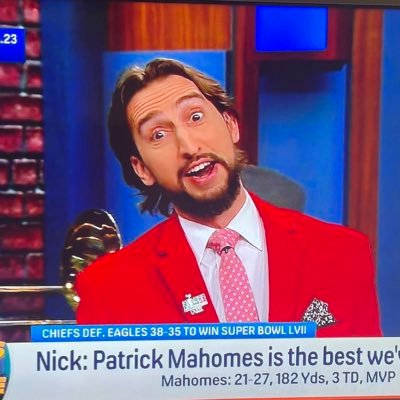
Excited for those awful “The NFL is rigged accounts!” to tweet the video of that roughing the passer that just took a Chiefs pick away.
blueleaf retweeted

Noah Fifita is a 5 foot 10 quarterback, and people offered him millions of dollars to leave Arizona.
He stayed.
Saturday he was the highest graded quarterback in college football.
Here is the whole thing.
He is from Huntington Beach, California, and he went to Servite High School in Anaheim.
He threw for 7,273 yards and 83 touchdowns there. Both are school records.
MaxPreps ranked him the eighth best high school quarterback in the country.
Now look at who offered him a scholarship.
Arizona. California. Colorado State. Fresno State. Hawaii. Idaho State. New Mexico. Utah State.
Two of those were Power Five programs. He is 5 foot 10, and that was the whole list.
He picked Arizona.
He sat as a freshman. His first career touchdown pass went to Tetairoa McMillan, who had been his high school teammate.
Then in Week 4 of the next season the starter, Jayden de Laura, got hurt.
Fifita came in and won the game at Stanford. By the time de Laura was healthy, the job was gone.
He threw 25 touchdowns and six interceptions that year and was named the Pac-12 Offensive Freshman of the Year. Against Arizona State he threw for 527 yards and five touchdowns, which is still the most in a game in Arizona history.
Then the coach who recruited him left for Washington.
The next season Arizona went 4 and 8 and Fifita threw 12 interceptions.
That is the moment almost everybody leaves.
Here is what he says about it.
"They've been loyal to me, they've trusted me, so I've been loyal to them."
The year after that Arizona won nine games and he threw 29 touchdowns and made first team All-Big 12.
On September 19 against Northern Illinois he completed 31 of 34 passes for 325 yards and four touchdowns.
One of those completions went seven yards to Isaiah Mizell and made him the leading passer in the history of the school, past Nick Foles.
Mizell said he wanted to make the moment special because Fifita is his brother.
Then Saturday at West Virginia. Sixteen of 23 for 341 yards and three touchdowns, including one that went 72 yards. Arizona won 52 to 31.
Pro Football Focus graded that game a 93.1, the best of any quarterback in the Power Four.
Away from the field he feeds people in Tucson who do not have anywhere to eat, and he coaches kids in flag football. His house is where the team goes. His younger brother Dash is a freshman linebacker there.
Here is what his head coach Brent Brennan says.
"Noah Fifita is the best story in college football."
Everybody leaves now.
He has thrown for more yards than anybody in the history of his school, and he did all of it in one uniform.

blueleaf retweeted

Brady thru 1st 150 games: 115-35
Mahomes thru 1st 150 games: 115-35
Brady thru 129 regular season games: 98-31
Mahomes thru 129 reg season games: 98-31
Brady in 1st 7 AFC title games: 5-2
Mahomes in 1st 7 AFC title games 5-2
Brady in 1st 5 Super Bowls 3-2
Mahomes in 1st 5 Super Bowls 3-2


blueleaf retweeted

Just two guys tossing a football back and forth across the US and Canadian border.🏈🇨🇦🇺🇸
blueleaf retweeted

“That’s their job” is a terrible excuse to be inconsiderate.
If you grab cold food, decide you don’t want it, and leave it sitting on some random aisle, now somebody has to find it, the food may be ruined, the store loses money, and everybody eventually pays for waste like that.
Same thing with carts. Same thing with trash. Same thing with restaurants.
Yes, workers get paid to do a job. That doesn’t mean we should make their job harder on purpose.
Put it back. Clean up after yourself. Think about the person coming behind you.
Being considerate is free.

blueleaf retweeted

On this day in 2023, Rodion Amirov tragically lost his battle to cancer. He was 21 years old. Rest in peace, Rodion 💙


blueleaf retweeted

Dear Sarah,
A special message to our No. 1 fan.
#LouGehrigDay


blueleaf retweeted

"What's wrong with taking that sunlight in the AM when it's useless and just putting it at the end of the day when I can use it better?"

blueleaf retweeted

To the make DST permanent
Folks who say “just start school later”
You aren’t wrong. But presumably YOU’d also have to start your day later if your kids did.
Essentially you are just arguing for everyone starting at 10am instead of 9am. Congrats you’ve invented standard time.
blueleaf retweeted
So which is it? Is the sunlight at that hour waking you up or is it wasted?
Multiple studies show that gradual increasing daylight at that hour before one wakes up, actually improves, cognition, strength, and well-being.
But all these people who are talking have absolutely no knowledge of these studies and most are not interested in finding out about them either.
Even fewer understand that the impetus for DST is coming from the retail lobby who have studies that show credit card transactions go up significantly during DST and drop after it is done.

blueleaf retweeted

Joe Biden had cognitive issues. Republicans called it out.
McConnell is having cognitive issues. Republicans should be calling it out.
blueleaf retweeted

My thoughts in regards to permanent Daylight Savings Time:
Having grown up in Washington State and struggled with seasonal depression for decades, I can tell you that Utahns do not fully understand what they would be signing up for with permanent daylight saving time.
In northern Utah, permanent daylight saving time would push midwinter sunrise to around 9:00 a.m. That would mean children arriving at school in darkness, commuters spending much of the morning without sunlight, and many people beginning their entire workday before their brains receive one of the most important signals for regulating sleep, energy, and mood.
My grandfather was a pioneering sleep researcher who studied circadian rhythms and seasonal depression. He invented the Dawn Simulator, a light-control box that gradually turned on household lights to mimic a natural sunrise. His work helped provide the basis for the modern dawn-simulation systems used today.
The purpose of that invention was simple: morning light matters. Sunrise helps suppress melatonin, anchors the body’s internal clock, and tells the brain that the day has begun.
Permanent daylight saving time would delay that signal by an additional hour during the darkest part of the year. It would likely worsen symptoms for many people who already struggle with seasonal affective disorder, and it could potentially trigger clinically significant symptoms in others who are susceptible but have never experienced them before.
Yes, Utah would gain more evening light, but evening light is not biologically interchangeable with morning light.
An earlier sunset may be inconvenient. A 9:00 a.m. sunrise, repeated throughout the winter, could be genuinely damaging to sleep, energy, and mental health.
Utah should not trade essential morning light for an extra hour of recreation after work.
blueleaf retweeted

America already made daylight saving time permanent once. In December 1973, 79% of Americans supported it and Nixon signed it into law. By February 1974, eight weeks into the experiment, support had collapsed to 42%. The policy never changed. Winter arrived.
Sunrise in Washington DC came at 8:27am. Kids left for school in total darkness, carrying flashlights and wearing reflective tape. When Congress moved to repeal, members cited the deaths of eight Florida schoolchildren in the first weeks of the change.
The energy case collapsed too. The whole point was the oil embargo, and the Department of Transportation concluded the fuel savings were too small to matter. Ten months after signing it, Congress repealed it and Ford put the country back on standard time.
There's a mechanism that makes this cycle repeat: permanent DST is only ever voted on when the sun is up. Polls run in the abstract, votes happen in warm months, and the benefit, a free hour of evening light, is easy to imagine year-round. The cost is concentrated in about 10 weeks of dark winter mornings and only becomes real after implementation. So the policy polls beautifully right up until January.
Today's vote happened in July. The 1974 law passed in December, right before the exact winter that killed it. If this clears the Senate, the first real test arrives in January 2027, when sunrise in Indianapolis comes after 9am.
Sleep researchers have watched this loop for 50 years, which is why the American Academy of Sleep Medicine, the AMA, and the National Sleep Foundation all back the opposite reform, permanent standard time. Congress just picked the one version of clock reform America has already tried, hated, and repealed.

blueleaf retweeted

We tried this in the early 70s. Everyone hated it because during the winter the sun didn’t rise until 9am, several children were killed at the bus stop when it was pitch dark. They promptly reversed course. Keep Standard Time!


blueleaf retweeted
With respect, popularity is a remarkably poor standard for determining public-health policy. Cigarettes were once overwhelmingly popular. Sugary drinks, ultraprocessed food, excessive screen time, and chronic sleep deprivation remain popular. Popularity tells us what people enjoy—not what is biologically healthy. The human circadian system does not take opinion polls.
Permanent daylight saving time does not create one additional minute of daylight. It merely relabels the existing daylight—taking an hour from the morning and moving it to the evening clock. That may feel pleasant after work, but morning light is the strongest environmental signal for advancing and stabilizing our circadian clock, while evening light pushes that clock later. Permanent DST would therefore mean darker winter mornings, more children traveling to school before sunrise, and more adults awakening and commuting before receiving the most important circadian light signal of the day.
The American data are quite revealing. A 2019 study in the Journal of Health Economics compared communities on opposite sides of U.S. time-zone borders. People living on the side with later sunsets averaged approximately 19 minutes less sleep per night, were more likely to report insufficient sleep, and had higher rates of obesity, diabetes, cardiovascular disease, and breast cancer. Because neighboring communities were compared across time-zone boundaries, this was substantially stronger evidence than simply comparing distant parts of the country.
A separate U.S. analysis examined approximately four million cancer diagnoses in 607 counties across 11 states. After adjusting for latitude, poverty, smoking, and state, overall and several specific cancer rates generally increased from the eastern toward the western portions of time zones—the direction associated with later morning light and later sunsets. This was ecological evidence and cannot prove that clock time caused the cancers, but it is hardly reassuring.
A 2023 national study also found significantly higher suicide rates in western portions of U.S. time zones than in corresponding eastern portions. Again, this does not prove individual causation, but it adds to the remarkably consistent pattern linking later clock-timed daylight with circadian disruption and adverse health outcomes.
Most recently, Stanford researchers modeled light exposure and circadian burden county by county using American health data. Compared with continuing to change the clocks, permanent standard time was projected to result in approximately 2.6 million fewer Americans with obesity and 300,000 fewer people having experienced a stroke. Permanent DST was also better than changing the clocks twice yearly—but produced only about two-thirds of the modeled benefit of permanent standard time. In other words, even when the clock-changing problem is removed, standard time still performs better than daylight time for population health. The authors appropriately describe these as modeled estimates, not guaranteed outcomes, but the direction of the evidence is clear.
Yes, we should stop changing the clocks twice a year. But eliminating the acute disruption by adopting permanent DST would simply institutionalize a chronic one-hour displacement from solar time. That is why the American Academy of Sleep Medicine, the American Medical Association, the Sleep Research Society, the National Sleep Foundation, and numerous circadian scientists support permanent standard time rather than permanent DST.
I completely understand why people enjoy brighter summer evenings. I do too. But personal preference at 7:00 p.m. should not outweigh population health at 7:00 a.m. Schools, businesses, and communities are perfectly capable of adjusting their schedules seasonally when later activities are desirable.
We should adjust our schedules to the sun—not permanently falsify the clock and expect human biology to follow along.

It’s clear that Americans want more daylight in the evenings and to end the biannual clock change.
I’m excited to share that tomorrow, the House will vote on my Sunshine Protection Act to make DST permanent and bring it one step closer to becoming law.
buchanan.house.gov/2026/07/1…

Yep. The best options:
1. Lock the clock on Standard
2. Keep changing so Northern states don't spend their morning in darkness
Locking on Daylight isn't remotely a good option.
