

Where precision becomes market advantage. [email protected]
Mexico City
Joined August 2022
- Tweets215
- Following372
- Followers14K
- Likes467



Pinned Tweet
In the context of U.S.–Mexico relations, current security dynamics require a disciplined, North American strategic lens. In our view, the operating environment in Mexico reflects elevated structural risk driven by asymmetric governance, uneven territorial control, and the convergence of state and non-state power centers. For U.S.-linked institutions, firms, and personnel, this is no longer a localized security issue but a bilateral risk vector with direct implications for workforce safety, supply chains, and reputational exposure.
Mexico is exhibiting characteristics of state militarization without commensurate institutional rollback. Expanded military authority over civilian infrastructure, persistent checkpoint and surveillance growth, and the normalization of armed presence point to a governance model prioritizing control over transparency. From a U.S. perspective, this complicates bilateral coordination, limits accountability mechanisms, and increases uncertainty for U.S. persons operating or transiting within Mexican territory, particularly outside major urban centers.
Organized crime has evolved from a parallel economy into a systemic actor embedded in local communities, political structures, and cross-border flows. Through taxation, coercive monopolies, and population displacement, these networks erode legitimate entrepreneurship while leveraging private capital and political access. This dynamic weakens Mexico’s internal resilience and exports instability northward, directly intersecting with U.S. national security priorities including fentanyl mortality, human trafficking, and corruption spillover into U.S. law enforcement and institutions.
At the strategic level, U.S. policy options are constrained by diplomatic sensitivity, demographic interdependence, and media scrutiny. With tens of millions of Americans of Mexican descent and extensive cross-border familial ties, escalation carries asymmetric internal social and political costs. Any kinetic response, overt or covert, must balance deterrence with legitimacy, as miscalculation risks undermining bilateral goodwill while accelerating criminal network adaptation toward alternative markets beyond North America.
The practical implication for U.S.-aligned organizations is unambiguous: adopt a security and governance posture benchmarked to active-duty operating standards, systematically avoid high-friction geographies, enforce disciplined information controls, and discount official crime and stability metrics as lagging or structurally distorted. In this environment, advantage is not derived from reaction, but from foresight, sequencing, and resilience.
This is where LBR creates differentiated value. LBR operates as a strategic risk integrator: preserving client access, cross-border connectivity, institutional credibility, and decision-making optionality across the U.S.–Mexico security and trade corridor. Through the coordinated deployment of strategic litigation, integrated government affairs, and top-tier real-time analytics, LBR builds the most effective institutional bridge between the United States and Mexico. This integrated model allows clients to navigate regulatory friction, political volatility, and security asymmetries with precision, maintaining continuity and leverage where others encounter constraint or withdrawal.


León Barrena Rodríguez & Partners LLP retweeted

I spent 35 years building banking systems for banks worldwide, including central banks. I know how banks decide where their money goes.
When you build systems, you have to make them work, so you have to know how they work.
The Basel Committee de-industrialised the countries that adopted its rules. It's that simple: I explain the whole complicated mechanism in my essay. They simply regulated it away because that was the most profitable thing to do. It was implemented in such a systemic global way, and nobody seemed to notice
Capital is what a bank must hold before it can lend, the way a manufacturer or miner must hold supplies before it can sell. No miner doubles their costs to serve one group of customers. But that's what the banking system does to miners and manufacturers. Since 1988, the Basel rules have required banks to hold twice the capital against a factory loan as against a home loan, and under Basel III the gap reaches five times. So banks lend less to industry and more against houses. It should be stopped tomorrow.
Manufacturing's share of GDP fell in ten of the eleven countries I examined. In Australia it fell from 13.7% to 5.4%. Every other country that followed fell as well. The only truly crafty ones were the Koreans, who did a good job of offsetting it.
Regulators were warned in writing that the rule would steer credit, and they adopted it anyway. No parliament voted for it, and it's simply too dumb to keep doing, but we do . Not today; there is no justification. Yet from India, across Europe, across the US, including Australia, sanctions against industrial capacity. Financialization has gone too far it needs to be reviewed .
The charge is manslaughter by gross negligence. The mechanism is proven.
Same Rules, Different Ruins:ctindale.substack.com/p/same…
Mexico now spends 10.9% of government outlays on net interest, the highest share in a peer sample of OECD economies, ahead of the U.S. (10.6%), Colombia (7.4%) and Italy (7.1%), despite having a far lower debt ratio than any of them.
The 2027 Economic Package budgets MXN 1.575 trillion for financial costs (4.0% of GDP), roughly 17% of budget revenue and a quarter of tax collection, while a 3.9% broad deficit pushes broad public-sector net debt (SHRFSP) to 55% of GDP.
Debt dynamics require a primary surplus of roughly 0.7% of GDP to stabilize debt, but the plan delivers about 0.1%. Two rating agencies already sit one notch above junk (Moody's Baa3, Fitch BBB-), S&P holds BBB on negative outlook, and Pemex carries US$77.5bn in debt that ultimately rests on the sovereign.
With pensions and social spending at a record MXN 2.5 trillion, a physical investment cut 12.3% in real terms and only 1.6% of GDP in discretionary fiscal space, the clock is running: under persistent shocks, interest would pass 20% of revenue by 2028 and investment grade could be lost in 2028–29. Relief implies three hard options, likely combined after the June 2027 midterms. The first is a revenue reform of 1.5–2% of GDP from a tax base stuck near 16% of GDP. The second is phasing out fuel tax subsidies and restructuring Pemex rather than continuing to fund it. The third is targeting social transfers under a binding fiscal anchor.
A fourth path also exists: eroding Banxico's constitutional autonomy so it finances deficits and tolerates inflation, quietly shrinking real debt at the expense of savers and wages.
That would forfeit the very credibility that keeps 83% of federal net debt domestic, long-dated and in pesos, and it would trade a slow squeeze for a fast repricing.
Morena has outlasted every rival at the ballot box; it might have finally met its true opposition: the bond market.

#Opinión | México gastará más en los intereses de su deuda que en la salud de todos los mexicanos. El año que entra el Estado pagará 1.6 billones de pesos sólo de intereses: 4% del PIB, más que todo el gasto en salud. | Por @santiago_i
proceso.com.mx/opinion/2026/…

Approximately 54% to 60% of Mexico’s entire electricity grid relies directly on natural gas imported from the United States. Washington just demonstrated that it can cripple Mexico within 72 hours at will.
The arbitrary 20% reduction in U.S. natural gas exports to Mexico was executed precisely as American production reached an all-time high in July 2026. One could be forgiven for thinking this is a veiled message designed to signal absolute leverage.
While the domestic commentocracy naively invokes "long-term supply contracts," as if assuming the Trump administration doesn't treat contractual legalisms as irrelevant, the structural reality is that half of Mexico's national grid hangs by a Texan pipeline valve.


EU notifica a México la reducción de importación de gas natural; Cenagas afirma que sólo se cuentan con tres días de reserva.
#Latinus #InformaciónParaTi
latinus.us/mexico/2026/10/7/…

The current security crisis is the inevitable culmination of structural tensions that have been compounding since January. Anyone who's been reading the room could see this coming.
Washington has effectively trapped the Sheinbaum administration in a geopolitical pincer movement. They're forcing an impossible choice between the survival of her core political base and the fundamental stability of her governing coalition.
This external pressure has induced absolute executive paralysis. Any decisive alignment guarantees a fatal political fracture: the presidency must either purge Omar García Harfuch (thereby abandoning U.S. cooperation and its institutional security apparatus) or sever ties with the Tabasco faction and its operational acolytes. The latter is structurally unfeasible, as this faction functions as the administration’s ultimate dead-man’s switch, holding existential leverage over Palacio Nacional's most deeply buried political and operational secrets.
Consequently, Harfuch emerges as the central fulcrum of the coalition's survival. He stands in systemic, unavoidable opposition to the administration's deep-state architecture (epitomized by unelected figures like Andy Lopez Beltran or José Merino) and the lucrative illicit revenue streams, notably fuel smuggling, commanded by the Tabasco nexus. Washington has already identified its preferred victor in this internal war, systematically utilizing its punitive and diplomatic leverage to force the outcome of keeping Harfuch as "our man in Mexico".
For Sheinbaum, there is no negotiated exit; the escalation pathway is firmly locked, and the structural disintegration of the governing coalition by 2030 is a real possibility.

📰 Hoy, el Wall Street Journal @WSJ, reporta una supuesta confrontación entre Sheinbaum y Harfuch por su cooperación con Washington.
Y, el mismito día, Manuel Velasco, coordinador del Verde en el Senado, destapa a Harfuch rumbo a 2030 y lo llama "el Pedro Infante de la política".
🤔 ¿Casualidad? ¿O nado sincronizado?
La filtración podría estar ayudando a construir a Harfuch como un funcionario ajeno al obradorismo, cercano a Washington y enfrentado a AMLO.
🇻🇪 ¿O será que ya están viendo en Harfuch la carta de Washington para México, al estilo de Delcy Rodríguez en Venezuela, ante la creciente ingobernabilidad y el deterioro de la relación de Sheinbaum con Estados Unidos?
🎭 Más que una confrontación, podría ser una operación de manejo de percepción política.
🥱 La política guinda se ha vuelto tan burda y predecible que su análisis empieza a aburrir.
Con info. del muro de @AGutierrezCanet.


Depends on whether the cost of the Tabasco network is judged to exceed the cooperation perks still coming from Sheinbaum’s more technocratic side, adjusted for the domestic political return now available from a harder line.
That cooperation currently has a measurable value: migration enforcement that holds southwest border numbers below earlier peaks, a limited set of extraditions, continuity under USMCA that supports nearshoring and manufacturing supply chains, and enough information-sharing for U.S. agencies to act against cartel targets without absorbing the full political cost of intervention. While those outputs hold, treating the broader Morena structure as a difficult but usable partner remains the lower-cost option for the Trump administration. A public demand for regime change before that calculation shifts would risk trade disruption and a migration surge for limited gain.
The offsetting cost is the channel associated with Andrés Manuel “Andy” López Beltrán and the Tabasco group. U.S. agencies have been reviewing accusations linking his circle to organized-crime contacts and large-scale fuel smuggling; no formal investigation has been opened. Separate Mexican investigative accounts and leaked recordings place close associates in fuel-smuggling and extortion activity tied to CJNG cells in Veracruz and Tabasco, including protection arrangements that ran through security officials appointed while Adán Augusto López was governor.
Those arrangements generate revenue and logistics that support precursor movement and local territorial control. So long as the technocratic wing Sheinbaum represents can still deliver border and extradition results, Washington has treated this as a corruption problem inside a partner government. If the results stop improving, or if a seizure, financial trace, or cluster of U.S. deaths makes the political protection clear and expensive, the cooperation premium no longer covers the cost.
Two additional factors now lower that threshold. First, a visible campaign against the cartels offers the Republican base a concrete demonstration of force after the Iran episode, where the costs were high and the result contested. Action against Mexican narcoterrorism networks is closer to home, easier to explain in terms of fentanyl deaths and border control, and does not require the same extended overseas commitment. That political return for Trump is real and counts in the decision.
Second, Brazil’s shift to Bolsonaro makes a regional coalition plausible. A Shield of the Americas framing (limited to governments willing to treat narcoterrorism based in Mexico as a shared hemispheric threat) gives Washington partners for intelligence, financial pressure, and political cover without needing a universal Latin American consensus. It does not remove Mexican sovereignty constraints or the risk of trade and migration blowback, but it reduces the isolation cost of acting unilaterally against the cartels.
The steps that follow remain sequential. Sanctions and visa actions against specific operators come first. Pressure on trade rules or ports tied to compromised customs channels can follow. Wider direct action against cartel infrastructure becomes more likely if Mexican forces will not clear it, and easier to present as a regional coalition effort once Brazil is aligned. Open talk of regime change is still a last resort, and only after an assessment that Sheinbaum’s wing is either unable or unwilling to cut the Tabasco channel.
Until that assessment is reached, the residual cooperation from Sheinbaum still reduces border crossings and keeps supply chains intact. However, the hemisphere’s political shift and the U.S. domestic need for a clearer win after Iran change the price of waiting; but they do not erase the operational limits.

The breaking news out of Washington just turned Mexico's greatest strategic vulnerability into a potential crisis. Donald Trump has officially called for a total ban on U.S. diesel exports to combat domestic prices that have hit a record $6.53 a gallon. Declaring, “I’ve said let’s not send out the diesel. We make a lot of diesel,” Trump indicated that a final decision will come fast and an announcement is expected very soon.
We warned months ago that this exact scenario was building, yet the Sheinbaum administration did absolutely nothing to secure strategic reserves or diversify supply. Right now, this is Mexico’s primary strategic concern, threatening to wreak havoc on the daily lives of millions.
This impending decree would mark the first U.S. diesel export ban in history, and it drops like an anvil on an already fractured global energy market. The United States is the world's largest diesel exporter, and Europe, its biggest customer, has been buying record volumes of American petroleum products to survive the loss of Gulf barrels.
With Russia, the world's second-largest exporter, having already halted its own outbound shipments, Europe's worst-ever energy crisis is about to spiral; already, 16% of French gas stations are entirely out of fuel. But while Europe scrambles for alternatives, Mexico is in risk of facing outright logistical paralysis.
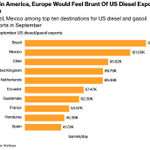
The mathematical reality of our dependency leaves the country entirely exposed. According to SENER data, Mexico's domestic consumption of diesel and heating oil hovers around 398,500 barrels per day. To sustain this demand, we rely overwhelmingly on the United States, which has been exporting roughly 220,000 barrels of distillate fuel per day to Mexico. If Washington shuts the valve, Mexico will be forced to blindly scramble to replace more than half of its daily lifeblood from distant, severely depleted international markets at a staggering premium.
The economic and fiscal fallout of such a disruption will be devastating. Diesel is the engine of heavy freight, agriculture, rail, and manufacturing; any spike in replacement fuel costs will automatically drive up the price of transporting food and essential goods, unleashing fierce inflationary pressures across the board.
To artificially suppress pump prices and hide the crisis, Hacienda is already bleeding revenue through a 100% fiscal stimulus that wipes out the IEPS excise tax collection on diesel. Subsidizing this unprecedented global shock will blow a massive hole in public finances, severely compromising the 2027 Economic Package just as the government grapples with surging social program obligations. By subsidizing the illusion of stability instead of building physical reserves, the administration is trading short-term optics for a catastrophic macroeconomic shock.

BREAKING: Trump calls for a total ban on US diesel exports, saying "Let's not send out the diesel. We make a lot of diesel," that a decision would come "fast," and that an announcement is expected "very soon."
It would be the first US diesel export ban in history.
Europe stands to be hit hardest, as the US is the world's largest diesel exporter and Europe its biggest customer, buying record volumes since the Gulf barrels stopped, making its worst-ever energy crisis worse. Russia, the second largest exporter, has already halted its own exports.
US diesel is at a record $6.53 a gallon today and 16% of French stations are out of fuel.

BREAKING: Trump administration prepares 90-day total diesel export ban, with Trump inclined to announce it by the end of the week, per Politico.
Energy Secretary Chris Wright called energy CEOs on Tuesday night to tell them a 90-day ban was coming in the coming days, and a number of them immediately called the White House to push back. One oil industry executive who has discussed the ban with senior White House officials says Trump would consider any blowback and consequences "a December problem."
An external adviser to the administration says there has been "a bunch of frantic outreach" searching for alternatives and calls the ban "a terrible idea," yet Trump is expecting to proceed anyways.
It would be the first US diesel export ban in history, and Europe would be hit hardest as the biggest customer of the world's largest diesel exporter, with Russia, the second largest, already halted. US diesel is at a record $6.53 a gallon.

The cushion that carried the energy market through summer has been spent, and the bill is about to be presented. We were early but not wrong. The structure we predicted has arrived worse than expected.
China's decision to live off roughly 1.4 billion barrels of pre-war stocks was what kept a Hormuz-scale crude loss from becoming a global products crisis. That phase is ending. The Brent-Shanghai spread has moved from a $20 discount in late April to a modest premium, with Shanghai back above $100. Seaborne imports remain near 7.1 mbd, still 4 mbd below pre-war, but Chinese buyers are now paying $15 to $20 over Brent for Congolese, Canadian and South American oil. Beijing has stopped absorbing the shock and is bidding for the same residual barrels the Atlantic Basin needs.
The other buffers are nearly gone. The U.S. SPR stood at 285.4 million barrels on September 4, 40 percent of capacity and the lowest since 1982, and it was always a crude instrument aimed at a products problem. The Gulf Coast diesel crack passed $100 per barrel on September 1 after Russia's July diesel export ban, and U.S. retail diesel hit a record $5.85. With refiners at maximum distillate yield and exports elevated, export restrictions have become a plausible midterm instrument. Mexico, the largest single destination for Gulf Coast product, is the most exposed counterparty.
Mexico's position has shifted rather than improved. Refining posted real gains in July, with gasoline at 418 kbd and diesel at 289 kbd, but crude exports fell to 450 kbd, down 25 percent, and the 2027 budget assumes only 427 kbd. Gasoline imports were still 354 kbd, higher than a year earlier, leaving roughly 45 percent of supply imported. Diesel imports fell to 90 kbd, yet Mexico is now exporting ULSD to Europe at record cracks while holding domestic diesel at 27 pesos through a full IEPS waiver: a seller into scarcity and a subsidiser against it at once.
That is where the fiscal exposure sits. Hacienda has raised the diesel stimulus three weeks running, from 6.00 to 7.36 pesos per liter, the entire quota plus a top-up, and Magna from 1.53 to 3.45 pesos, while renewing the retail price pact for six months. At current levels, forgone IEPS runs near 250 to 300 billion pesos annualised, roughly 0.7 to 0.8 percent of GDP, scaling with Gulf Coast product prices rather than Mexican crude.
The 2027 Economic Package, delivered September 8, does not price this. It assumes the Mexican mix at $61.8 against $78.4 today, a 3.4 percent deficit, RFSP of 3.9 percent, and gasoline IEPS revenue of 538.5 billion pesos, up 16.2 percent in real terms. That is reachable only if the stimulus is withdrawn almost entirely; Hacienda already concedes 2026 IEPS fell 2.1 percent real because it activated. The package also cuts Pemex support from 263.5 to 81.1 billion pesos and books a 14 billion stand-alone surplus, which requires importing 440 kbd of products at record cracks without recovering the cost at the pump. Higher crude offers little relief: at 427 kbd, each $10 above assumption adds about 28 billion pesos, far short of what a year of full diesel stimulus removes. If cracks hold through the first half of 2027, the realistic deficit is closer to 4 percent, financed by a stimulus reversal that breaks the pact in a midterm year, by absorbing the gap in Pemex, or by returning to the debt market the package was meant to lean on less.
Our thesis stands, with a sharper channel. Washington will ration product before politics. China will pay premiums Mexico cannot. Europe's appetite for Mexican diesel means Mexico is bidding against itself. And refining-first has moved the country's exposure from the crude price, which Hacienda hedges, to the products crack, which it does not.
What follows will appear as a widening gap between the IEPS line Hacienda has written for 2027 and the one it collects, arriving through the same Gulf Coast supply chain Mexico has spent five years trying, and failing, to replace.
BREAKING: US diesel has officially hit a record $6.20 a gallon, up 69% since the Iran war started and only 3 days after crossing $6 for the first time in history, with California at a record $8.14, San Francisco at $8.62, and individual stations, including a Shell in San Diego, selling at $9.99 today, the maximum their pumps can display, while others are posting "out of diesel" signs.
The surge comes as the US enters peak diesel demand season with supply at historically low levels, hours after Trump said the shortage "isn't done by the Middle East."
Mexico's binding constraint in AI and semiconductors is not talent or geography but the risk preference of domestic capital. Savings flow overwhelmingly into CETES, deposits, and real estate, and venture equity remains marginal to GDP. Afores allocate almost nothing to productive growth.
Frontier compute and semiconductor fabrication are among the most capital-intensive activities in the global economy. A single training cluster or semiconductor fab exceeds the annual deployment of Mexico's entire venture ecosystem. No reform changes that arithmetic in the relevant time horizon.
The Sheinbaum reform, by designating these sectors national-security and subjecting foreign acquisitions above 49% to state review, targets the only capital with the balance sheet and conviction to fund Mexican ventures in this space.
Discretionary review adds timeline risk and a structural discount to every term sheet. The likely results of this are simply that deals that die before they're born and Mexican founders redomiciling to the United States (leaving Mexico) to preserve fundraising optionality. The measure doesn't protect a domestic industry, but simply prevents one from forming.
A better framework would admit capital, extract capability through technology transfers, and leave engineers and IP behind when the foreign partner exits.
Sovereignty in the coming decades will be partly defined by domestic compute and model capability. Without it, a country becomes a permanent consumer of foreign technology, with data, pricing, and critical systems governed elsewhere.
By making investment harder rather than more productive, the reform risks locking Mexico's nearshoring gains into low-margin assembly while the high-value layers stay abroad.
The fix is simply to trade ownership review for transfer-and-licensing, pair it with domestic capital formation, and make foreign investment the instrument of capability-building rather than the threat to be contained.


Today, the Office of the United States Trade Representative announced that the United States and Mexico will hold a series of bilateral negotiating rounds related to the first Joint Review of the USMCA.
ustr.gov/about/policy-office…

Sheinbaum's eager embrace of Ursula von der Leyen and the recent EU-Mexico summit makes perfect psychological sense for a government feeling deeply besieged by intensifying trade and security demands from Washington.
Confronted by aggressive pressure from the United States, a high-profile diplomatic gathering with European leadership provided a momentary breath of fresh air and a highly useful domestic political victory.
However, framing the European Union as a viable strategic or economic counterweight to the United States is a dangerous and foolish geopolitical miscalculation: it represents a textbook example of mistaking the performance of autonomy for the substance of power, relying on diplomatic optics to mask a rigid structural reality.
The belief that Mexico can secure meaningful security or economic guarantees from Brussels ignores Europe’s own current vulnerabilities and strategic limitations.
The European Union is increasingly isolated, preoccupied with its own regional security crises, and well aware of Mexico’s internal instability and entrenched narco-alliances, leaving it with neither the capacity nor the desire to offer security assurances.
Furthermore, while the modernized Global Agreement is a positive development, Mexico-Europe trade can never realistically challenge or replace the economic architecture of the USMCA. This diplomatic outreach to Europe is also a symptom of Mexico's regional isolation, having failed to secure unified or robust support from its Latin American neighbors, forcing the administration to grasp for distant life rafts.
As a dwindling middle power navigating a hardening global rivalry, Mexico must accept that the era of effective hedging is over, as Washington increasingly demands explicit alignment on trade, supply chains, and security.
When threats intensify, middle powers must choose a larger system to lean into, and for Mexico, that choice has already been dictated by geography and economic integration.
The objective for the Sheinbaum administration should not be an impossible escape from dependence or a heroic resistance to American demands, but rather transforming that dependence into a reciprocal relationship, something the recent Rocha Moya crisis exposes as impossible to attain for Sheinbaum. Doing so would imply a political debacle for the Morena alliance structure.
By acting less like a defiant outsider and more like a strategic partner, Mexico could turn its unique assets (such as nearshoring capacity, manufacturing hubs, and critical geography) into indispensable bargaining chips within the North American framework. So far it has failed to achieve this.
Ultimately, navigating a relationship with a difficult patron like the United States is a choice among lesser evils, but it remains Mexico's only viable path to long-term leverage.
While Washington frequently bullies its neighbors with tariffs and sudden policy shifts, it also offers unparalleled access to the world’s deepest capital markets, an immense consumer base, and institutions that Mexicans and cross-border businesses can actively lobby and influence.
Seeking refuge in European summits offers temporary political comfort, but true national strength will not come from stitching together ad hoc coalitions or celebrating symbolic forums.
Mexico's security and prosperity depend entirely on its ability to bargain effectively, realistically, and unsentimentally from within the U.S.-led system.


El acuerdo firmado entre México y la Unión Europea no busca sustituir al T-MEC, sino complementar la estrategia comercial del país
bit.ly/4dR0OCn

As we predicted, the structural vulnerabilities of the North American energy ecosystem are starting to fracture the Mexican energy market.
According to a core report by El Financiero, government-mandated price caps have triggered fuel shortages across 11 Mexican states. Columnist Atzayaelh Torres highlights that the voluntary pricing pact has shattered because Pemex imports a considerable amount of the nation's fuel and cannot absorb a 50% spike in maritime freight costs alongside soaring global spot prices while pump prices remain frozen.
Consequently, Mexico's domestic buffer has evaporated: Reynosa's storage has hit absolute zero, and the Valley of Mexico has just three days of inventory (violating the country's five-day legal safety minimum). This hand-to-mouth existence means redirecting supply to patch an emergency in Monclova instantly causes shortages in Saltillo. To survive, 4 out of 10 service stations have abandoned the pact, selling diesel above the mandated limit to avoid bankruptcy.
This domestic paralysis is colliding with a looming wall of U.S. protectionism, invalidating Pemex’s long-term supply contracts with American refineries. If the Trump administration shifts to export restrictions to safeguard domestic inventory, triggered once SPR drawdowns end, U.S. tank bottoms occur, and Asian markets exhaust reserves to aggressively resume crude buying, these contracts will become legally and logistically impossible to fulfill. Facing its own inventory crisis, Washington will prioritize domestic price stability and cut its southern neighbor loose, leaving Pemex completely stranded from its primary refining lifeline.
Globally, HFI Research warns we have crossed a "point of no return," exposing a massive disconnect between Wall Street consensus and physical reality. While JPMorgan, Goldman Sachs, and Morgan Stanley wishfully assume the Strait of Hormuz will reopen in June to keep oil around $100/bbl through year-end (with JPM admitting the Strait must open to avoid hitting a global tank bottom) geopolitical anchoring prevents a diplomatic resolution.
The physical market cannot be resolved with optimism: May’s implied global oil flow averaged a staggering deficit of -7.5 million b/d (driven by a 12 million b/d production shut-in, offset by a 2 million b/d demand loss and a 2.5 million b/d SPR release).
Even a June 1 resolution guarantees delays, as ballast tankers are currently in the U.S. draining excess storage, pushing any meaningful production restart to August at the earliest.
IEA Executive Director Fatih Birol recently confirmed that their last emergency oil release burned through a massive 20% of total collective stocks. While the IEA claims readiness for further action, the remaining 80% of reserves are thinly fragmented across 32 nations, and most of Europe has already fallen dangerously below its mandatory 90-day inventory floor.
For Mexico, these compounding global and regional pressures converge into an imminent economic reckoning.
Stranded without a domestic inventory cushion and structurally cut off from its American refining lifeline, the country faces a systemic supply cliff that no amount of political rhetoric can bridge. As the U.S. pivots inward to hoard its remaining stocks and the global market fights over the IEA's fragmented reserves, Pemex will be forced to compete for prohibitively expensive international spot cargoes: a high-stakes game it fundamentally lacks the liquidity to play.
Mexico is now looking at a systemic transportation paralysis, cascading industrial supply chain disruptions, and severe inflationary shocks on basic goods. The country is rapidly accelerating toward a hard floor where the illusion of subsidized energy sovereignty completely shatters against the unyielding physical reality of an empty tank.


Mexico is effectively running on a countdown, fueled by a U.S. energy subsidy that is fast approaching its breaking point. The energy landscape is currently trapped in a high-stakes paradox: North American gasoline inventories have plunged to their lowest levels since 2014, yet the U.S. continues to push for record-breaking export volumes of crude and refined products. The U.S. is effectively subsidizing the Mexican supply at the expense of its own domestic buffer. This "artificial suppression" of prices (driven by strategic releases and political pressure to curb inflation before the summer) has prevented the necessary demand destruction that usually accompanies a supply shock.
The structural fragility of this policy is now being exposed by the latest data. For the week ending May 8, the system saw a massive total crude draw of 10.31 million barrels, fueled by a record Strategic Petroleum Reserve (SPR) release of 8.6 million barrels and a commercial draw of 1.71 million. Furthermore, after an EIA miscalculation of imports and exports by approximately 6.6 million barrels last week, current estimates suggest a total crude draw of 11.6 to 12.6 million barrels for the upcoming report.
This pressure is being intensified by a shift in Asian markets: as Asian refineries temporarily refuse to buy high-priced crude, global product storage will continue to draw down, forcing refining margins higher. Inevitably, as product levels run critically low, refineries will be forced to increase runs and crude buying simultaneously. This outcome is set to unfold within the next two weeks, accelerating the collision course with "tank bottom" by early July.
For Mexico, this trajectory is nothing short of an existential threat. The Mexican energy model remains tethered to U.S. refining capacity, then any "tank bottom" event north of the border will trigger an immediate and non-negotiable halt in exports to its southern neighbor as Washington pivots to prioritize domestic stability. This looming shortfall is colliding with a Mexican fiscal reality where Pemex lacks the liquidity to compete for increasingly expensive spot-market cargoes. If the U.S. is forced to curb demand through drastic price hikes or export restrictions in July, Mexico faces a terminal supply gap that its current "sovereignty" rhetoric cannot fill.
The math for Sheinbaum is cruel: a neighbor that cannot provide for its own citizens will not, under any circumstances, continue to fuel a non-cooperative neighbor’s economy.


🚨 ⛽Entre las entidades con reportes de escasez están Aguascalientes, Zacatecas, Chihuahua, Nuevo León, Querétaro, Hidalgo (Tula), Estado de México, Ciudad de México, Jalisco, Coahuila y Tamaulipas
elfinanciero.com.mx/nacional…

The shift from playing the "unaware victim" during the Chihuahua accident to mocking the NYT report today is a massive red flag. Back then, the government used "unauthorized intervention" as a weapon to attack local rivals. Now, they are calling a reported joint operation "fiction" because the truth is too damaging to their brand.
Admitting that the CIA is providing the blueprints for Mexican-led kills would shatter the administration's "sovereignty" narrative and expose how much they actually rely on Washington's intelligence to get results.
Mockery is a defensive tactic used when the facts are too expensive to acknowledge. If Sheinbaum admits this cooperation happened, she confirms that her security cabinet (and Harfuch specifically) is acting as a junior partner to U.S. agencies.
They aren't laughing because the story is fake, they are laughing to distract from the reality that the U.S. is now calling the shots on high-level targets. It’s a desperate attempt to protect a political image that is being dismantled by well-timed leaks from the north.

This response looks like a desperate attempt to contain an intentional leak by the CIA designed to undermine Harfuch's strategic standing. In the world of intelligence, a story of this magnitude appearing on a platform like CNN is rarely an accident but a deliberate signaling mechanism.
By allowing the narrative of unilateral "lethal operations" to circulate, the CIA is effectively signaling that the era of "cooperation without subordination" is over, and that they are prepared to bypass Mexican institutions entirely if their strategic objectives (specifically the resolution of the Rocha Moya case) continue to be obstructed.
The timing of this "leak" serves as a firm, kinetic warning to Harfuch himself. For years, Harfuch has been positioned as the pragmatic, "American-friendly" face of Mexican security, a role that many viewed as his primary credential for a 2030 presidential run.
However, the Americans appear to be punishing him for his perceived failure to facilitate the high-level judicial priorities currently tightening around the Morena inner circle.
By exposing a unilateral operation on his doorstep, Washington is stripping Harfuch of his most valuable asset: the perception that he is the only official capable of managing the bilateral security relationship.
Harfuch’s reactive and boilerplate response suggests a cabinet member caught in a pincer maneuver. He is trapped between an increasingly aggressive U.S. intelligence community and a domestic administration that is hyper-vigilant against "double games." If Harfuch was unaware of the operation, he appears incompetent in his own territory, if he was aware but kept it from the President, he is politically compromised.
This public denial is a frantic effort to prove his loyalty to the "sovereignty" script of the Sheinbaum administration while knowing full well that the Americans have the evidence to dismantle his narrative at a time of their choosing.
Ultimately, this is a targeted strike against Harfuch’s long-term political aspirations. The message from Washington is clear: American support for his future ambitions is not a given, but a variable contingent on his willingness to "play ball" on the Rocha extradition and the dismantling of narco-financial structures.
By leaking their ability to operate unilaterally and lethally, the U.S. has demonstrated that they no longer view Harfuch as a necessary intermediary, but as a hurdle that can be bypassed or broken. His 2030 path is now being re-evaluated through the lens of this strategic betrayal, leaving him with a dwindling set of cards to play.

Respecto a la versión difundida por CNN sobre una explosión ocurrida en Tecámac, Estado de México, en la que se señala una presunta participación de la CIA en operaciones contra cárteles, el Gobierno de México rechaza categóricamente cualquier versión que pretenda normalizar, justificar o sugerir la existencia de operaciones letales, encubiertas o unilaterales de agencias extranjeras en territorio nacional.
La cooperación con Estados Unidos existe, es importante y ha dado resultados relevantes para ambos países; sin embargo, ésta se realiza bajo principios claros: respeto a la soberanía, responsabilidad compartida, confianza mutua y cooperación sin subordinación.
Bajo estos principios, ambos gobiernos han logrado avances importantes en el combate al crimen organizado transnacional, entre ellos detenciones de objetivos relevantes, aseguramientos de droga, armas, precursores químicos, laboratorios clandestinos, recursos financieros y bienes vinculados a estructuras criminales. Estos resultados demuestran que la colaboración bilateral puede ser efectiva cuando se conduce por canales institucionales, con intercambio de información y pleno respeto al marco legal de cada país.
En México, las acciones operativas corresponden exclusivamente a las autoridades mexicanas competentes. Cualquier cooperación internacional se limita al intercambio de información, coordinación institucional y mecanismos formales establecidos por el Gobierno de México, particularmente a través de la Secretaría de Relaciones Exteriores y las instituciones del Gabinete de Seguridad.
The New York Times leaves Omar García Harfuch in an untenable position. By reporting that the CIA provided the intelligence and planning while Mexican authorities performed the actual killing, Washington has effectively stripped Harfuch of his "sovereignty" shield. His categorical denial now stands exposed as a potential cover-up for a proxy assassination designed by the U.S. and executed by his own forces.
Harfuch is now in a critical bind: he must either admit he lied about the extent of U.S. involvement or confess that he lacks control over the kinetic operations occurring on his own turf. This leak is a targeted demolition of his 2030 "bridge-builder" persona, signaling that the Americans no longer value him as a protected asset. By shifting the responsibility for the kill back to Mexico while claiming the intellectual credit, the U.S. has paralyzed Harfuch, leaving his presidential aspirations tethered to a scandal that both the Mexican left and Washington can now use to dismantle him at will.
nytimes.com/2026/05/12/world…