

Investing in the Worlds of Tomorrow.
Joined July 2021
- Tweets616
- Following29
- Followers440
- Likes10.8K




Planetary Capital retweeted

US threatens Europe over Starlink restrictions ft.trib.al/0KUTiUQ

Planetary Capital retweeted

🚀 Two Canadian space companies just earned conditional approval to list on the Toronto Stock Exchange! Maritime Launch Services and NorthStar Earth & Space both won it this week.


It is bad.
Space stocks are in their worst moment since I began analyzing in 2021. So…ever.
You could call this the sci-fi 1928.
After July, I won’t say this is as bad as it gets. If it gets worse it will be quite the education. We have no control but we can observe and learn.
$SPCX $RKLB $ASTS $PL $FLY $LUNR $VOYG $HAWK $BLSY $SATL $SPIR $SPCE $RDW $YSS $MDA


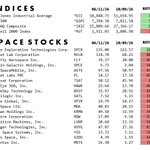
In the above chart. 73% of all instances are red. Also, most of the space theme is clearly trading in unison, perhaps with the exception of SpaceX. When the tide turns the gains should be broad. The bulk of earnings should be coming in about 3 weeks. That could do it.
Outside that, war ends and we should move. A strong relief bounce from extreme oversold conditions is also possible any time now.
$RKLB
8 days red.
The record for 2026.
Down about 32% in that period.
Its going to zero obviously.
$RKLB
Given the macro (oil spike, ai bubble fears, morons running country, cucks leveraged, etc) anything better than the -6.81% drop from yesterdays neutron “delay” (was already known) is a huge success and especially with today, means that uninformed nonsense is done pressuring the stock!
Planetary Capital retweeted

You’re not gonna believe this.
5,000 stocks are down 20%+ from their 52-week highs.
And it gets crazier…
Nearly 4,000 are down 40%+.
Think about what that actually means.
While the major indices have held together, underneath the surface thousands of stocks have already been living through their own bear markets.
The index looking fine while individual stocks are getting absolutely destroyed underneath it.
Some seriously messed up shit when you actually look under the hood.

Its like my Bavarian grandmother telling me how to surf in Cabo.

Jim Cramer says he expected $RKLB to fall much harder after Neutron’s launch delay to 2027.
Instead he thinks investors are getting a “great opportunity to sell, sell, sell.”


$RKLB
GREAT DAY!
Strong versus the overnight and open. Sets us up to end week with bullish tone. Not a forecast, just an observation.
$RKLB
Lowest Friday close of 2026 sits at 60.93.
Lowest Friday close since the Death Star arrived in our skies is 62.95.
Chances are slim.
But…would be hella bullish.
Stairs up.
Planetary Capital retweeted

28.1 miles on Mars, powered by Rocket Lab hardware.
NASA's Perseverance rover has now driven 28.1 miles (45.2 km) across the Red Planet in just five and a half years, breaking an off-world driving record that took Opportunity nearly 15 years to set.
Rocket Lab solar panels powered Perseverance's cruise to Mars, then on the surface, Rocket Lab Robotics (formerly Motiv Space Systems) hardware helps turn those miles into science — from the Mastcam-Z camera mechanisms that zoom in on targets, to the 7-foot robotic arm placing instruments against Martian rock with sub-millimeter precision.
Every mile is another step in the search for signs of ancient life.

$RKLB
0630am Cantor Fitzgerald
✅ Overweight $122
0900am Keybanc
✅ Overweight $135>$100
1000am TD Bank
✅ Buy $90
Wall Street so far -10%, $52-53
A close above $60 really feels like the death knell for all enemies of the stock.
Planetary Capital retweeted

While everything is crashing out and ranting, and I don't blame them, here are some positives:
- Rocket Lab has identified the specific manufacturing defect rather than facing an unexplained structural failure.
- Engineers successfully reproduced the problem and implemented corrective measures.
- The revised curing process has already produced a high-quality aft dome.
- The replacement forward dome is in production.
- Management has outlined measurable near-term technical milestones.
- Second and third Neutron vehicles are already being manufactured.
- Management is prioritizing repeatable manufacturing and structural reliability rather than forcing an arbitrary launch deadline.
- Rocket Lab expects to announce additional commercial contracts.
His exact quote:
"There's significant demand for what Neutron has to offer, including some new contracts we'll be able to talk about soon. We'll be in the fortunate position of partnering with customers who choose Neutron not just for a single launch, but for multiple missions across long-term partnerships."
$RKLB

$RKLB NEUTRON UPDATE: First launch delayed to 2027.
Rocket Lab has officially pushed Neutron's maiden flight into 2027 after discovering another manufacturing issue with its first-stage carbon composite propellant tank.
This is disappointing, particularly after multiple previous delays.
However, the technical explanation matters because this isn't an engine failure, a fundamental vehicle redesign, or a failed launch attempt.
It's a manufacturing and qualification problem involving one of the most challenging structures on the rocket.
1. WHAT EXACTLY WENT WRONG?
Earlier this year, Neutron's first-stage tank failed qualification because of issues associated with a third-party manual carbon-fiber layup process.
Following that failure, Rocket Lab transitioned to its intended long-term manufacturing approach: Automated Fiber Placement (AFP).
AFP uses automated machinery to lay carbon fiber with greater precision, consistency, and speed.
This transition also allowed Rocket Lab to introduce design improvements, including:
- Eliminating certain structural joints/inserts.
- Increasing carbon composite thickness in selected areas.
- Strengthening the forward and aft propellant tank domes.
- Moving toward a more repeatable manufacturing process suitable for high-volume rocket production.
Rocket Lab successfully manufactured several major components using AFP, including first-stage barrel sections and propellant domes.
However, during inspection of the newly manufactured forward dome, engineers discovered tiny voids within the carbon composite layers.
These voids are essentially small air pockets trapped between layers of carbon fiber.
They can compromise structural strength, durability, and reliability, particularly in a large pressurized propellant tank.
Importantly, Peter Beck said the presence of these voids did not necessarily mean the dome would fail during flight.
But Rocket Lab wasn't willing to accept a structure without demonstrating sufficient safety and performance margins.
So production was paused while engineers investigated.
2. WHY DID THESE VOIDS FORM?
This is where the engineering becomes particularly interesting.
Carbon composite structures must undergo a curing process, during which heat causes the epoxy resin to harden and bind the carbon fibers together.
Normally, aerospace manufacturers use an autoclave, which applies heat and pressure to help consolidate the material and minimize defects.
But Neutron's structures are enormous.
Rocket Lab is attempting to manufacture what Beck describes as the largest pressurized carbon composite structure ever built, using one of the world's largest AFP machines.
Traditional autoclave manufacturing isn't practical at this scale.
As a result, Rocket Lab has had to develop specialized out-of-autoclave curing processes.
These processes must produce consistent structural quality across extremely large and sometimes unusually thick composite sections.
The problem was traced to the thicker carbon composite regions introduced after the earlier tank qualification failure.
Those areas were more challenging to cure consistently, allowing voids to develop.
In other words, the structural improvements introduced after the first manufacturing setback created a new manufacturing challenge.
This is an important distinction.
The issue wasn't simply that AFP couldn't manufacture the dome. It was that Rocket Lab needed to refine the curing process for the thicker sections of the updated design.
3. HAS ROCKET LAB ACTUALLY FIXED THE PROBLEM?
According to Beck, yes, at the manufacturing-process level.
Rocket Lab's engineers successfully reproduced the defect during testing, identified the conditions responsible, and introduced mitigations to prevent it.
They then manufactured and cured another major composite component: the aft dome.
Using the revised process, the aft dome achieved what Beck described as the highest carbon composite quality the company has produced to date.
That's meaningful progress.
Rather than simply guessing at a solution, Rocket Lab says it:
- Identified the defect.
- Reproduced it under controlled testing.
- Developed process changes.
- Applied those changes to another major flight structure.
- Achieved a successful manufacturing result.
However, there's an important caveat.
The replacement forward dome still needs to be manufactured, cured, inspected, and qualified.
The successful aft dome provides encouraging evidence that the revised process works, but it does not automatically establish that the entire first-stage tank is flight-ready.
4. WHAT IS THE NEW NEUTRON TIMELINE?
This is arguably the most important part of today's announcement.
Rocket Lab has confirmed that Neutron's first flight will move into 2027.
However, Peter Beck deliberately declined to provide a specific launch month or quarter.
Instead, he outlined three major milestones that must be completed before Rocket Lab can establish a more credible launch target.
Milestone 1: Manufacture the replacement forward dome.
This process is already underway using the AFP machine.
Milestone 2: Cure and inspect the new forward dome.
Rocket Lab will use ultrasonic testing and other inspection methods to verify structural integrity and confirm the absence of unacceptable voids or additional manufacturing defects.
Beck expects the first two milestones to be completed before Q1 2027, meaning by the end of 2026.
Milestone 3: Complete first-stage assembly and qualification testing.
Once the forward dome is ready, Rocket Lab must integrate it with the aft dome and other structural components to complete the first stage.
The stage will then undergo:
- Hydrostatic testing to validate its structural performance under pressure.
- Cryogenic testing to validate its behavior under the extremely cold conditions associated with cryogenic propellants.
Rocket Lab expects this third milestone, including the testing campaign, to be completed during Q1 2027, assuming no additional setbacks.
Only after these milestones are completed does management expect to be in a position to announce a more precise first-launch date.
My interpretation of the timeline:
Q4 2026: Replacement forward dome manufacturing, curing, and inspection.
Q1 2027: First-stage assembly, hydrostatic testing, and cryogenic testing.
After Q1 2027: Rocket Lab expects to have enough information to communicate a new target launch date.
This does NOT mean Neutron is guaranteed to launch in Q2 2027.
There are still additional vehicle integration, launch preparation, and flight-readiness activities to complete.
Any specific launch quarter at this stage would be an estimate rather than management guidance.
5. WHY IS ROCKET LAB NOT RUSHING THE FIRST LAUNCH?
Peter Beck emphasized that Rocket Lab is not developing Neutron simply to get one rocket off the pad.
The objective is to establish a reliable, reusable, high-cadence medium-lift launch system capable of serving commercial and government customers over many years.
That requires manufacturing processes that can be repeated consistently across multiple vehicles.
Beck's argument is that rushing a minimally qualified vehicle to the pad could create even bigger problems later.
If the first rocket requires significant redesign or repeated requalification, the company could lose more time trying to scale production after flight one.
Instead, Rocket Lab is attempting to solve manufacturing challenges upfront.
There is a legitimate strategic rationale here.
6. THERE IS AN IMPORTANT POSITIVE DEVELOPMENT: ROCKETS TWO AND THREE.
One detail I found particularly interesting was Beck's confirmation that Rocket Lab is already building its second and third Neutron rockets before the first one has flown.
This is consistent with the company's strategy of developing manufacturing infrastructure and production capability alongside the initial vehicle.
The potential advantage is significant.
If the first flight validates the design, Rocket Lab may be better positioned to transition into subsequent launches rather than starting production of the next vehicle from scratch.
It also suggests the company is investing in a production system rather than treating Neutron as a one-off prototype.
Of course, there is risk.
If flight testing reveals significant design changes are necessary, hardware already in production could require modifications.
But assuming the architecture performs as expected, parallel production could help accelerate the transition toward operational cadence.
2027 will be a critical year for Neutron.