

Professor of Economics, University of Rhode Island
Kingston, Rhode Island
Joined July 2010
- Tweets1.1K
- Following276
- Followers1.5K
- Likes243


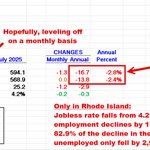


RI's September labor market data show an apparent end to the string of nightmarish annual declines, with a suggestion of monthly stabilization. But where else can the jobless rate fall from 4.3% to 3.6% annually when resident employment declines by 11,000?

We are currently witnessing an all-time high in diesel fuel prices, or so we are told. Never base this assessment on current dollar values. Adjusted for today's purchasing power, we see the record high actually occurred in July 2008.

The RI labor market somewhat parallels the US: Cyclical employment is not as strong as overall employment, which is supported by education, healthcare, and government. Manufacturing here though is doing very well, though.

A clarification of the recent employment change debate: monthly employment numbers are net changes, job gains minus job losses. As long as there are job losses (almost always) job gains exceed employment change. The debate traces the green line, but job gains are the blue line.

4/ At least monthly changes have settled down, so the string of recent implosive declines in our labor force and resident employment may well (hopefully) be coming to an end.
3/ I fully expect the recent implosions in our labor force and resident employment measures to be eliminated with data rebenchmarking in January. In the meantime, I suspect that the only people naive enough to believe the 3.9% July jobless rate will be our media.
2/ If our labor market were deteriorating as much as recent household survey data suggest, retail sales would be plunging, initial UI claims would be exploding, and benefit exhaustions would be surging. None of this is happening, in fact just the opposite is true.
1/ Bizarre continued with July's RI household survey data. According to the data (which I have very little confidence in), our jobless rate fell from 4.2% to 3.9% as resident employment was decimated (-13,800 or 2.4%) while our labor force fell by 16,700. Only in RI!

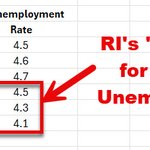
3/ Even with my reservations about RI labor data accuracy, we can see a longer-term pattern: A falling unemployment rate, the result of a declining labor force. This has been RI's historical "secret sauce" for reducing its jobless rate. Too bad the media is so oblivious to this!

2/ According to official data, RI's labor force has fallen off a cliff in absolute terms or relative to the US. I find the last four months of data difficult to believe. I view them as makeup for abnormally low growth rates in 2025. Data revisions will eventually clear this up.

1/ Good news! My Current Conditions Index for June has at long last moved into expansion territory. RI's recession thus ended in either April (50) or June (58). RI labor data is very messed up (see following posts), which makes this determination difficult.
My May Current Conditions Index shows a basis for optimism about RI's economy. We are not yet in the expansion range, but have moved to neutral for two of the last three months. Hopefully, this signals our moving from recession. But with data difficulties, this remains uncertain.
If RI's labor force participation rate (% of resident population aged 16+ in the labor force) were the same as before the pandemic, June's unemployment rate would be 7.7%. This and the actual rate are bizarre. When in doubt, average them: 5.9%, my best guess of the actual rate.
For anyone who believes RI's June unemployment rate really was 4.1%, below the national rate, I have some swamp land in South County they might be interested in. Sadly, the local media will just report the number absent context, so presumably they are potential swamp land buyers.
Today's household survey data remain horrible on an annual basis, but monthly values appear to be a distinct improvement. The question now is how distorted have recent values been?

The household survey data for RI continue to be odd, to say the least. Year-over-year changes are exceptionally large (and bad). While monthly changes look normal, view these relative to the large recent changes, which are not very flattering.

I have been very skeptical of the official household survey labor data for RI. The recent sharp declines have no obvious cause. What if RI's labor data followed the same or similar path as that of the US? Much less decline, which I suspect revised data will eventually show.

I don't believe RI's labor force is falling off the earth, despite the recent numbers. Look at the chart: We grew much faster than the US throughout 2023. I believe the negatives now are "makeup," which will ultimately lead to a statistically right-sized data series for RI.

Yesterday, I showed RI's bad April household survey data. As expected, the RI media just reported the new (totally meaningless) jobless rate, absent context. The participation-adjusted unemployment rate I calculate each month jumped to 7.3% in April, versus 4.6% officially.
