






Kuron retweeted

A tool that understands what you sell before you type a word?
That’s @kuron_ai's first minute!!
@kuron_ai is live now.
Here’s what that minute looks like.
You paste your website. Kuron reads it, builds your ICP and finds the segment most likely to convert.
It picks an agent built from a real GTM operator’s playbook, and shows you a preview of the outreach before anything goes out.
You approve it, and the campaign is live.
Three steps, and under 10 minutes from zero to launch.
The initial few users noticed.
One said the suggested ICP “felt like the tool understood what I was trying to sell.”
Another said it “scans my website instead of making me fill out everything manually.”
My dev brain judges every onboarding. This one passed.
After launch, Kuron sources the leads, writes the LinkedIn messages, handles the replies and books the meetings.
I’m not the one building @kuron_ai. I just get a front-row seat.
3k free credits to try it. Link in the comments.
Go go go!!!
Kuron retweeted

Five years ago, I wanted a tool that thought, not just sent.
It’s live now. It’s called @kuron_ai.
SalesRobot automated what you told it to do. That was the point, and it worked.
But what I kept wanting was outbound that does the thinking for you: which segment to go after, which angle would land and what to say when someone finally replies.
Effortless to run, fitted to your ICP, and no playbook to work out first.
So we built @kuron_ai as one AI employee.
Expert playbook in. Relevant LinkedIn outreach out.
It decides the campaign, builds the list, writes the copy and handles the replies, all the way to a booked meeting.
It can also send video, voice notes, personal images and GIFs, instead of the same text everyone else is blasting.
We let a few people try it cold.
One of them said: “The suggested ICP felt like the tool understood what I was trying to sell.”
To everyone on the waitlist: thank you for waiting.
3k free credits to try it.
Link in the comments.
Kuron retweeted

Introducing your new AI GTM employee - @kuron_ai 🚀
Trained on real campaign data and playbooks from 40+ GTM experts.
Tell Kuron what you're selling, and it'll:
→ Figure out who you should target
→ Build your ideal prospect list
→ Write personalized outreach sequences
→ Launch campaigns on LinkedIn
→ Manage replies and follow-ups
→ Help turn conversations into booked meetings
Built for 6 VERY SPECIFIC jobs.
Just tell Kuron what you're selling and let it do the heavy lifting.
Kuron retweeted
HOT TAKE: the next generation of GTM operators won't be the people who know how to use the most AI tools.
it'll be the people who know how to direct AI agents to get actual business results.
think about it - AI has made almost every individual outbound task ridiculously cheap.
prospect research, lead enrichment, cold emails, sequences, follow-ups. anyone can automate these now.
so knowing how to do them isn't much of a competitive advantage anymore.
the real skill is knowing how to:
1/ give an AI agent a business goal instead of a list of tasks
2/ provide enough context for it to make good decisions
3/ build systems that can adapt instead of blindly following instructions
4/ know when the agent should act independently and when a human needs to step in
5/ measure success by actual outcomes, not how many tasks got automated
and that's a VERY different skill set from being good at prompting or knowing your way around Clay.
you need to understand the strategy behind outbound well enough to know what decisions an agent should make, and why.
that's what we've been building at @kuron_ai.
we're making the expertise of 40+ GTM operators accessible through an AI agent that can actually put it to work.
because as execution gets cheaper, knowing what to execute (and why) becomes even more valuable.
handing over to you soon. if you haven't signed up for early access, there's still time [link in the comments]. Sign up and get 3x bonuses from us!
Kuron retweeted

This is my hot take.
The next generation of people who dominate outbound will be the ones who know how to direct AI agents, not just use AI tools.
AI has made individual GTM tasks almost free.
Anyone can generate cold emails, research accounts, enrich leads, build sequences and automate follow-ups in a few minutes.
Which means technically "good" outbound is becoming easier for everyone to replicate.
The people who win will be the ones who know how to get AI to do something useful with all of that capability:
>Give an agent a business objective and let it figure out how to approach it
>Build a system that can make decisions instead of following a fixed sequence of instructions
> Know which parts of GTM can be delegated and which still need human input
> Give an agent the right context so it can make better decisions
> Figure out how to turn all of this into an actual business outcome
The best GTM operators already understand this.
You have to start with the outcome you want and work backwards into what the agent needs to do to get there.
What should it figure out on its own?
What context does it need?
Where should it make decisions?
Where should it ask for help?
How will you know whether it's actually working?
AI has made execution cheaper.
It hasn't made knowing what to execute, and why, any less valuable.
Which is why we want to make the expertise of 40+ GTM operators accessible through an AI agent that can put their knowledge to work.
*drumroll please*
That's @kuron_ai for you, coming super soon now.
So learn to use the tools. Experiment with agents. Figure out how to direct them.
And stop measuring your AI skills by how many tasks you can get a model to complete.
Start looking at what you can actually get it to accomplish.
Kuron retweeted
Small line from watching @kuron_ai's approach take shape, but it's been sitting with me for a few days now: over-personalization is treated as a red flag, not a strength.
Feels backwards on first read.
More personal should mean more relevant, right?
Isn't that the whole promise of AI-driven outreach, hyper-relevant messages for every single prospect?
But I've actually seen this exact failure mode myself, more than once.
Outreach that stitches together three or four data points into one sentence that technically proves "we did our research," but reads like it was assembled by a checklist instead of written by a person who actually cared.
It doesn't feel personal when you read it.
It feels like being watched, then having that watching narrated back to you as a compliment.
One sharp hook, grounded in something real, consistently beats ten awkward compliments stacked into an opener trying to prove effort.
That's a genuinely different design principle than "more personalization variables = better outcome," which is the assumption almost every other tool in this space is quietly built on.
I think @kuron_ai's right and most of the market is wrong on this specific point.
Curious if others have run into the same thing, personalization that technically checks every box on paper and somehow reads worse than something simpler would have.

Kuron retweeted
While building your B2B outbound strategy from scratch, turn the entire market into a set of hypotheses.
Before you build a list, answer these:
1/ Who is actually worth targeting?
Define the situation they’re in.
- recently funded.
- hiring their first sales team.
- expanding into a new market.
- replacing a competitor.
- growing without adding headcount.
this way, you’re defining who is most likely to have the problem.
2/ Why should they care right now?
A company can be a perfect fit and still have 0 reason to talk to you today.
Look for something that changed.
- new hire
- funding round
- team expansion
- new product
- leadership change
- shift in their tech stack
The goal is to find the reason this problem matters now, not 6 months from now.
3/ Who actually feels the problem?
Ask:
- who deals with this problem every week?
- who owns the KPI it affects?
- who gets blamed when it goes wrong?
- who has enough influence to fix it?
Sometimes that’s the VP, sometimes it’s the person 2 levels below them.
4/ What should make them reply?
Before writing the message, write the reply you want.
“yeah, we’re dealing with this.”
“we’re actually looking at this right now.”
“how are you doing that?”
“send me more.”
Then work backwards.
What problem, trigger or observation would make that reply feel natural?
If you can’t answer that, your copy probably isn’t the problem yet.
5/ How should each segment be approached differently?
If every segment gets the same message, you haven’t really segmented anything.
A newly funded company should get a different angle from a company cutting headcount, vs a new VP should get a different message from someone who’s been in the role for five years.
The signal should change the campaign otherwise it’s just personalization theatre.
6/ What did the campaign teach you?
Track the hypothesis behind the campaign.
Which situations produced the best conversations?
Which signals actually predicted interest?
Which personas moved fastest?
Which objections kept coming up?
Which angle got people to lean in?
Every campaign should make the next one smarter.
That’s how I’d think about outbound today:
hypothesis → evidence → segment → message → campaign → learning
instead of:
find 10,000 leads → personalize → send.
And this is a big part of what we’re building with @kuron_ai
You give it the GTM objective and it helps reason through the ICP, signals, prospects, messaging and campaign execution around it.
Because outbound gets a lot better when the system doing the sending also understands why those people were picked in the first place, and Kuron understands it, on autopilot.
Kuron retweeted

Your "personalized" message went out to 400 other people this morning, word for word.
Anyone who asked AI to write a LinkedIn message for a Head of Sales got almost the same one you did.
Be honest, how many of these hit your LinkedIn inbox this week?
→ "I came across your profile and was really impressed by..."
→ "Loved your recent post about..."
→ "I noticed your team is growing fast..."
→ "Would you be open to a quick 15-minute chat?"
When all the AI gets is a job title, it writes the safest message it can, and the safest message is the one everyone else got too.
Nobody told it why this person is worth contacting, or why right now.
That's the part tools like @Kuron_ai work out before anything gets written.
You tell it who you sell to, and it decides who's worth contacting and what angle fits each of them, using playbooks from GTM experts who've run these campaigns.
Then it writes around that angle, runs the outreach on LinkedIn and handles the replies.
I use AI for outreach every day, and I've stopped asking it to just write me a message. I want it to figure out who I should be talking to first.
Sign up early for 3x bonuses → kuron.ai/waitlist.html
Kuron retweeted
Introducing @kuron_ai - your AI GTM employee.
→ Learn your offer
→ Find the right buyers
→ Enrich every contact
→ Create personalized LinkedIn sequences
→ Handle replies
→ Book meetings
Your AI-powered outbound team, running 24/7.
Join the waitlist ↓
Kuron retweeted
R.I.P. spending $5000/month on 5 different outbound tools 💀
You can have a tool for prospecting, one for enrichment, one for research, one for outreach, and one for whatever the hell the 5th one does...
And still not book even ONE SINGLE MEETING
Kuron takes a different approach.
You give it the objective, and that’s all you gotta do
It figures out who to go after → researches why they're a fit → builds the strategy → runs the outreach → handles the replies → learns from what happens.
So Kuron isn't a 6th tool that you need to add to your stack (which you won’t really be needing anymore)
It's replacing the whole stack.

Kuron retweeted
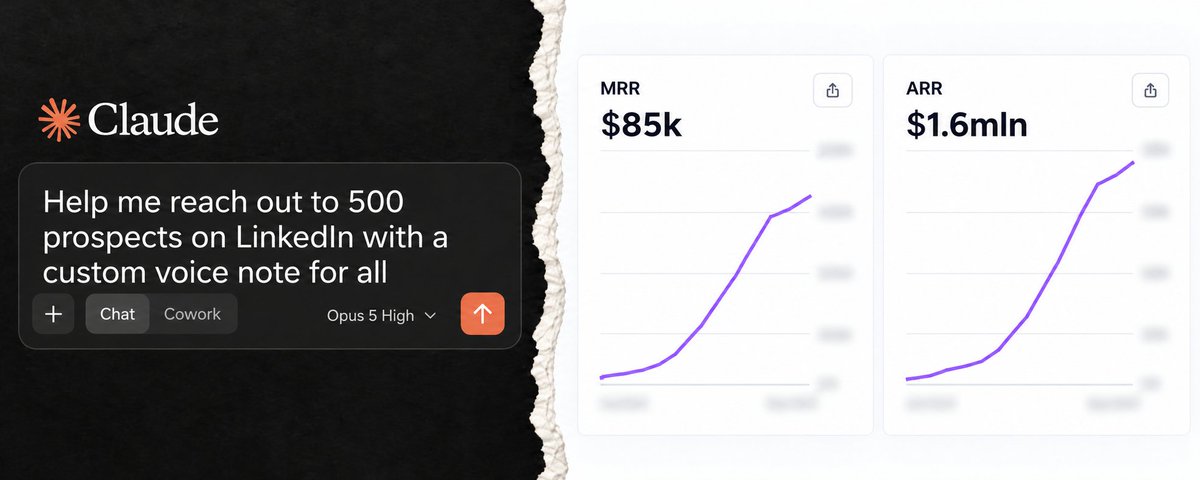
This is how you automate your LinkedIn outreach with Claude for free.
And I'm talking prospecting, personalization, voice notes, follow-ups, objection handling AND appointment setting.
steal my 6-step setup:
1/ Find prospects using actual buying signals
Connect Claude to @SalesRobotAi through MCP.
Claude can pull people who:
> Engaged with your competitor's content
> Commented on a problem your product solves
> attended a relevant event
> Belong to communities where your ICP hangs out
... and more places, or you can simply upload your csv.
but now every prospect comes with context about WHY they're relevant.
2/ Generate outreach using that context
Give Claude the prospect's company, engagement signal and your offer.
have it explain the connection between the signal and your product before writing the DM.
this prevents the usual "noticed you're VP of Sales" personalization.
3/ Automate personalized voice/video messages
Ask Claude to turn the prospect research into a 20-30 second script (it even gives you tips to record)
@SalesRobotAi handles sending the personalized voice/video messages through your sequence.
You don't have to manually record every message.
4/ Add personalized memes
@SalesRobotAi integrates with @HYPERISE1 to add personalized images and memes to sequences.
We've used memes in cold outreach and generated 239 positive replies.
Test these as follow-ups when conventional text messages get ignored.
5/ Automate reply handling
Create an AI Inbox Manager SOP containing:
→ Your offer and campaign objective
→ Your sender profile
→ Common objections and how to handle them
→ Your calendar
Attach it to the campaign.
When a prospect replies, the AI can continue the conversation using previous context, handle objections and move toward a meeting.
6/ Automate reply management & appointment setting
The AI can keep the scheduling conversation going when the first proposed time doesn't work.
We've had prospects reschedule with the AI and confirm booked meetings without manual intervention.
The workflow:
Buying signal -> Claude research -> personalized DM -> voice/video/meme follow-ups -> AI reply handling -> booked call.
@SalesRobotAi handles the execution.
We're now building @kuron_ai to automate the strategy behind it too: which market, which signals, which angle and which campaign to run.
Start with one small, signal-based campaign.
You can try the SalesRobot + Claude MCP setup for free.

Kuron retweeted
SalesRobot automated what you told it to do.
Kuron is what I wanted five years earlier: the thinking, not just the sending.
One AI employee.
Expert playbook in.
Relevant LinkedIn outreach out.
Video, voice, images, GIFs.
3–4× reply rates vs the usual baseline.
Waitlist open at kuron.ai
Kuron retweeted
Enzo Carasso has generated over $42mln in pipeline for his clients.
And here’s what he has to say to GTM engineers:
Everyone's obsessed with tools right now - Clay, claude code, agents, scrapers, etc
But the tools are becoming free. anyone can launch a campaign now so it’s not really the edge..
What's left is something AI can’t do that well:
→ reading a real-world signal nobody else noticed
→ connecting it to why a buyer actually behaves that way
→ re-architecting the funnel around it
→ turning that into ROI, not just activity
(we’re solving the strategy part with @kuron_ai BTW)
Full breakdown of HOW they do it at C17 Labs is in the article:

Kuron retweeted
You're doing everything the gurus told you to do for your cold outbound.
Your lists are clean, sequences are “impactful,” you’ve got the best tool.
and you wake up and check the dashboard expecting never-seen-before results.
but all you get is 2-3 meetings booked, your agency telling you it’s "a slow quarter," SDRs hitting activity metrics perfectly.
the numbers just don’t add up. and you don’t even know why..
and then you send more.
more follow-ups, more enrichment, more budget.
but this is what nobody’s telling you about cold outbound:
the teams consistently booking are not smarter or more disciplined.
they're working with someone who has done this enough times. the best of the best outbound experts.
they're the bridge between your current situation and those never-seen-before results.
@kuron_ai is built on playbooks from 40+ of these experts [yes, the best of the best] who've generated $10M+ in real pipeline.
People like Eric Nowoslawski, Kellen Casebeer, Rish G., and more..
you pick the expert closest to your industry and goals and they run your outbound end to end - list, copy, execution, reply handling, booked meeting to calendar, everything.
or you can just let @kuron_ai suggest you the expert.
join the waitlist early and claim 3000 free credits → lnkd.in/dnnvCpY4

Kuron retweeted
exactly why vertical agents > infinitely configurable agents [aka horizontal agents]
ai tools treat personalization like a game of adding more variables.
industry, role, pain point, recent post, funding, tech stack, hiring, n number of custom instructions on top.
this just creates more ways for the output to go wrong
@kuron_ai is deliberately opinionated about what an agent should know, which signals actually matter, and which variables it should use for a specific job.
less variables = better context + tighter execution

Kuron retweeted
Been paying attention to how @kuron_ai 's actually built, and the architecture breaks into four distinct pieces.
Worth writing down, because it's a genuinely different shape than most "AI SDR" tools I've looked at, which tend to treat outreach as one big problem for one model to solve.
Campaign strategy.
Which segment to target, which angle will actually land. Not guessed fresh each time, pulled from patterns across thousands of real agency campaigns.
This is the layer that decides everything downstream, and it's also the layer most AI wrapper tools skip entirely, they assume you already know your segment and angle, and just help you execute faster.
@kuron_ai 's betting the strategy layer is where the real leverage is, not the execution.
List building.
Lookalikes, post engagers, intent signals, built programmatically instead of manual research.
This part I actually recognize from my own work, it's the same instinct behind every sourcing pipeline I've built, don't do by hand what a system can reliably do for you.
The difference here is scale and the quality of what it's built on, agency-grade patterns instead of a single company's dataset.
Copy.
Proven frameworks, modified with one or two custom variables, deliberately not over-personalized.
That detail stuck with me the most out of all four. Over-personalization is being treated as a design smell here, not a feature to maximize.
One sharp hook beats ten variables stitched together into a sentence that reads like a mail merge wearing a trench coat.
Reply management.
The layer I think gets underrated everywhere, including by me until I really thought about it.
Getting a reply was never the actual hard part of outbound. Converting a reply into a booked call is. Most tools stop at "detected a reply, flagged it for you."
This is built to carry the conversation all the way through, which is a fundamentally different (and harder) problem than reply detection.
Four narrow, well-defined jobs, coordinated, instead of one model trying to do all four at once and doing each one adequately.
That's the part I think is actually the interesting architecture decision here, not the AI itself.

Kuron retweeted
Automating the sending is easy. It also fixes none of the reasons nobody replies.
I've built these systems for years. The sequences, the triggers, the AI that writes and sends without me touching a thing.
And every bit of it automates the same half of the job. The easy half.
What it can't touch is the half that actually decides whether outreach works.
Like who's worth reaching in the first place or what that person cares about this quarter. That's the judgment layer.
Which is why you can fire off 1,000 messages a day, fully automated, and still book nothing. The people winning at outreach are the ones making better calls about who and why.
And that part, nobody had managed to automate.
So it's been interesting watching it get built into a product, instead of left for a person to figure out on the side.
That's what @Kuron is. An AI GTM team that runs the whole function, from the strategy down to the sending.
You tell it who you want to reach, in plain English.
It builds the campaign around GTM playbooks made by people who've closed more than $20M in pipeline.
Then it runs everything multichannel, manages the replies as they come in, and books the meetings for you.
The half I always had to do by hand, the deciding, is the half it's built to run.
Sign up early for 3x bonuses → kuron.ai/waitlist.html
Kuron retweeted

With @kuron_ai, we're trying to get beyond "the agent remembers everything."
Because memory alone isn't learning.
The interesting question is:
What did all those campaigns change about the agent's next decision?
Otherwise, you've just built an agent with a very good memory.
Kuron retweeted
Pipeline-maxxing 101
This is what you will be able to do with @kuron_ai.
→ Give it your GTM goal and the context around your business, what you're selling, who you're selling to and what you're trying to achieve.
→ Have it look at your existing customers and campaign history to figure out what your best customers actually have in common. It might find patterns that aren't even part of your current ICP.
→ Have it go into the market and find more companies that match those patterns while also looking for high-intent signals.
→ Have it research those accounts before it reaches out, so it can understand what's actually happening inside the company and whether there's a real reason to contact them.
→ Have it figure out who to contact and how to approach them based on the account, instead of relying on a job title and a generic sequence.
→ Have it build and run the outbound, including the messaging, personalization, sequencing, follow-ups and replies.
→ And then it can look at what happened across those campaigns and use that to figure out where to look next.
Now why is all of this SO AWESOME??
Your outbound is producing data about your GTM every single time it runs.
If certain types of accounts keep turning into meetings, or a particular signal keeps showing up in your best customers, @kuron_ai can use that to make better decisions about where to find the next part of your pipeline.
Pipeline-maxxing ftw 💁♀️
Kuron retweeted
I know this might hurt everyone's ego but IDC!!
I think a lot of GTM judgment is repeatable enough to be encoded into software
We tend to talk about great GTM people like they have some kind of sixth sense.
They don’t
They've seen enough situations play out to start noticing things that a lot of people probably don't.
They've seen which type of companies actually convert into good customers, which signals tend to mean something, which are usually a waste of time, and which ideas "look" good until they're tested.
A lot of what looks like instinct is really just having a very large mental library of patterns that happened before.
And that's what got me thinking...
why does all of that knowledge have to live inside one person's head?
Because if that knowledge can be written down, structured, tested, and actually used by a system, then you don't have to lose it every time that person changes roles, changes companies, or just gets too busy to explain what they know.
And I'm not talking about turning someone's brain into a 40 page PDF called "The Ultimate Outbound Playbook" lol.
GTM knowledge is wayyy more specific than that.
It's built from 1000s of little decisions that happened while someone was actually doing the work and thinking through those decisions
That’s where we’ve been a lil busy these past few months 😉
We've been working with 40+ GTM experts to capture that kind of knowledge inside @kuron_ai , so the agent has something real to reason from when it's working through an outbound problem.
The idea is pretty simple.
The more good GTM context you can give the system, the better decisions it should be able to make on its own.
And over time, that knowledge can keep changing as the market changes and new campaigns give you more information.
I'm really curious to see how far you can take that.