
Local AI for real world use cases. 5 DGX Sparks/equivalents + CRS804 Switch. Time-series data expert at work. Industrial data systems.
USA
Joined May 2008
- Tweets4.4K
- Following599
- Followers422
- Likes6.1K




Pinned Tweet
iPhone 18 preorders now open, should you upgrade?
iphonecomparison.pricesearch…
kkiran retweeted

We plugged Google Research’s Harness² into JEV 1.14.
Zero weights touched, yet driving massive gains on vision benchmarks round after round.
Under the hood, the system:
⚡️ Rewrites its own prompts
🛠️ Builds its own tools
🧠 Distills its own experience
JEV-Harness² repo drops soon. Stay tuned.

Google just open-sourced Harness².
(turn any harness into a self-improving system)
a harness is everything wrapped around the model, like the system prompt, tools, memory, skills, and subagents. today a person designs it once, and the agent runs every new task with that same fixed setup.
Harness² lets the agent refine that setup for each new task on its own, with the model weights left untouched.
on every task, the agent proposes edits to its harness, runs a few candidate versions, and composes a better harness by comparing how those runs behaved.
because it learns from the differences between runs, it needs no correct answer or grader for the task.
that covers a single task. Harness² also carries what it learns from one task into the next.
after each task, it saves the harness it settled on along with the lessons that held up across the runs. the next time it refines a harness, it starts from those notes instead of from scratch.
this means every finished task makes the next round of edits more informed.
Google tested this with Gemini 3.5 Flash and GLM-5 on legal, office, and professional work benchmarks. one round of edits was enough to beat their original harnesses, and giving the agent more rounds pushed scores higher.
those extra rounds can go wide or deep. the agent either tries several candidate harnesses at once or keeps refining a single one step by step, using OpenCode or Codex to carry out the work.
you can find the Harness² repo here: github.com/google-research/h…
I wrote about a similar idea for agents already running in production, where the harness should repair itself after a failure instead of waiting for someone to debug the trace by hand.
that piece walks through how @Cometml's Opik (open-source) closes this loop, going from a failing trace to a proposed fix to a regression test that stops the same failure from coming back. it's quoted below.

TensorFold 1.1.0 turns a pair of DGX Sparks (GB10) into a strong TP2 platform for GLM-5.3-Flash.
@ashxhart keeps delivering 🚀 fast 🙏
What TP2 DGX Sparks gain -
• Native CUDA EXL3 path - Two-rank serving from the Mia-AiLab EXL3 checkpoint (4-bit mcg experts on the shared EXL3 module). Ranks agree on checkpoint bytes and media limits before load and watch each other (one failure stops the other).
• Exactness + concurrency - On two GB10s: drafted replies equal plain (17/17), 2/4 concurrent streams match their solo runs, and resumed/cached chats match cache-off.
• Vision - --vision for images and video (rank 0 encodes, sends rows to the peer).
• Fabric-aware prefill - TF_GLM_PREFILL_REDUCE=split (default) probes connectivity before load; =ring for neighbor-only RoCE topologies while preserving rank order.
• High parallelism - Index keys/gates in 4,096-row rings (~0.674 GiB/stream at 40k context) so --parallel 16 fits and streams share verify windows.
• Efficiency knobs - Optional dense linear packing (TF_GLM_DENSE_BITS / TF_GLM_HEAD_BITS) to 4/6/8-bit; RoCE shard cap; NCCL cuMem off to avoid pool exhaustion.
• Drafting - MTP + optional DFlash2.
Result: a dual-Spark box that delivers reliable, concurrent, multimodal GLM-5.3-Flash locally with measured match quality and practical throughput on the GB10 fabric.

TensorFold 1.1.0 is live.
We fixed a lot of bugs, including Nemotron loading on M1-M4, Super VL tool calls, GLM long-chat caching, streaming delays and external-drive model scans, alongside new native CUDA models.
Thanks to AdrianBinDC, akol1, astro-15-alive, @bhcc2025, @Bizuayeu, BlivionIaG, BobClawblaw, @rielstamand, chaog992, cwschroeder, Deesha08, @u1tra_instinct, gilby, harrisonfriia, heitke, @jayleaton, @jishvenugopal, jkuepker, jregan-beasley-smc.
And thanks to jschmied, justincasey, @MiaAI_lab, Mirrdhyn, @MrV_777, @mweinbach, nmcbride, philip-pentatonic, @plotarmordev, @sethforprivacy, @woolsey, @petruspennanen, tovereast, tpischke, @ViC305, ZackSample; also @aojensen for work queued beyond 1.1.0.
@plotarmordev @volatilemarkts

Never into Lambos or Porsches or Ferraris. This is on a whole another level!
I see a future where Roadster flips or rollercoaster rides would be a paid service to experience the magic and I will gladly pay!
I’m sure few Hollywood studios wired the $250K for first dibs. @TomCruise could hopefully put this to great use in his next flick!

iPhone Duo - Your best bet to buy is from your carrier!
@Apple botched iPhone Duo preorder timing. I refreshed on the app and website on WiFi and cellular data. No availability for launch day (showed delivery in Dec 2026 when the page loaded 5 minutes later at 0505AM).
Had to buy it through @TMobile , not sure why $35 fee to buy in full but they deliver the phone on Oct 23rd or so they say!


Native Zig + CUDA Driver ConnectX-7 RoCE TP=2 on Linux Blackwell clusters is unlocked. ⚡️
We replaced PyTorch distributed with a zero-Python Zig + libibverbs pipeline across twin 100 GbE CX7 rails:
• 14.87 µs GPU-to-GPU all-gather latency (UVA mapped)
• 15.25 GB/s dual-rail line saturation
• Full TP=2 MLP layer: cross-node transfer is < 2% of total compute time (17.8 µs vs 1.27 ms GEMM)
• Zero-regression on GLM-5.3-Flash quality (10/12 dev benchmarks passing with 40/40 pytest suite)
Upstream PR patch prepared for @ashhart's TensorFold (#593) + full hardware receipts:
github.com/ThinkCode/tensorf…
Huge respect to @MiaAI_Lab for GLM-5.3-Flash and @ashhart for the TensorFold engine.
🤖 Made with AI

Any Mac user use DigUp yet? My MBP has 4TB storage. This might take a while to index the first time. Promising project, I couldn't put it to test just yet.

kkiran retweeted

Every open model ships frozen.
What if it could learn and update its own weights as it's being used?
I have been working on a bit of engineering called Living Weights for about three months, and I think it's time to release it.
The model becomes uniquely yours, no KV stashing, no MD files, no trickery.... just live learning. 😎
Unload the model, move it to another machine, and it still knows what you told it. Could this be the start of recursive self improvement for local AI?
It drops in the latest TensorFold release today, with support for @NVIDIAAI Nemotron Lightning. 🤯👀
@abheer @sundeep @NaderLikeLadder
Special thanks to @volatilemarkts for the name.

The last 24 hours reinforced the same pattern: aggressive compression, tiny decision models, and on-device runtimes that actually fit a normal 16GB laptop.
(links below)
🤖 Made with AI

Underdog Saluki 27B - xitter.cf/ivanfioravanti/status/…
Unsloth decision models - xitter.cf/UnslothAI/status/21078…
Samsung LittleBit - xitter.cf/thesupermannx/status/2…
Liquid Open d1 - xitter.cf/atomic_chat_hq/status/…

Local Liquid d1 3B crushed OpenAI Decision at Snake 🐍
@liquidai d1 on a single RTX 3090 decides in 8 ms so its snake made 82 moves a second and ate 86 apples while OpenAI's API took 345 ms a call and ate 3
Run decision models -> atomic.chat
Underdog Saluki 27B (Apache 2.0) - Qwen 3.8 27B derivative, ~7× smaller than full precision, keeps ~96% of benchmark scores, stronger tool-calling, and runs as the best model under 8GB inside Underdog. Early users already report fast local inbox/newsletter triage.
Unsloth decision-model recipe - Fine-tune a Clef head + LoRA on small bases (Qwen3.5 0.8B and similar). Aggregate decision-benchmark accuracy jumped from 20.7% to 74.3% on ~4GB VRAM; downstream accuracy rose from the 30–37% range to ~78% in one epoch. Works on Qwen3.8 / Gemma 4-class models too.
Samsung LittleBit - Latent factorization that compresses a 13B model under 1GB (down to ~0.1 bits/weight in extreme configs). Core matmuls become bitwise XOR / sign flips; reported ~11.6× inference speedup vs FP16 with usable quality where older sub-0.5-bit methods collapse.
Liquid Open d1 - d1-3B (text + vision) and d1-omni-600M (text + image or audio). atomic.chat’s local run on one RTX 3090 decided in ~8 ms (82 moves/sec, 86 apples) versus OpenAI’s decision API at ~345 ms (3 apples) in the same Snake setup. Designed for edge-to-workstation latency, not just chat.
Net: 16GB RAM is no longer a compromise tier for private agents, tool use, and real-time decisions.

kkiran retweeted

Todos los productos de Adobe reimplementados desde cero, gratuitos y de código abierto
→ getartcraft.com/apps

ALT Interfaz de herramientas creativas para edición de imágenes, ilustración, video y desarrollo de bibliotecas.
kkiran retweeted

Introducing EmbeddingGemma 2, a new open multimodal model that sets the standard for on-device efficiency.
- our first open, natively multimodal embedding model
- handles text, code, image, video, and audio tasks within a lightweight, modular 740M parameter form factor
- ideal for offline, privacy-first RAG when paired with Gemma 4
- outperforms some specialist models more than twice its size
Weights available now on Hugging Face.
kkiran retweeted

HOW TO BECOME A FORWARD DEPLOYED ENGINEER (53 MIN MASTERCLASS)
Some forward deployed engineers are getting PAID $1M+/year (kinda crazy, I know)
And I REALIZED almost nobody talks about HOW they do it in any detail. It's basically nowhere online.
So I asked someone who does it ALL DAY LONG for Fortune 500 companies to walk me through it, step by step. and he shares EXACTLY how he does it
youtube.com/watch?v=1a5HxU52…
Here's what I learned:
1. They start by listening, not building. They interview the people doing the work and let agents quietly read the company's data for a few weeks. The real process is almost always 3x longer than the one on paper.
2. They sort every step into four buckets: delete it, automate it with a simple rule, give it to an AI agent, or keep a human on it. A surprising amount ends up in the first bucket.
3. They build inside the tools the company already uses. Nobody has to learn a new app. When a human needs to sign off, it's just a Slack message.
4. They use the cheapest model that gets the job done. Most of this work doesn't need the most expensive AI.
5. They measure everything before and after, then come back 6 months later and prove it worked.
This + concrete client examples + way more on today's episode of @startupideaspod (thanks to @vasuman)
A full course pretty much on the topic aivalable to you 100% for free.
This episode is for ANYONE who wants to be a FDE or who wants to make their company AI-native by deploying agents.
Watch
kkiran retweeted

An Anthropic engineer packed his whole engineering workflow into agent skills, so anyone can copy it
Addy Osmani, ex-Google, now works on Claude Code.
His repo turns a coding agent into a senior engineer.
Each skill is a structured workflow: when to use it, the steps, the excuses agents use to skip steps with a rebuttal for each, red flags, and the evidence required before it can call the job done.
25 skills, sorted by phase:
> Define: figure out what to build
> Plan: break it into small tasks
> Build: write it test-first
> Verify: debug and prove it works
> Review: quality, security, performance
> Ship: rollout, CI, docs
Skills also switch on by themselves. Start designing an API and the API skill kicks in.
Useful if you ship with agents solo, or want every agent on your team held to the same bar.
npx skills add addyosmani/agent-skills
repo: github.com/addyosmani/agent-…


kkiran retweeted

We'll be spending a lot more time trying to understand the outputs of language models. A few thoughts, tips & tricks:
Writing. Something I've had success with: Ask your LLM to explain something in ASD-STE100, it's a controlled language specification originally developed for aerospace maintenance documentation. LLMs well-versed in this language and it comes with heavy constraints on clean writing style that I often find a lot more readable. Sometimes I've tried to soften it a bit e.g. ask for "80% of the way to ASD-STE100" because the spec is quite stringent. But even better:
Diagrams / images. Instead of writing, ask your LLM to create a diagram. These can be a lot easier to process, parse, and understand. But even better:
Web pages. Ask for output "in HTML" to get a beautiful, interactive webpage. LLMs are getting really good at frontend and can create beautiful experiences, animations, etc. But even better:
Explainer videos. The output format I am most bullish on is fully custom / bespoke explainer videos generated on any arbitrary topic. Experiment with things like "Create a 3b1b style video explainer on X. Use my ElevenLabs API key for audio narration". (you'd need an API key for the latter or you can ask your LLM to find you decent free alternatives that use your local compute). This is actually starting to work!
In summary:
- As LLMs get better, they will do more and more of the legwork autonomously, and a lot more of our work will rise up the abstractions into oversight and understanding.
- Luckily, LLMs can help here too because as intelligence and code are increasingly abundant, you can ask for large, custom, discardable software artifacts (e.g. web apps, video explainers) that would have never made sense to create before. Push the boundaries here and you'll be surprised.

This is how I like to benchmark, by creating apps that I use myself, every day!
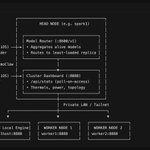
This is done entirely using GLM 5.3 Flash TP4. A lot of prompting and iOS skills were fed. I used omp. My goal is zero telemetry, private tracking of my AI cluster using Tailscale (Macs will be added as well). Apple Intelligence for summaries - who has time for all the metrics! Notifications when things go wrong, analysis of idle times so we get the bang for the buck (coming up)!
This will be free if Apple approves! I have one of the Sparks hosting the router for all models. Not sure if everyone follows that approach. Something to research and support various configurations.
Thanks @MiaAI_lab @plotarmordev @ashxhart for the amazing work on this recipe!

