

Ham Radio Operator, Computer Geek, wanna be musician, collector of hobbies, and Educator. Views and opinions are my own
Sunman, IN
Joined September 2008
- Tweets12K
- Following4.1K
- Followers1.6K
- Likes12.7K




S. Ryan Russell, MIT (he/him) retweeted

My car wouldn't start in a Tractor Supply parking lot in Tennessee, so I opened the hood.
I know nothing about engines. In American movies, opening the hood is how a man calls for help. It works outside the movies too.
The first one arrived in under two minutes with a fifty-pound bag of chicken feed on his shoulder. No hello. He set the feed on my bumper, put his hands on his hips, and looked into my engine.
Then a man from a truck hauling fence posts. Hands on hips.
Then an older man came out of the store holding a receipt. He had not finished paying. Through the window I could see the cashier still holding his card. I think he heard the hood.
Nobody touched anything. Nobody asked my name. Three strangers stood around my engine like it was a campfire.
"Battery," said Chicken Feed.
"Could be the starter," said Fence Posts.
"It's not the starter," said Receipt.
Fence Posts made a clicking noise with his mouth to show what a bad starter sounds like. Receipt said that was the wrong click and did his own, and for a while two grown men in Tennessee just clicked at each other. I did not interrupt. It felt religious.
It was the battery. The terminals were crusted white. Chicken Feed walked to his truck, came back with a can of Coca-Cola, cracked it, and poured it on my battery.
"Has to be Coke."
"Pepsi works," said Fence Posts.
"Pepsi does not work, Ronnie."
"It's the same acid!"
"Then why'd God make Coke?"
I looked it up that night. Men have been having this exact argument online since at least 2004.
The sun was going down. Receipt said, "Somebody hold a light," and a flashlight was in my hand.
I pointed it at the battery.
"Not there. Where I'm looking."
I moved it.
"Where I'm looking NOW."
For ten minutes I chased an old man's eyes around an engine with a beam of light. I have trained with a sword for twenty years. Nothing has ever asked more of my wrists.
Then, without looking up, Receipt said, "Don't watch my hands, son. Watch my face. Took my daddy eleven years of yelling to teach me that."
So I watched his face. I saw where he was going to look before he looked, and the light was already waiting there.
He stopped correcting me.
The car started on the first try. Nobody cheered. Chicken Feed took his feed back off my bumper, Fence Posts said "There ya go," and in under a minute they were gone, the way they came.
I was closing my hood when a truck two rows over wouldn't turn over. Up went its hood. A father, and a boy of maybe nine.
I walked over with the flashlight. I did not ask. I put the light where the father's eyes were about to go.
He glanced at me. Then at his son.
"Watch how he holds it."


S. Ryan Russell, MIT (he/him) retweeted

My wife's brother spent six years at a Japanese car plant in Kentucky. He was sent to teach the Americans our way of working.
He came home with a notebook. On the cover, in Japanese: "Things I Learned Instead."
Some pages:
"The first day of deer season, half the line takes vacation. HR plans for it every year. Nobody pretends to be sick. They just say 'deer season.'"
"They name the machines. The welding robot on Line 2 is Darlene. Darlene gets a birthday cake."
"When someone's wife has a baby, the whole line signs a card. The card is bigger than the baby."
"A man with thirty years on the line showed me a better way to do my own job. Then he said, 'Don't tell your boss I told you that, boss.'"
"Every Friday, someone brings doughnuts. Nobody is assigned. Somebody always does."
"They thank the janitor by name. Every day. His name is Curtis."
The last page is from his final day.
In our system, anyone can stop the line, but only for a problem. Stopping it is serious.
"On my last day, the line stopped for one minute. There was no problem. They stopped it to shake my hand."
He says it's the only time in six years he was happy to see the line stop.
S. Ryan Russell, MIT (he/him) retweeted

Did you know Twitter links can reveal which device was used to share them?
Check the URL ending:
s=46 → iPhone
s=20 → Web Browser
s=19 → Android
Try it yourself by copying a tweet link.
Technology is interesting, isn't it?

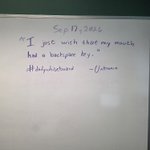
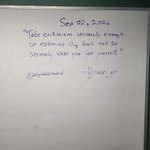
Oct 28, 2026
"Do not let what you cannot do interfere with what you can do."
#dailywhiteboard - John Wooden – at Greendale, IN

S. Ryan Russell, MIT (he/him) retweeted

❗️ A developer hid a Bitcoin key on a PHP server left unpatched against PHP2Shell, the critical flaws fixed on Oct 21, and dared anyone to steal it.
17 hours on, the wallet holds ~$2,000 and nobody has taken it.
The developer says someone is crashing PHP but "still no RCE yet".


Readers added context they thought people might want to know
The GitHub repository cited as the source explicitly acknowledges in its README that the supposed exploit is fabricated: “And of course it’s fake. Duh. Note: No harm intended, purely for fun.”
github.com/0x1c1101/CVE-2…
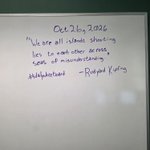
Oct 26, 2026
"We are all islands shouting lies to each other across, seas of misunderstanding."
#dailywhiteboard - Rudyard Kipling – at Greendale, IN

S. Ryan Russell, MIT (he/him) retweeted

We had a Linux server that showed two successful SSH logins from an external IP overnight.
The strange part was that there were no failed password attempts before them.
The attacker got in cleanly.
So I checked the SSH logs properly.
Both sessions said:
Accepted publickey
That meant we were not dealing with a guessed password.
I pulled the fingerprint from the logs and compared it with the keys in:
/home/deploy/.ssh/authorized_keys
There was only one key there.
And it matched.
The comment on the key was:
deploy@old-build
That name sounded familiar, so we checked our records.
The build server it belonged to had been retired months ago.
But nobody had removed its SSH key from this production server.
I checked the timestamp on authorized_keys.
The key had been sitting there since November 2025.
So this was not some new persistence the attacker had just created.
It was an old trust relationship we had forgotten about.
That was actually worse in a different way.
I checked the login history and confirmed both sessions came from the same external IP.
Then I looked for files touched during those sessions.
A backup copy of the application’s .env file had been created under /opt/api/.
That immediately raised another concern because environment files often contain things like database credentials, API keys and application secrets.
At that point we disabled the deployment account, removed the stale key, rotated the application secrets and started checking every other server that might still trust the same old build key.
The lesson from this one was simple.
Not every compromise starts with malware.
Sometimes the attacker just finds a credential or key that your own environment forgot existed.
Passwords expire.
Employees leave.
Servers get retired.
But SSH keys can quietly sit in authorized_keys for years if nobody is actually reviewing them.
That is why key rotation and access reviews matter.
The attacker did not need to break SSH.
We had already left the door open.

S. Ryan Russell, MIT (he/him) retweeted

Another one, will this week ever end?

Evolving threat 🚨 CVE-2026-111497, previously known to affect Node.js (node2shell) and Python has evolved into “HTTP2Shell.”
A significant blast radius.
This vulnerability leaves many libraries and applications using HTTP vulnerable to pre-auth RCE via Brotli decompression.
Please be aware. Fixes not yet available for all affected services. Look for Brotli (1.2.1) dependency upgrades when they become available.

S. Ryan Russell, MIT (he/him) retweeted

I made some progress 😌. I took a dummy radio and chopped it up to have a Mock up. Hopefully I can get some additional measurements!


S. Ryan Russell, MIT (he/him) retweeted
If you run any kind of PHP application on your server... it's time to patch. Except... the patch is not here yet.
Some info here: jackalsyn.com/posts/php-up-2… - but disabling upload progress *may* help, it's just not the full fix:
session.upload_progress.enabled = Off

S. Ryan Russell, MIT (he/him) retweeted

Security called me at 6:12 AM today.
"Patch every PHP server immediately."
I asked what happened.
"Two critical vulnerabilities. Remote code execution. No authentication required."
Cool.
How many PHP servers do we have?
According to inventory: 12
According to reality:
Nobody knows.
We found one running WordPress.
Three running old internal tools.
One under someone's desk.
Two inside vendor appliances.
A forgotten employee directory from 2016.
And a server named:
PHP-OLD-DO-NOT-TOUCH
Naturally, that one runs payroll exports.
Then we found a PHP 5.6 box.
I asked who owned it.
The documentation said:
BRIAN.
Brian left in 2019.
We called Brian.
He said:
"Oh wow, that's still running?"
Excellent.
By 8 AM, leadership joined the incident call.
CEO:
"Can hackers actually get in?"
Security:
"Potentially yes."
CEO:
"Without a password?"
Security:
"Yes."
CEO:
"Then why do WE need passwords?"
Not the lesson.
Finance asked if we could wait until the weekend to patch because downtime affects revenue.
Security explained that the alternative was letting strangers execute code on our servers.
Finance asked for a cost comparison.
At 9:17, someone suggested temporarily taking the vulnerable websites offline.
Marketing refused.
"Our campaign is live."
So for the next hour, the company officially decided maintaining a landing page for 20% off webinar registration was more important than preventing remote server takeover.
We finally patched everything we could find.
Then our scanner discovered another PHP server.
Hostname:
TEMP-PHP-2014
Uptime:
4,512 days.
Nobody knows what it does.
Nobody owns it.
Nobody can shut it down.
But every time we block network access, the warehouse stops printing shipping labels.
Security has classified it as critical infrastructure.
It is running PHP 5.4.
The vulnerability has existed longer than half our employees.
The emergency patch took four hours.
Finding out what PHP actually runs took eleven.
The internet isn't held together with code.
It's held together with servers everyone is afraid to turn off.
S. Ryan Russell, MIT (he/him) retweeted
This might be the most watched GitHub Actions build in the history of the platform: github.com/docker-library/ph…

S. Ryan Russell, MIT (he/him) retweeted
Compliance decided mandatory training must remain available during an internet outage.
So IT was told to store the videos locally on every laptop.
Brand reviewed them.
“1080p isn’t premium enough.”
Now they’re 4K.
Security reviewed them.
“Local content must be encrypted.”
Done.
Result:
24 GB of mandatory training videos on every employee laptop.
900 laptops.
21.6 terabytes of identical videos.
Within a week people started opening tickets because their drives were full.
Finance asked why IT needed to buy larger SSDs.
I suggested we stream the training instead.
Compliance reminded me it had to work during an internet outage.
I asked when someone would urgently need to complete annual ethics training while the entire company network was down.
They said:
“That’s not the point.”
One of the mandatory courses is called:
DATA MINIMIZATION: ONLY STORE WHAT YOU NEED
We currently maintain 900 offline copies.
S. Ryan Russell, MIT (he/him) retweeted

AMD CEO Lisa Su just went after Nvidia's $4,000 AI box using a $1,499 machine the size of a lunchbox.
Holding it up on stage with one hand, she ran a model with 235 billion parameters live, with no data center, cloud or rented GPU behind it.
The surprise is the chip. Inside is AMD's Ryzen AI Max+ 395, which became the first x86 processor whose CPU and GPU draw from one shared pool of 128GB of memory. That one design choice lets a desktop handle models that once needed a server rack.
On Linux, 110GB of that pool can go to the GPU. An RTX 5090 offers 32GB. A 4090 offers 24GB. So this box has more than three times either card, in a case about as thick as a paperback.
The number that stunned the room: on DeepSeek R1 inference, the chip ran more than 3x faster than an Nvidia RTX 5080. A $1,499 desktop beating a $1,000 graphics card on real AI work. For a decade, Nvidia told the world that serious AI meant Nvidia hardware. AMD just made it a desktop item at half the cost.
Now the math. A heavy AI user today might pay for Claude Code Max ($200), ChatGPT Pro ($200), Cursor ($20) and Gemini ($20). That adds up to $5,280 a year. At that rate, the box covers its cost within months, then keeps running at no extra charge.
The setup: install Ollama, pull Qwen3 235B, and aim Claude Code at localhost. The interface stays the same. But nothing leaves the machine, there is no per-request bill, and no provider slows you down at 3am when you finally sit down to build.
This is where every AI subscription starts to look optional. Lawyers worry less about leaks to OpenAI. Developers stop staring at the token counter. Founders stop renting H100s for prototypes they abandon because of the bill.
Whoever gets there among the first thousand will own private AI consulting for the next two years.
If you're new here, @GeniusGTX is a gallery for the greatest minds in economics, psychology, and history. Follow along for more similar content.
Readers added context they thought people might want to know
The device Lisa Su demoed, AMD's Ryzen AI Halo Developer Platform (Ryzen AI Max+ 395, 128GB unified memory), sells for $3,999.99 via Micro Center, not $1,499. The $1,499 figure refers to unrelated third-party mini PCs. tweaktown.com/news/112183/am… linuxcompatible.org/story/amd-ryze…
S. Ryan Russell, MIT (he/him) retweeted

Hoy se cumplen 15 años del fallecimiento de Dennis Ritchie, creador de C y co-creador de UNIX.
Varias de las personas que trabajaron con él en Bell Labs pasaron por Nerdearla. Sus charlas están disponibles en nuestro canal de YouTube 👇

S. Ryan Russell, MIT (he/him) retweeted
Computer scientist Margaret Hamilton passed away at 90 on Sep. 30th. Considered an icon at MIT, she designed the flight software for the Apollo missions to the moon.
More on her groundbreaking work: bit.ly/4zegcS8
Video v/MAKERS
S. Ryan Russell, MIT (he/him) retweeted

Margaret Hamilton, who led the team that wrote the code that put humans on the moon, has died at 90 🕊️


S. Ryan Russell, MIT (he/him) retweeted

We are saddened by the passing of pioneering computer scientist and software engineer Margaret Hamilton. As leader of the team that developed the onboard flight software for the Apollo missions, Hamilton helped make Apollo 11’s historic journey to the Moon possible. Her team’s innovative work helped guide the mission safely to the lunar surface and forever changed the fields of computing and spaceflight.
In 2025, the Museum awarded Hamilton the Michael Collins Trophy for Lifetime Achievement to recognize her remarkable body of work: s.si.edu/4zrbl0m

ALT A person with long hair and glasses is writing on papers at a desk filled with documents. They are wearing a checkered jacket. The background shows a window with blinds.
S. Ryan Russell, MIT (he/him) retweeted

Margret Hamilton, Pioneering Software Engineer, Dies Aged 90 ift.tt/H2QsVKY
