

Ending the Middle East wars and antisemitism. Phase 1: Social media mastery. Founder and CJN of Leverage (https://xitter.cf/t.co/zWIKDxUnuq)
Amsterdam
Joined November 2013
- Tweets2.5K
- Following463
- Followers754
- Likes487








Pinned Tweet
How We End the Middle East Wars. How We End Antisemitism.
This region is low on hope. October 7th exposed what we should have known all along -- Hamas will never allow peace between Jews and Arabs.
The overwhelming support Hamas received from the Palestinian public, and in many parts of the Muslim world, proved that the problem is far deeper than just Hamas.
The region is low on hope because everyone now understands that politics can't solve this. Politics was never the problem to begin with.
The problem is far deeper. It is a struggle at the level of the individual soul.
That is where the fight truly is.
That is where we are going to win.
A wealthy American entrepreneur wants to back the campaign to bring truth (or tourists, depends on the audience) back to Israel. Actually, he wants to back a media company akin to what I've been aiming at for some time now.
He suggested we kick this off with a live event in NY in front of some of the most wealthy an serious people in the world.
I didn't expect that. I never envisioned it. (I see other things, like dead people haha jk maybe not).
But when he said it, immediately after the words left his mouth and traveled into the mic of his phone and into the speakers on my laptop and into my ears and then in my mind, an image appeared.
I saw a flash of a stage. I saw men in suits and women in sparkly dresses, some of them asking me strange questions.
My initial reaction was mixed. But I understand the importance. I'll do it if given the opportunity.
I thought it was super cool that he planted an image in my mind. It only took a few words to root that future into my being. Now we're working to make it happen.
That's powerful stuff.
And we all have that power.
The CEO of one of the world's largest parking companies sent me this text in reply to a long note calling out his team and their resistance to exploring a partnership with the startup I was working with at the time.
The call with my partner the following morning confirmed the tone of the message: he was pissed.
I wasn't on the call and only received a second-hand account of what was said. The CEO didn't like the challenge to his authority and the way he runs things. Otherwise he would have ignored my text, like he had been doing to my partner. Clearly I got under his skin. Instead of dropping his guard and getting real with us, he got defensive and lashed out.
Then he got manipulative. You can see in his message that he is trying to separate my then-partner as the "good guy" from me, the reckless maniac who doesn't know how to build a partnership.
He didn't answer any of my concerns on the call with my partner. (His team was hostile to us early on -- uncalled for -- and didn't like to admit that their work was suboptimal when AI is eating up their industry).
He did repeat how much he did want to partner with us (funny), and then set up another call with my partner and one of his top guys. Which didn't go anywhere because none of the underlying blocks were resolved.
To be clear, none of this story represents the totality of any individual's personality. The CEO built an amazing company and is very very skilled at what he does.
This is an observation about how telling the truth is a provocation. The angry response, the follow up call, the manipulation -- all of that is information about the real game.
You don't get that kind of info via vanilla follow up texts.
You get it by telling the truth, no matter the audience.
Ps, I'm Koby, founder of Leverage. We help VCs and startups accelerate mega deals via articles in the elite business press: Bloomberg, WSJ, FT, and Reuters.

A Gulf-based VC has been speaking with Leverage about teaming up to maximize the value of their portfolio.
I went in cold via one of their GPs. He doesn't come from finance. He's got a rolodex though.
We hopped on a call to discuss. Three of them vs me. My contact spoke roughly 60% of the time. His partner took up the rest. The third colleague was mostly silent.
Conversation went okay. We didn't dive into the details of the fund and what they want to achieve. That's where the real stuff is. But it was a first call.
My contact was enthusiastic about doing media work. His partner was more cautious. They had been burned by a Bloomberg article recently. An article about a portfolio company turned into a story about geopolitics. It's annoying to see an opportunity to sway the market wasted.
He asked me if there's a way to control for this. I answered him honestly -- no, there really isn't -- but not effectively.
I should have asked him why he thought reporters would write the same story twice. It's the news business after all. He would have concluded that the chances are zero.
We could have dived deeper into why the original angle was not compelling enough. Most stories about startups fail to pass muster because they are "too small" for elite outlets like Bloomberg to care.
The Gulf, however, sells itself.
We end the call. My contact emails me a few minutes later asking for my WhatsApp. Sent.
I wait a few days and then ask if they want to do a full strategic breakdown. What are the aims of the fund -- and we work backwards from there.
If we're gonna work together, then we better do it right from day one.
No reply. A few days pass and I send my contact a voice note. "Hey, wanted to see where you're heads at. If not moving forward, no worries, I'll drop this and move on. Just looking for some clarity."
The thought of losing an option spurs immediate action.
A reply 20 minutes later. Checked with his partner, he said, and they want to know how Leverage is different from other shops.
Now this tells me more. My contact is deferring to his partner, who comes from private equity, on this decision.
Leverage is being evaluated by the decision maker by the reaction he sees in his partner about me.
I'm not in the room, so to speak. But I am still watching.
Sometimes people project their past experiences with PR onto Leverage. It's unconscious so I don't argue. They have no evidence to support their claims and they do not know what Leverage is capable of.
They just have to experience it to know that Leverage is different.
The articles Leverage helps generate is one thing.
Noticing the things about power and hierarchies that others don't. That's the difference.
Otherwise you pay attention to surface-level stuff, deluded that you were winning the whole time.
Ps, I'm Koby, the founder of Leverage. We help VCs create bidding wars for uprounds and exits via articles in the elite business press: Bloomberg, FT, WSJ and Reuters
I knew that a b2b startup founder in the UK was a right fit for Leverage the moment I asked him what he wanted from us: competitive threat to potential acquirers.
He understands the game. "Threat" sounds dark and ominous but really it's the only language that speaks in the corporate world. It's the only chance a b2b startup has of landing enterprise deals, or be acquired.
To get them to adopt the good, you have to show them the bad. The cost of inaction.
Losing your "safe" corporate job, in this case, with all the perks and theater that comes with the title and the brand.
In practice, we tell the elite business media -- Bloomberg, Reuters, WSJ, the FT -- about what's going on inside those mega corporations. What problems they actually have. What deals they are considering. All of it to stir the competitive nature of people so that they do the right thing. You have to trigger people's fear of losing their jobs to do so.
Survival is the ego's game. Even if you lose your job, the human wakes up the next morning and functions. The story is what changes. The messiness of the process is the result of divided selves populating the entire corporate structure.
Think of how much time is wasted in corporations in arriving at consensus. Most decisions are simple. It's the fear of looking like an idiot that slows everything down. That's why corporate communication is so lifeless.
It's consensus language.
Going top-down is the best way to slice through the noise. An article in one of the leading business outlets is what holds the system accountable.
The investor and shareholder class read those outlets. They move money as a result of those articles. Billions and trillions of it. They will absolutely phone up C-suite management when they see their equity is not managed properly.
And even if they don't, C-suite fears that they will. Fears that the folks to who decide their job security will call them with questions they don't have answers to.
Leverage sees this. We see the meeting of interests between reporters and VCs and startup founders.
We welcome it. We nourish it.
Founders like Mr. UK don't need to be told why this works. Live long enough as a founder and you start to see every interaction through the prism of masks, self-interest, power dynamics and unconscious fears.
Not cynically.
Honestly.
To solve any problem, one must first diagnose it properly. To do good in the world, one must deal with how it is, and work with it.
Ps, I'm Koby, founder of Leverage. We help b2b startups accelerate enterprise dealmaking, fundraising and exits via articles in the elite business press.
A mid-sized VC investor told me about "zero billion dollar" companies in his portfolio. Good traction, tens of millions in ARR, but not enough exposure outside the cap table to explode the valuation (and therefore his carry).
It was a revealing remark.
Does it signal a lack of trust in the fundamentals of the business for an upround? Does that lack of trust undermine the energy needed to find a buyer for the VC's position? Is the block a lack of ownership over who decides whether the time is right to explore an exit or upround?
I won't know until I do (profound, I know). But what it revealed within me is a hyper curiosity about this use case.
Are there other VCs that deal with this dynamic? As I said, am super curious to learn more about it.
Ps, I'm Koby, founder of Leverage. It's a platform that helps VCs create bidding wars for their portfolio companies via articles in elite business media, like Bloomberg, FT, WSJ and Reuters.
The first Leverage user had a call with a WSJ reporter last week. We'll see what distance remains between now and publication. So far so good.
It was a bit of a nightmare to get there. In this period I also realized that suffering is the gap between expectation and reality. So I started closing the gaps. That's why the product improved, and we're here.
Lessons learned:
1) FOUNDERS ARE RISK AVERSE: I was fooled into thinking startup founders are risk-takers. Perhaps on the margins. There's still a deeply embedded human fear of being banished from the herd, which expresses itself as a concern about pissing off potential customers by speaking to the press.
Sure, they'll speak openly in a private forum, where they're confident their customers/investors/whomever won't hear what they think or see what they're up to. But they freeze up at the thought of exposing what they know to masses of people, including those potential customers.
All while knowing that top-down pressure is the most effective way to get the corporate machine moving. The entire system is built on accountability for heaven's sake.
Modern journalism has solved for this with anonymous attribution. Sources can speak freely trusting that reporters will protect them from their fear of blowback.
Leverage explains this, and adds another option of protection: submit verified documents that tell the story. In either situation -- anonymous sourcing or documents -- the reporters have to vet and fact-check all claims with all named parties in the article. Documents, however, are black and white.
No corporation, no matter how powerful, can deny what's down on paper.
2) NEVER BE CUTE:
The first tip Leverage shared with reporters didn't spell the whole story. Naturally, they turned us down.
Who the hell is Leverage? We are reliable but that isn't the point. We are dealing with the natural human inclination of reporters projecting all annoying PR people onto Leverage.
Been burned by desperate PR people trying to control what gets published to our readers --> here comes some guy out of the blue --> must be another one of them --> safer to assume not worth my time.
Obviously that did not turn out to be true. As I said, the first Leverage user just had a long call with the number one business paper in the world. That doesn't just happen.
All tips going forward provide the scoop material up front, plus the nut-graf/why now context.
3) EMAIL BLAST WORKAROUND:
I send an email to reporters in the Leverage network with scoops and investigations about the biggest corporations in the world, sourced from startup founders in the Leverage network. Expanding this to VC investors now.
The idea is that sources want proof that an outlet will take their story. Reporters don't want to be bothered with something not worth their time either.
Early validation: a reporter claimed a tip within 6 minutes of sending the email. That speed is possible because the tip is on a first come, first served basis.
Til the next update.
Ps, I'm Koby, ex-Israel bureau chief for Bloomberg News and now founder of Leverage. We help elite business reporters get scoops and investigations on the world's biggest companies and governments. Reporters from the FT, Bloomberg, WSJ and the UK Sunday Times are using the platform.
DM me if interested.
When I was Israel bureau chief for Bloomberg News, I broke news that Amazon was building its own quantum computer. It's a story that makes no sense unless you understand the hidden mechanism behind it.
After all, I was a reporter in Tel Aviv. Amazon HQ is in Seattle. That's many time zones apart. How the hell did I land on this scoop?
I got the tip from an Israeli founder in the quantum computing space. What his motivations were I had no idea. I didn't care either.
It was a friggin scoop on Amazon!
Imagine how jealous the Amazon reporter at Bloomberg was. He was probably bashing his head against Amazon's army of flaks (I dealt with them months later and they presented me vanilla info on their quantum computing program as though it was story-worthy. I guess when you're that big, you develop an entitled attitude).
And some dude in Israel bumps him to 3rd byline.
Now imagine if he had access to those sources from his seat in Seattle.
That's what Leverage is. It's a platform I built that helps reporters at elite business outlets get scoops and investigations on the largest companies in the world.
It's built on the understanding that startup founders who sell to the mega corporations are the most under-appreciated and under-utilized source of global news. Leverage gives them the rationale and superhighway to talk to reporters.
Journalists from Bloomberg, WSJ, FT and the UK Sunday Times are using it.
DM if you're interested.
A managing partner at a VC with $5b AUM lamented to me the pace of his career development. He's in his late 30s, early 40s and hadn't yet made the FU money he's seen some founders make post-exit.
When he made the decision to join VC a decade ago, he thought he would have gotten there by now. Instead he finds himself working round the clock, frustrated by the long cycles. His mind runs even when it shouldn't. Always gaming.
It's a familiar pattern that I see amongst high-achievers. An obsession with achievement mixed with a dose of envy. The elements of a character most susceptible to FOMO.
Someone who works round the clock chasing something he wishes he had will chase the next chance to get it. Never giving himself the time to stop and realize he's already got it.
He's alive. He is the creative force to life. He's already won. He's acting like he hasn't.
I told him that Leverage, the platform that I built to help VCs generate FOMO for their deals, is his ticket out of the race (in as many words).
The opportunity to wield the power the system has been using against him. The chance to compress the time it takes to get what he wants into a single decision.
Because FOMO is not just one article in an elite business outlet, like Bloomberg or WSJ. It is the activation, at scale, of all the fears and hidden desires that people, too afraid to express, project onto an opportunity he created.
Money is the surface and final evidence that this works. The attention is the signal.
In practice, it looks like an exit or upselling your seed or Series A/B whatever stake at 10x-20x returns.
Look deeper and you realize it is freedom that you've won. The freedom not to need the system. Freedom from chasing. To be present. To see life and the world as it is, instead of this crazy fantasy that takes up so much of one's mental energy.
That is true wealth.
That's on the other side of telling the truth.
That's why Leverage was built.
To free those who want freedom.
When I was a beat reporter for Bloomberg News, an investment banker in Hong Kong was once screaming on the phone at me because I asked his company for comment about something he had told me a few hours before.
How could I and now I have to go to CNBC and tell them. On and on. A massive tirade that, looking back on it, I realize had nothing to do with me. Clearly the guy was under a lot of stress. Shouting was his ego's way of dealing with loss of control (which we don't have anyway).
The tell was that none of it made any sense. He was speaking to a reporter. A reporter's job is to report the news. He told me some news.
What did he think I was gonna do?
That's quite a lot of information. It means that he was in investment banking not for the sake of it but for some image he held in his mind. Some story to impress someone. Usually one or both of his parents.
I was apparently fucking with that.
I should have told that guy to go fuck himself but I was "nice." I told my editor what happened. He said better to maintain the relationship for future collaboration.
Jeez. What a mistake on my part. Why would anyone who's job it is to report the news ever deal with a guy like this on those terms? Dangerous territory indeed.
When I was Israel bureau chief for Bloomberg News, someone leaked to me the filing that legendary investor and billionaire James Simons was backing a new fund by the Israeli VC Team8.
It was a brilliant move.
1) It gave the executives of this fund plausible deniability, which is what they need to feel safe when sharing major news. It's hard for me to believe they didn't tell the leaker to share this with me. He was getting paid by them. But I can't prove anything, and the execs never told me about Simons. He did.
2) The involvement of Simons made this a slam dunk. Billionaire is one thing. Hedge fund legend is what gives elite business reporters a major boner. Because it gives the investor class a major boner. I'll stop myself before this gets too graphic.
3) They were in the middle of raising their fund. Simons' involvement, published on Bloomberg, meant ramping up FOMO to level 10. Every LP, every big investment house, every HNW -- all of them who desire proximity or a chance to meet Simons or get a piece of him and his world and all the wild ego fantasies they entertain -- the clock started ticking to zero the moment the article dropped. All the leverage went to Team8.
It struck me important to share this after a handful of conversations with VC investors yesterday.
You're all sitting on info the elite outlets would love to report, and would put you and your investments in a far more desirable position. But you're too scared to do anything about it. That fear is holding you back, and you don't have somewhere to look for help that you can trust.
Leverage, the platform that I built, is meant to be that bridge.
The place where a VC investor can safely deliver information to the world's top business outlets and compress the time it takes to upsell and exit your positions.
DM me if you'd like to learn more.

As a beat reporter for Bloomberg News I was working on a sexual harassment story about a billionaire close to Teva, the Israeli drugmaking giant. This was around the time of the me-too hysteria.
My source told me about it when we met in person in NY. He had his reasons. Top of the list was his dislike for the billionaire.
But my source was reluctant to tell me more. He wanted me to dig out the damning details from other people. Typical.
I called up former board members. Some shat their pants. One confirmed that the billionaire did something stupid he shouldn't have done. I lacked details however, and it's the details that make such a story publishable.
I wrote my source back and told him that I hit a wall. He agreed to meet me in Tel Aviv. In Sarona Market, if you ever heard of it.
I saw him in the distance. He was sitting outside on a concrete slab. As I approached I could see the serious demeanor on his face. It was almost the end of the working day.
I sat next to him. I remember being cheerful (I'm generally a happy guy). He didn't say hello. He just pulled out a paper from his briefcase.
On it were the names of the two women who settled their cases with Teva.
"I'm trusting you with this," he told me. I wasn't sure what he meant. Trusting me to deliver the story? Trusting me to cover his ass? Both? Was there an implied threat? These thoughts crossed through my mind, not as words though. As currents in my nervous system.
I took out my phone and copied everything on that doc.
A few days later, I'm on the phone with one of the women in question, who tells me she ain't gonna talk because of the NDA she signed.
Dealing with sources is thrilling and frustrating. They tell reporters stuff because they want to the story our there -- why else are they talking to a journalist?
But their fear of taking responsibility for telling the truth makes the process far less straightforward than it would otherwise be.
What reporters need is leverage. The ability to tell their sources, "if you don't play ball, you won't get what you want."
Or, "I've already spoken with 3 other people and they tell a different story. You have 24 hours to talk before this story moves."
That's what Leverage is. It's a platform that connects elite business journalists with a bank of sources from around the world, to help them nail scoops and investigations.
Reporters from WSJ, Bloomberg, the FT and The Sunday Times are using it.
DM me if you're interested.
Ps, I'm Koby, ex-Israel bureau chief for Bloomberg News, and now founder of Leverage.
Yesterday, reporters from Bloomberg, FT and The Sunday Times received Leverage's first free email receiving tips on the biggest companies and governments on earth.
The tips were about Mercedes and the biggest life insurance companies in America.
If you want to get actionable scoop and investigative material in your inbox (all tips have to be verified of course), DM me.
Ps, I'm Koby, founder of Leverage. I built this platform to help elite business journalists get sourced up and get around flaks who make doing what they do unnecessarily hard.
Getting sourced up is what helped me go from stringer earning roughly $30k/year to becoming Israel bureau chief for Bloomberg News within 5 years (and earning $200/year at the peak).
About a month before I quit Bloomberg News, I was invited to a fancy dinner at Israeli billionaire Sami Sagol's house to honor Michael Bloomberg's philanthropies.
It was full of politicians, diplomats and businessmen. I was the sole journalist there, because, well, it was Michael Bloomberg.
I have a vivid memory of watching minister of Knesset Tamar Zandberg scan the room for people she wanted to speak to. As if her eyes were marking bodies "important" and "skip."
And she was the "lefty," who paint themselves the high-minded and educated idealists. I was surrounded, I felt, by calculating egos, and not by people interested in genuine human connection.
On the one hand, I get it. How often are you close to so many people of supposed influence? The former head of the Mossad Yossi Cohen was there. The US ambassador to Israel gave the opening speech. One of Bloomberg's lieutenants gave me a few minutes. I had a tense conversation about an article I wrote with Jon Medved, the founder of the Israeli VC OurCrowd.
When you need to get shit done, as these folks believe they must, the ego says there is no time for serendipity. I recognize this in myself.
Thing is, this builds the kind of trust that demands performance -- You exist only if you serve my interests. Otherwise you are marked "skip."
I hated this kind of shit when I was a reporter. I wonder how others feel about it.


Someone from the Mossad once approached me when I was Israel bureau chief at Bloomberg News to write an investigation into Iranian funds traversing through Lebanese banks.
He had a small file of interesting documents showing funds moving around Lebanon's biggest banks, signed off by folks who also happen to be involved in "charities" that ended up funding Hezbollah terrorism.
I didn't end up doing the story because 1) there wasn't a headline grabbing figure or bank caught in the scandal, and 2) Iranian funds in the Lebanese system was not anything new or surprising.
My attention was also fractured into a zillion different places. I was managing the bureau, editing stories, doing administrative work and also reporting and writing. I lacked the focus and energy to keep a determined approach to nail this down.
It's not like a story wasn't there. I'm quite sure that with a bit more digging, we would have had an explosive story. Then I definitely would have made all the time needed to make this work.
I share this with you to say that even the sexiest sources still have to cross a certain threshold.
Reporters aren't lazy or dumb. A lot of them are overwhelmed. Many are demoralized. Ease of doing business goes a long way.
As a business reporter and then Israel bureau chief for Bloomberg News, I averaged around 15 in-person source meetings a month.
That's almost one per day. Probably not enough since Bloomberg was relatively low in the Israel media totem pole, and I had a jillion beats to cover.
But it was the most fun part of the job.
You waltz into some fancy restaurant and schmooze for an hour or so. You pick up a tidbit. You eat great food. The bill is taken care of. Nothing else matters besides the person in front of you. Part of you gets lost in their world while another part wonders how they fit in the algorithm that is global news.
Not every meeting lands you a scoop. Most people aren't savvy enough to be the best sources -- that's why those few are the best. Nevertheless, every source meeting plays a role in the future.
Whether it's for a quote, a story idea, or someone to confirm someone else's tip. When I left Bloomberg, I had over 500 business cards amassed over six years of full time reporting. I never planned it that way. It just sorta happened.
Get sourced up. It's the most productive thing a reporter can do. It helped me go from stringer with essentially zero experience to Israel bureau chief in five years.
Ps, the pic is a receipt for $475 dinner for 3 at a high-end Jaffa restaurant. I'm guessing wine was involved! 😂

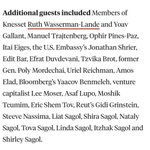
Many thanks to @Daroff for giving me time to present the viral social media campaign to bring tourists back to Israel.
William is CEO of the Conference of Presidents of Major American Jewish Organizations, making him one of the most influential figures in American politics and community life. He was supportive of this initiative that I'm leading, and encouraged me to shoot for the moon. He agreed to keep watch as things progress.
He is also the first person to challenge me with a Passover reference. "Ma nishtana," he asked me, as he tried to dig out what separates this campaign from all the rest.
I told him about the celebs and influencers in the pipeline and the mega giveaway campaign that guarantees virality. The relaxed vibe that exudes confidence in Israel's ability to provide a world-class experience. And there's one last surprise -- but that one I'm keeping close to the chest. 😘
William is right to question this project's uniqueness. It either speaks for itself, or it doesn't.
Time to execute!
✌️

Three years as Israel bureau chief broke my spirit, largely because I failed to achieve my goals to transform the office into one of the best newsbreaking machines in the world.
I failed because I played corporate politics very badly. I wanted to hire barak ravid to break global political news and then redirect the very limited resources we had towards Israeli tech. Those startups were a massively underrated source of global business news -- I broke scoops on Amazon, Tesco and SoftBank from Israeli startup founders as sources. No outlet on earth saw what I saw. It was there for the taking.
But my bosses stood in my way. I was too "nice" to cut through their bullshit.
Yes I kept getting raises. But I ended up quitting after 3 years in that gig. In reality, the thing I feared -- pissing off my bosses would cost me my job -- actually panned out. The thing I desired -- real positive change that was good for everybody -- never materialized.
Given that I ended with nothing, here's what the take-no-prisoners version of Koby would have done:
The second one of the executive editors started putting nonsensical objections to hiring Barak -- not looking so good at the moment, is it? -- I would have fired off an email to the editor in chief, his deputy, and the person in charge of global headcount for news. Then CC the rest of the managerial chain.
Mind you, these were the Covid years. Flying out to New York to develop a relationship with those three and presenting my case in person was out of the question.
Likely all the mid-level guys would have lost their shit. How could I and all that crap. This is of course window dressing for their own insecurity. Bypassing the chain of command triggers this kind of harsh defensiveness because it makes their stupid objections irrelevant.
Put differently. One of their deepest fears is of irrelevance. If some bureau chief in Tel Aviv makes the case of how to run the office better than all of them combined, they fear their judgment is called into question in front of the folks who determine their job security. Get the game?
What matters is simple. Either this organization is serious about optimizing the use of its people or not.
If the editor and chief and his top people aren't, well, I was going down in flames anyway.
Going to the top was the only chance I had at winning. I would have created a handful of enemies, yes, but they would have to show some begrudging respect if the bureau reached new heights.
Because they know what take-no-prisoners Koby is capable of. And he's likely to do it again if they piss him off.
One of my editors phoned me up after my first market-moving scoop as a companies reporter for Bloomberg News. "That's real journalism," he told me.
I was stunned. "Really?" I thought. It was a short article about how one of Israel's biggest banks was planning to trim its staff by 10%. The shares popped. Local press picked up the story.
I thought "real journalism" was Gay Talese or Barbarians at the Gate. That was what drove me, at least. All I did was take out a board member for coffee. Towards the end of our first date, if you will, he spilled the beans. I sent a source note to my team leader, he got it approved by some mega senior executive editor and that was that.
The EE was kind enough to follow up afterwards. This was the kind of sourcing she wanted to see more of, she said. It made me feel like I was walking in rare company.
As you can imagine, this became the backbone of my journalism career. I had to get sourced up. It's what helped me become Israel bureau chief in my 5th year in journalism -- an unheard of rise in a hyper-competitive industry.
There's nothing more thrilling than watching your scoop move markets. You piece together an article, you're never quite sure if everything you got is accurate, you get sourcing signed off by some senior editor, and then BOOM -- some stock, some currency, some bond, whatever, it just takes off, up or down.
As a reporter, contact you have with your readers comes sparingly. When it does, it's almost never instant. You check your reader count obsessively but they're usually just numbers on a page. You never really know the impact of your work.
But a market-moving scoop? That's clear. People trade millions, if not billions, of dollars in a heartbeat because of your work. They show trust in the organization. And if not that, then it's the FOMO of not acting on the story you just published.
Not to mention the satisfaction of knowing that in a bureau, not too far away from yours, your competitors are shitting their pants trying to match what you already got.
Get sourced up. It pays off.
Ps, that's me in the glasses in 2015, celebrating my first "Green B," which is what Bloomberg called back then a market-moving scoop (donno if they still do that). That's why I got all that green stuff in my hands.

If you're a business reporter at one of the world's elite media outlets and you want to stress out because you haven't produced a scoop in weeks, colleagues are going around you to confirm tips, and all you have are flaks as sources, then I suggest you continue to do the following three things you're probably doing already:
1) NEVER MEET WITH SOURCES IN PERSON
Everybody loves being treated like a transaction! Invest zero time in getting to know people and have some strange belief that the brand you work for is all it takes to break news.
You're in a hyper competitive field FFS. They're getting after it. So should you.
2) ONLY THINK ABOUT YOURSELF
This is likely your biggest problem. You're stuck in a loop about what everyone thinks -- other reporters, editors, your bosses -- and how are you going to hang on to your job and how are you going to get ahead. Blah. Blah.
Stop.
Notice how this strategy sucks. Notice how far ahead others are. Notice your output.
Stop.
Start looking at things from the source's perspective. Why would they talk to you? What do they stand to gain? Do they have an axe to grind?
This doesn't automatically get you scoops. It does get people talking. That's how you start attracting more intel. That's how you start building momentum.
3) THINK LINEARLY
You think breaking news about Amazon = speaking only to Amazon employees.
Wrong.
FFS, the world's biggest companies deal with zillions of vendors, service providers, consultants, advisers. They hear things directly from the companies on your beat. They are likely more honest than the companies on your beat.
Maybe they have a project they want to accelerate. Maybe they are trying to sabotage a company initiative they deem harmful. Maybe they're sick of watching the company waste millions and see the good in bringing this to shareholder attention.
Whatever it is, they're out there. And that gives you way more leverage vs the flaks and C-suite next time you want to talk.
Speaking of Leverage, that's the company I built. It's a platform that connects elite business reporters -- WSJ, Bloomberg, FT, Reuters -- to startup founders working with the largest corporations in the world.
The whole point is to help you produce scoops and investigations. We're already working with five WSJ and Bloomberg reporters. DM if you're interested to learn more.
Ps, the man in the picture is Rami Levi, the founder of one of Israel's largest supermarket chains. He's worth well north of $600 million.
I snuck a pic before we started to talk (this was when I was a reporter in Bloomberg's Tel Aviv bureau, before I became bureau chief).
You can infer whatever you want from this picture and post 😂
