Photo by Kaiser Matin (@kaisermatin)Photo by Kaiser Matin (@kaisermatin)Photo by Kaiser Matin (@kaisermatin)Photo by Kaiser Matin (@kaisermatin)Photo by Kaiser Matin (@kaisermatin)Photo by Kaiser Matin (@kaisermatin)Photo by Kaiser Matin (@kaisermatin)Photo by Kaiser Matin (@kaisermatin)Photo by Kaiser Matin (@kaisermatin)Photo by Kaiser Matin (@kaisermatin)
Follows/retweets do not = endorsement
1
10
2,097
Kaiser Matin retweeted
This origami-inspired helmet can fold flat to fit in your handbag. RABA can be flattened to easily fit in a backpack or handbag, and transformed into a 3D helmet in seconds using the dial on the back. #gigadgets #innovative #origami #helmet #safety
9
112
9
447
Kaiser Matin retweeted
Man with cerebral palsy uses 'sleight of mouth' to create amazing #ORIGAMI art
19
261
33
908
Kaiser Matin retweeted
Microcontroller & Dev Board Comparison – Key Specs & Differences In the fast-moving world of embedded systems, choosing the right microcontroller or development board can make or break your project. Here’s a side-by-side look at four popular platforms: 1️⃣ Arduino Uno Rev3 ⚙️ Processor: 8-bit AVR ⏱️ Clock Speed: 16 MHz ⚡ Voltage: 5V operating 🔌 Peripherals: Simple (sensors, logic gates) ✨ Best for: Beginners, quick prototyping (3.3V output, 5V tolerant) 2️⃣ STM32 Nucleo F446RE ⚙️ Processor: 32-bit ARM Cortex‑M4 (with FPU) ⏱️ Clock Speed: 180 MHz 💾 Memory: 512 KB Flash / 128 KB SRAM ✨ Best for: Industrial-grade, complex computation 3️⃣ ESP32 Dev Module ⚙️ Processor: 32‑bit Dual‑Core Xtensa LX6 (FPU) ⏱️ Clock Speed: up to 240 MHz 💾 Memory: 4 MB Flash / 520 KB SRAM 🌐 Connectivity: Wi‑Fi + Bluetooth 4.2/LE 🔌 Peripherals: Rich set (I2C, SPI, UART, PWM, ADC/DAC) ✨ Best for: IoT, battery‑powered devices (3.3V logic) 4️⃣ Raspberry Pi 4 Model B ⚙️ Processor: 64‑bit Quad‑Core ARM Cortex‑A72 ⏱️ Clock Speed: up to 1.5 GHz 🌐 Connectivity: Gigabit Ethernet, dual‑band Wi‑Fi, BT 5.0 🔌 Peripherals: PC‑class (media, networking) ✨ Best for: Mini‑PC applications, full Linux OS (5V @ up to 3A) 💡 Bottom line Each platform shines in its own zone: → Arduino → beginner prototyping → STM32 → industrial / compute‑intensive tasks → ESP32 → connected & battery‑efficient IoT → Raspberry Pi → desktop‑like Linux environment Your choice ultimately depends on project complexity, power budget, and connectivity needs. Which board do you reach for first? Let me know in the comments 👇 #Microcontrollers #IoT #EmbeddedSystems #Arduino #STM32 #ESP32 #RaspberryPi #Electronics #FirmwareDevelopment #EmbeddedC #HardwareDesign #RealTimeSystems #TechEducation #EngineeringMindset #CareerDevelopment #Innovation
1
25
136
3,406
Kaiser Matin retweeted
Every word. She’s hilarious. 🤣
1,469
6,108
1,103
33,331
2,361,930
Kaiser Matin retweeted
A population density map of Bangladesh; one of the most densely populated nations in the world.
2
6
470
Kaiser Matin retweeted
“The best classroom in the world is at the feet of an elderly loving person.”
80
838
60
4,682
192,143
Kaiser Matin retweeted
WTF… Claude just did some insane stuff across engineering, chemistry, math and physics 🤯 lemme quickly explain what they actually did 👇: • Hardware: Gave Claude a simple prompt and it designed 3 working electronic devices from scratch. Circuit boards, components, software, 3D-printed cases, everything. Engineers built them and all 3 worked without circuit fixes. Basically turned an idea into real hardware. • Chemistry: Showed it pictures of 4 complex molecules and asked how to make them. No internet, no research papers. Claude figured out full chemical synthesis plans, checked its own work and flagged risky steps. Stanford, Yale and Caltech professors rated the plans around grad-student level. Not lab-tested yet, but imagine how useful this could be for research. • Math: Took on 203 unsolved optimization problems and beat the best-known solutions in 72 cases. Even proved optimality in 45. One involved scheduling 42 trains, where it found a way to cut peak power demand by 2.6%. Think logistics, transport, energy grids, all that. • Physics: Worked on 2 open problems involving black holes and quantum gravity. One was a calculation left unfinished since 2003. Claude found an answer and also figured out an exact mathematical limit researchers had only been able to estimate for years. Both are now in preprints. and the crazy part is these are completely different fields. we're going from AI answering questions to AI actually designing things, helping plan experiments and tackling research problems people have been stuck on for years. some results still need real-world testing and independent verification, but still man… what a time to be alive 🔥
During pre-release testing, Claude Fable 5.2 and Claude Mythos 5.2 worked on ambitious projects in many different fields. Here are a few. From a one-paragraph prompt, Fable 5.2 designed three working electronic devices, including this home voice assistant hub.
1
9
1
41
21,766
On this day in 1957, the laser got its name in a Bronx candy store. Gordon Gould was a 37 year old physics grad student at Columbia. On November 13 he walked into a neighborhood candy store because the owner was a notary public. Gould had nine pages of notes he wanted stamped and dated. At the top of page one he wrote a new word. LASER. Light Amplification by Stimulated Emission of Radiation. Masers already amplified microwaves. Gould figured the same physics would work with light. His notes covered optical pumping and two mirrors facing each other to bounce light back and forth until it built into a beam. He didn't build the first one. Theodore Maiman did that at Hughes Research Labs in 1960 with a ruby crystal and a flashlamp. Charles Townes at Columbia and Arthur Schawlow at Bell Labs were chasing the same idea. Gould's big mistake was waiting to file. He thought he needed a working device first. Others filed ahead of him, and he spent close to 30 years in court. He finally won key patents in 1977 and 1987 and collected millions in royalties. By then lasers were already in barcode scanners, CD players, surgery, chip fabs and factories. Telecom is where the laser paid off biggest. Tiny semiconductor lasers push light through fiber and carry most of the world's internet traffic. Every carrier, cloud provider and hyperscaler runs on optics. The next chapter is happening inside AI data centers. Copper can't keep up with the bandwidth and power that thousands of GPUs need to talk to each other. Silicon photonics and co-packaged optics move the laser right next to the chip, and the big chip and networking players are spending billions to get there. It's going up too. NASA's Psyche mission sent data by laser from about 140 million miles out, and laser links between satellites are becoming standard in new constellations. Ultrafast lasers are cutting parts to micron precision, and laser systems are driving fusion and quantum research. The notebook still exists, candy store stamp and all. Nine pages that started an industry we're still building on. #TechHistory #Lasers #Photonics #OpticalNetworking #AI
1
4
6
681
Kaiser Matin retweeted
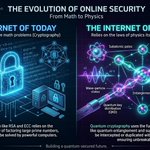
Scientists Just Teleported the Letter Q Through 100 Quantum Channels at Once! Is This the Future of the Internet? Imagine sending information through 100 quantum channels simultaneously without physically sending the original object. It sounds like science fiction, but scientists have just demonstrated something remarkably close. Researchers created a 10 × 10 grid of light, with each of its 100 positions carrying a piece of quantum information. Together, these tiny light patterns formed the letter Q. Here's the fascinating part: Using quantum entanglement and ordinary classical communication, the team transferred the quantum states of light to another location, where the original pattern was reconstructed. No physical image travelled between the two locations! Even more impressive, all 100 channels achieved an average accuracy (fidelity) of 0.60, beating the classical benchmark of 0.52. Every individual channel surpassed that benchmark. Published in *Physical Review Letters* in August 2026, this experiment could help scientists build faster, higher-capacity quantum communication networks in the future. One important detail: This is not faster-than-light communication, and the letter itself was not physically transported. Scientists transferred the quantum information needed to recreate it. Today, it's a letter. Tomorrow, could it be the foundation of a completely new kind of internet? Source: Lou, Y., Wang, J., Zou, Y., Hou, L., Liu, S., & Jing, J. (2026). Hundred-channel reconfigurable quantum teleportation. *Physical Review Letters, 137*, 080801.
15
63
9
173
8,553
Kaiser Matin retweeted
BREAKING: NASA makes U.S. history with first-ever quantum link established between an aircraft & the ground.
402
1,410
329
20,069
1,962,668
Kaiser Matin retweeted
THE QUANTUM INTERNET IS COMING Remember when I said China leads the quantum network race? The US just answered twice in the same week. Result one: Stony Brook and Brookhaven National Lab sent quantum information through open air across 13 miles. No cable at all. The first US demonstration of its kind. Result two: a NIST led team transmitted entangled photons across 62 kilometers of fiber. Not lab fiber but an existing, ordinary, already in the ground telecom cable. The toughest real world test the quantum internet has passed. Why both are hard: entanglement is the resource that makes quantum networks work, and it's absurdly fragile. Temperature, vibration, atmosphere, the noise of regular traffic in nearby fibers, all of it destroys quantum states. Getting them through 38 miles of commercial cable, or 13 miles of open sky is a massive feat. But kilometers aren't the whole story. China's famous 12,000 km quantum backbone runs on an older architecture, trusted relay nodes. Every few hundred kilometers the signal stops, gets measured, gets re-sent. What NIST demonstrated is the next architecture which is entanglement over real infrastructure, end to end, no trusted middlemen. And it rides fiber that's already underground. Every telecom on earth already owns the hard part. What Stony Brook demonstrated is the path off the ground entirely. Free space links are the stepping stone to quantum satellites, the one domain China has monopolized since Micius launched (Though its had its problems). So overall, China built more kilometers of the old design over a decade. The US just demonstrated the new design on buried cable AND in open air, in seven days. This race has just begun. $IONQ $RGTI $INFQ $QBTS
China is further along in Quantum than most give them credit for, and it's a key reason why the US keeps increasing funding and legislation. Here's where China stands. Start with the only number you can pin down: $10 billion. And it's a single building. The Hefei National Laboratory, 37 hectares, the largest quantum facility on earth. Everything else in "China's quantum spending" wraps around that lab such as university grants, a 12,000km quantum network, a satellite. A decade of infrastructure. But it's about to get bigger. In March, China's Five-Year Plan named quantum the #1 future industry in the country. That designation triggers procurement mandates, subsidies, and a $17.5B venture fund behind it. Provinces are stacking their own quantum funds on top, and China Telecom took a controlling stake in the nation's quantum crypto champion with $1.4B+ more planned. The goals are explicit, a general purpose quantum computer prototype by 2030, and 3,000 deployed quantum applications by 2030. China already leads in quantum communications, and it's not close. First quantum satellite, longest unhackable network on earth. Two major results in Nature and Science this last January alone. Where China trails: the part that matters for useful computing. Logical qubits and error correction. No verified Chinese result comes close to Quantinuum's 94 logical qubits or Google's error correction breakthrough. Their best machine runs 180 physical qubits. The most interesting part is that Alibaba and Baidu both shut down their quantum labs and handed the hardware to the state. These next decades will get interesting and it will only spark more US innovation and funding. $IONQ $RGTI $INFQ
45
387
41
1,580
234,255
Kaiser Matin retweeted
⚛️ Matter just surprised physicists again! Scientists have discovered an unusual quantum state called a fractional Fermi sea, where atoms organize themselves in ways that challenge traditional quantum theories. This discovery could open the door to exploring exotic quantum behaviors and mysterious particle-like effects never fully understood before.
7
45
1
139
3,311
Kaiser Matin retweeted
Perhaps love is a form of Quantum Entanglement: two souls connected so deeply that no distance can separate them, no silence can break their connection, and whatever happens to one, somehow resonates in the other. ❤️
5
1
8
169
Kaiser Matin retweeted
🚨 Japan’s Quantum Breakthrough Could Change Everything! Imagine sending information instantly across space without wires, without satellites… just pure quantum magic. Scientists in Japan have made a shocking discovery with a mysterious “W state” — a special kind of quantum entanglement that could open the door to the future of quantum teleportation. While this doesn’t mean people or objects are teleporting yet, it’s a huge leap toward a world where quantum communication is faster, safer, and almost sci-fi level. Experts say this breakthrough could transform computing, secure messaging, and the way we share information across the universe. Could this be the moment when science fiction starts to become reality? Source: Science Daily. (n.d.). Scientists capture W state, unlocking quantum teleportation.
67
242
37
840
32,185
Kaiser Matin retweeted
JUST IN: NASA UNVEILS $10 BILLION MOON BASE CONTRACT FRAMEWORK — SPACEX AND BLUE ORIGIN LEAD NEW LUNAR GOLD RUSH
4
3
62
7,777
Kaiser Matin retweeted
Just announced at MAX POWER: a $1 million Moon Base Student Challenge! go.nasa.gov/3UBpcCs The competition tasks U.S. high school and post-secondary student teams to develop solutions to real-world engineering constraints for establishing a long-term human presence on the Moon.
276
564
78
3,447
702,524
Kaiser Matin retweeted
A heart doctor told me: “There are 3 kinds of people who will not get heart attacks.” 1. The ones who never wake to pee at 3 AM
24
131
2
1,051
880,008