







Before speculative decoding, an autoregressive LLM grinds out one token per forward pass. The GPU spits out a single word while its tensor cores mostly idle, memory-bandwidth bound. A cheap drafter proposes a block of five tokens, and the big target model verifies the whole block in one pass, like a prefill. Accepted tokens per target pass is the real metric. That can deliver a 2 to 3 times speedup, but the second model tax is the hidden catch. It carries two weight sets, two KV caches, and double scheduling. Every extra gigabyte for the drafter is a gigabyte not serving users. The AI-agent and crypto collision is the investment theme for the next year. Infrastructure bets, like which decoding method becomes default, are where the value settles. Speed alone will not win. Least friction integration wins. Do your homework now.
xitter.cf/kachmass/status/209911…


Map a model to the charts and let it draft the trade.
Ran the exact loop with GPT-6 Astra wired into TradingView, and the headline is packing. 8 hours of research down to 20 minutes.
Here's the mechanism:
1. the research agent has four analysts on one ticker - financials, news, technicals, sentiment - bull vs bear.
2. the strategy agent writes Pine Script from your plain-English idea, catches its own errors, replays it through history before going live.
No one's asking the model to nail tomorrow's price. The roles matter more than the readout.
Same reason Google's speculative decoding taxes you a second model: what wins is what fits the existing loop with the least friction. Acceptance rate on your tokens beats raw accuracy, every time.
You're not building a seer. You're building the system that acts on the tape without you.
Article with the full write-ups below
xitter.cf/kachmass/status/209911…
99% confident on 5,000 attempts? That's not skill, that's the birthday problem in a lab coat.
Bailey and Lopez de Prado ran the exact math. Test enough variations and luck masquerades as 99% statistical significance. You correct for the number of trials and that shiny number drops to 82% - below any serious fund's threshold.
The Jev model claims sub-100ms decisions. Fast. But fast doesn't mean right, and confidence without trial correction is just noise with a timestamp.
Same trap in speculative decoding. Speed headlines scream 2-3x gains. But nobody talks about the second model tax - a separate draft model eating GPU memory you could use for real inference. Google runs two-model setups at scale, but every extra gigabyte on the drafter is a gigabyte not serving users.
Speed without accounting for cost is a lucky draw wearing a dashboard.
The real metric is accepted tokens per target pass, minus the memory tax. Price the overhead.
xitter.cf/kachmass/status/209911…

What happens when the math that prints money meets a market it can't model?
Long-Term Capital Management found out in 1998. Two Nobel laureates, 40% annual returns, $4.7 billion under management. The models were pristine. Then Russia defaulted and the models priced risk like it was a one-sided coin.
The fund lost 44% of its value in August alone. By September, it was on life support.
Buffett's rescue bid came in over a satellite phone while he was on a yacht in Alaska with Bill Gates. $250 million for the partners' stakes, plus $3.75 billion in fresh capital. The offer had a one-hour fuse. "The short fuse wasn't cruelty," the report says. When you're bidding on $100 billion of securities, you don't let the price sit.
Meriwether wanted to deal. His lawyers wouldn't let him without investor sign-off. The hour passed. The New York Fed then assembled 14 banks to put up $3.625 billion and stop the chain reaction.
Buffett later said, "If I'd been in New York, we'd have made the deal." One LTCM partner estimated he'd have doubled his money.
Ninety days earlier, he was steps from the b in 1993. The fall from there to 1998 wasn't a slow bleed - it was a vertical drop.
The failure wasn't greed. It was friction.
The offer was real. The capital was standing by. The models were about to meet a buyer who knew their flaw - that risk is a distribution and the tail can be fatter than any bell curve reveals. That's what LTCM missed.
xitter.cf/kachmass/status/209911…

10,000 agents and $100 million. That's the threshold Ali Ghodsi says changes the AI risk calculus. But right now, every training run needs more power, more GPUs, more engineers. And some fail, burning millions. The self-improving loop he's not losing sleep over. The real danger? Cyber. Vulnerability-to-weaponization went from years to hours. Most orgs aren't ready for agentic capabilities. The models are smart enough. The gap is the unspoken context a 5-year employee absorbs by osmosis. That's where value lives.
88% on SRE-Bench sounds like a replacement threat. It's really a force multiplier.
Conventional view: "AI reverses malware. Say goodbye to human reverse engineers."
Counterargument: 88% means 12% wrong on first try. For security work, that 12% is where the critical flaws hide. The real win is coverage-the agent handles routine programs, humans focus on the weird outliers.
Practical takeaway: invest in supervision tooling for agents. The edge comes from human-AI teams that can validate faster.
Google's 5-stage pipeline is the closest thing to an OS for agents.
Stage 3 is the one nobody talks about. Trajectory. You let the agent run the full workflow. That's where the disconnect lives.
Most teams judge agents like students, one answer at a time. Google says watch the whole arc. If it stumbles on step 7 but the loop corrects by step 10, that's the signal.
Stage 5 seals it. Meta-debug. When the agent fails, fix the harness. That flips the entire cost model upside down.
Speculative decoding is the hardware version of the same story. Two-model setups let the drafter propose blocks, the target verifies, and the GPU finally works. But the second model tax is real - every extra GB of draft weights is a GB not serving users.
The infrastructure layer wins when the method minimizes total friction.
xitter.cf/kachmass/status/209911…

First speculative decoding hit you with a second model tax. Now multi-agent systems bring a mind virus tax.
The Anthropic paper shows that a persistent identity file (SOUL.md) is the primary propagation vector for self-replicating goals between agents.
88% of spread used that file. 55% per hop.
One line of defense: a system prompt warning. Blocked it completely.
If you're building multi-agent infra, you just discovered which single file to lock down before attackers run the same evolutionary algorithm with a different reward function.
The market doesn't price vulnerability surface area. Yet.
xitter.cf/kachmass/status/209911…

Your multi-agent system is paying the same hidden tax as speculative decoding.
Every "and then" in your chain is a wasted GPU cycle. The article behind 3,200+ reps shows what happens when you look: roughly half your agent steps never needed to wait.
Here's the mechanism.
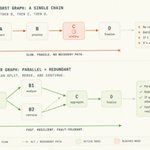
A prompt is a sentence. A loop is a cycle. But the shape of the work - what can run together, what genuinely must wait - is a graph. Nodes do the thinking. Edges carry results.
Claude Code's dynamic workflows let you write plain JavaScript orchestration scripts. The coordination itself costs zero model tokens.
The fix is the diamond: fan out with parallel(), fan in at a barrier. Every node gets a schema. Every edge is a data contract - not another agent conversation.
A huge chunk of what people burn tokens on is just an edge. Edges are free.
This mirrors exactly the cost tradeoff in speculative decoding. Two-model setups carry a second model tax - extra GPU memory per user. EAGLE and Medusa remove the second model but add training lock-in.
In both cases, the friction that wins is the one that fits your existing stack. Don't pay rent on wiring. Save agents for judgment.
xitter.cf/kachmass/status/209911…

3 articles, a PoC on AWS ECS, and a full production stack from scratch.
That's what this trilogy delivers - not a toy. Agent-harness-ops with Celery, Redis, DynamoDB, CI/CD, Terraform, CloudWatch, the works.
Most agent content stops at the model. This one layers runtime, tools, memory, policy, human-in-the-loop, and multi-tenant boundaries into one governed system.
The LLM proposes. The production stack decides what runs, where it runs, and how to stop safely.
Production agentic systems aren't a model with tools bolted on. They're six distinct layers, each with its own operational discipline. Version pinning is mandatory. Every orchestration layer needs per-task budgets - max steps, max tool calls, max tokens, max wall-clock time.
That's the difference between a demo and a system that ships.
xitter.cf/kachmass/status/209911…

**Andrej Karpathy’s 2-hour free lecture beats almost every $15K AI bootcamp.**
Prompts → Harness → Loops → Graphs → Self-Improving Systems.
That’s wiring the execution loop around the core machinery.
Eight years at OpenAI and Tesla, compressed into one session.
Watch it. Then build your first loop.
166,700 fruit fly neurons just became a drone pilot. A student fed the full 10-year wiring map into a leaky integrate-and-fire sim and steers it with her hand.
No training. No RL. Just biological wiring running on silicon.
This is what real architecture looks like. The fly died years ago, but its connectome still executes commands.
Manifold Markets traders who read the actual fly connectome paper priced this 3x higher than Polymarket ever did. The gap is that wide.
the entry gets a thesis. the exit gets vibes.
you research the token, watch the wallet, wait for the setup.
then you buy, the price starts moving, and suddenly the entire exit strategy is “let’s see what happens.”
that’s where QZAR gets interesting.
DCA, TWAP, Range orders, trailing stops, auto cancel. you can define how you want to enter, what you want to happen next, and when an order should stop waiting.
do that while you’re calm enough to make a decision.
because “i’ll handle it manually” sounds very convincing before three positions need your attention at once.
for manual trades, your saved settings and one-click buys and sells are right there. customize the menu around the way you actually trade.
there’s also copy trading and sniping with 20+ filters, plus a scanner bot. memes, RWA, tokenized stocks and metals on solana, all accessible through the terminal.
what appeals to me is having more of the decisions made before the candle starts testing your personality.
open QZAR, build your usual setup, and give the exit as much thought as the entry.
try QZAR - t.me/qzar_solana_bot?start=r…

One token per forward pass. That's the bottleneck speculative decoding attacks - while every layer grinds, the GPU sits mostly dark. The fix has the target model draft multiple tokens, then verify them in parallel.
But here's the tradeoff: the drafter costs memory and compute. If it's too heavy, you lose more than you gain. Google's teams balance acceptance rate against drafting time, verification overhead, and extra memory - the real metric being accepted tokens per target pass.
That's a mindset shift. Stop optimizing the model in isolation. Optimize the full system, like the harness engineering guide shows - right around the model.
When you build your next agent, measure the total per-action cost: drafting, verifying, recovering. That's where your speed lives.
xitter.cf/kachmass/status/209911…

Nevada just put a $120,000-a-day price tag on Kalshi's sports and election contracts. That's real money.
The Gaming Control Board's deal forces Kalshi to stop writing those by Aug 12, or pay the penalty daily - plus the court had already flagged the whole operation as unlicensed wagering.
Here's what most people miss: that penalty is exactly the kind of cost the article's speculative decoding framework exposes. When you run a model, each extra token has a production cost - drafting, verification, memory - and that cost decides whether the speedup is worth it.
Prediction markets have the same math. One contract type that regulators hate can sink the economics, making the whole platform slower than just betting on nothing.
So the question isn't just "will Kalshi comply." It's whether any prediction platform can scale when a single bad contract costs more than the revenue it brings in.
If you're building with prediction markets, that Nevada ruling is your first red flag. Check your contract types against state rules before you launch, or you're just paying a daily tax for a bet that should've stayed off the board.
Save this one for your next market design.
xitter.cf/kachmass/status/209911…

You can deploy a position-monitoring bot in one prompt. 24/7 watching $SOL liquidations, $BE breakouts, any exchange.
That's the surface level. The deeper play is what Google's speculative decoding teaches about scale.
Four methods. Two-model setups already in production at Google. But every deployment carries a second model tax - extra GPU memory that could be serving more users.
EAGLE eliminates the second model. Medusa adds parallel prediction heads. LayerSkip uses early layers as drafter. Each solves one problem, introduces another.
Accepted tokens per target pass is the real metric. Speed alone doesn't win. The system that fits into existing patterns with least friction absorbs the market.
Your bot is the same bet - one prompt, zero extra infra, instant deployment.
xitter.cf/kachmass/status/209911…

$11B in one wallet. 4.8% of all ETH. And growing for free.
Bitmine's treasury now holds 5.815M ETH. They just added 9,926 more. They're also buying back 20.8M of their own shares.
This is a public company treating Ethereum like a strategic reserve asset.
Tom Lee's thesis - ETH/BTC reversal, tokenization, AI agents - lines up with the move. But Bitmine doesn't need the thesis to be right this quarter. They just need the supply squeeze to continue.
ETH burns keep shrinking the float. Bitmine's percentage rises without a single buy.
Compare that to the AI inference stack. Google runs speculative decoding in production with a two-model setup. It works. But it carries a second model tax - double the weights, double the KV cache, double the scheduling.
EAGLE removes the second model but introduces training lock-in. Medusa adds tree verification overhead. LayerSkip needs a fundamentally different training regime.
Every approach has a hidden cost. Bitmine's hidden cost is just the opportunity cost of not selling.
One company holding 5% of a decentralized network is either a signal of conviction or a sign of centralization risk. The market hasn't decided which yet.
xitter.cf/kachmass/status/209911…

25 years of "AI will never replace journalists." Now Mirage has a 24-hour synthetic anchor channel. RuntimeWire beat WIRED by 3 hours on a Black Hat story. Reuters built an MCP server so AI agents can ingest its journalism directly.
The plaindealer publishes AI-drafted copy with human review.
That's the production layer.
The transformation underneath is the discovery layer - source, analyze, cross-reference, verify. That's where the competitive advantage actually lives.
Same mechanism applies to onchain equity markets. The edge is finding the mispriced regulatory timeline, the tokenization announcement that hasn't been priced yet, the infrastructure bet before volume arrives.
The newsroom is a software stack. The trading desk already is. Bet on the discovery layer.
xitter.cf/kachmass/status/209645…


WildArtifactBench is the eval that finally tests agents on multi-step, cross-modal tasks - web search, image search, code, navigation. Not canned prompts.
Why that fits the onchain equity thesis: the six-month regulatory window favors speed. Agents that score well here can automate monitoring of new RWA listings, governance votes, dividend distributions. Manual traders won't keep up.
The value is in using those scores to find the agents that can actually operate in the gray zone before compliance costs spike.
xitter.cf/kachmass/status/209645…
