

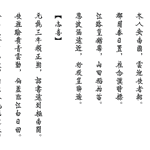


it works quite fine


Thanks to Nôm Na Việt, there is now a font for the Lệnh thư script. This script is unique to Lê dynasty Vietnam. It was used specically in edicts. It is the first ever font for Lệnh thư. It was machine generated
The font supports chữ Nôm.
github.com/nomnaviet/nnv-fon…


I think they’ve broken up.
Earlier, I heard a really loud argument over there. They were even banging on the table and yelling and shit. It seemed like the woman was in the man’s apartment, because he kept telling her to 'get out and get lost', several times. Things like, “I don’t want to see your face anymore,” and so on. It was pretty intense, every time things quiet down a bit, I even check the clock just in case a murder happens and the police question me about it. Then there were sounds of someone being shoved or knocked over, followed by “Don’t touch me!” etc etc. After a while, I knocked on their door. A young man came out, around 30, bald, a little shorter than me, with a face that looked like he wanted to kill me too. I asked, “What are you guys fighting about? You’re making so much noise.” He corrected me, still glaring like that: “Arguing, not fighting.” I immediately got a sense of what kind of person he was, but I figured he was just angry, so I didn’t take it personally. I told him, “Please keep it down a little.” He just replied, “Yeah,” and closed the door. It’s been quiet ever since.

to my neighbors next room, if you're going to have sex, please go to a motel, the soundproofing in this building is really not that great
4
319

The way historical place names were coined in Vietnam is seriously underrated in some cases. For example, after passing through Southern Pass, before reaching the main territory of Annam, you would first have to cross a pass called Demon Gate Pass (鬼門關). And besides Annam and Jiaozhi, Vietnam also had another name used by both chinese and vietnamese which literally means Fire Nation(炎邦).


The person who's in charge of the store's page loves putting the products' images into AI and make videos out of them. I don't really know what to feel about it
2
6
585


During the Xia dynasty, the first day of the 1st lunar month was designated as the beginning of the year. During the Shang dynasty, it was the first day of the 12th lunar month. During the Zhou dynasty, it was the first day of the 11th lunar month. After Qin Shi Huang unified the Six States, he once again changed the date, designating the first day of the 10th lunar month as New Year's Day. Thus, calendar resets did not always move the beginning of the year to spring.
In the first year of the Taichu era, Emperor Wu of Han commissioned Sima Qian to establish the Taichu Calendar (太初曆), which restored the Xia system by designating the first day of the first lunar month as New Year's Day. For this reason, it also came to be known as the Xia Calendar (夏曆).
As for the two characters “春节” (Chunjie, Spring Festival), their earliest known appearance seems to be in the Biography of Yang Zhen in Fan Ye's Book of Han, written during the Southern Song dynasty (1127–1279): “又冬无宿雪,春节未雨,百僚焦心。” (Moreover, there had been no lasting snowfall during the winter, and no rain had fallen by the spring period, causing all the officials to grow deeply anxious).
However its use as a replacement for New Year period has a history of only slightly over 70 years. As for the designation of the year itself, during the time of Yao and Shun it was called zài (載), during the Xia dynasty, it was called suì (歲), during the Shang dynasty, sì (祀), and it was not until the Zhou dynasty that the term nián (年) came into use. (年 ,孰孰也。)


