

I'm a birder, bird-bander and I'm mainly targeting shorebirds and passerines and owls in the northeast of Japan.🦉
Joined November 2017
- Tweets87
- Following207
- Followers300
- Likes1.1K
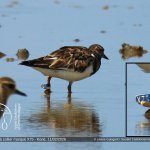



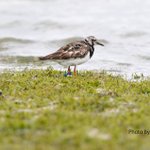


A Ruddy Turnstone released by me in Miyagi, Japan, was seen on 11 Feb 2026 near Koné, New Caledonia. Amazing that a bird from my local area reached the South Pacific — perhaps even hanging out with Kagu!
Thanks to Liliane Guisgant and the SCO for reporting this Record.


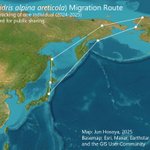
One of the Dunlins we tagged with a GNSS logger last winter has returned! The bird completed a round-trip migration of at least 13,500 km between Miyagi, Japan and the Arctic coast of North America—an incredible journey for a 60-gram bird. Truly amazing!

1
3
124

2024/5/1 The Solitary Snipe (Gallinago solitaria wintering here) just before migration is working hard to accumulate fat. Where do they migrate to? There are few of them remaining in my study area. Now, many Latham's snipe (Gallinago hardwickii) have arrived here to breed.
4
514
I have been studying albatrosses in the northeast region of Japan off the Pacific since 2014. One of my main goals is to determine the mysterious breeding site of some Short-tailed albatrosses that are not ringed. #WorldAlbatrossDay


13
664
Several Solitary Snipes are remaining yet. I recaptured a Solitary Snipe on the 23rd, originally ringed at the same place (25 m away) in a year (24th Apr 2023).This individual has almost finished its moult and stored its fat (161.6 g). They might go to breeding areas in a week.

We caught and banded 13 species and 35 birds last Sunday in Sendai-city, Miyagi Pref. Japan, including two Redーflanked bluetailes. What fantastic birds.


18
A Ruddy Turnstone flagged at Torinoumi Miyagi Pref. Japan was resighted in Lord Howe Island, Australia, on 9th October 2022 by Mr. Liam Murphy!
It's 7,900 km from our site, but it must have flown from the low Arctic region, so it must have been more than 10,000 km.


A Red-necked Stint resighted in Thailand! I captured this bird on 21st Sep 2019 at Torinoumi Miyagi Pref. Japan as Juvenil. On 12th Oct 2022, Mr. Thanakrit Khamsanoh resighted it in Baan Pak Talay, Ban Laem, Phetchaburi, Thailand. It has been 1117days and 4800 kilometres.


I know many birds can be identified by the shape and length of thier bill. Still, the slightest difference in angle can make them look complately different! These 3 photos are all of the same individual (Lesser Sand-Plover)


I'm happy to participate in this important article about shorebirds, recently published in Oecologia. The article uses stable isotope from shorebirds' feces and breath to infer shorebirds' diets through feeding and field experiments.
link.springer.com/article/10…

3
One of the snipes I caught last night seems ready to go toward the south. The fat score was 4(Meissner 2009), and the weight was 217.5g!


I ringed 118 waders last Friday night!
Bar-tailed godwit J1, Great knot J3, Broad-billed J1, Long-toed J8, Red-necked J77, Terek Sand J21, Common sand A3+J2, Grey-tailed Tattler A2, Wood sand J1 and Latham's snipe J1
A big wave of Juv Red-necked stint!


We did a "Big-day" on 3rd Jan 2022! Our team confirmed 90 species, excited and exhausted.
The competition in Japan, 10 teams took part, 202 species were confirmed, and the best team confirmed 108 species.
here are the details https://xitter.cf/t.co/jJ1oUI8icY
7
I caught and ringed a woodcock U/A using torch. In our area (north east of Japan) , only a small number of them winter here.


I found and caught a Solitary Snipe! Its distribution is limited in Asia and we don't know this species well, so I want to learn about them by catching them. It was a beautiful and amazing bird.


