

part of https://xitter.cf/t.co/J2hhqo9EMf and https://xitter.cf/t.co/0C86ppFoKf 🧠 think-design-code 👨💻🛠 brew beans ☕️ eat sushi 🍣 read books 📚 jundialwan anywhere else 🌏
Indonesia
Joined August 2011
- Tweets19.9K
- Following3K
- Followers2.1K
- Likes17.6K





official workspace mcp server lesgooo
cloud.google.com/blog/produc…

102
meeting.ai is now available on hermes agent
hermes plugins install meeting-ai
get things done with your agent based on your discussions from zoom gmeet teams or in person meeting
no need to copy paste the transcript or note file anymore
hermes-agent.nousresearch.co…

2
254
jun 🇮🇩🇵🇸 retweeted

One reason founder CEOs are so hard to replace is that they’re effectively also the chief product officer. They know how the product was built, can hold the entire product in their head, and have the vision and authority to reinvent it.
When they leave, the CEO role gets filled, but the product role they played rarely does.


jun 🇮🇩🇵🇸 retweeted

What's most changing in tech jobs right now:
Declining:
• Front-end engineer: −51%
• iOS/Android engineer: −46%
• UX researcher: −45%
• Product designer: −28% (record low)
Rising:
• Forward deployed engineer: 4.6x
• Hardware engineer: 2x
• AI engineer: +46%
• Security engineer: +34%
Plan accordingly.
(Based on % change in open roles over the past year)

STATE OF THE TECH JOB MARKET IN 2026
Twice a year, I dig into trends in hiring and job openings. This is the fifth report I've done, and the most surprising yet:
1. PMs are winning in the AI era
2. Engineering demand has stalled
3. Design openings are at a record low
4. Every role now requires AI skills
5. Tech jobs are concentrating in the Bay Area
6. Remote roles are at a record low
7. The tech job market is growing fast, but mostly outside of software (gasp!)
Full report here: lennysnewsletter.com/p/state…


jun 🇮🇩🇵🇸 retweeted

hot take: you don't need a software factory, and i don't love the term. it's just marketing
all you need is good software engineering and investing your tokens in the right places. the more deterministic the better (and token efficient)


jun 🇮🇩🇵🇸 retweeted

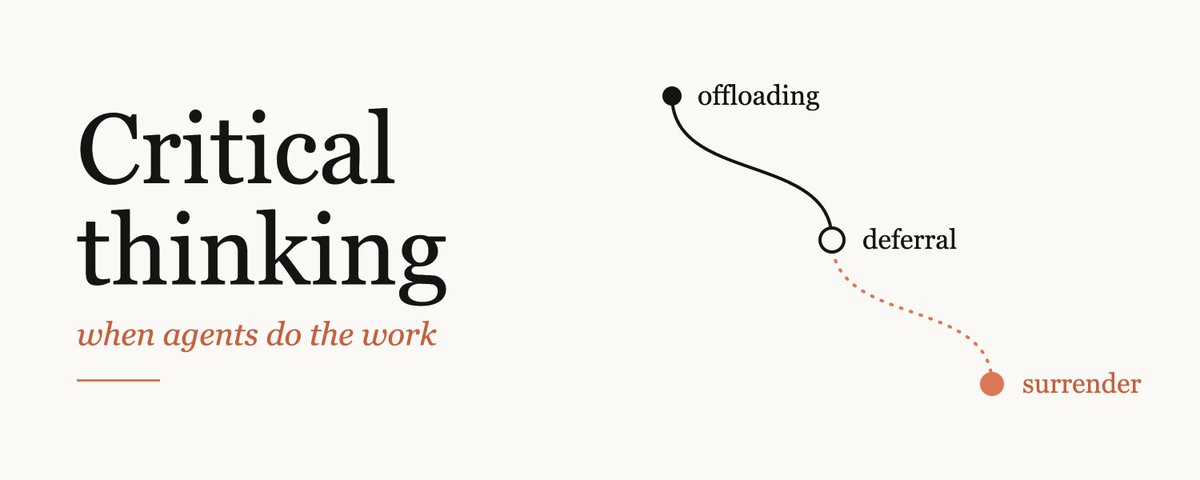
HOLY: Anthropic's Claude Code engineer Addy Osmani is warning about a brutal AI paradox: the more coding you hand to agents, the more you risk losing the very skills needed to supervise them.
He calls it "cognitive surrender." AI-generated code looks pristine, tests pass, and engineers start approving work they no longer understand.
Anthropic's own research warns: "supervising Claude requires the very coding skills that may atrophy from AI overuse."
Osmani makes a striking observation: "When you're producing more than you can stand behind, you're no longer reviewing. You're hoping."


jun 🇮🇩🇵🇸 retweeted
maybe a hot take but i now consider adversarial reviews mostly a waste of tokens. far better to use those tokens on empirical combined with formal verification. i have updated pstack to use the interrogate skill less, and eventually i think i may remove it altogether
i have found very little value with code review in the abstract, agents tend to just get lost in the nitpicks and yagnis
jun 🇮🇩🇵🇸 retweeted
how do you trust your agents' work more? copy this post/link and give it to your @bot or agent!
1. codebase improvements: this is just good software engineering - better architecture, stronger types and invariants, clear boundaries. agents love to copy what exists and take the shortest path, so make the easy thing the right thing. categorically eliminate problems through code and you won't need to think about it again.
2. static analysis: lint rules, tests, CI, verification (eg TLA+). very token efficient ways to catch issues ahead of time.
3. prose: comments, rules, AGENTS.md, skills - anything that can't be enforced and requires agent judgment. use it minimally, but do use /create-verification-skill.
4. human review: the hardest to scale. at the rate agents land code, it's pretty much impossible to thoroughly review every PR, so spend that effort on the highest leverage point, designing an environment where agents do the right thing by default.
this forms an inverse pyramid: you want most of your effort at the top, least at the bottom. codebase improvements are deterministic, making it more token efficient, and lets you sleep more soundly at night.
install github.com/cursor/plugins/tr… and create a new Project:
1. look through my slack/chat messages and code review comments where i've given feedback on PRs, code, architecture
2. use /recall on my past transcripts to learn how i steer agents
3. /poteto-mode use /correct and /architect on past commits to find the most common pitfalls agents fall into, then propose a plan to rearchitect the code i own so it's more agent friendly. answer open questions with prototyping rather than defer to me, and back the plan with real data.
4. before you begin, use /sharpen + /in-your-own-words and confirm this prompt with me

jun 🇮🇩🇵🇸 retweeted

My dear friends, I’d like to show you my latest toy project
Introducing Handwired: turn your regular JavaScript code into a neural net!
- no training
- exact outputs vs the JS program
- fully differentiable
All runnable in a browser, without GPU
jun 🇮🇩🇵🇸 retweeted

We have built 10 different AI products at PostHog like PostHog AI, our Wizard, Replay Vision, Scouts, and more. Combined, they are used by nearly 100k people every month.
Along the way, we’ve learned a lot about building them, what works, and what doesn’t. Here are the 38 most important lessons:
jun 🇮🇩🇵🇸 retweeted

Dusting off this tweet from April because this gap in shared understanding of LLM capability is *widening*. It's now less "two groups of people speaking past each other" and more a sharp funnel.
- Napkin math somewhere around 6B people (~75% of the population) have barely come in contact with LLMs at all.
- Around 1-2B (~20%) are casual and infrequent users of free-tier ChatGPT-like products. This group sees derpy chatbots and treats them a bit like a better Google search, a writing aid, or etc. Maybe an agent tries to book you a flight. I have non-tech friends who (reasonably, imo) say they have not much use for it at all. Even many professionals outside of math&code are in this tier. For example, execs and many other functions spend a lot of their time talking to other people, so while they understand what is happening intellectually, it is still second-hand and a bit abstract.
- Now we get to professional use of frontier-grade LLMs in math&code. Somewhere around 20M people (0.2%) see first-hand that large, complex projects that used to take them weeks/months can now be completed by agents with a prompt. Building apps, copying apps, translating apps, decompiling apps from binaries... This has all happened very quickly and recently - less than 1 year ago, I was writing code manually by hand, typing memorized computer code commands into a code editor character by character, occasionally pressing Tab to autocomplete a little chunk of code.
- And finally we get to the ~5,000 people (~0.00006%) with access to frontier-grade systems internally. The external world has seen the preview. It looks like swarms of thousands of agents collaborating over weeks on software mega projects: minting zero days, running cyber attacks and defenses at machine speeds, discovering new science, advancing the frontier of mathematics. Things that would have taken top professionals in the industry years of work. Meanwhile, human review and comprehension are starting to fall behind. For example, people are still involved in the "archeology" of the OpenAI-HF incident from many months ago. Mathematicians may be poring over the 722 manuscripts on frontier mathematics for a while.
The funnel is driven by a combination of factors:
1. The impact scales with ambition, problem size, and horizon. A question with a paragraph answer barely stresses the system. You need a reservoir of big, difficult problems that you really care about. This aspect drives the consumer / professional dimension of the funnel.
2. The jaggedness of the system (which I have written about a lot separately). Capability peaks in domains that are digital, verifiable and economically valuable. This is because LLM capability emerges from reinforcement learning on verifiable rewards on a curated environment mixture driven by revenue potential. This aspect primarily drives the area (e.g. math&code) dimension of the funnel.
3. Access. Free-tier, paid-tier, internal.
So this is the weirdness of the moment. The general public has mostly not interacted with these systems. When they have, it looks like a derpy chatbot. The majority of professionals still see only a modest uplift. And a small sliver of professionals are experiencing the vertigo of the curve going vertical. And it is all happening at the same time.

Judging by my tl there is a growing gap in understanding of AI capability.
The first issue I think is around recency and tier of use. I think a lot of people tried the free tier of ChatGPT somewhere last year and allowed it to inform their views on AI a little too much. This is a group of reactions laughing at various quirks of the models, hallucinations, etc. Yes I also saw the viral videos of OpenAI's Advanced Voice mode fumbling simple queries like "should I drive or walk to the carwash". The thing is that these free and old/deprecated models don't reflect the capability in the latest round of state of the art agentic models of this year, especially OpenAI Codex and Claude Code.
But that brings me to the second issue. Even if people paid $200/month to use the state of the art models, a lot of the capabilities are relatively "peaky" in highly technical areas. Typical queries around search, writing, advice, etc. are *not* the domain that has made the most noticeable and dramatic strides in capability. Partly, this is due to the technical details of reinforcement learning and its use of verifiable rewards. But partly, it's also because these use cases are not sufficiently prioritized by the companies in their hillclimbing because they don't lead to as much $$$ value. The goldmines are elsewhere, and the focus comes along.
So that brings me to the second group of people, who *both* 1) pay for and use the state of the art frontier agentic models (OpenAI Codex / Claude Code) and 2) do so professionally in technical domains like programming, math and research. This group of people is subject to the highest amount of "AI Psychosis" because the recent improvements in these domains as of this year have been nothing short of staggering. When you hand a computer terminal to one of these models, you can now watch them melt programming problems that you'd normally expect to take days/weeks of work. It's this second group of people that assigns a much greater gravity to the capabilities, their slope, and various cyber-related repercussions.
TLDR the people in these two groups are speaking past each other. It really is simultaneously the case that OpenAI's free and I think slightly orphaned (?) "Advanced Voice Mode" will fumble the dumbest questions in your Instagram's reels and *at the same time*, OpenAI's highest-tier and paid Codex model will go off for 1 hour to coherently restructure an entire code base, or find and exploit vulnerabilities in computer systems. This part really works and has made dramatic strides because 2 properties: 1) these domains offer explicit reward functions that are verifiable meaning they are easily amenable to reinforcement learning training (e.g. unit tests passed yes or no, in contrast to writing, which is much harder to explicitly judge), but also 2) they are a lot more valuable in b2b settings, meaning that the biggest fraction of the team is focused on improving them. So here we are.
jun 🇮🇩🇵🇸 retweeted

"Almost every software development organization has at least one developer who takes tactical programming to the extreme: a tactical tornado. The tactical tornado is a prolific programmer who pumps out code far faster than others but works in a totally tactical fashion. [...] In some organizations, management treats tactical tornadoes as heroes.
"However, tactical tornadoes leave behind a wake of destruction. They are rarely considered heroes by the engineers who must work with their code in the future. Typically, other engineers must clean up the messes left behind by the tactical tornado, which makes it appear that those engineers (who are the real heroes) are making slower progress."
@JohnOusterhout, A Philosophy Of Software Design, 2018
Sound familiar?


jun 🇮🇩🇵🇸 retweeted

the right way to use model capabilities is not to ship 10x more features to prod
it's to spend more time understanding your users, trying experiments, building prototypes, learning about things you don't understand so that you can ship things that actually work

