



Jag retweeted

2/ Bring your own compute.
Each bot gets its own Space, a desktop with its own screen and apps. Run it on your laptop or the office Mac mini, in your own AWS, Google Cloud or Azure account, or on a sandbox provider like E2B, Daytona or Modal. Watch it work and take over anytime.
Jag retweeted

Chrome DevTools for Agents is powerful. If you don't already have it in your workflow, I would strongly consider it! It's been useful for testing, and works with all my various agents
The video shows scaffolding and then testing WebMCP tooling right in one prompt:

Jag retweeted

Satya Nadela is basically describing the death of the traditional SaaS model.
Explains the AI agentic future, and where the "value" lives.
Because business logic is moving from the software application to the AI agents.
Currently, you buy software for its specific features and rules.
Nadella argues that in the future, software apps will essentially become dumb databases ("CRUD") or simple tools.
The AI Agent will hold all the intelligence, orchestration, and reasoning, simply updating the databases as needed. The software becomes a commodity; the AI becomes the "brain" and the worker.
Video from Bg2 Pod Youtube Channel
Claude Opus 5.5 is on another level.
Ever since it dropped, my building speed has been unreal. I was previously leaning on ChatGPT Astra on the Max plan and while Astra is solid, scaling it gets astronomical expensive.
Opus 5.5 is hitting that rare sweet spot of insane quality, speed, and sustainability.
Anyone else migrating workloads over? Are you seeing this kind of jump in output?
#Anthropic #DevCommunity #google
Curious why so many devs are comparing Opus 5.5 vs. GPT Sol for coding.
Try handing a complex, real-world build to GPT-6 Astra and Opus 5.5 side by side instead.
If you’ve tested both on real agentic workflows, drop your findings below 👇
#ClaudeAI #OpenAI #AgenticCoding #DevCommunity
Huge win for @claudeai Opus 5.5.
Was troubleshooting running a pi agent in a @Docker sandbox for the @omnigent_ai harness. While GPT-6 Astra light gave it a solid effort with multiple checks and tests, it got stuck. Opus 5.5 took the exact same task and resolved it in an hour flat. Brilliant execution.
@AnthropicAI isn't kidding - matching Fable 5.1-level performance while cutting typical run costs by 40% vs Opus 5 is a massive leap.
anthropic.com/claude-opus-5-…

Jag retweeted

alright - just got Jev deployed for a real production use case, which now performs at fable level quality but 10x faster and saves a ton of money
context - a powerful capability of firstmate is that as an orchestrator it intelligently routes each task to an appropriate agent (permutation of harness, model, and reasoning effort) based on custom user preference
by default, that's done by the firstmate agent and the LLM would have to do some thinking, make tool calls to read dispatch rules, quota data etc and then do the dispatch. this is slow and does cost a bit of LLM tokens
i just replaced this dispatch process with Jev. it makes the same decision with no thinking or tool calls, done in ~200ms, and for the 25 tasks i evaluated this with, it gives the exact same answer fable would have given...
there's still a tool call needed to invoke Jev, done by the firstmate agent which uses an LLM. but even with that counted, the saving from Jev still resulted in a -71% reduction in cost and -90% reduction in wall time of completing the whole dispatching process
Jev API calls themselves are almost free.. i made 100+ calls, and my usage dashboard still shows $0.01 (which i think means "haven't reached $0.01 yet"). if we just look at the part Jev replaced and not the whole system, then the saving is on the magnitude of ~100x
if you also have Jev and you use firstmate, set TYPESAFE_API_KEY in your .env file in your firstmate repo to activate this
exciting times! i think this is starting to enable a whole new architectural paradigm for software. LLMs are just a small part of it. more on that soon


Jag retweeted

OPPORTUNITY‼️: @Microsoft will give your startup up to $150,000 in Azure credits. No VC backing required. No equity. No accelerator needed.
This is @msft4startups. The Founders Hub branding is gone, but the offer is bigger than ever.
What you get:
- $200 in starter credits instantly
- up to $150,000 in Azure credits
- access to AI tools for development
- tech resources and dedicated support
- GTM help & access to Microsoft's customer network
Eligibility: pre-seed through Series C, B2B software, AI, or tech, working toward or at MVP, privately held.
🔗Apply → microsoft.com/en-us/startups
P.S. We build the best data rooms and are proud to be part of the Microsoft for Startups program ourselves. → @ThePageform

Jag retweeted

Microsoft CEO Satya Nadella's new interivew: Explains how the next AI moat will not be the model you use, but the learning loop only your company can run.
He is really asking what happens to the firm when intelligence becomes something you can rent.
For a century, companies protected value through people, processes, data, routines, customer memory, and the tacit knowledge buried in daily operations.
Foundation models threaten to flatten that advantage because the same general intelligence can be used by everyone.
Nadella’s answer is that firms need their own “hill climbing machine,” a private loop where models learn from company-specific tasks, traces, evaluations, and outcomes.
That means the real asset is not just the model.
The asset is the environment that keeps improving the model in ways competitors cannot copy.
Private evals become strategic memory.
Workflow traces become training signal.
Human judgment becomes a way to steer compounding, not just correct mistakes.
This also reframes AI adoption: a company that only consumes a foundation model may gain productivity, but it may leak the deeper value of its operating knowledge.
A company that builds a disciplined learning loop can turn everyday work into accumulating IP.
The future firm may therefore be measured by how well it converts its unique activity into durable model improvement.
The frontier will not belong only to whoever owns the largest model.
It will belong to whoever owns the best loop.
----
From "Stanford Online" YouTube channel, (link in comment)


Jag retweeted

Giving an AI agent your passwords is insane. Someone built the open-source alternative.
The problem sits under every agent demo you've seen. An agent that reads your email, updates your Notion, and files your invoices needs your logins, and that handover of raw passwords and API keys is where most people close the tab.
OpenConnector puts an open-source gateway between the agent and your apps. Credentials stay locked behind the runtime while the agent gets a catalog of ready-made actions for over 800 services, from Gmail and Slack to Notion and Airtable. The agent asks for an action, the gateway runs it against the real service, and the secrets never touch the model's context.
The controls are the part I like. You decide which actions an agent can touch through allow and block policies, scope access per connection, hand out runtime tokens instead of real keys, and read redacted logs of every run.
It speaks MCP out of the box, ships thousands of prebuilt actions in TypeScript, and self-hosts with one Docker command or a push to Cloudflare. The project is young, and the whole stack, from the provider catalog to the action executors, sits open for anyone to inspect.
Agents are getting hands. A gateway like this decides what those hands are allowed to hold, and I'd rather that layer be open source than a black box.


Jag retweeted

Introducing the Open Knowledge Format (OKF), an open specification that formalizes the LLM-wiki pattern into a portable, interoperable format.
AI is only as smart as the context we give it. As we build more advanced, agentic AI systems, they need accurate metadata and context to be useful. But in most organizations, that context is locked inside fragmented data catalogs, isolated wikis, scattered code comments, or the minds of senior engineers. Every time a new AI agent is built, teams are forced to solve the exact same context-assembly problem from scratch.
To solve this, we've announced OKF, a vendor-neutral, open specification that formalizes the "LLM-wiki pattern" into a portable, interoperable format. It provides a standardized way to represent the enterprise knowledge that modern AI systems rely on.
— Just markdown: readable in any editor, renderable on GitHub, indexable by any search tool
— Just files: shippable as a tarball, hostable in any git repo, mountable on any filesystem
— Just YAML frontmatter: for the small set of structured fields that need to be queryable: type, title, description, resource, tags, and timestamp
We’ve also shipped reference implementations to help you hit the ground running, including an enrichment agent for BigQuery, a static HTML visualizer, and live sample bundles on @github → goo.gle/4uGvAEe
➕ Knowledge Catalog can now natively ingest OKF!
Stop reinventing data models and building bespoke integrations for every new AI tool. Here's more about how OKF works → goo.gle/4uGvBbg

Jag retweeted

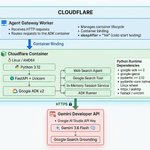
Cloudflare OS is an open-source platform that lets everyone in your company build apps, automate work, and safely access internal systems, shaped around what your organization knows and how it operates. cfl.re/4w6ViT0

Jag retweeted

Here are somethings it does:
1. Connects to your gmail and calendar, so records fill themselves in.
2. 18 tools, 4 skills - everything is queue based - powered by @eve, @vercel, @getcontextdev and RapidAPI for LinkedIn research.
3. Books its own follow-ups and has to say when it'll be back to update its research / findings.
4. Fully sandboxed.
github.com/trycompai/crm


