

Annenberg Professor of Natural Sciences, University of Pennsylvania
Joined September 2010
- Tweets5.1K
- Following1.1K
- Followers3.7K
- Likes10.9K





Joshua B. Plotkin retweeted

We are searching for a new colleague in our Department of Biology at University of Oregon!
This is a super special opportunity-- an endowed chair position in Genetics/Genomics. Come join us!
I'm happy to answer any questions folks might have
careers.pageuppeople.com/726…
Joshua B. Plotkin retweeted

Applications are open for the NITMB Fellows program!
NITMB is seeking early-career researchers who have an interest in transforming biological research and inspiring new mathematical discoveries
Apply by November 15, 2026: nitmb.org/nitmb-fellows-prog…

Opportunity: Penn MindCORE Fellowship!
MindCORE seeks to recruit outstanding postdoctoral researchers for our Research Fellowship for Postdoctoral Scholars. Housed within the School of Arts & Sciences of the University of Pennsylvania, MindCORE is an interdisciplinary effort to understand human intelligence and behavior.
Applications due December 1, 2026.
mindcore.sas.upenn.edu/post-…

Thank goodness.
(Clarification would be required in my department, for real. Also, my standard reaction to claims that algebraic geometers say are obvious..)


I can only infer that’s a joke. Because the idea of a committee on the role of mathematics writ large, and the impact of AI, but lacking applied expertise …

Credits: lyrics by me and Claude · music and vocals by Suno · video written in code by Claude on @_mexicat's pdoom engine
An evolutionary origin of collective decision making in humans and machines. New paper, with Guocheng Wang and Qi Su:
arxiv.org/abs/2610.05676
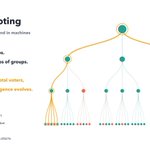
Human institutions and machine-learning algorithms both decide by layered, non-linear voting. Engineers train networks with back-propagation. Institutions have no engineer.
We find that rewarding individuals only when their vote is pivotal, at every layer, lets collective intelligence evolve by peer imitation alone. That reward scheme plays the role of back-propagation in ML.
This result gives a naturalistic, evolutionary account of decision making, by human institutions and machines alike.

...and if Wolfram does read it: iterating his tournament would make a nice project for one of his summer programs.
Likewise, Steve. And talking into the void is a respectable strategy here: TFT also cooperates first and hopes for the best.
My pleasure. Excited to see your interest and Wolfram's too.
Nothing is more fun than starting to explore these things from scratch. So I almost hesitated to fill in the history, except that it really does vindicate the robustness of Axelrod; and allow us to pose new questions!
Wolfram's adaptive-evolution runs were first done by Axelrod in 1987, and the evolutionary experiment you suggest was run on all 2-state machines by Linster in 1992. Much has been understood and proven since, including generically when TFT succeeds.
xitter.cf/jplotkin/status/210752…
1/3
Steve, I agree with your main point: a ranking against a uniform field of strategies and the outcome of evolutionary dynamics are different objects. But there is more to say, both about what Wolfram's post leaves out and about what the field has established since Nowak & Sigmund. The second part matters more, because much of it is proved rather than simulated. I also ran the experiment you propose on Wolfram's own finite-state machines; results at the end.
I. What Wolfram's post leaves out
1/ Finite automata as strategies for the repeated Prisoner's Dilemma are a forty-year literature: Rubinstein, Binmore & Samuelson and others started this in the 1980s. Linster (1992) studied the evolutionary dynamics of all 26 one- and two-state finite-state (Moore) machines, which is exactly Wolfram's 2-state space.
2/ Axelrod ran Wolfram's adaptive-evolution experiment in 1987, with a genetic algorithm (in Davis, Genetic Algorithms and Simulated Annealing). Evolving against a fixed field of eight strategies from his second tournament, 11 of 40 runs produced rules that scored substantially higher than TFT. Those rules defected on the first move and exploited one member of the field. When the rules evolved against each other instead, reciprocating rules eventually spread.
3/ The experiment you propose, iterating the tournament, has also been run on Wolfram's whole class of strategies. van Veelen (2012) evolved populations drawn from every strategy that can be encoded by a finite-state automaton. The populations showed perpetual oscillation between cooperation and defection, through neutral mutants that allow other mutants to invade.
4/ Without errors, 20 of Wolfram's 22 two-state machines are deterministic memory-one strategies. TFT, Grim and WSLS are three such machines. His 2-state ranking is therefore a ranking of corners of the memory-one strategy space, the four-dimensional cube of cooperation probabilities that Nowak & Sigmund studied in full.
5/ Wolfram's play has no errors, or trembling hand. Without errors, Grim never enters permanent defection against an opponent that does not defect first. Errors are the reason WSLS and generous strategies are favored in the Nowak–Sigmund work, and errors really change the outcome in Wolfram's setting too (see below)
6/ Wolfram writes that it will be difficult to "prove a theorem" about which strategy is best. Theorems about which strategies resist invasion do in fact exist, and they are what I would most add to your thread.