
I am a researcher at Kyung Hee university in South Korea. I got Master’s degree and now I’m seeking PhD positions in the U.S. I work on video understanding.
South Korea
Joined November 2023
- Tweets14
- Following64
- Followers0
- Likes4




Qwen3-VL-4B + DeltaDirect: motion direction 49.7 → 93.4.
Training-only projector loss. Inference unchanged. Above even Qwen3.5 models and GPT-5.
@Alibaba_Qwen @QwenDevs , your model with our loss. Details and code 👇
jong980812.github.io/which-w…

Which Way Did It Move? (NeurIPS 2026)
Video-LLMs are near chance at telling if an object moves left/right/up/down. The info is in the features; the model can’t bind it to the answer.
DeltaDirect fixes this: 25.9% to 85.4%, +21.9 pts on real videos.
📄 arxiv.org/abs/2605.22823
DANCE (NeurIPS 2025 Spotlight)
Saliency maps mix up motion and context. Words can’t describe motion well.
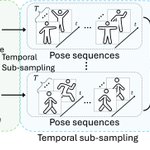
DANCE predicts actions through 3 disentangled concepts: motion (pose sequences), objects, and scenes. Clear explanations, competitive accuracy.
📄 arxiv.org/abs/2511.03725
ESSENTIAL (ICCV 2025 Highlight)
Most video CIL methods replay dense frames, eating memory.
We keep sparse features (episodic) + learnable prompts (semantic) and recover dense temporal info via cross-attn. Strong results, far less memory.
📄 arxiv.org/abs/2508.10896

PCBEAR (CVPR 2025 XAI4CV Workshop, Spotlight)
Explaining action recognition with pose concepts, not static text.
Static + dynamic pose concepts, discovered automatically by clustering skeleton sequences. Interpretable, with test-time intervention.
📄 arxiv.org/abs/2504.13140

CA²ST (IEEE TPAMI 2026) 🔊
The audio extension of CAST: spatial, temporal, and audio experts exchange info via Bottleneck Cross-Attention in every layer.
Balanced on EK100, SSv2 & K400, and strong on audio-visual benchmarks (VGG-Sound, EPIC-SOUNDS).
📄 arxiv.org/abs/2503.23447

CAST (NeurIPS 2023)
Action recognition needs what’s in the scene and how it moves. Most models lean one way.
We pair a spatial expert (CLIP) and a temporal expert (VideoMAE) via bottleneck cross-attention → consistent gains on EK100, SSv2 & K400.
📄 arxiv.org/abs/2311.18825

