

Jakarta Selatan, DKI Jakarta
Joined April 2013
- Tweets1.3K
- Following929
- Followers154
- Likes332


Jomet retweeted

Google just dropped a banger paper.
If you write or curate skills for your agents, this one is for you.
(bookmark it)
Agent skills are just folders holding the instructions an agent follows for a task, and people increasingly let agents write those instructions themselves.
The loop is simple. Run the agent on some tasks, read the runs that failed, rewrite the instructions, and keep the rewrite only if the score goes up on a held-out validation set.
That last check matters, because an edit that quietly makes the agent worse would pile up over time. So the system always applies the edit, tests it, and reverts the file if the score drops.
Here is where it breaks. Working out why the agent failed is the expensive part, since it means reading full traces and comparing failed runs against successful ones.
But that diagnosis never gets written down. The only thing saved is the new instruction text it produced.
So when that instruction reverts, the finding behind it goes too. The next round reads the same failures, reaches the same conclusion, and often proposes the fix that already lost, with no memory that it was ever tried.
WikiSkill fixes this by splitting the one folder into three:
1. Raw traces, written once and never touched.
2. A wiki of accumulated knowledge, holding what keeps breaking, what has worked, and every edit tried so far with the reason it passed or failed. Nothing here is ever deleted.
3. The skills themselves, reverted whenever an edit makes things worse.
So the instructions can roll back, but the understanding behind them never does.
Their own example makes it click. An early skill gets rejected for being too vague, and instead of vanishing, that rejection is logged.
The next round reads the log, sees the vague version failed, and writes a concrete rule in its place. That one gets accepted.
Same failure, same analysis, but the second attempt starts from knowing what already did not work.
The authors confirm this is where most of the gain comes from by turning the knowledge layer off. The average score drops by about a quarter.
Two other results are worth the read on their own.
Smaller models with evolved skills beat much larger models running without any, and skills evolved by one model transfer across families, sometimes working better than the ones a model wrote for itself.
Paper → arxiv.org/abs/2608.27454
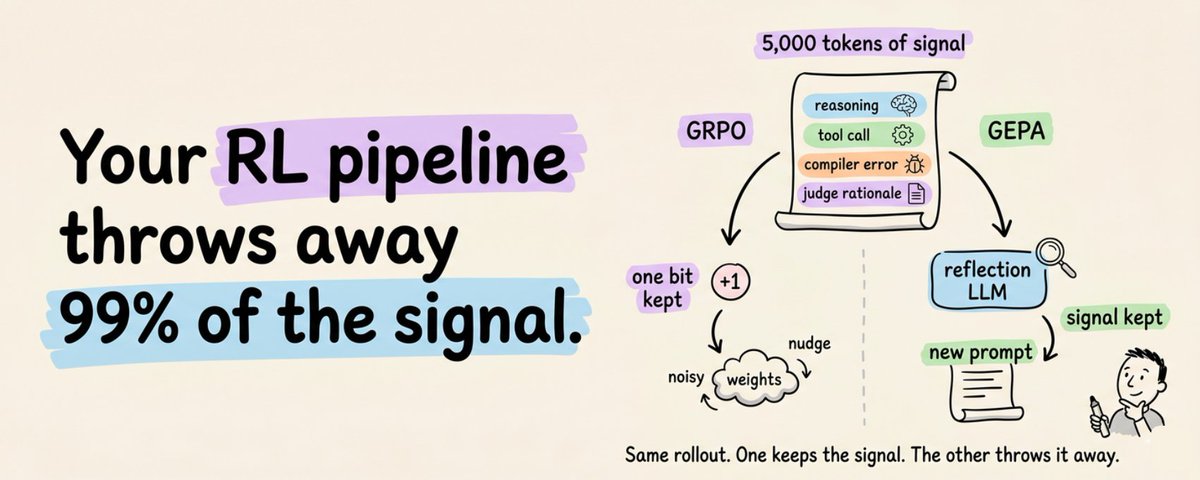
I wrote about a related idea (GEPA) earlier, which improves a model by having it reflect on its own mistakes in plain language and rewrite its prompt, with no weight updates involved.
The detailed article is quoted below.


Jomet retweeted

14 days. Unlimited building. ⚡
From Aug 24–Sep 6, get unlimited access to MiniMax M3 and M2.7 on @gmi_cloud—plus Speech 2.8 and Music 3.0.
Start building on GMI Cloud. What will you create? 👇

unlimited MiniMax M3 and M2.7, 14 days FREE on GMI Cloud
from 8/24 to 9/6, Speech 2.8 and Music 3.0 too.
access via both GMI API key or @OpenRouter👇
Jomet retweeted

I just closed a $70,000 deal with help from 10 Hermes agents
Here is how it happened:
A couple of months ago, one of my clients asked me to review their IT spending.
The biggest surprise was Atlassian.
They were using Jira, Confluence, Jira Service Management, and several paid plugins because the built in reporting and time tracking were not meeting their needs.
With more than 300 users, they were spending around $140,000 every year.
They had been paying that for six years.
That is roughly $840,000.
So I asked them:
“If I build something that replaces most of these tools, improves the workflows your team struggles with, and cuts your bill in half, would you pay me $70,000 per year?”
They said yes.
So I put 10 Hermes agents to work
For the next month, they worked alongside me for almost 8 hours a day.
About half of the code was built using Fable 5 and the other half using Opus 4.8.
I spent approximately $11,000 on tokens :P
That sounds expensive until you compare it with a $70,000 yearly contract and a product I can now offer to other companies.
One month later, the product was ready.
The client loved it and gave me the green light to open it to the public and it's my code :)
I called it Kapvel
Kapvel includes:
• Project management and Jira ticket imports
• A full service desk with a customer portal
• Built in time tracking and reporting
• Documents with real time collaboration
• Spreadsheets, presentations, and whiteboards
• Electronic signatures and approvals
• QA test case management
• A dedicated UAT portal
• GitHub, Bitbucket, and GitLab integrations
• Pull request workflows inside the same platform
• Custom themes and branded portals
The part I am most excited about is what happens when someone submits a support ticket to me:
My Hermes agents can immediately review the request, investigate the issue, and start working on a solution.
Kapvel is basically:
Jira + Confluence + DocuSign + Everhour + QA + UAT
All inside one platform, with simpler pricing and fewer third party plugins.
This is not a mockup
The client is already using it
Now I am preparing to open Kapvel to other teams
Comment KAPVEL for early access.
Jomet retweeted

Introducing OpenShip CLI
The fastest way to launch your ultimate self-hosted Vercel alternative directly on your server, with the full platform included: versioning, CI/CD, team invites, job runners, and more.
Just set your installation URL, then:
> Add your admin email & password
> Choose your domain
> Choose whether to migrate your existing websites to the OpenShip Edge
> Sign in, make your first deployment, invite your team, enable CI/CD, and unlock the full Cloud Commander experience
Get a fully programmable reverse proxy with a powerful UI, deep traffic analytics, live insights, middleware, rate limiting, and more.
OpenShip Edge is just getting started, with even more networking capabilities coming soon.
Jomet retweeted

11 GitHub repos with 1.5M+ combined stars replace tools you'd otherwise pay $50K+/year for
1. free-for-dev (131k⭐) - hundreds of services with permanent free tiers. No trials, the repo's own rule.
github.com/ripienaar/free-fo…
2. public-apis (453k⭐) - 1,500+ free APIs: weather, finance, images, games.
github.com/public-apis/publi…
3. awesome-selfhosted (309k⭐)- self-hosted replacements for Notion, Google Photos, Zapier and dozens more subscriptions.
github.com/awesome-selfhoste…
4. awesome-claude-code (51k⭐) - skills, hooks, slash commands, orchestrators for Claude Code.
github.com/hesreallyhim/awes…
5. anthropics/skills (165k⭐) - the official skills repo. Start here before third-party ones.
github.com/anthropics/skills
6. awesome-mcp-servers (91k⭐) - thousands of MCP servers connecting your agent to browsers, databases, anything.
github.com/punkpeye/awesome-…
7. awesome-llm-apps (116k⭐) - 100+ ready AI agents and RAG apps with full code.
github.com/Shubhamsaboo/awes…
8. system-prompts-and-models-of-ai-tools (142k⭐) - leaked system prompts of Cursor, Devin, v0, Claude Code.
github.com/x1xhlol/system-pr…
9. awesome-codex-skills (15k⭐) - curated Codex skills sorted by category: data & analytics, writing, productivity, development.
github.com/ComposioHQ/awesom…
10. awesome (490k⭐) - the list of every other list. Whatever's missing above, it's here.
github.com/sindresorhus/awes…
Bookmark this before you pay for something that's already free 👇


Jomet retweeted

Introducing GLM-5.1: The Next Level of Open Source
- Top-Tier Performance: #1 in open source and #3 globally across SWE-Bench Pro, Terminal-Bench, and NL2Repo.
- Built for Long-Horizon Tasks: Runs autonomously for 8 hours, refining strategies through thousands of iterations.
Blog: z.ai/blog/glm-5.1
Weights: huggingface.co/zai-org/GLM-5…
API: docs.z.ai/guides/llm/glm-5.1
Coding Plan: z.ai/subscribe
Coming to chat.z.ai in the next few days.


Jomet retweeted

A new chapter begins.
Play & Kollect is now live on @Ronin_Network!
Equip your best gear, embark on Adventure Runs, and start collecting those juicy new rewards!



📈 Bitcoin's potential near all-time high discussed with recent bullish momentum.
#Bitcoin #BitcoinHalving #cryptotrading #bitcoinprice

ALT Bitcoin's potential near all-time high discussed with recent bullish momentum. #Bitcoin #BitcoinHalving #cryptotrading #bitcoinprice
1
122
💼 Impact of Institutional Investments
1. Observation of institutional and retail FOMO contributing to Bitcoin's rise.
2. Highlighting record-breaking inflows into Bitcoin-related ETFs.
3. Emphasis on the anticipated long-term effects of institutional investments.
1
40

Jomet retweeted

Adu porto, ga mau kalah sama @justinsuntron
ps: sebelum dicolek petugas pajak, tentu saja cuma editan

ALT i wish
