

Co-founder @stackup_fi Past: https://xitter.cf/t.co/J9miPTgwAR (SpaceX, MIT, Relativity, Virgin Galactic)
Los Angeles, CA
Joined August 2021
- Tweets2.6K
- Following1.1K
- Followers4.4K
- Likes9.2K



John Rising retweeted

🎂 Look who’s turning 4!
Happy Birthday, Will it get some wind for the sailboat?! 🎉
by @johnrising_ on fx(hash)
raster.art/artwork/will-it-g…

I've been chipping away at how to make AI write better for a few months now, and I've built something that finally works well enough to share.
bymorning.ai/journal/editing…
In case you have any doubt whether OpenAI uses its own models for their own important decisions -
They've named their new service business "DeployCo"

OpenAI just bought 150 consultants and formed a $14B vehicle to help companies use its AI.
But if AI is really as magical as everyone says it is, why would you need an army of engineers to customize it for each team?
Making AI useful means encoding processes, institutional memory, and workflows. It's like integrating an ERP; the value comes from the scaffolding around it, not the model itself.
SpaceX has an option to acquire Cursor, presumably to supercharge the development of Grok Enterprise.
Since the SpaceX-xAI merger, Elon has publicly admitted xAI is behind on coding tools compared to Anthropic and OpenAI. He ordered layoffs in March and started poaching Cursor's own senior engineers. Now this deal gives xAI exactly what it needs: Cursor's product surface and its distribution to hundreds of thousands of developers — the two things you can't build fast enough from scratch when you're trying to catch up.
The ~$60B option / $10B walkaway structure is a try-before-you-buy where xAI gets to validate whether Cursor's distribution channel can be converted into a Grok Enterprise on-ramp. If it works, they buy. If it doesn't, Cursor keeps $10B and walks. Either way, xAI gets months of developer telemetry and product integration work.
xAI is trying to build a competitive coding AI product and needs both a world-class interface and an installed base of expert users to do it. Cursor has both. SpaceX provides the capital and compute (Colossus).
So the AI coding market just consolidated into three camps: Anthropic (Claude Code), OpenAI (Codex/Windsurf), and now xAI (Cursor/Grok). The question is whether bolting the best IDE onto a catching-up model lab is enough to compete with labs that are shipping their own increasingly good interfaces.
techcrunch.com/2026/04/21/sp…

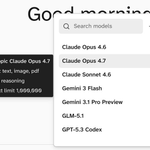
Claude Opus 4.7 launched a few hours ago and I've been pushing it on a few things today.
Here's what stands out to me:
3/ The tool-calling is different.
It's way stripped down from 4.6. I haven't come to a strong view on whether it's better or worse, but it's def different.
Aggressive tool and subagent calling has historically worked better b/c there's very little penalty for spinning up more calls than strictly needed.


.@and2wt3n has built a great AI memory system into @bymorning_ai, complete with incognito mode, easily edited, and only ever stored on your device.

Everyone's saying taste is what AI can't touch, that machines generate but can't curate, produce but can't judge, and that taste is ours, the last moat.
I don't buy it.
Most people use "preference" and "taste" like they're the same word, but they're not. Preference is liking something — this song over that one, this shade of blue, a gut-level pull toward one thing and away from another. Taste is knowing why something is good or bad. @HenryEOliver put it simply: taste is knowledge, not feeling.
Once you accept that reframe, the whole debate shifts, because knowledge has structure. It can be broken down, accumulated, and transferred. If taste is knowledge, the question isn't whether machines can feel their way to good judgment, it's whether they can learn their way there. Very different question.
@paulg once wrote that the recipe for great work is "very exacting taste, plus the ability to gratify it." He's right. But if taste is knowledge, and knowledge is learnable, what happens when both halves of that recipe are computable? Not just the gratification, the generation, the execution, but the exacting judgment itself?


I keep seeing that, the more fluent someone gets with AI, the more invisible work they take on around it.
Some of this work feels like uniquely human work, like applying taste. But is it actually uniquely human? How durable will these skills be? Are you actually doing less work, or just different work?
I've written down some of my thoughts, and will be adding more to our blog over the next months:
bymorning.ai/journal/borrowe…