

Most marketing advice comes from people who've never had skin in the game. I own storage facilities, run a SaaS platform, and a marketing agency.
White Plains, NY
Joined May 2009
- Tweets960
- Following303
- Followers417
- Likes1.3K


Pinned Tweet
We recently helped a storage facility increase move-ins by 239% in Q4, achieve positive net move-ins, and hit #1 on Google.
An operator of a storage facility in California came to me when his occupancy dropped to 58.63%, his lowest point.
Net Move-ins had become negative each month, and their Q4 (typically the slowest season) threatened to make things worse.
We had to create a marketing plan to help turn things around quickly before the next peak season.
Our 3 Step Process:
1️⃣ SEO Overhaul:
Optimized their Google Business Profile using our 33-point GBP optimization checklist.
Improved on-page SEO of the facility page by adjusting key tags, adding internal links, and adding more content to help users convert on the page.
Implemented our title tag and meta description testing system to maximize click-through rate on Google search results and get more potential renters onto our facility page.
2️⃣ Targeted Google Ads:
Focused ad spend on users within a 5-mile radius actively searching for storage.
Implemented our ad copy testing system to find the right messaging to maximize click-through and conversion rates (phone calls + online rentals).
Paused underperforming keywords that were not cost-effective. We look at conversion volume and cost per conversion to make these decisions.
3️⃣ Conversion Rate Optimization:
Identified UX and technical issues preventing rentals on the facility pages.
We added social proof, a value prop explaining why our facility is different, and an FAQ section with common questions users ask before renting a unit.
We set up tracking in Google Analytics to understand which marketing channels were most efficient at driving online rentals, which helped us evaluate all of our changes.
📊 Results:
✅ 239% move-in growth: 23 move-ins (Q3) → 78 move-ins (Q4)
✅ Positive net move-ins even in slow months: -4 (Q3) → +28 (Q4)
With the right marketing process, even the toughest seasons can become opportunities for growth and new records.

You don't always need more leads to get more move-ins.
Sometimes the biggest opportunity to improve your marketing results has nothing to do with generating more leads.
It's converting more of the leads you're already getting.
A few years ago, one of the biggest conversion problems in self-storage was the online rental process. Complicated checkouts, poor mobile experiences, and too many steps to complete a rental were costing operators customers.
Fortunately, a lot of that has improved.
Many FMS and website platforms have made significant progress in simplifying the online rental experience. But from what we're seeing across the operators we work with, some of the biggest conversion issues have shifted back to the call center and lead follow-up process.
How many calls are going unanswered?
How quickly are missed calls being followed up on?
How effective is your team at converting inquiries into rentals?
What happens when someone calls but isn't ready to rent immediately?
Are you actually tracking which leads turn into move-ins?
We regularly see situations where marketing is generating plenty of opportunities, but the systems needed to turn those opportunities into customers aren't working well.
And when that happens, marketing gets blamed.
The natural reaction is to change agencies, adjust campaigns, or increase advertising budgets. But none of those changes fix the underlying problem.
Improving call handling and lead follow-up isn't always easy. It takes time, effort, training, accountability, and sometimes changes to how your operation runs.
It's also not as exciting as launching a new marketing campaign. But the payoff can be significant.
Because unlike improving a single ad campaign, these changes improve conversion across every channel generating leads for your facility.

1
1
20
The more we do marketing for self-storage operators, the more I realize something:
Often the biggest opportunity to improve marketing ROI has nothing to do with changing your marketing.
Marketing, revenue management, call centers, facility operations, and customer experience are far more interconnected than most operators realize.
You can have great ad campaigns & consistent lead volume. But if your pricing isn't competitive, your calls aren't being answered, or your rental process is difficult, your marketing results will suffer.
That's why I've started thinking about self-storage growth as an 8-step customer journey.
1. Demand
Is there enough demand in your market? What does the competitive landscape look like? Marketing can't manufacture demand that doesn't exist.
2. Visibility
When someone needs storage, can they find your facility? This includes Google Ads, Google Maps, organic search, and other discovery channels.
3. Win the Click
When customers see your facility alongside competitors, why should they choose you? Reviews, ratings, location, messaging, and promotions all influence this decision.
4. Website
Once someone lands on your website is all of the information easy to find?
5. Pricing & Inventory
Do you have the right units available at competitive prices? You might generate plenty of qualified traffic, but if customers can't find the unit they need at a price they're willing to pay, they won't convert.
6. Conversion Paths
How easy is it to actually become a customer? Online rentals, reservations, phone calls, chat, and walk-ins all matter.
7. Lead Follow-Up
What happens when someone calls and nobody answers? Speed to lead, call handling, and follow-up processes are key.
8. Customer Experience & Retention
What happens after the customer rents? Move-in experience & service quality ultimately determine how valuable each acquired customer becomes.
When your move-ins drop or cost per move-in rises, the natural reaction is to ask the marketing team why performance declined. But the real problems might have nothing to do with SEO.
Stop evaluating marketing in isolation. Focus on identifying what's limiting growth across the entire customer journey, fix that constraint, measure the impact, and repeat.

1
37
More leads aren't always the answer in self storage. Sometimes you need to do a better job converting the leads you already have.
In September, we significantly increased lead volume but move-ins barely improved compared to August. We were getting more opportunities, but they weren't translating into enough new tenants.
So we shifted more attention toward lead conversion. Specifically, we focused on two areas:
1) Live phone calls: Improving how incoming leads are handled, how questions and objections are addressed, and how effectively calls turn into rentals.
2) Lead follow-up: Improving the process for following up with prospects who don't rent during their first interaction.
In October, lead volume increased only slightly compared to September. But move-ins jumped from 17 to 29 (+71%). Even more importantly, the portfolio went from -4 net move-ins in September to +13 in October.
That's a pretty significant difference without needing a massive increase in lead volume. We still have plenty of work to do on lead conversion, but we're already seeing the impact of focusing on it.
This is something that gets overlooked in self-storage marketing. When move-ins are down, the first instinct is often to spend more on advertising, generate more traffic, or find another source of leads. Sometimes that's exactly what you need.
But if you're not converting enough of the opportunities you're already generating, more leads just means more missed opportunities.

2
23
Most self storage operators aren't using their existing tenant data to improve Google Ads performance.
And the ones that are, usually just upload a spreadsheet once and rarely update it again.
We've built a better way.
StorIQ can now automatically sync your tenant data from your Facility Management Software directly into Google Ads Customer Match lists.
Here's how it works:
1) Daily Updates: Your customer list automatically refreshes as new tenants move in. No more manually exporting and uploading spreadsheets.
2) Reduce Wasted Ad Spend: Use your customer lists to limit existing tenants from eligible campaigns, so you're not spending money advertising to people who already rent from you.
3) Improve Ad Targeting: Give Google's bidding algorithms more first-party customer data to help identify potential renters. These audience signals can be especially valuable when using broad match keywords with Smart Bidding.
Google Ads is increasingly reliant on automation and first-party data to optimize campaigns.
But your customer data is only as useful as it is accurate and up to date.
A spreadsheet uploaded 6-12 months ago doesn't reflect the hundreds of tenants who may have moved in since then.
With StorIQ, your customer lists stay current automatically.
Less manual work and better ad performance.

1
42
The customer journey doesn't end when someone rents a storage unit.
What happens after move-in determines how long they stay and how much revenue they generate.
A great customer experience can make your future marketing more effective (and cheaper).
This is Step 8 of our 8-Step Self-Storage Customer Journey Analysis: Customer Experience & Retention.
So far, we've covered:
1) Demand: How many people are searching for storage?
2) Visibility: Are you showing up when they search?
3) Win the Click: Are customers choosing your facility in search results?
4) Website Experience: Can visitors find the information they need?
5) Pricing, Offers & Availability: Are pricing and inventory aligned with your objectives?
6) Conversion Paths: Can customers rent through their preferred method?
7) Lead Follow-Up: Are you converting interested customers who don't rent immediately?
Step 8: Customer Experience & Retention
Getting the move-in is only the beginning. The longer customers stay and the better their experience, the more valuable each move-in becomes.
Here's what we look at:
1. Move-In Experience
Is onboarding smooth? Are access instructions clear? Is the unit clean and ready? A frustrating move-in experience can start the relationship on the wrong foot.
2. Ongoing Experience
Is the facility clean, secure, and well-maintained? Are billing, customer support, and issue resolution handled well?
3. Retention
How long are customers staying? Why are they moving out? Improving retention increases customer lifetime value, which directly impacts marketing economics.
If customers stay longer and generate more revenue, you can potentially afford to spend more to acquire each move-in.
4. Customer Advocacy
Are happy customers leaving Google reviews? This is where the customer journey becomes a flywheel. More positive Google reviews can help improve your visibility and competitiveness in Google Maps, bringing us right back to Step 2: Visibility.
Most operators think about marketing as everything that happens before the move-in. But what happens afterward can be just as important.
Better retention improves your acquisition economics. Better experiences generate more opportunities for reviews and referrals.
The customer journey shouldn't be a straight line. It should be a flywheel. This final step should help strengthen the earlier steps, creating a system that becomes more effective over time.

1
1
34
Not every customer who contacts your storage facility is ready to rent immediately.
Some are comparing options. Others are waiting until their move date gets closer.
If you're not following up with those customers, you're losing move-ins that your marketing already paid to generate.
This is Step 7 of our 8-Step Self-Storage Customer Journey Analysis: Lead Follow-Up.
So far, we've covered:
1) Demand: How many people are searching for storage?
2) Visibility: Are you showing up when they search?
3) Win the Click: Are customers choosing your facility in search results?
4) Website Experience: Can visitors easily find the information they need?
5) Pricing, Offers & Availability: Are your pricing and inventory aligned with your objectives?
6) Conversion Paths: Can customers easily rent or contact you through their preferred method?
Step 7: Lead Follow-Up
One of the biggest missed opportunities in self-storage marketing is what happens after a customer expresses interest but doesn't immediately rent. Think about all the leads your facility generates through phone calls, online reservations, abandoned rentals, forms, and live chat.
How many of those customers are actually being followed up with?
Here's what we look at:
1. Speed to Lead
How quickly does your team follow up after someone submits a reservation, abandons an online rental, or requests information?
The longer you wait, the more opportunities you give that customer to rent somewhere else.
2. Follow-Up Frequency
Are you following up once and giving up?
Or do you have a consistent process for staying in touch until the customer rents, tells you they're no longer interested, or reaches the end of an appropriate follow-up sequence? 1 unanswered call or email shouldn't automatically mean a lost opportunity.
3. Communication Channels
Are you following up through phone calls, SMS, and email?
Different customers prefer different communication methods, just like they prefer different conversion paths.
4. Follow-Up Quality
Is your team actually helping customers make a decision, or just asking if they're still interested? Good follow-up should answer questions, address objections, recommend the right unit, and make it easy to complete the rental.
5. Tracking & Accountability
-Do you know how many leads never received follow-up?
-How many eventually converted? How many were lost?
If you're not tracking these numbers, you probably don't know how many move-ins you're leaving on the table.
Many operators focus heavily on generating more leads without fully understanding what happens to the leads they already have.
Two facilities can generate the same number of leads from the same advertising investment and end up with completely different move-in results. The difference is what happens after that first interaction.
Before spending more money to generate additional demand, make sure you have a system for converting the demand you've already paid for.

2
52
Your storage facility can have great SEO, competitive pricing, and a well-designed website.
But getting someone to your website doesn't mean they're going to rent.
Your job is to make each of these paths as easy as possible, not force the one that's best for you, like many operators do.
This is Step 6 of our 8-Step Self-Storage Customer Journey Analysis: Conversion Paths.
So far, we've covered:
1) Demand: How many people are searching for storage?
2) Visibility: Are you showing up when they search?
3) Win the Click: Are customers choosing your facility?
4) Website Experience: Can visitors easily find the information they need?
5) Pricing, Offers & Availability: Are your pricing and inventory aligned with your objectives?
Step 6: Conversion Paths
Not every storage customer wants to rent the same way.
Some are ready to complete an online rental immediately. Others want to call, reserve a unit, chat with someone, or visit the facility first.
Here's what we look at:
1. Online Rentals
Can customers complete a rental quickly and easily, especially on mobile?
2. Phone Calls
Are your calls being answered? And when they are, is your call center doing a good job converting those leads into rentals?
Many operators are losing a significant number of move-ins over the phone without even realizing it.
3. Reservations & Abandoned Rentals
How quickly and how often is your team following up with reservations and abandoned rental leads?
4. Live Chat
Can your live chat actually help customers rent units, assist with checkout, and answer questions about unit sizes, availability, and pricing?
5. Walk-Ins
Marketing can drive walk-ins through Google Maps (SEO and Ads). Once customers arrive at the facility, your on-site manager plays a critical role in converting that traffic into move-ins.
When operators aren't hitting their move-in targets, the default response is often to focus on marketing.
But if you're losing customers through missed calls, abandoned rentals, poor follow-up, or difficult checkout processes, more marketing isn't going to fix those problems.
You can have 2 facilities running the exact same ads with the exact same budget and get vastly different results.
One facility could be losing money on those ads, while the other is profitably scaling its budget.
I can't tell you how many operators come to me saying, "Marketing has never worked for us."
And when we dig into their customer journey, we often find that 4 out of their 5 conversion paths are completely broken. No amount of marketing is going to work under those conditions.
Your customers don't care what's best for you. They want the path that's best for them. And if you don't offer it, you're going to lose rentals.

2
57
Your storage facility can have great SEO, strong Google Ads performance, and a well-designed website.
But it can't make your pricing competitive or create inventory you don't have.
This is Step 5 of our 8-Step Self-Storage Customer Journey Analysis: Pricing, Offers & Availability.
So far, we've covered:
1) Demand: How many people are searching for storage?
2) Visibility: Are you showing up when they search?
3) Win the Click: Are customers choosing your facility in search results?
4) Website Experience: Can visitors easily find the units and information they need?
Step 5: Pricing, Offers & Availability
Pricing is one of the most powerful tools for influencing move-in volume.
Lowering rates can help generate more move-ins. Raising rates can intentionally slow move-in volume while prioritizing higher-revenue tenants.
What you're constantly managing is the balance between move-in volume and revenue per tenant. And the right balance depends on your facility's current stage and objectives.
For example:
A facility at 15% occupancy in lease-up:
Your priority is probably move-in volume. Competitive rates and promotions can help accelerate occupancy, and your marketing should be focused on generating as much qualified demand as possible.
A stabilized facility focused on maximizing revenue:
Your priority may shift toward higher rates and better revenue per occupied unit, even if that means fewer move-ins.
Neither approach is inherently better. It depends on what you're trying to accomplish. This is why pricing, inventory, and marketing need to work together. Most operators treat revenue management and marketing as completely separate functions and evaluate whether they are "working" separately.
If you raise rates and your conversion rate drops, that doesn't necessarily mean your marketing is underperforming.
And if you lower rates and move-ins increase, that doesn't necessarily mean your marketing suddenly improved.
You have to evaluate marketing performance in the context of the facility's pricing strategy, available inventory, and business objectives.
Your goal with marketing should be to generate the right amount of demand, at the right acquisition cost, to support your facility's current objectives.

1
48
Your storage facility can have great SEO, strong Google Ads, and plenty of website traffic and still struggle to get move-ins.
Getting customers to your website is only half the battle.
What happens when they land on your facility page matters just as much.
Step 4 of our 8-Step Self-Storage Customer Journey: Website Experience
In the first three steps, we focused on getting potential customers to your website:
1) Demand: How many people are searching for storage in your market?
2) Visibility: Is your facility showing up when customers search?
3) Win the Click: Are you giving customers a reason to choose your facility over competitors in search results?
Now they've made it to your website. Are you making it easy for them to find the information, units, and pricing they need?
When we design self-storage facility pages, we follow a pretty simple structure:
1. Business Information at the Top
We want the essentials immediately visible:
• Facility name
• Address
• Phone number
• Office and access hours
• Quality facility photos
Customers shouldn't have to hunt for basic information about your facility.
2. Unit Inventory & Pricing
We want the unit inventory grid as high on the page as possible, ideally immediately after the business information.
This is what most visitors are looking for. They want to know which sizes are available, what they cost, and how to rent one. Don't make them scroll through paragraphs of content to get there.
3. Customer Reviews
Directly below the inventory, we like to embed customer reviews. Visitors have now seen your facility, available units, and pricing. Reviews help build trust and give them more confidence to take the next step.
4. Supporting Content & SEO
Below those three sections, you have much more flexibility. We typically include:
• FAQs
• Your facility's value proposition
• Types of storage offered
• Amenities and features
• Information about the local area
This content is valuable for SEO and answering additional questions, but it shouldn't get in the way of the primary conversion experience.
The biggest takeaway?
We put the most emphasis on three sections of a facility page:
Business information → Unit inventory → Customer reviews
Make it as easy as possible for a potential customer to get all of the information they need to make a purchase decision.

2
57
Showing up on the first page of Google doesn't guarantee someone will choose your self-storage facility.
You could have great visibility across Google Ads, Google Maps, and organic search, but if competitors are getting the clicks and calls, that visibility isn't translating into opportunities.
This is Step 3: Win the Click or Call in our 8-Step Self-Storage Customer Journey Analysis.
Step 1 was understanding market demand.
Step 2 was maximizing visibility across Google's first page.
Now we need to answer a different question. When a potential renter sees your facility alongside competitors, what makes them choose you?
There are several factors that can influence that decision:
1) Google Reviews: Your star rating, review count, and how you compare to nearby competitors.
2) Google Business Profile: Your photos, business information, and how compelling your listing appears in Maps.
3) Google Ads Copy: Your headlines, descriptions, pricing, and promotions. Are you giving renters a compelling reason to click your ad?
4) Organic Search Listings: Your SEO title tags and meta descriptions, including pricing or promotional messaging that helps your listing stand out.
5) Location & Convenience: Your proximity to the renter and whether your location fits their needs.
All of these factors can influence whether someone clicks your website, calls your facility, or chooses a competitor instead. This is also why ranking improvements don't always lead to more rentals. You can improve visibility without improving your ability to attract clicks and calls.
But there's another important opportunity here that often gets overlooked. Winning the call directly from Google, without the renter ever visiting your website.
There are several ways this can happen:
1) Google Search Ads: Call assets allow potential renters to call directly from your ad.
2) Local Services Ads: Renters call your facility directly from the LSA listing.
3) Google Business Profile: Both organic Maps listings and eligible paid placements can display a call button, allowing renters to contact you without visiting your website.
This means the customer journey doesn't always involve a website visit. A renter might search for storage, compare a few listings, and call your facility directly from Google.
At StorIQ, we analyze these factors alongside competitor data to identify opportunities to make our clients' listings more competitive.
Sometimes the biggest opportunity isn't spending more on ads or improving rankings. It's making the listings you already have more compelling.

1
46
Ranking #1 on Google doesn't mean you're capturing all the potential renters in your market.
A potential renter searching for self-storage could encounter several different businesses before ever reaching the traditional organic search results.
That's why we focus on maximizing visibility across the entire first page of Google, not just ranking in one position.
This is Step 2: Visibility in our 8-Step Self-Storage Customer Journey Analysis.
Once we've established that demand exists in a market (Step 1), the next question is how often your facility is being seen by those potential renters.
There are several opportunities to appear on Google's first page:
1) Google Search Ads: Paid listings at the top of search results.
2) Local Services Ads (LSA): Another opportunity to appear prominently for eligible searches.
3) Google Maps Ads: Paid visibility within local map results.
4) Local SEO: Ranking your Google Business Profile in the unpaid map results.
5) Traditional SEO: Ranking your website in organic search results.
6_ Aggregators: Getting listed on third-party storage websites that already rank well on Google.
Each of these creates another opportunity for a renter to discover your facility. And they work together. If a user see you multiple times on the first page of Google, they assume you are the best facility in that market.
Someone might scroll past your search ad but notice your Google Business Profile. Another renter might discover you through an aggregator. Someone else might click your organic website listing.
The goal isn't necessarily to rank #1. It's to occupy as much relevant first-page real estate as possible.
At StorIQ, we analyze these different channels to understand where each facility is visible, where competitors are capturing attention, and where the biggest opportunities exist.
Having only one listing on the first page of Google often isn't enough, especially in competitive markets. More visibility creates more opportunities to win the click.

2
27
Before you spend more money on marketing your self-storage facility, make sure you're solving the right problem.
Too often, marketing performance is evaluated without understanding where the actual constraint is.
That's why we've developed an 8-step customer journey analysis at StorIQ to identify exactly where each facility is losing opportunities.
Here are the 8 steps we analyze:
1) Demand
2) Visibility
3) Win the Click
4) Website
5) Offer, Pricing & Availability
6) Conversion Paths
7) Follow-Up
8) FMS-Verified Move-Ins
I'm going to break down each of these steps in a series of posts, starting with Step 1: Demand.
This is arguably the step we have the least control over as marketers.
We can help a facility capture more of the demand that exists, but we can't necessarily create more people who need storage. And that matters when evaluating marketing performance.
If fewer people are searching for storage in your market, rentals could decline even if your marketing campaigns are performing well. The relationship between supply and demand plays a major role here.
What we focus on is understanding demand from a marketing perspective.
We've built tools at StorIQ that give us visibility into two important areas:
1) Google Search Demand: How many people are searching for self-storage in your market, and whether that demand is increasing or decreasing over time.
2) Competitor Advertising Trends: Using Google Ads competitor data, we can see changes in competitors' advertising activity month over month and whether they are increasing or decreasing their ad budget.
Neither tells the full story on its own.
But combining these insights with broader supply-and-demand data from other tools gives us a much clearer picture of the market.
At this stage, we want to distinguish between a market demand problem and a marketing performance problem. Because those are two very different things, and understanding the difference helps us determine where to focus our efforts.

36
One of the biggest mistakes I see in self-storage marketing is assuming that more marketing is always the answer.
Not getting enough move-ins? Spend more on Google Ads. Do more SEO. Generate more leads.
But what if marketing volume isn't actually what's holding your facility back?
I've found there are 8 key stages in the self-storage customer journey where a bottleneck can limit growth:
1. Demand: Is there enough demand in your market for the storage units you're trying to rent?
2. Visibility: Are you showing up when potential tenants search for storage?
3. Winning the Click: When people see your facility, are they choosing you over competitors?
4. Website: Is your website making it easy for visitors to take the next step?
5. Offer, Pricing & Availability: Do you have the right unit types, pricing, and promotions to compete?
6. Conversion Paths: Are you making it easy to rent through online checkout, phone calls, reservations, walk-ins, and other channels?
7. Follow-Up: Are you consistently following up with leads who haven't rented yet?
8. FMS-Verified Move-Ins: Can you connect actual move-ins back to the marketing that generated them and use that data to improve performance?
Every facility has a different bottleneck. A facility struggling with visibility needs a very different strategy than one generating plenty of leads but failing to convert them. And once you solve one bottleneck, another becomes your new biggest constraint.
It's a constantly shifting process. As you improve one part of the customer journey, another part becomes the limiting factor holding back further growth.
That's why effective marketing requires continually identifying and addressing the current biggest constraint, rather than simply repeating the same tasks or doing random acts of marketing every month.
Doing more marketing is the reason why your marketing isn't working. Instead, identify the biggest constraint, address it, measure the results, and repeat.
That's how you build a more effective growth strategy for each facility in your portfolio.

30
More marketing isn't always the answer to getting more self-storage move-ins.
One of the biggest mistakes I see is treating every facility the same. More SEO, more Google Ads, more leads.
But what if your actual problem is pricing, unit availability, website conversions, or how your team handles phone calls?
We've spent the last six months focused on understanding what marketing actions will actually move the needle for each facility.
In this video, I break down:
-The 4 objectives you should consider for each facility
-The 8 stages of the self-storage customer journey
-The 5 conversion paths that lead to move-ins
-How move-in attribution helps identify where to focus
The goal isn't to do more marketing. It's to identify and fix the biggest constraint preventing your facility from reaching its goals.
33
We analyzed over $1 million in recent Google Ads spend across self-storage facilities and pulled out some insights.
This time, we looked at keyword themes and how much more expensive each one was at driving move-ins compared to the lowest-cost theme.
Using brand keywords as the baseline, here’s what we found:
- Geo keywords: +70% (cost per move-in)
- Near me keywords: +157%
- Competitor keywords: +177%
- Generic keywords: +206%
- Storage type keywords: +299%
A few takeaways stood out:
1. Brand is the cheapest traffic, but that’s not surprising. If someone is already searching your facility name, they usually have very high intent.
2. Geo keywords are the strongest non-brand theme.
These are keywords like "Storage units in austin tx". They were only 70% more expensive than brand, which made them the most efficient non-brand option in the data.
3. Generic and storage-type keywords get expensive fast.
Broad searches like “self storage” and specialty searches like “RV storage” were much less efficient when measured against confirmed move-ins.
4. Not all clicks are equal.
A keyword may generate clicks or even leads, but that doesn’t mean it is generating move-ins efficiently.
That doesn’t mean every higher-cost theme should be turned off. Some facilities need broader reach. Some markets are more competitive. And some specialized facilities need storage-type keywords in the mix.
But the data does suggest that keyword strategy should be built around what actually drives move-ins, not just what drives traffic.
For most self-storage campaigns, that likely means:
-using geo keywords as the foundation
-being more selective with near me
-and watching generic and storage-type terms much more closely
The more we analyze confirmed move-in data, the clearer it becomes.

24
We analyzed over $1 million in recent Google Ads spend across self-storage facilities and pulled out some interesting insights.
One of the clearest findings was how significantly cost per move-in increases as you target customers farther away from a facility.
Here’s what the data showed:
0-1 mile: most efficient, baseline
1-2 miles: +22%
2-3 miles: +26%
3-5 miles: +44%
On one hand, this is pretty intuitive. As someone gets farther away from a facility, they usually convert less efficiently, so you would expect cost per move-in to rise.
But it’s still valuable to see the data clearly back that up. From what we found, under 3 miles is generally the sweet spot. That’s where facilities tend to get the most efficient move-ins.
That said, not every market is the same. In some areas, there simply isn’t enough search volume within a 3-mile radius to spend your target budget. In those cases, you may need to expand to 4 or 5 miles to capture enough demand.
So the takeaway is not that every facility should strictly cap targeting at 3 miles. The takeaway is that radius targeting should be intentional:
- Prioritize the closest radius first
- Use confirmed move-in data to judge efficiency
- Expand outward only when needed to reach sufficient volume
The closer the customer is to the facility, the better performance usually gets. But the right radius still depends on the market, demand, and budget.

18
September was one of the strongest Local Services Ads months we’ve seen for a number of self-storage operators.
Across several portfolios, September produced some of their highest confirmed LSA move-in volume to date.
A few examples from the screenshots:
- 12 confirmed move-ins in September
- 9 confirmed move-ins in September
- 8 confirmed move-ins in September
- Another operator jumped from 4 in August to 8 in September
- One portfolio went from 4 in August to 9 in September
And October is already off to a fast start, with multiple operators generating confirmed move-ins in just the first week.
The biggest change for us has been solving one of the biggest problems with LSA. Which is knowing which calls are actually real leads and whether those leads turn into move-ins.
Our LSA tool automatically listens to and scores the call recordings, filters out existing customers and non-leads, and gives us real-time true lead data. It then rates every lead so Google gets feedback in real time.
That means we can finally evaluate LSA using the metric that matters:
-Cost per move-in.
-Not calls.
-Not impressions.
-Not Google's reported leads.
-Actual tenants.
There is still a lot we want to build around LSA, but getting reliable move-in attribution in place is already changing how we evaluate budgets, lead quality, and whether LSA should be scaled up or pulled back at an individual facility.
September was a very encouraging month. October is starting even faster.


17
Google Ads Auction Insights is one of the most useful datasets for self storage for understanding why ad performance may be changing.
But the native report directly in Google Ads makes it difficult to see the bigger picture.
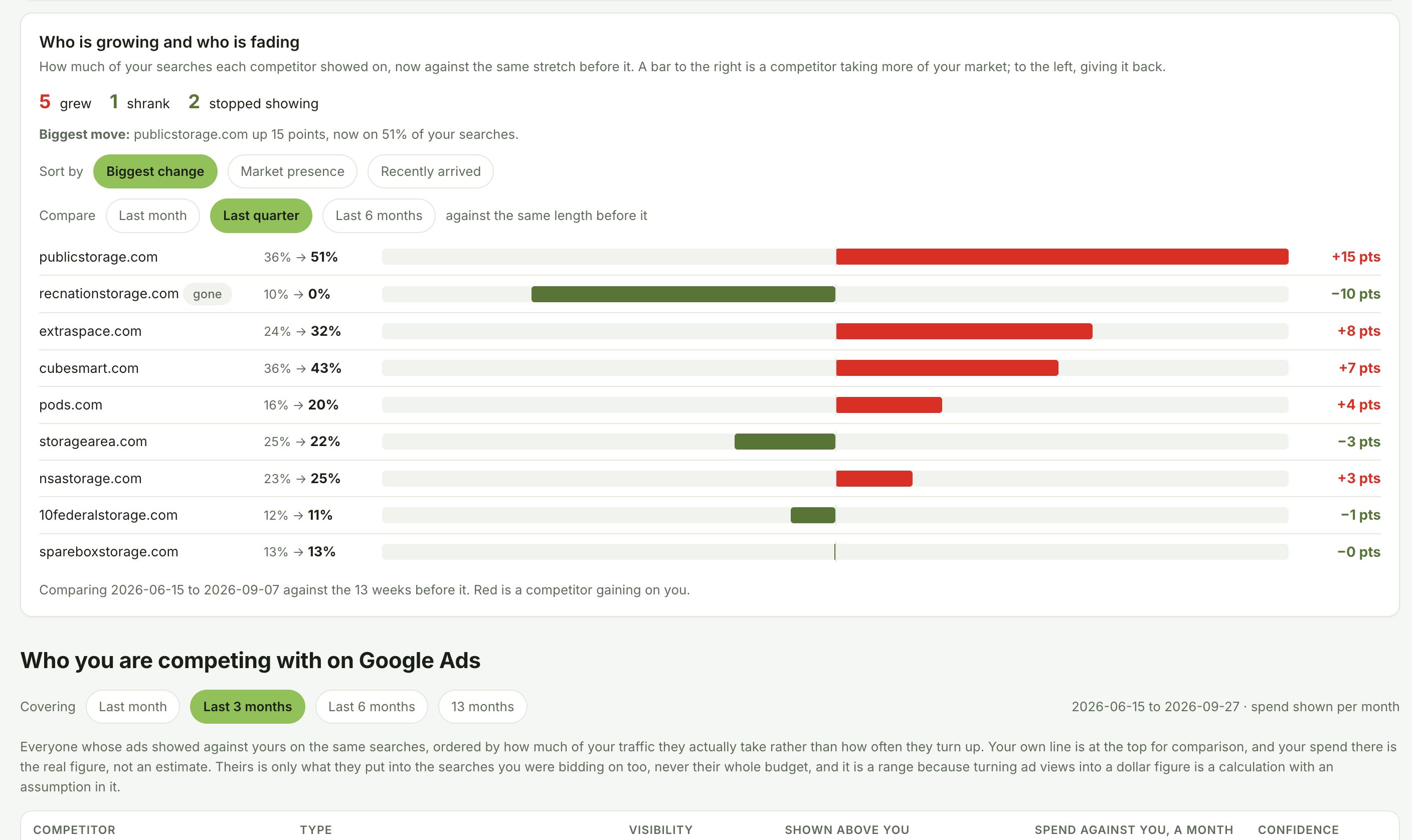
We recently built a tool that pulls Auction Insights data and turns it into trends and visuals so you can better understand what is happening in the competitive landscape.
For example, we can now see:
-Which competitors are becoming more aggressive in a market
-Which competitors are pulling back
-How competitor visibility changes month over month or quarter over quarter
-Whether a new competitor has entered the auction
-How much competitive pressure is coming from REITs, top 100, regional operators, aggregators, and other businesses
In the example image below, you can clearly see Public Storage steadily increasing its presence in the auction. The more interesting part is what happens when we combine this with actual performance data.
We can overlay competitor pressure against metrics like:
-Cost per move-in
-Cost per lead
-Cost per click
-Conversion rate
So if your cost per move-in suddenly increases, you can start diagnosing whether your own account became less efficient or whether a major competitor dramatically increased its presence and changed the economics of the ad auction.
Auction Insights shouldn't just be a report you glance at once in a while. There is a lot of useful competitive intelligence buried in the data when you trend it over time and connect it back to actual advertising performance.
This is another piece we're adding to StorIQ to help self-storage operators understand not just what changed, but why it changed.

40
We just added a big upgrade to StorIQ’s Local Map Rank Tracker: competitor intelligence at every grid point.
Instead of only seeing where your facility ranks, you can now click any point on the scan and see the top 10 Google Maps results in exact ranking order for that location.
We also added a market-wide competitor view that ranks the top 20 competitors based on their average position across the entire scan.
And because knowing who is outranking you is only half the battle, we’re pulling in additional GBP data to help diagnose why:
-Review quantity
-Star rating
-Primary GBP category
-Secondary GBP categories
-Average rank across the grid
-Top 3 / Top 10 coverage
-Best ranking position
The goal is to turn local rank tracking from a reporting tool into something more actionable.
Instead of: “We rank #5 here.” You can start asking: “Who is consistently beating us, and what are they doing differently?”
More coming to the StorIQ Local SEO tools soon.


47
414 leads for this self storage portfolio in December and 809 in July.
Up 41% year over year and no single tactic gets the credit.
(I can't show a clean year-over-year chart because they switched FMS in Q4 2025. But for context, last July they were closer to 575 leads. Same month, same facilities, roughly 41% more leads.)
Most operators chase one magic markeitng tactic. "We need better ads." "We need SEO." "We need to be on SpareFoot." Then they put everything into that one channel and hope it works.
That's a massive risk.
When one source is carrying your business, you feel every slowdown. Google changes something, a competitor raises bids, an aggregator shifts its ranking, and your phone goes quiet.
The goal to own as much of page one of Google as possible:
→ Local Service Ads at the very top
→ Search ads right below
→ Map ads in the local pack
→ Local SEO to rank in the map pack organically
→ Organic listings further down the page
→ High placement on the aggregators
One searcher. Multiple chances to find you. Every path leads to your facility.
Look at June on this chart. Leads dipped from 704 to 646. With one lead source, that's a panic month. Here it was a blip, because the other channels kept producing. July came back at 809, the best month yet.
That's the real benefit of 3–5 strong lead sources. You don't feel it when one slows down. You can push volume up across all of them at once
Focusing on only one marketing channel is a big gamble. It works until it doesn't, and then you start scrambling trying to figure out what to do. And leads are only the start. What matters is how many turn into move-ins, which is why we track every one back to the FMS.

2
1
64