





Ran a small experiment this week.
Asked an ai agent to build a lead scoring tool.
It came back with a lead search tool instead.
Not a bug, and not a bad agent.
It read the skills, the memories, and the connected documents before answering.
Genuinely looked thorough.
The request was simple enough. Score each lead, if it is 80 or higher route to Book Meeting, otherwise Follow up, let sales override it by hand.
Somewhere in there, it lost the thread.
Not because it is not smart enough. A chat box can only hold the words you type into it, one dimension, nothing else.
The shape of the flow, the sequence, the branching rule, the reason override existed, none of that fits through a text box.
Ran the exact same request again, this time drawn on a canvas instead of typed.
Same six pieces, landing together instead of one word at a time
Shipped exactly as drawn, on the first try.
Nothing against the assistant.
It did exactly what a chat box lets it do.
We just gave it a better door to walk through.


I got @typesafeai Jev to generate code and ui components.
Now it builds UI components by instinct.
You describe what you want.
Jev create the component and answers questions based on probabilities, the same way a designer decides: the font, the radius, the spacing, etc
Try it: ui-generator-instinct-jev.ve…
i just open sourced it for those curious
github.com/joevidev/ui-gener…

Game changer 🤯

After co-inventing ChatGPT, I kept asking myself: why have superhuman chat models not led to AGI?
I’ve spent the last 2 years in stealth building a new way to train models (RLCD), and a new type of frontier AI model that we are releasing today: Jev
• 20-200x faster
• 40-400x cheaper (w/ output tokens free)
• Frontier composable intelligence optimized for decisions
AFAICT the shortest path to AI-based economic revolution
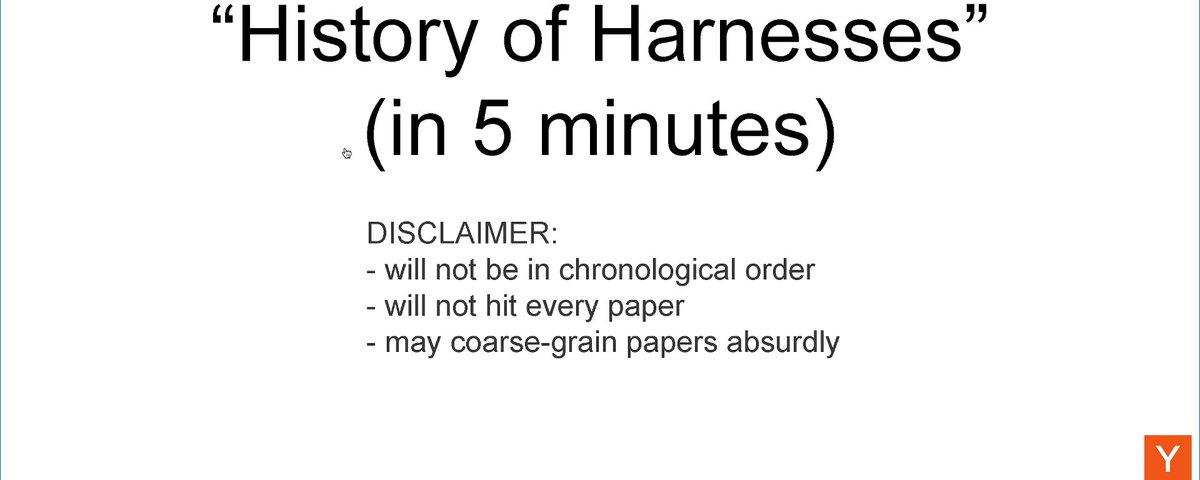
I went to the YC Paper Club – Harness Edition a few weeks ago
Here is the best technical explanation of harnesses, presented on a timeline


Everyone is talking about graph engineering right now
It's funny
That was one of the first things @dianamunozlar and I sat down to think about, long before it was a conversation
How do we let people build software the way the brain actually works?
In neural graphs. In structures of information
And how do we remove every translator in between the ones that quietly corrupt the original input
The answer we landed on is the one the market is now discovering on its own
We've forced ourselves to think in a single line
One dimension
That's not wrong. It's just not enough
Software doesn't live in one dimension.
Neither does thinking
Our official launch is in a few days stay close
If you want to be one of the first to build on a new kind of interface one that understands how you think when you build, and builds it that way this is the moment.
Waitlist open
buivo.ai


A remake of this was needed @juliafedorin 😂
xitter.cf/juliafedorin/status/20…


Joel Timana retweeted
For that reason, we created Hymoex (a role-based architecture for graph execution)
github.com/Pymut/hymoex


Today, for the first time,
@dianamunozlar and I are introducing @buivoai 🔥.
AI gave every role a faster way to work alone.
Business prompts. Product prompts. Engineering prompts.
Going in different directions.
The problem was never the LLMs.
It was the interface.
So we built it.
The oldest human expression now ships software.
The waitlist is open:
buivo.ai?utm_source=twitter&…

Introducing ReactLines.
Atomic Procedural Memory Units
for cognitive agents.
The problem
Agent behavior lives in giant prompts.
Instructions collide, drift, and conflict.
They can't be scoped or reused.
A formal 11-field schema
for behavioral policies
who does what, when, why,
and under what constraints.
Six scopes, from narrow to global:
TURN → SESSION → FLOW →
AGENT → ORG → GLOBAL.
Broader scopes subsume narrower ones.
A 5-stage retrieval protocol
injects only the relevant rules,
recovering 95% of them at top-3.
Built for scale:
add more rules without growing your prompt.
At 100 rules, 97% fewer tokens
than a monolithic prompt
Deployed in real-world production environments
Research designed and executed for large-scale orchestrations.
PS: Useful resources and links in the first comment

Introducing ReactLines.
Atomic Procedural Memory Units
for cognitive agents.
The problem
Agent behavior lives in giant prompts.
Instructions collide, drift, and conflict.
They can't be scoped or reused.
A formal 11-field schema
for behavioral policies
who does what, when, why,
and under what constraints.
Six scopes, from narrow to global:
TURN → SESSION → FLOW →
AGENT → ORG → GLOBAL.
Broader scopes subsume narrower ones.
A 5-stage retrieval protocol
injects only the relevant rules,
recovering 95% of them at top-3.
Built for scale:
add more rules without growing your prompt.
At 100 rules, 97% fewer tokens
than a monolithic prompt
Deployed in real-world production environments
Paper and resources
pymut.ai/labs/reactlines
