






Jukka Nuotio retweeted
I just love it when they say that Ukraine must give up some abstract “territory in the Donbas” for “serious negotiations” to begin, as if it were some empty stretch of land that Zelensky is foolishly refusing to give up.
And nobody bothers to mention that this is, in fact, Ukraine’s most heavily fortified defensive belt against Russia, built up and reinforced over more than a decade, which Putin has spent almost five years trying and failing to capture.
It’s as if, say, in October 1940, Hitler had said: “I’ll consider peace talks with Britain, but only if the British first allow the German troops assembled for Operation Sea Lion to cross the English Channel and establish a beachhead on British soil.”
Or if Stalin had said in January 1940: “We’ll begin peace negotiations, but only if the Finns first let the Red Army through the Mannerheim Line and give it a clear path to advance toward Helsinki.”
And if you told them they were out of their fucking minds, you’d be branded a “warmonger” who “doesn’t want peace.”
Jukka Nuotio retweeted

Iran used Starlink without authorization in attacks against the US.
Meanwhile, Elon and Trump are disrupting Starlink/Starshield connections in Ukraine.
Jukka Nuotio retweeted

"Mom, I just want to live."
These were the last words of 17-year-old Romana Myasoyedova.
On March 16, 2022, in Mariupol, russian occupiers shot her in the back and killed her.
She was just 17. All she wanted was to live.

Jukka Nuotio retweeted

In 1932–1933, the Holodomor wiped out between 3.5 and 5 million Ukrainians.
This famine caused by the Soviet regime was not a tragedy of fate, but a deliberate genocide aimed at breaking and erasing the Ukrainian people. Impossible grain quotas, the confiscation of all food, the encirclement of villages, and the ban on fleeing condemned millions of innocent people to death by starvation.
Remembering, preserving this memory, and telling the world the truth is an essential duty.
Even today, Ukrainian grain is targeted once again, including grain meant for countries facing food shortages.
History reminds us that an evil left unpunished always returns.
We do not forget. We bear witness.
Jukka Nuotio retweeted

How the Stalinist Regime Destroyed the Free #Ukrainian Peasantry.
"#Dekulakization" refers to a policy of mass repression, property confiscation, and deportation implemented by the #Soviet authorities against prosperous, independent peasants (so-called "kulaks") and their families during the period of total collectivization in the late 1920s and the 1930s.
Confiscation of property: Peasants were stripped of their land, livestock, farming equipment, grain, housing, and basic necessities, which were then transferred to collective farms (kolkhozes) or state authorities.
The "dekulakization" campaign effectively preceded the #Holodomor of 1932–1933. Wealthy peasants and their families were driven from their homes, and all their property was seized for collective farms; more than half of those targeted were deported to #Siberia or the #Arkhangelsk region of #Russia.
The "dekulakization" was carried out by OGPU detachments led by "plenipotentiaries sent from the center (#Moscow)," with the involvement of local lumpen elements and Party officials—in execution of #Stalin’s plan to "liquidate the kulaks as a class" and the resolution of the #Politburo of the Central Committee of the All-Union Communist Party (#Bolsheviks) dated January 30, 1930.
Pictured are Petro Maksymeiko—a victim of dekulakization—along with his wife, Yevdokiia, and their two children...

Jukka Nuotio retweeted

The artificial famine orchestrated by Stalin’s regime, known as the Holodomor, claimed the lives of more than three and half million Ukrainians in 1932–33.
On this Holodomor Remembrance Day, it is our duty to do everything in our power to ensure that Putin’s regime fails in its attempt to inflict genocide on the Ukrainian people once again.

Jukka Nuotio retweeted
On Holodomor Remembrance Day russians hit a grain storage in Ukraine.
Obnoxiously on brand for them.

Jukka Nuotio retweeted
Today, on Holodomor Remembrance Day, we publish our first Historical Memory Dossier, dedicated to the millions of Ukrainians who died in 1932–33 and to those who survived to bear witness.
1/15


Jukka Nuotio retweeted
💔📸 Sloviansk today.
One of ten people killed in today's russian airstrike.
Ten lives cut short.
And here we are, in the fifth year of this full-scale war, watching the world continue to tolerate this horror.
I wish the world understood how much this hurts.

Jukka Nuotio retweeted
The echoes of the nightmarish tragedy of the Great Famine of 1932–1933, in which around four million Ukrainians perished, can still be felt far beyond Ukraine itself and across the decades, right up to the present day.
Even in our own time, Ukrainians of my generation growing up in small towns and villages were taught by our grandparents from early childhood to finish everything on our plates, even if we were no longer hungry, down to the very last crumb.
We were also taught to have a special reverence for bread: if you accidentally dropped a slice, you were to pick it up from the floor, kiss it, and symbolically ask forgiveness from those who had grown it in the fields and put it on your table.
And all because even our grandparents’ generation had inherited from their parents a panicked, paralyzing, all-consuming fear of hunger. And that instinct was deeply ingrained in them: eat your fill while there is food, don't waste a single crumb, who knows what tomorrow may bring!
Some had even experienced famine themselves, particularly in the aftermath of World War II. After all, Stalin’s communist famine of 1932–1933 was neither the first nor the last in Ukraine, one of the most fertile lands in the world, one of Europe's principal breadbaskets with a centuries-old tradition of prosperous farming.
And those older than us can often tell you how utterly terrified their grandparents and other relatives were of letting them play outside as children.
We know why: during the famine of the 1930s, cases of cannibalism, the abduction and murder of children for food, were not uncommon.
And in virtually every Ukrainian village, you will hear stories like these about those times. Even in the village in the Donbas where I grew up, I remember old people telling us as children how some people had simply gone completely insane from hunger. They told the story of a young woman who had been unable to feed her infant because of starvation but had never come to terms with what had happened.
Whenever someone came into her house, she would shush them: “Why are you making so much noise? You'll wake the baby.” And in the cradle lay the long-desiccated little corpse.
The famine of 1932–1933 is a colossal trauma that haunts an entire nation to this day, an enormous, heavy stone skull looming over its shoulder.
It is why, if you drive through central Ukraine even today, you will come across memorial crosses draped with embroidered rushnyky in many village cemeteries.
And it is why, in the exhibition hall of the Holodomor Museum in central Kyiv, you will find enormous, thick volumes printed in tiny type, one for each region within the borders of Soviet-occupied Ukraine at the time, available for anyone to read.
They list the names of those who died en masse, entire streets, entire families, entire villages, of “unknown causes,” “exhaustion,” or “weakness.”
Atrocities such as the Holodomor, which undoubtedly rank alongside the greatest mass crimes and genocides in human history, transcend time and geography and become a mirror of human morality, even for those seemingly far removed from Ukraine.
Such was the case with the young British journalist Gareth Jones, who, horrified by what he had witnessed in Ukraine, became one of the first to break through Soviet censorship and report on the mass starvation in The Manchester Guardian.
But he was ridiculed, vilified, and subjected to what amounted to a campaign of persecution and ostracism, orchestrated by the Soviet authorities. Young Jones himself soon met his death in Inner Mongolia under mysterious circumstances. And only yesterday was a monument to him finally unveiled in Kyiv.
And then there was the infamous Walter Duranty, who, as we know, joined the campaign to discredit Jones and deny the Holodomor, dismissing his account as a “big scare story” about famine in the Soviet Union. Does that not remind you of today's legions of arrogant Putin apologists and defenders of the war against Ukraine? As we know, he had been awarded the Pulitzer Prize for his shameless glorification of Stalin and his socialist paradise.
Interestingly, one of the people who helped modern, independent Ukraine reclaim the memory of its ancestors' tragedy and commemorate it with dignity was an American, James Mace, a native of Oklahoma.
He spent many years studying the history of Ukraine, the Holodomor, and the crimes of the communist regime in general, including at Harvard. He lived and taught here in Kyiv, married a Ukrainian poet, wrote columns for Ukrainian newspapers, and lived quite modestly in Troieshchyna.
He died many years ago and is buried in Kyiv's Baikove Cemetery, on its memorial avenue alongside some of Ukraine's most distinguished and celebrated figures. But back in 2003, he proposed that Ukrainian families in every household commemorate the millions of victims of the Holodomor on the fourth Saturday of every November.
The tradition took root, and ever since, at 4 p.m. on that day, many people here have placed candles in their windows in memory of our great-grandmothers and great-grandfathers who starved to death.
Today is that very day, Holodomor Remembrance Day in Ukraine.
Meanwhile, in Russia, which is waging Europe's largest war of aggression since World War II in an attempt to destroy Ukraine, the glorification of Stalin is gathering pace once again, new monuments to him are going up, and yet more propaganda television series are being made with the message that “it all had to be done”...

Jukka Nuotio retweeted
This is the story of little Volodia.
In memory of the millions of lives lost during the Holodomor (1932–1933), this is the story of one of them.
Jukka Nuotio retweeted

In 1932–1933, Stalin’s regime inflicted the Holodomor on Ukraine - a genocide that claimed the lives of millions of Ukrainians.
The Soviet authorities imposed impossible grain procurement quotas and took all the food from Ukrainian farmers - even what they needed to stay alive.
Villages placed on so-called “blacklists” were cut off from food and other essential supplies.
The authorities also banned people from leaving Ukraine in search of food. Even trying to save your life by gathering a few ears of grain could cost them life.
By current estimates, around four million people died of starvation in Soviet Ukraine.
The Soviet authorities covered up the truth. They denied the famine, concealed the number of people who had died, restricted access to the affected areas and persecuted anyone who tried to tell the world what was happening.
This, too, was a Russian occupation. This, too, was an international crime.
Jukka Nuotio retweeted
The algorithm here seems to have become more aggressive against pro-Ukraine accounts. Numbers are way down. Are they throttled by the owner like Starlink? As dangerous to Russia as Ukrainian drones?
Jukka Nuotio retweeted
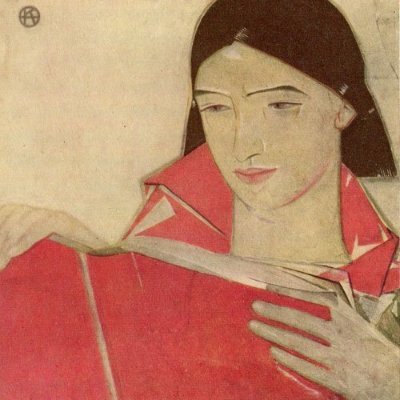
Today we remember victims and survivors of Holodomor (1932-1933). Two of my great-grandfathers died, and my great-grandmother used to tell me about it. Please read and share this thread about 🇺🇦 art and Holodomor 🧵
artwork by Viktor Zaretskyi, 1989

Jukka Nuotio retweeted

“Kuuma kesäpäivä Dniprossa, 1933. Isoisoäitini Galina touhuaa keittiössä. Hänen parivuotias tyttärensä leikkii talon terassilla. Hetken kuluttua – pahaenteinen hiljaisuus, sitten askelia. Galina aavistaa pahinta: hän nappaa vesurin ja juoksee kadulle. Kaksi miestä on kaapannut lapsen säkkiin, myytäväksi tai syötäväksi. Galina ei jää ottamaan selvää. Hän iskee vesurilla säkkiä kantavaa miestä olkapäähän. Säkki putoaa, ja miehet pakenevat. Mummoni jää henkiin ja tarina kulkeutuu seuraaville sukupolville.”
Lähes jokaisella ukrainalaisella suvulla on kokemustarinoita holodomorista. Holodomor tarkoittaa neuvostovallan masinoimaa nälänhätää vuosina 1932–1933. Miljoonia uhreja vaatineen kansanmurhan muistopäivää vietetään marraskuun neljäntenä lauantaina.
Kommunismin ja Stalinin nimissä toteutettu maatalouden pakkokollektivisointi riisti Ukrainan maaseudun tyhjäksi. Kylät eristettiin, eikä nälkää näkeviä päästetty lähtemään. Neuvostovallan sadistinen propaganda kylvi riitaa ja vaiensi tiedonsaantia. Niiltä, jotka eivät täyttäneet viljakiintiöitä, vietiin kaikki. Heitä myös lähetettiin pakkotyöleireille tai teloitettiin. Moni katosi jäljettömiin tai kuoli kadulle. Ruumiita ei kerätty viikkoihin.
Holodomorin aikana osa ihmisistä näytti pahimman puolensa: he varastivat sukulaisiltaan ja kantelivat valloittajille naapureiden piilotetusta kotivarasta. Toiset tekivät päinvastoin. Suvussani muisteltiin usein henkilöä, joka uhrasi itsensä tyttäriensä ja miniöidensä tähden. Hän telkesi itsensä aittaan ja näännytti itsensä, jotta muilla olisi paremmat mahdollisuudet selviytyä.
Tänään vihollisen hyökkäyssota käyttää samoja keinoja kuin sen edeltäjä. Siksi kunnioitamme holodomorin uhrien muistoa ja jatkamme Ukrainan tukea voittoon, päivästä toiseen.
Vieraskynä:
Valeria Gasik

Jukka Nuotio retweeted

Today is Holodomor Remembrance Day.
Those who have followed me for a long time know that on this day I like to quote my grandfather, who was a teenager at that time. I knew him as a strong and brave person, fun and full of life in his elderly years, but memories of the Holodomor always made the light in his eyes dim.
He remembered people roaming the streets of Kharkiv hoping to find any food, collapsing, or dying right there. A wagon would come to collect the dead bodies along with the dying, who were too weak to move. Returning to those memories hurt my grandfather every time, which is why I share them. Such atrocities must be remembered.
The photographs below show the Holodomor on the streets of Kharkiv, taken by Austrian engineer Alexander Wienerberger, who worked at the Kharkiv Plastics Factory in 1932–1933.
As a result of the Holodomor, at least 1,037,600 people died in the Kharkiv region within its administrative borders at the time.


Jukka Nuotio retweeted

Worms in the soup. Sewage flooding prison corridors. Women forced to use dirty rags instead of sanitary products. Starvation, beatings, sexual humiliation, and the screams of Ukrainian soldiers being tortured behind prison walls.
This is what Ukrainian combat medic Halyna Fedyshyn endured during nearly 20 months of Russian captivity.
She survived the siege of Mariupol and the hell of Azovstal, only to face another nightmare in Russian prisons.
Her testimony is horrifying. What she witnessed, what she suffered, and what she heard happening to her fellow prisoners must never be forgotten.
I have published her story, including the terrible details of her captivity and the extraordinary strength it took to survive.
Please read it. Share it. And remember the Ukrainians who are still suffering in Russian prisons.
mykhailorohoza.substack.com

Jukka Nuotio retweeted

Väännetäänpä nyt rautalangasta: Jared Kushnerin käsitys Venäjästä ja Euroopan turvallisuudesta voi pahimmillaan muodostua uhaksi myös Suomelle.
Rauhanneuvotteluja käydään maailmanpolitiikan korkeimmalla tasolla, presidenttien palatseissa ja näyttävissä puitteissa. Näistä neuvotteluista syntyvä julkisuus luo helposti vaikutelman siitä, että asioita hoitavat poikkeuksellisen pätevät kansainvälisen politiikan ammattilaiset.
Kushnerin viimeaikaisia puheenvuoroja kuunnellessa kannattaa kuitenkin tarkastella, millaisiin oletuksiin hänen lähestymistapansa perustuu.
Kushner kuvailee Putinia politiikan suurmestariksi, Venäjän pääneuvottelijaa erinomaiseksi ystäväkseen ja antaa Venäjälle tunnustusta siitä, ettei se ole käyttänyt ydinaseita Ukrainassa. Samalla hän pitää eurooppalaisten Venäjää kohtaan tuntemia pelkoja pitkälti perusteettomina.
Kushnerin julkisissa puheenvuoroissa toistuu siinä määrin Venäjän johdon käsityksiä historiasta ja Euroopan turvallisuudesta, että on aiheellista puhua riskistä, jota kutsuisin Venäjän turvallisuuspoliittisen maailmankuvan amerikkalaistamiseksi.
Venäjän kannalta olisi valtava diplomaattinen saavutus, jos Yhdysvallat ryhtyisi itse esittämään ja perustelemaan Venäjän tavoitteita ratkaisuina Euroopan turvallisuusongelmiin.
Venäläisten kanssa käydyissä neuvotteluissa on helppo päätyä hyvin ongelmalliseen asetelmaan.
Venäjä kertoo amerikkalaisille olevansa valmis rauhaan ja esittää listan ehdoista, jotka Ukrainan pitäisi hyväksyä. Ukraina puolestaan haluaa säilyttää itsenäisyytensä, tarvitsee aseita ja vaatii uskottavia turvallisuustakuita.
Jos neuvottelija pitää Venäjän ehtoja lähtökohtaisesti kohtuullisina, ukrainalaisten haluttomuus hyväksyä niitä alkaa helposti näyttäytyä rauhan esteenä. Hyökkääjästä tulee neuvottelukumppani ja hyökkäyksen kohteeksi joutuneesta maasta ratkaistava ongelma.
Kushnerin historiakäsitys tekee tästä asetelmasta entistä ongelmallisemman. Hän esimerkiksi väittää, että Venäjälle on viimeisen tuhannen vuoden aikana hyökätty noin kerran vuosisadassa ja aina nykyisen Ukrainan kautta. Jo Napoleonin sotaretki vuonna 1812 kumoaa väitteen.
Venäjän vuosisatoja jatkunut imperialistinen laajentuminen jää tässä historiantulkinnassa lähes kokonaan käsittelemättä.
Miltä tämä näyttää Suomen näkökulmasta?
Joulukuussa 2021 Venäjä vaati, ettei Nato saisi enää ottaa uusia jäseniä. Venäjä perusteli tätä omalla turvallisuudellaan. Suomelle vaatimuksen hyväksyminen olisi tarkoittanut itsemääräämisoikeutemme kaventamista.
Miten Suomen asema olisi tällaisessa tilanteessa hahmotettu neuvottelupöydässä, jossa Venäjän turvallisuusvaatimuksia pidetään ymmärrettävinä ja sen naapurimaiden huolia liioiteltuina?
Yhtä ongelmallinen on Kushnerin käsitys sotilaallisesta pelotteesta. Hänen mukaansa Trump olisi valmis antamaan Ukrainalle Naton viidettä artiklaa muistuttavat turvallisuustakuut, mikäli niiden toimeenpanoa vaativa tilanne olisi erittäin epätodennäköinen.
Sodan epätodennäköisyys syntyy juuri siitä, että turvallisuustakuiden antajat ovat uskottavasti valmiita sotimaan. Ilman tätä valmiutta lupaus on arvoton.
Yhdysvaltain nykyisen hallinnon piirissä puhutaan avoimesti koko Euroopan turvallisuusjärjestyksen uudistamisesta. Kyse on siis huomattavasti suuremmasta asiasta kuin yhden sodan päättämisestä.
Suomelle on äärimmäisen tärkeää, että tällaisia neuvotteluja käyvät ihmiset ymmärtävät Venäjän historian, vallankäytön menetelmät, poliittiset tavoitteet ja sotilaallisen pelotteen perusteet.
Meidän turvallisuutemme kannalta olisi kohtalokasta, jos amerikkalaiset ostaisivat Venäjän historiantulkinnan, hyväksyisivät sen turvallisuusvaatimukset neuvottelujen lähtökohdaksi ja kuvittelisivat voivansa korvata sotilaallisen pelotteen diplomaattisilla lupauksilla.
theatlantic.com/ideas/2026/1…

Jukka Nuotio retweeted

“Russian-speaking territories should go to Russia – why should Russians give them up?” – German opposition leader Alice Weidel on Donbas.
Does this argument sound familiar?
It is remarkably similar to the argument Hitler used to justify German territorial expansion before World War II.
In 1938, Hitler justified the annexation of Austria by arguing that Germans and Austrians belonged to the same nation. Later that year, he demanded the Sudetenland from Czechoslovakia because of its predominantly German-speaking population.
In 1939, he used similar arguments to justify territorial demands against Lithuania and Poland.
Speaking the language of a neighboring country does not give that country the right to annex your homeland.
One would hope that German politicians, of all people, would understand this.
