

"There is nothing new in the world except the history you do not know." - Truman. USMC. Creator of Flashpoint: https://xitter.cf/t.co/TUHmT6fXty
Los Angeles, CA
Joined April 2020
- Tweets4.5K
- Following3.9K
- Followers3.8K
- Likes15.4K
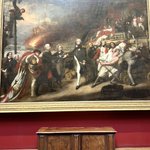






The Victory of Lord Duncan 11 October 1797
Oil on canvas National Gallery of Scotland
Adam Duncan's victory over the Dutch allies of the French Revolutionary government off Kamperduin (Camperdown) in 1797 was as significant as Trafalgar.


Kazuo Otani received the Medal of Honor posthumously for his heroic leadership on this day in 1944. Otani's platoon was pinned down by a German ambush in Italy. He rallied the platoon, organizing an effective counter-attack, and dragging a wounded soldier to safety, before he was cut down. Honor and remember him!

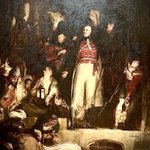
General Sir David Baird discovering the body of Sultan Tippoo Sahib after the capture if Seringapatam in 1799.


Frank Ono, part of the famed 442nd Regimental Combat Team, made up of Japanese-Americans, received the Medal of Honor for his leadership on July 4, 1944. When his platoon attacked a heavily defended hill, Ono repeatedly exposed himself to enemy fire to move the assault forward or to defend against counter-attacks.
Ono survived the war. He received the Distinguished Service Cross, which was upgraded in 2000 to the Medal of Honor.


JF Murphy retweeted

“Freedom is not a gift that lasts long in the hands of cowards.”
-Theodore Roosevelt

JF Murphy retweeted

163 years ago, the men of the 20th Maine and the heroes of the 3rd Brigade faced one of the great turning points in American history at Gettysburg’s Little Round Top🇺🇸 “Bayonet!”


JF Murphy retweeted

Not Yet Two O'Clock: Faulkner Sets the Scene
The finest thing ever written about Pickett's Charge does not appear in a history of the battle. It appears in a novel about a murder in a fictional Mississippi county, published eighty-five years after the guns fell silent, buried mid-paragraph as though its author were half embarrassed to be caught caring so much. William Faulkner set it down in Intruder in the Dust in 1948, and no historian before or since — and I include the best of them — has come closer to explaining what that afternoon became in the Southern mind after the fact of it was done.
Shelby Foote would have been the first to say so. He held Faulkner above every American novelist living or dead — a fellow Mississippian, near enough a neighbor — and as a young man he once drove down to Oxford with Walker Percy to pay the great man a call, Foote marching up to the door at Rowan Oak while Percy, too awed to move, sat waiting in the car. When Foote spent twenty years writing his own three volumes on the war, it was Faulkner's shadow he wrote in, and he knew it, and never pretended otherwise.
What Faulkner understood — what the passage below holds suspended like a fly in amber — is that the charge exists twice. Once in history, where it ran its course in less than an hour on the afternoon of July 3, 1863, and cannot be called back. And once in memory, where the clock stands forever at "not yet two o'clock," the brigades in position, the flags loosened, everything still in the balance — where there is still time, every time, for it not to begin. The boy in Faulkner's conceit gets to stand in that instant whenever he wants it. The men behind the rail fence got it once, and briefly, and then the word came.
Notice, too, who inhabits Faulkner's tableau: Pickett with his oiled ringlets, Garnett, Kemper, Armistead, Wilcox. No Pettigrew. No Trimble. No Davis's Mississippians waiting off to the left with the railroad cut two days behind them, no Brockenbrough, no fences. Faulkner's passage does not merely describe the legend — it demonstrates how the legend was built, and who was left outside it. The boy dreams of Virginians. This series has spent its length among the men he never dreams of.
But read the passage. Read it aloud if you can, the way it was built to be read, one sentence carrying you the whole way down like the slope of Seminary Ridge itself. Then look at the painting, and the men standing ranked and waiting in it, and remember that for them there was no whenever he wants it. There was only the once.
— William Faulkner, "Intruder in the Dust," 1948, follows below.


On this day in 1898, Theodore Roosevelt was a volunteer lieutenant-colonel serving in the cavalry when he displayed extreme bravery during the Spanish-American War.
Totally disregarding his own safety, Roosevelt inspired his men by example, charging up a hill and becoming the first to reach the enemy trenches, where he shot a Spanish soldier with his pistol.
Roosevelt's superior, General Wood, nominated him for the Medal of Honor after the War. The Medal was denied, however, for political reasons, as Roosevelt had criticized the Army leadership for their medical care of American soldiers in the weeks after the War.
In 1998, a group of Congressman, led by Paul McHale of Pennsylvania, a Marine Corps veteran of the Gulf War and Afghanistan, ensured that Roosevelt received the Medal that he had been denied one hundred years before.
Please honor and remember this great American!
ROOSEVELT, THEODORE
The President of the United States of America, authorized by Act of Congress, March 3, 1863, has awarded in the name of The Congress the Medal of Honor to
LIEUTENANT COLONEL THEODORE ROOSEVELT
UNITED STATES ARMY
for conspicuous gallantry and intrepidity at the risk of his life above and beyond the call of duty:
Lieutenant Colonel Theodore Roosevelt distinguished himself by acts of bravery on 1 July, 1898, near Santiago de Cuba, Republic of Cuba, while leading a daring charge up San Juan Hill. Lieutenant Colonel Roosevelt, in total disregard for his personal safety, and accompanied by only four or five men, led a desperate and gallant charge up San Juan Hill, encouraging his troops to continue the assault through withering enemy fire over open countryside. Facing the enemy’s heavy fire, he displayed extraordinary bravery throughout the charge, and was the first to reach the enemy trenches, where he quickly killed one of the enemy with his pistol, allowing his men to continue the assault. His leadership and valor turned the tide in the Battle for San Juan Hill. Lieutenant Colonel Roosevelt’s extraordinary heroism and devotion to duty are in keeping with the highest traditions of military service and reflect greet credit upon himself, his unit, and the United States Army.

Steven Bennett was an airborne artillery spotter in Vietnam in 1972 when he noticed North Vietnamese troops massing around a friendly position.
Eager to blunt the imminent attack, Bennett called for both air and artillery fire, but both were denied.
Consequently, Bennett positioned his slow moving and lightly armored plane to strafe the enemy. He and his co-pilot made four low level gun attacks, stymying the enemy, before his plane was hit by a surface-to-air missile.
Discovering that his co-pilot's parachute had been damaged by the missile, Bennett decided to try a water landing in the Gulf of Tonkin. The plane cartwheeled on landing and Bennett was caught in the sinking wreckage and drowned.
The observer survived to recount how Bennett had stayed with him when he could have jumped free on his own. Bennett was posthumously awarded the Medal of Honor. He was survived by his wife and his two year old daughter, Angela.
Please honor and remember this great American!
