

Coach/Counselor/Pastor to Clear River/Worship. Word. Table./ Husband, Dad, Poppa./ Running the race, learning endurance. James 1: 2-5 = life verses.
Manassas, Va.
Joined March 2008
- Tweets14K
- Following1.8K
- Followers2K
- Likes7.4K







Pinned Tweet
"He is not ashamed to call them his children." (Hebrews 2:11)
Let that sink in: Jesus knows EVERYTHING about you—every struggle, every failure, every weakness—and He is NOT ASHAMED of you. You belong to Him. #BelovedOfGod #UnashamedIdentity #AdoptedByGrace
Jeff Ling retweeted

To lose your sense of humor is to lose your sense of proportion. And nothing is more important in theology than a sense of proportion.

So good. It’s hard to enjoy X when believers keep lobbing grenades at each other.

Jeff Ling retweeted

Hmm. I think Putin could have ended this war much more easily by never invading Ukraine in the first place—and by not killing scores of Ukrainian civilians just this week.
And, as I wrote in @USAToday, President Trump continues to blame Ukraine for a war of Russian aggression.
Our @TalbotTheology students in Kyiv live with the suffering and danger of this unjust war every day.
@realDonaldTrump, please use your influence with Putin to help bring this war to an end. Russia can stop its aggression today.
The distinction is simple:
If Russia stops fighting, the war ends. If Ukraine stops fighting, Ukraine ends.
usatoday.com/story/opinion/2…

Jeff Ling retweeted

I support the death penalty. God himself told Noah that those who willfully take the life of another should be executed.
The United States Army prohibits public executions, but the Pentagon does not seem to care about following its own rules.
The pagan Roman Empire relished the public spectacle of executions. Growing up overseas in an Islamic country, some executions were public. Christendom, over time, recognized that justice is not to entertain or titillate. Justice is not meant to be a spectacle.
In Ezekiel 33:11, scripture reads, “As surely as I live, declares the Sovereign Lord, I take no pleasure in the death of the wicked, but rather that they turn from their ways and live.” Proverbs 24:17 echoes that for us. “Do not gloat when your enemy falls; when they stumble, do not let your heart rejoice.”
In Chapter 19 of De Spectaculis, Tertullian, one of the early post-apostolic church fathers, wrote about the public spectacle of executions in Rome. “It is good, no doubt, to have the guilty punished. Who but the criminal himself will deny that? And yet the innocent can find no pleasure in another's sufferings: he rather mourns that a brother has sinned so heinously as to need a punishment so dreadful,” he wrote.
In Confessions, Augustine wrote of his friend Alypius, who, dragged into the Coliseum to see gladiatorial fights, shut his eyes, though not his ears. Upon the cheers of slaughter, he opened his eyes to the blood, and the bloodlust corrupted him. Augustine’s writing has long taught Christians not to be entertained by the spectacle of violence, as watching it can damage you.
I support the death penalty. Public executions are soul-twisting and we should not go down that road.
A measure of spiritual maturity is when we ask less for Jesus to still the storm and more for us to be able to stand with him in it. Good on ya Pete.

Jeff Ling retweeted
Last night, I shared with our Talbot School of Theology faculty and staff some of my thinking about the future of theological education, and particularly how we might have a greater focus on joining Jesus on mission.
My thesis was pretty simple: Theological education must participate in God's mission, not merely explain it.
I shared seven thoughts:
-Mission comes before the seminary.
-Theological education is formation, not merely information.
-Scripture tells a missionary story.
-Mission should shape every theological discipline.
-Bring theological education closer to the mission.
-Measure missional outcomes, not merely institutional outcomes.
-The seminary itself should be a sent institution.
I've said from the beginning that my vision is for every part of Talbot to flourish. I still believe that. But I also want us to think more intentionally about how we're forming biblically grounded, spiritually mature, missionally engaged leaders.
I'll write more about this in an article soon, but thought I'd share the outline here.
Lots more to think through, and I'm looking forward to the conversation.
But, we are having a great faculty and staff retreat!

Jeff Ling retweeted

Note: not saying a church should always be politically moderate. Given the cultural moment, it may find itself more on one side or the other. But if it has no enemies on the left--or right--that's a bad sign. In fact, it's probably an apostate church.

Andrew Osenga dropped his new album today and it’s absolutely lovely.
open.spotify.com/album/2aUz0…
Jeff Ling retweeted

“If the problem in the 16th century was abusing the sacraments through superstition, the problem today for many Protestants is abusing them through neglect and faithless participation.”
—@AdrielTweets
🎥 Watch the full episode: youtu.be/TM_DlFf1hj4
But when the goodness and loving kindness of God our Savior appeared, he saved us, not because of works done by us in righteousness, but according to his own mercy, by the washing of regeneration and renewal of the Holy Spirit, whom he poured out on us richly through Jesus Christ our Savior, --Titus 3:4-6
Jeff Ling retweeted

When exactly did Jesus show up? When did he step onto the world stage?
When he was born in Bethlehem? That is when “the Word became flesh and dwelt among us” (John 1:14), but his conception and birth were far from the beginning of his biography.
Was Jesus active as far back as the days of Israel in the Old Testament? Yes. Paul tells us that the Israelites in the wilderness “drank from the spiritual Rock that followed them, and the Rock was Christ” (1 Cor. 10:4). Isaiah saw his glory (Isa. 6 and John 12:41). And Jesus was the divine messenger sent by the Father to lead the children of Israel to the Promised Land (Exod. 23:20–23; Jude 5).
But Jesus was around much earlier than Israel and the prophets.
What about the time of Abraham? Jesus told his opponents, “Before Abraham was, I am” (John 8:58). Before the patriarch existed, Jesus existed. Indeed, he speaks in the present tense: “I am.”
What about creation? John tells us that the Word “was in the beginning with God” and that “all things were made through him” (John 1:2–3). Paul says, “by him all things were created” and “all things were created through him and for him” (Col. 1:16).
So, if all things were created through the Son of God, his biography predates creation.
As we read today in Bible in One Year, on the night before his crucifixion, Jesus prayed, “Father, glorify me in your own presence with the glory that I had with you before the world existed” (John 17:5). Before the world existed!
Jesus, the Son of God, was God before his incarnation, before Israel, before Abraham, and even before creation.
So when did Jesus show up? He didn’t. His bio has no beginning.
There never was a time when the Son of God did not exist. Before Israel, before Abraham, before creation, before there was a before or after, before time itself, the Son of God eternally existed with the Father and the Holy Spirit.
Jesus never stepped onto the world stage.
He made the stage.
He is “God of God, Light of Light, very God of very God, begotten, not made.”
______
For an excellent resource on this, see Putting Jesus in His Place: The Case for the Deity of Christ by Robert M. Bowman Jr. and J. Ed Komoszewski, a.co/d/0bF3E9oz

Jeff Ling retweeted

“The definition of spiritual growth is going from having a thin skin and a hard heart to having a thick skin and a soft heart.”
- John Stott
Jeff Ling retweeted

As often as we eat this bread and drink this cup, Paul says, we proclaim Christ’s death until He comes. What is it we proclaim?
We might think we proclaim Jesus’ gruesome suffering. But this turns from Eucharist into eulogy, the table into a tomb.
What we proclaim is a coronation: Jesus’ kingly self-gift and ascent to His cruciform throne. We proclaim God’s ironic inversion of all human plots.
Jeff Ling retweeted

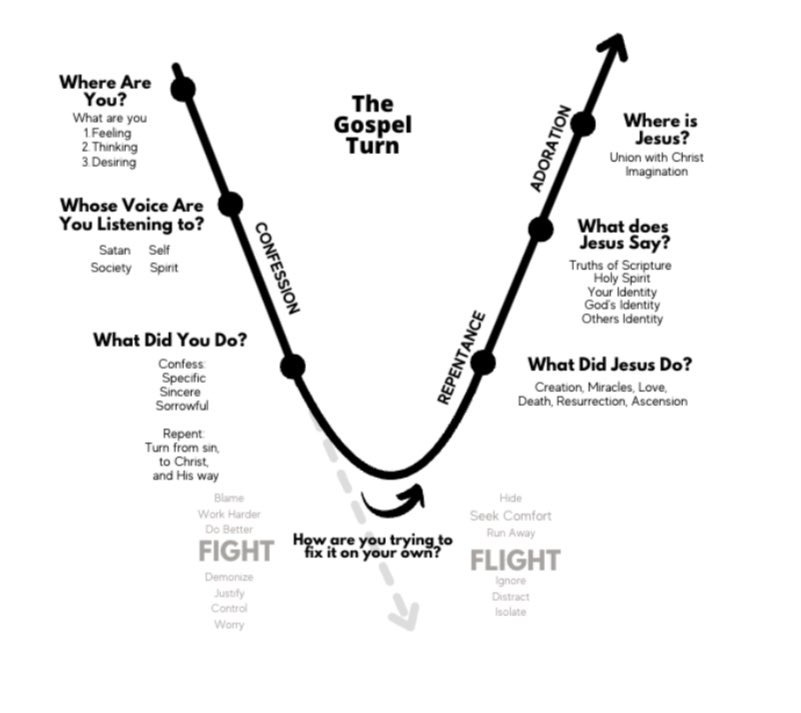
In Genesis 3 we see God asking 3 important questions. I like to think of this as the first therapy session in the history of mankind. The more I meditate on this passage the more I see my own story and the story and experience of every person I counsel.
When God called out, “Where are you?” it was to get to Adam’s heart. It was the voice of law reaching Adam’s conscience - exposing what he was trying so hard to hide.
God already saw everything. “Nothing is hidden from His sight” (Hebrews 4:13). But He spoke in a way Adam could feel - to open his fearful, hiding heart. It was as if God were saying, “Do you really think I can’t see you?” Where is your heart that you would hide from me?”
Sin always makes us want to run from God. It convinces us that distance is safer than drawing near. But the tragedy is that we can’t actually flee from Him and even if we could, running never brings relief. Hiding from God only deepens our misery. We try to escape from the only One who can heal us.
In that moment, God’s question wasn’t just merciful confrontation; it was gospel invitation. He calls us and invites us to confession and repentance and gives us Christ. His law exposes that so in His grace He can cover us.
Jeff Ling retweeted

If you listen to Cain, he will tell you that righteous Abel was the problem.
If you listen to Potiphar’s wife, she will tell you that righteous Joseph was the wicked man.
If you listen to Pharaoh, he will tell you that Moses was an enemy of the state.
If you listen to Saul, he will tell you that loyal David was a traitor.
If you listen to Haman, he will convince you that Mordecai was a dangerous enemy.
If you listen to Ahab and Jezebel, they will tell you that Elijah, the prophet of God, was the troublemaker.
If you listen to the Pharisees and the teachers of the law, they will tell you that the sinless Jesus was a blasphemer.
If you listen to Judas Iscariot, he will find a way to justify betrayal.
If you listen to Pontius Pilate, he will wash his hands while Truth stands directly in front of him.
And if you listen to the world, do not be surprised when it calls righteousness evil and evil good.
My friends, listen carefully: a lie does NOT become Truth simply because it is repeated loudly, confidently, or by powerful people.
Be careful what you hear.
Be careful whom you believe.
Be careful whom you follow.
Test everything by the Word of God.
The world may condemn you for standing for Biblical Truth but the only verdict that ultimately matters is His!!!
Stand firm. Stand faithful. And above all, listen to Jesus.
