


Jeff Gortmaker retweeted

Who uses AI agents?
How do agents impact output?
How might agents change work patterns?
New working paper studies usage + impacts of coding agents (1/n)

Jeff Gortmaker retweeted

💡 Why would a firm spend millions training workers it doesn’t even employ?
From open-sourcing to certifications, superstar firms often train the workforce of their customers.
My JMP explains why. 🧵

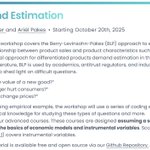
Next week, I'm teaching another round of my online Mixtape course on BLP-style demand estimation!
The sessions are hands-on and last time we had a ton of great questions. Sign up here: mixtapesessions.io/session/d…

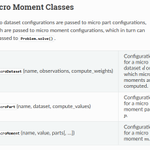
For a sense of what I'll be covering, check out the open source course materials. Problem sets quickly get you working with my and @conlon_chris's PyBLP.
GitHub: github.com/Mixtape-Sessions/…

Jeff Gortmaker retweeted

@giulia_bran and I are looking for a pre-doc to work with us on topics related to Industrial Organization and Trade @NYUStern
Ideally for two years starting in September
apply.interfolio.com/165860
@econ_ra
My job market's done, and I'm heading back to the NYC area! Excited to join @PrincetonEcon as a postdoc next year and @NYUSternEcon as an AP in 2026.
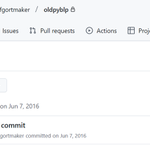
In a happy twist of fate, this means @conlon_chris and I will be colleagues exactly 10 years after our first PyBLP commit:

Jeff Gortmaker retweeted

Thanks for the shout out, @marxmatt!
We plan to release this data publicly next year. Please reach out if you’re interested in learning more.

@realjoshlerner and @HarvardEcon Ph.D student Namrata Narain( @nummoose) created a dataset of patents in China, including massive de-duplication of records from multiple sources. expecting to open-source it in 2025!


Happy to share that this paper was just accepted @JEconometrics!
It's my and @conlon_chris's 2nd paper tied to our PyBLP software, so here's a thread on surprising (to me) benefits of combining methods research with open source work. 1/6

Hey #econtwitter, I'm excited to share a new WP with @conlon_chris about micro data (e.g. consumer surveys) in BLP estimation. Alongside it, we finally released PyBLP version 1.0!
Paper: jeffgortmaker.com/files/micr…
Code: github.com/jeffgortmaker/pyb…
Docs: pyblp.readthedocs.io/en/stab…
1/16


6/6 All this to say: if you're doing methods research, there are some clear private benefits that can come jointly with doing open source work (impact, transparency, networking, etc.) but also others that could be more surprising.
7/6 Also: I'm on the job market! If you're interested in the economics of (industrial policy for) open source or want to see a (very simple) example of micro BLP in action, check out my job market paper: xitter.cf/jeff_gortmaker/status/…
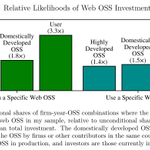
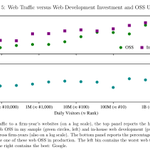
Hey #EconTwitter, I'm on the job market with a paper about open source software. OSS is a global public good, widely used and provided by the private sector, but the target of recent industrial policy.
Paper: jeffgortmaker.com/files/Open…
1/

Jeff Gortmaker retweeted

1/12 I’m excited to share my job market paper, “Delay Your Rivals? Vertical Integration in Securitization and Lending Competition” (with @JosDSalas1).
In this 🧵, I’ll explain how vertical integration (VI) impacts competition, loan rates, and origination. drive.google.com/file/d/1oeS…
Jeff Gortmaker retweeted
Economic valuations fluctuate in ways empirical research cannot fully explain
What information are we missing? Economic theories emphasize the role of hard-to-quantify beliefs and perceptions
My job market paper develops algorithms + measurement to quantify perceptions of firms

Jeff Gortmaker retweeted

Excited to share that I'm on the 2024-2025 job market!
My job market paper is about failures of contingent thinking -- the act of reasoning about hypothetical events. 1/
Hey #EconTwitter, I'm on the job market with a paper about open source software. OSS is a global public good, widely used and provided by the private sector, but the target of recent industrial policy.
Paper: jeffgortmaker.com/files/Open…
1/
17/ Subsidies seem more effective and generate large innovation spillovers, especially if the US responds in kind.
Subsidies can be cheap because OSS investment is rare (weak private benefits), but impactful because OSS use is widespread (strong public benefits).
18/18 This has been a joy to write and present (not only because I get to use PyBLP screenshots to illustrate US-China collaboration).
I'm excited to keep studying the tech sector from an IO perspective, and building econometric tools on the way.
Links: jeffgortmaker.com