

hello ai
Berlin, Germany
Joined December 2021
- Tweets1.5K
- Following428
- Followers686
- Likes6.5K










Arthur 🇩🇪 retweeted

Astra for Law will initially be offered to selected firms through Trusted Access in ChatGPT and Codex, with API access coming soon. We’ll maintain the legal configuration so builders can focus on their own products and workflows.
We’ll build the next chapter of Astra for Law alongside the lawyers and legal technology partners who put it into practice. openai.com/index/astra-for-l…

Arthur 🇩🇪 retweeted
Astra for Law pairs GPT-6 Astra with instructions for legal analysis and writing, settings for thorough work, and a new Legal Search Index.
The index searches U.S. case law, statutes, regulations, court rules, and administrative decisions across more than 230 million URLs—with sources added daily.
That helps lawyers move from the facts of a matter to relevant authorities and supporting passages they can examine themselves.

Arthur 🇩🇪 retweeted

Places to launch your startup:
1. ProductHunt
2. Betalist
3. Uneed
4. TrustMRR
5. Fazier
6. OpenAlternative
7. Microlaunch
8. Peerlist
9. TinyLaunch
10. SaaSHub
11. Indie Hackers
12. Hacker News
13. Toolfolio
14. Tiny Startup
15. SideProjectors
16. Alternativeto
17. LaunchIgniter
18. PeerPush
19. SaaS Genius
20. There's an AI for that
21. DevHunt
Arthur 🇩🇪 retweeted

Google just released free 2-hour course on full Graph & Loop engineering: 1 prompt → 100 agents → loops → graphs from 0% to 100%:
0% → 0:35 - Graph engineering from scratch
30% → 31:17 - build your first agents graph
45% → 43:40 - run hundreds agents in parallel
75% → 1:04:58 - Loop engineering: route, check, repeat
100% → 1:30:09 - self-improving graphs that work while you sleep
most people keep stuffing instructions into one agent - the real upgrade is a graph that routes, checks, and rebuilds the workflow at runtime
learn graph from Google, ship your first - then unlock the complete system design below ↓


Arthur 🇩🇪 retweeted

Add teammates as editors to your ChatGPT Sites so you can build and publish together.
Collaborators can push changes to the same project while Codex handles git management and CI behind the scenes.
Arthur 🇩🇪 retweeted

we're going to move managed deepagents to public beta this week
big focus on all the "boring" and "undifferentiated" infra around agent so you can focus on the agent logic. so far this includes:
- opinionated evals setup (using harbor)
- memory (agent and user level)
- proper oauth for tool access
- easy channel integrations (slack, github)
- seamless sandbox integration
what else would be good?
Arthur 🇩🇪 retweeted
own your intelligence
if you want an open source starterkit: github.com/langchain-ai/open…


Arthur 🇩🇪 retweeted

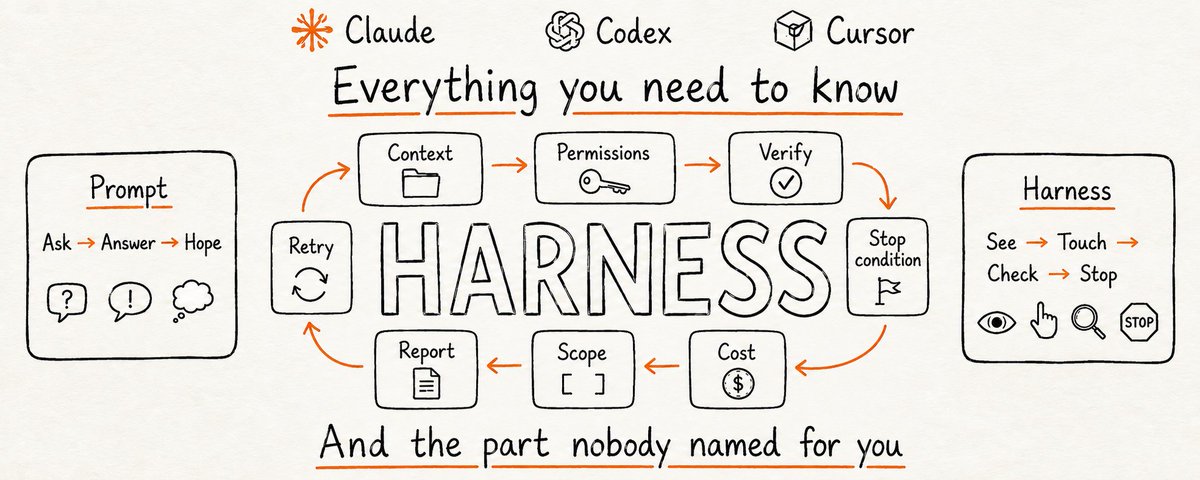
OpenAI engineer:
"Nobody on my team has touched code in 9 months. Agents write all the code, the way you do it is harness engineering."
In 45 minutes he breaks down exactly how to build the setup so agents do the full job without you in the loop.
This beats any paid course on building agents I've seen.
Watch it, then read the full guide on harness engineering below.

Arthur 🇩🇪 retweeted

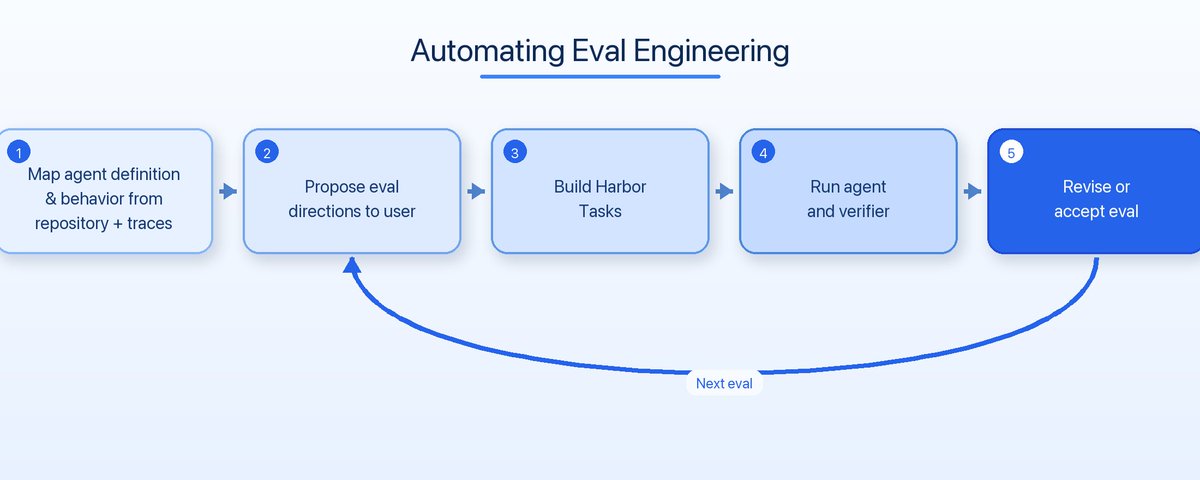
New version of the eval-engineering skill released, thanks for everyone's feedback on the first version.
npx skills add github.com/langchain-ai/lang… --skill eval-engineering
updates:
- now supports simulating users in multi-turn evals with instructions + examples
- more guidance on good Environment Design. examples on simulating backends/databases + how to use traces to make sure the env reflects prod
- more instructions on iteratively refining the harness, environment, and verifier with the user
Evals/Environments are hard, pls keep the feedback coming, more coming to reduce the friction of doing this while keeping domain experts in the loop!


Arthur 🇩🇪 retweeted

A post of ours on vendor lock in and LLMs. We don't like the growing trend of AI companies quietly hiding your data while stripping away your control. We think that's bad for users and bad for the ecosystem. Here's are our thoughts: earendil.com/posts/session-p…

Arthur 🇩🇪 retweeted
Marketing agents are the NEW coding agents.
It's code in the cloud that makes decisions off your live business data on a loop. It researches, acts, reads the results, improves, and goes again.
Picture an agent that runs your entire Facebook ad account by itself. It researches your customer's pain points, generates on-brand creative, publishes it, kills the losers, scales the winners, and makes more of whatever's working.
We show you the EXACT stack.
Perplexity to scrape Reddit for real pain points, Nano Banana for on-brand static creative, a vision model to check it against brand guidelines, HeyGen for AI UGC video, all wired into a loop that reads Facebook's data and reacts.
Now point it at a business. What are some startup ideas you can point marketing agents to?
WordPress runs 43% of the internet. Take the plugins people already pay for, like Yoast, WooCommerce, and WP Forms, and build the AI-first version of each.
Examples:
Yoast (~$15M ARR) shows you red and green dots and tells you to fix your SEO yourself. The AI version just does it. Proven demand, no AI-native competition, and thousands of site owner pay agenices $1,000 a month and many wish they'd pay less and got more.
Coding agents changed who gets to build software.
Marketing agents change who gets to grow a company.
Full breakdown on @startupideaspod. Thanks to @codyschneider for the sauce.
Will break down more marketing agents if people are interested? Just LMK.
Watch.
youtube.com/watch?v=U2hogriG…
I'm rooting for you and happy growing.
I think we've heard a lot about coding agents recently.
And we're about to hear a lot more about marketing agents.
Arthur 🇩🇪 retweeted
This is f*cking gold.
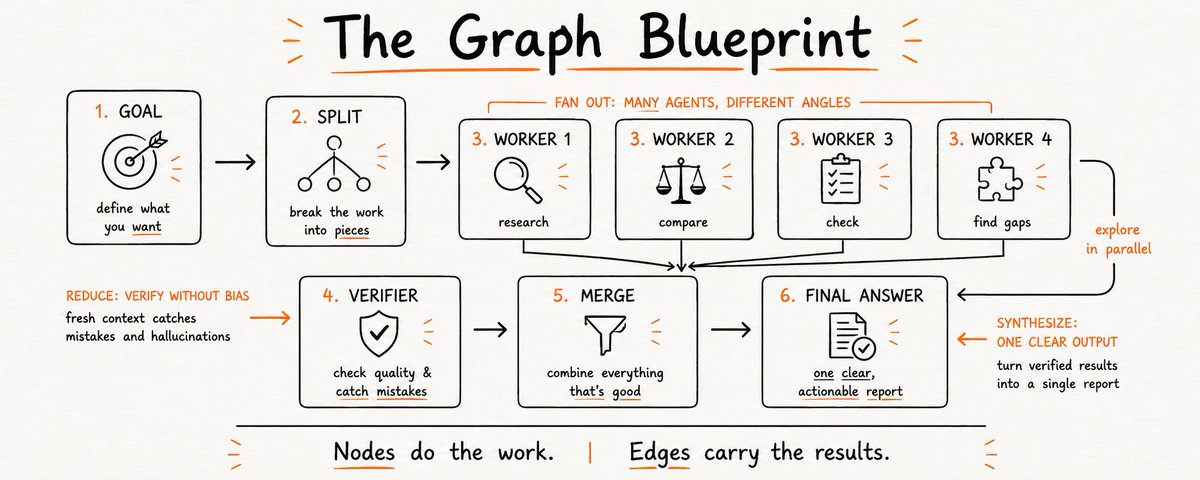
I've just made the clearest explanation of graph engineering you'll find anywhere.
No jargon, no code, no 2-hour lecture, just the four shapes every agent graph is built from.
Read on, and you'll never build with AI the way you did before.
-------
Shape 0 - Basics
A graph is just a plan for your AI work, drawn out so you can see it - which jobs run and which one waits for which.
Graph engineering is the skill of drawing that plan well, so the work that doesn't depend on anything runs all at once, instead of one slow step at a time.
Get it right and one person can direct a whole fleet of agents. That is why the best engineers jumped on it the moment loops got old.
-------
Shape 1 - The Chain
This is the one everyone builds by default.
Do A, then B, then C, each step waiting politely for the last to finish. It works, and it is the slowest shape there is.
If one step stalls, everything behind it stops. Use it only when the steps genuinely need each other's output.
-------
Shape 2 - The Diamond
This is the workhorse of every serious graph.
You split the job, fan the workers out in parallel, verify what they found, then merge it all into one answer.
Use it the moment the work breaks into pieces that don't read each other. Same shape behind a research report, a market scan, or a code review.
-------
Shape 3 - The Router
Sometimes the next step depends on what you just found.
One node checks a result and picks the path. a small job gets a quick pass, a big one triggers a full audit.
Use it when the work needs to branch. The decision runs the same way every time, because it lives in the structure, not in a guess.
-------
Shape 4 - The Cycle
Some jobs you can't size up front.
A bug sweep where finding one problem reveals three more. So you add a controlled edge back: keep finding, checking, looping until two rounds turn up nothing new, then stop.
Use it for discovery of unknown size. The one rule is a hard limit, or it runs until your budget is gone.
-------
That's the base, now you know the four shapes and when each one fits.
If you want to go deeper, I wrote a full article just for that, it explains everything step by step and breaks down where graph engineering wins and where it breaks.
It also walks you through building your own graph from scratch, read it below.



Arthur 🇩🇪 retweeted

Most edtech startups are building AI tutors that explain content better, but real alpha in education is real-time calibration.
Human learning is fundamentally a change in long-term memory, which requires productive struggle. Human teachers structurally cannot calibrate this friction for thirty different students at the same time.
If EdTech AI missed student level of desired difficulty, the resulting friction causes frustration and disengagement rather than learning.
This is a data collection problem. By capturing student progress in granular detail, systems can build high-resolution datasets that track exact retrieval success rates, spacing intervals, and failure signals over months.
The AI EdTech market is currently focused around content wrappers and engagement metrics. The company that owns memory formation data on millions of students will build a compounding psychometric moat.
If you're building something like this, apply at @cyberfund
Arthur 🇩🇪 retweeted

Something I have been thinking about: in the past, the best engineers I knew spent a lot of time automating their work in various ways. Better vim/emacs automations, writing lint rules to catch repeat code issues, building up a suite of e2e tests so they don't need to smoke test the app manually. These kinds of things were the highest leverage activities an engineer could do, because it multiplied their own output, which in turn meant they could build more things.
I think many of these automations have become even more important now. This is true for a number of reasons.
First, infra and DevX automation speeds you up. And if you are running an army of agents, each of those agents will be sped up also. More automation == more output per unit of time.
Second, moving things to code improves efficiency. Your agent could fix an issue every time it sees that issue happen, but that uses tokens and might miss cases. If Claude instead writes a lint rule, CI step, or routine, that class of issue can be fully automated forever. This is really what people are talking about when they talk about loops -- it's about automating entire types of busywork rather than solving them one off. This isn't a new idea at all. Engineers have been doing this for a long time!
Third and most importantly, automation makes it possible for others to contribute to the codebase more easily. Increasingly what I am seeing is engineers are contributing to codebases on day one because Claude can navigate the codebase for them, and that non-engineers are able to contribute to a codebase as effectively as engineers can. What gets in the way of both of these is domain knowledge that lives in peoples' heads rather than in automation -- the stuff you used to have to learn when ramping up. What has changed thanks to agents is the domain knowledge that can be encoded as infrastructure is no longer limited to what is expressible in lint rules and types and tests; it can now capture nearly all domain knowledge, encoded as code comments and skills and CLAUDE.md rules and memories. If I put up a PR for an iOS codebase I don't know and a code reviewer rejects it because it doesn't use the right framework, or if a designer builds a new feature and it gets rejected because it doesn't follow the right architectural patterns, these are failures of automation.
Every team should be writing the CLAUDE.md's, REVIEW.md's, skills, and docs that enable agents to productively work in their codebase with zero additional context from the prompter. This sounds crazy, and at the same time is a natural extension of the stuff engineers have always done: automate, and encode domain knowledge as infrastructure. As the model gets smarter and as the harness matures, this task becomes easier. In the meantime, it is on every team to look for ways to convert their domain knowledge to infra so that Claude can write code better, so that code review catches issues automatically, and so the next person working on your codebase can contribute more easily.

