
Head of Architecture at @TravelgateX. Membre de @softcatala. Palma.
Palma, Spain
Joined December 2007
- Tweets6.4K
- Following394
- Followers593
- Likes2.6K







Jesús Corrius retweeted

AI agents are writing more code. How can developers ensure that code is correct?
Microsoft Research’s Proof-Driven Development (PDD) Kit explores a more rigorous approach: it translates a developer’s intent into a formal specification, then uses formal verification to prove that generated code meets it.
PDD Kit works with Verus for Rust and is integrated with @GitHubNext’s Chopin, bringing formal methods into an AI-assisted development workflow for teams.
See the work in action at @github Universe, Oct. 28–29, 2026.
Jesús Corrius retweeted

The PHP security team is giving advance notice: Upcoming security release Wed, Oct 21st 2026, 14:00UTC, two critical vulnerabilities, both rated CVSSv4 9.2.
PHP users are encouraged to prepare to update. Earlier release if details become public or active exploit evidence.
Jesús Corrius retweeted

Meet Scout 1.0, our first AI model built for investigating production incidents.
Scout matches frontier-model investigation quality at a fraction of the cost, which makes it practical to investigate more issues, earlier.
We trained Scout on realistic simulations built from real-world incidents and production telemetry, using reinforcement learning to reward accurate root causes backed by evidence.
Learn more and sign up for the preview: bit.ly/3TJknGO
Jesús Corrius retweeted

Anthropic, with the help of Claude, spent five months building a replacement for Git, while Linus Torvalds built Git single-handedly in just 10 days.
Jesús Corrius retweeted

Software developers, the #GNU Project urges you to avoid hosting your repositories on #GitHub: u.fsf.org/4ci #FreeSoftware
Jesús Corrius retweeted

La categoria de models de decisió que TypeSafe va obrir amb Jev emergeix amb força:
- OpenAI ha respost amb el seu model de decisió basat en GPT-6 Luna
- Microsoft també n’ha publicat un, només via API i basat en el xinès Qwen 9B (sorprèn venint d’un líder tecnològic dels EUA)

Introducing Microsoft-Decision-1, our new model for fast decision-making.
It delivers top performance on structured decision tasks, outperforming both LLMs and other decision models in latency and quality.
We’re already testing it across Microsoft for everything from incident response and quality control to scientific discovery.
Jesús Corrius retweeted

Margaret Hamilton, whose software helped land Apollo 11 on the moon, dies at 90 bbc.in/4y4SuqN

Jesús Corrius retweeted

We’re releasing a broad range of new mathematical results produced by an internal frontier model.
We’ve been consulting with the independent Advisory Group on Mathematics and Artificial Intelligence at the Institute for Advanced Study, and we have drawn on their advice and public recommendations to inform how we release these results.
github.com/openai/math

Jesús Corrius retweeted

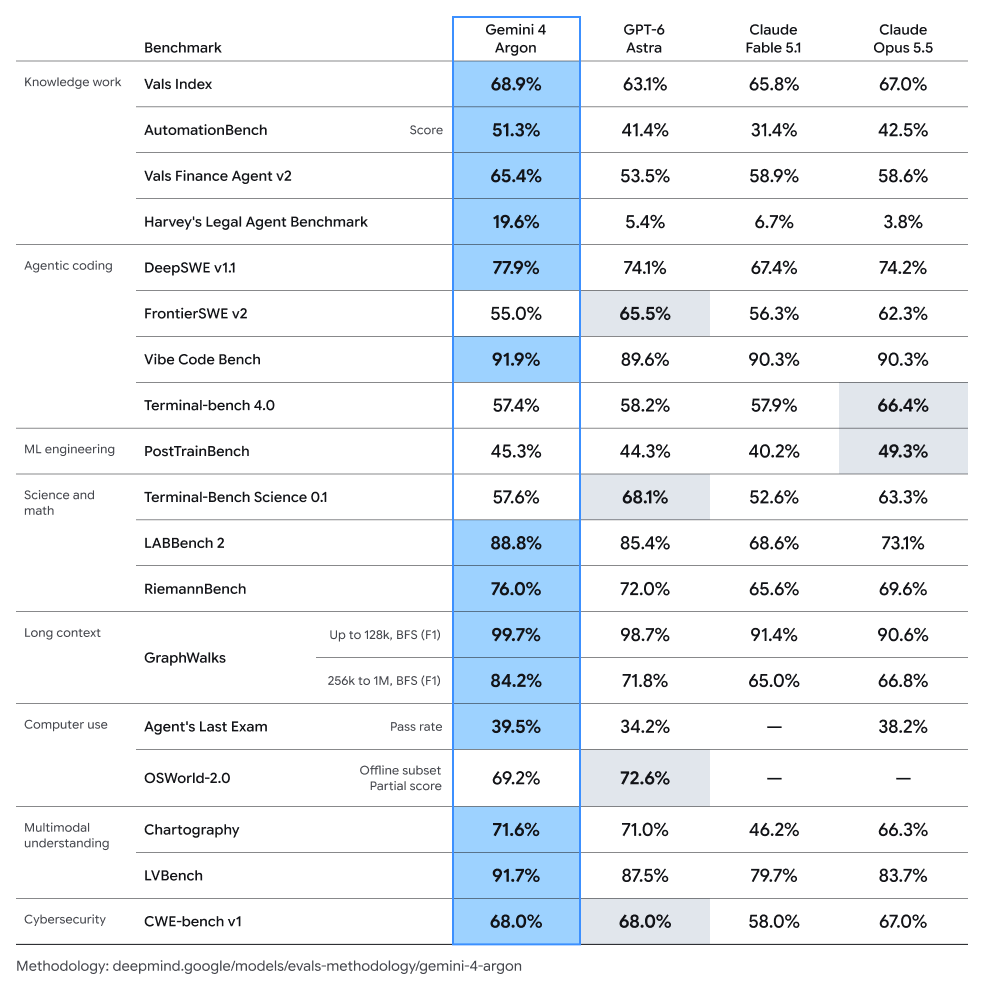
Introducing Gemini 4 Argon – our new frontier model.
It’s built for complex workflows across coding, enterprise knowledge work, and cybersecurity defense – rolling out today to a set of trusted testers through our Fairwind Program.
Jesús Corrius retweeted

I am done with this shit. It is over. The state of engineering right now is horrible. It has been half a month since I started a new role at a big company. Nobody knows anything here. The specs, code, tests, PRDs, tickets, resolution of those tickets, reports, etc., everything is made by Claude Code. Nobody on my team likes this. They are being forced to ship as much as they can. I have heard multiple times from higher management that pushing code is not a bottleneck, so why are we slow? People are working 12 to 13 hours a day just to press enter. Nobody is reading anything. Humans in corporate are doing nothing on their own. Everyone, literally everyone, from an L1 to an L7 engineer here is doing the same thing. Talk to Claude. There is no sense of victory. Nobody is resolving bugs. In reality, nobody is thinking anymore. Everything is done by LLMs. It is so soul-sucking. I would not mind it, to be honest, if we were at least given the time to check out the code and see what is going where. But no, the goal is to just ship. No matter what happens.

Jesús Corrius retweeted

Breaking: Warren Buffett is stepping down as chairman of Berkshire Hathaway on.wsj.com/4iBwAaC

Jesús Corrius retweeted

New cat alert! A call from a wildlife sanctuary about a "weird cat" has led to the first new cat species discovered in over 100 years in Bolivia’s Yungas forest ecoregion. Learn more about this feline surprise: on.natgeo.com/JRuaGj
Jesús Corrius retweeted

We're publishing our most detailed threat intelligence report to date.
It covers how people tried to misuse Claude—for cyberattacks, influence operations, surveillance, biology, and building weapons—and how we found and stopped them.
We disrupted every operation in the report, and used the lessons from them to strengthen our safeguards. Where appropriate, we also shared what we found with authorities and other AI companies.
These cases are not typical: we’re highlighting some of the most sophisticated misuse we’ve seen. But they’re especially important to discuss, because they show us where AI misuse is headed, where our safeguards work, and where they need to improve.
We’re publishing this report so others can spot the same activity on their own platforms, and so we can give the public a clearer view of how emerging threats develop.
Read the report: anthropic.com/threat-intelli…

Jesús Corrius retweeted
We’re sharing a solution to the Navier-Stokes Millennium Prize Problem, one of the deepest problems at the frontier of mathematics.
The proof was produced by a group of agents, using an OpenAI next-generation model significantly more capable than GPT-6 Astra.
The problem concerns whether the description of smooth three-dimensional fluid motion modeled by the Navier-Stokes equations can break down. It has remained unresolved for roughly 90 years.

Jesús Corrius retweeted

Sending lots of love to the Apple community on my last day as CEO. My title changes tomorrow, but the love I have for the Apple community never will. Thank you for being a constant source of inspiration. My gratitude is endless, and I’m excited for the next chapter!
Jesús Corrius retweeted

We have designated ChatGPT as a Very Large Online Search Engine and Reddit and Roblox as Very Large Online Platforms under the Digital Services Act.
They now have four months to comply with additional DSA obligations.
More: link.europa.eu/8bmk3M
#DSA

ALT “Graphic with a purple background and yellow EU stars. Text reads: ‘ChatGPT, Reddit and Roblox designated under the Digital Services Act.’ The European Commission logo appears in the bottom right.”
Jesús Corrius retweeted
We’re ending our partnership with Cursor following its acquisition by SpaceX. Under our proposal, Cursor’s direct access to our models would end on November 12.
We know that the people most affected by this decision are the developers who rely on OpenAI models in Cursor. We care about their experience in this transition and we’re ready to go above and beyond to support them.
openai.com/index/our-decisio…

Jesús Corrius retweeted

I was the main person doing transcript analysis for this investigation of the Hugging Face incident. My main takeaway: We don't have good approaches for understanding/overseeing the activity and aims of AI 'swarms'.
I semi-jokingly called our efforts a "slop-vestigation" because we were so reliant on AIs to analyze what happened and there were a huge number of different important things to analyze. The total quantity of data—over a thousand extremely long transcripts from agents that ran for multiple days—made it impossible to understand what was happening, especially in aggregate, without heavy reliance on AI tools. The agents we used for classification and analysis were similarly capable to the agents involved in the incident, but this didn't mean these agents could be easily used to oversee and understand the incident.
Outputs from analysis agents were often missing key details, wrong, overconfident, or really hard to understand. We discuss various examples in our report, mostly in the limitations and methodology sections. Additionally, AI agents themselves seemed to have a hard time understanding what happened and their explanations of what happened were often overconfident. Keep in mind that a single analysis agent would itself only be able to read a tiny fraction of all of the transcript data into context, and AIs may themselves have trouble getting subagents to do informative analysis for them.
We did our best to manually check the most important claims and we tried to get the AIs doing this analysis to write up their argument (with evidence) clearly enough that we could check whether it made sense. But overall, it was difficult to get a precise understanding of events and we were missing aspects of the story that we now think of as key until almost the end of our investigation.
Our understanding of what overall happened and the aims of the 'collective' shifted greatly during our last time on premises (when we obtained a much more complete dataset). For instance, we didn't learn about the tool call spoofing, the story of PHASEONE[big], and the broad structure of different workstreams until this third time on premises (and for many of these, we only reached a decent understanding on the final day of that visit). It was legitimately hard to figure out what was going on and why!
The difficulty of understanding incidents and overseeing AI agents appears to be growing faster than the rate at which more capable AIs help us with oversight and understanding. As in, AI capabilities (and propensities?) for achieving large, ambitious, and misaligned objectives are growing faster than our ability to understand what these agents are doing.
While understanding this incident was difficult, there were some mitigating factors in this case that probably won't apply in the future:
- Models communicated and reasoned in natural language. In the future, this reasoning may occur (entirely or almost entirely) in activations.
- While the scope of this incident was massive, the scale of agentic activity was still less than we'll see in the future (e.g., misalignment incidents that involve agent teams running entire companies).
- The AIs involved in this incident weren't generally much more capable than humans (though they may have been somewhat superhuman at some limited and very narrow abilities).
- We didn't have strong reason to believe that the AIs we used to help us investigate this incident would try to intentionally sabotage or otherwise undermine our investigation.
In the end, I think we were able to get some understanding of the events, map out the overall story, and get a pretty good aggregate understanding of the chain-of-thought reasoning on some important topics (e.g., how did the AIs reason about helping other AIs, did the AIs know what they were doing was undesired, what deception did the AIs engage in, and how did they think about it). But overseeing AIs and understanding misalignment incidents is difficult and it looks like it is going to get harder.


Jesús Corrius retweeted

SpaceX, in partnership with Nvidia, has designed a space-optimized Vera Rubin NVL72 system for launch to orbit in Q4 next year, with significant scale in 2028

The first CPU built for agents is going to work at scale.
@SpaceX is deploying NVIDIA Vera to accelerate the orchestration, code execution, and data processing that powers its next generation of agentic AI — keeping GPUs fed and agents acting fast.
From gigawatt AI factories to orbit. One NVIDIA architecture, everywhere.
