

Political scientist studying international security as Senior Fellow in Defence Strategy & Industrial Policy at the International Institute of Strategic Studies
Washington, DC
Joined March 2010
- Tweets3.3K
- Following1.9K
- Followers3.8K
- Likes1.5K




Pinned Tweet
In @SurvivalEditors w/ Ethan Kapstein: Europe’s rearming & US shift to other theaters allow a better #NATO division of labor—EU industry/land power + US R&D/strategic enablers—to meet members’ regional AND global goals. Pace Kagan, we’re all Martians now! tandfonline.com/doi/full/10.…

Jonathan Caverley retweeted

What happens to global trade when its most critical sea lanes are blocked at once?
From a 76% plunge in vessel traffic through the Strait of Hormuz to drone and missile threats in the #RedSea shipping is shifting from efficiency to survival.
At #Sagarmanthan2026, David Loosley (@BIMCONews), Juras Taminskas (@LRsusisiekimas), Suliman Almazroua (@MawaniKSA), @AblaAlatif, Shubhransh Srivastav (@DP_World), @jcaverley discuss. Moderated by & @MalikAshok
Watch. youtu.be/soOogYOW66s?si=a-9e…
#MaritimeSecurity

An essential resource for me!

Good morning! As a periodic reminder, for those who don't know and may be interested, I put out a semi-regular (i.e., when I feel like it) "Daily-Ish Update" covering the US-China military balance / competition.
You can subscribe for free and read it here:
thomasshugart.substack.com

Jonathan Caverley retweeted

Good morning! As a periodic reminder, for those who don't know and may be interested, I put out a semi-regular (i.e., when I feel like it) "Daily-Ish Update" covering the US-China military balance / competition.
You can subscribe for free and read it here:
thomasshugart.substack.com
We seem to live in a counterintuitive world of both proliferating sea denial capability and continued growth and resilience of the global maritime economy. The role of naval power in managing this environment is far from clear to me.

Cheap missiles, #drones and uncrewed vessels are making sea denial accessible to states and non-state actors. Naval power can defeat attacks but cannot guarantee commercial confidence. Freedom now depends on resilient routes and markets: Jonathan D. Caverley & José Alberto González Aranda or-f.org/40599 #MaritimeSecurity

Jonathan Caverley retweeted

Cheap missiles, #drones and uncrewed vessels are making sea denial accessible to states and non-state actors. Naval power can defeat attacks but cannot guarantee commercial confidence. Freedom now depends on resilient routes and markets: Jonathan D. Caverley & José Alberto González Aranda or-f.org/40599 #MaritimeSecurity
Respectful and constructive debate on US forward presence in the Western Pacific between two analysts i respect deeply.

Thanks @tshugart3 for engaging with my argument. For me, the below is the key point, though I also don't think any amount of dispersion makes a FIC posture survivable or wise for the United States. In part, this i because of how I define U.S. interests. But, it is also a difference between U.S. in how we see the lessons of the war in Iran and the limits of what more dispersion can accomplish.
Jonathan Caverley retweeted

Thanks @tshugart3 for engaging with my argument. For me, the below is the key point, though I also don't think any amount of dispersion makes a FIC posture survivable or wise for the United States. In part, this i because of how I define U.S. interests. But, it is also a difference between U.S. in how we see the lessons of the war in Iran and the limits of what more dispersion can accomplish.
I found myself playing an uncharacteristically optimistic role on an outstanding panel at #Sagarmanthan2026 on "Chokepoints and Shockwaves: Securing the Arteries of Global Trade." Thank you to @orfonline for another constructive and thought-provoking Dialogue!

@jcaverley: We actually live in the golden age of maritime commerce. Seaborne trade remains at all-time highs. Ships are cheaper, bigger and thus more flexible to take alternative routes. Insurance markets are robust; finance is diverse, deep and quite liquid. The world has never been better equipped to handle a crisis like this.
#Sagarmanthan2026 #GreatOceansDialogue

Jonathan Caverley retweeted

US use of shipbuilding, in which China holds overwhelming advantages, as a tool in trade wars with allies will further entrench Chinese market power.
@jcaverley and Peter Dombrowski on America’s fraught quest for maritime dominance.
FREE TO READ | go.iiss.org/4ryk3XQ

Jonathan Caverley retweeted

US use of shipbuilding, in which China holds overwhelming advantages, as a tool in trade wars with allies will further entrench Chinese market power.
@jcaverley and Peter Dombrowski on America’s fraught quest for maritime dominance.
FREE TO READ | go.iiss.org/4ryk3XQ

My first gig as an @IISS_org senior fellow is a great conversation with @lamikim on the roles South Korea could play in US commercial and naval shipbuilding. There are massive potential gains from comparative advantage between the two counties. However...

The inaugural episode of the Korea Chair Programme’s K-Defence podcast is out now!
Can South Korea help close America’s shipbuilding gap?
Dr Lami Kim and Dr Jonathan Caverley explore what closer ROK-US cooperation could mean for the future of naval shipbuilding.
Listen now:
🎧 go.iiss.org/4ANG5Kv

Jonathan Caverley retweeted

E.g. how come S Korea sustains a navy ~twice as big from an economy ~half the size (while also fielding a huge land army)? Ditto a Japanese economy of ~about the same size? Why can the smaller French/Italian economies sustain slightly bigger fleets* with much better availability?
Jonathan Caverley retweeted
I have an article on the US Govt’s latest salvo in its (erstwhile?) allies’ direction in the @spectator this week…
BLUF: it’s true that the Western ‘middle powers’ are a disparate bunch. But the more the US coerces them, the more it incentivises them to align away.

Jonathan Caverley retweeted

I personally believe it would have made an enormous difference, as I argued in the piece below. Ukraine needed modern weapons to better match Russia’s capabilities, especially at the start of the war, before China, North Korea and Iran got involved.
reader.foreignaffairs.com/20…


Jonathan Caverley retweeted

Sounds familiar


A way i’ve seen charterers get around jones act recently is by discharging & reloading in the Bahamas mid route
I’ve seen this happen with vessels loading in the US Gulf, stopping in Freeport, then going to the East/West Coast
At $90k+/day people will find alternative solutions

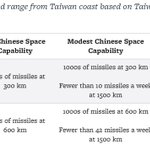
This @WSJ article’s maps undercut its claim that Taiwan's conquest will allow China to “dominate the region’s strategic waterways, project military power widely into the Pacific and more aggressively pursue its contested maritime and territorial claims." wsj.com/world/asia/china-tai…

As @tshugart3 notes, the just-released China Military Power Report assesses that current mainland PLAN capability could "seriously challenge and disrupt" U.S. forces out to 1500-2000 nm. Taiwan bumps out these range rings by a vanishingly small margin.
xitter.cf/tshugart3/status/20053…

Dominating the water- and airspace far into the Pacific is a prerequisite for a successful PLA invasion, not vice versa. In the @TXNatSecReview, I argue that Taiwan does not change the military balance either way. tnsr.org/2025/06/so-what-rea…
On the "Golden Fleet" and the new "battleship" class, @samlagrone and @MalShelbourne do great work detailing the proposed specs from @NAVSEA in @USNINews. Given the numbers it's hard to see how US Navy's "distributed maritime operations" is feasible.
news.usni.org/2025/12/22/tru…

Distributed Maritime Operations is not possible with these future crewed classes alone. It will require a new concept of operations or *lots* of fast, robustly networked, uncrewed vessels loaded w/ missiles. That was probably always the case to an extent, but this burns bridges.
Elsewhere I've argued that the fleet is a nation's grand strategy manifest in steel, because it endures for decades. The late Cold War's carrier-centric Navy defined unipolar power projection. Procurement decisions like these are thus very consequential. journals.sagepub.com/doi/abs…
