

Getting from data to insight.
Belgium
Joined February 2008
- Tweets6.6K
- Following944
- Followers2.4K
- Likes1.7K



Being dependent on US services has become a clear liability: head prosecutor of International Criminal Court has lost access to his email (apnews.com/article/icc-trump…). Can #kuleuven move towards open source/EU software? cc @SeverineVermei1 @TBaelmans #ict
FFS X... Not able to edit a post without paying? Here's the complete message.
Our latest paper is out: peerj.com/articles/cs-2792/. We added functionality to the #HDBSCAN clustering algorithm to also detect branches hdbscan.readthedocs.io/en/la… #eda #datavis #clustering

Our latest paper is out: peerj.com/articles/cs-.... We added functionality to the #HDBSCAN clustering algorithm to also detect branches hdbscan.readthedocs.io/en/la…... #eda #datavis #clustering
Our latest paper is out: peerj.com/articles/cs-.... We added functionality to the #HDBSCAN clustering algorithm to also detect branches hdbscan.readthedocs.io/en/la…... #eda #datavis #clustering
Are you a biologist interested in data visualisation to help you explore complex data or create effective visuals? If so, make sure to register for the course that we're organising at the EBI in June ebi.ac.uk/training/events/da… #biovis #viz #dataviz
For what it's worth: moved to Bluesky. Since quite a long time already the feed I get on twitter/X was not useful for me at all. On Bluesky I get to interact with people again... Find me here: bsky.app/profile/janaerts.bs… if you're interested in #dataviz, #omics, #bioinformatics
Jan Aerts retweeted

Datamapplot 0.4 is out now, and has far more powerful and effective interactive plots.
Here is an example of a Data Map of 2.4 million papers on ArXiv, ready to be explored.
Jan Aerts retweeted

🚨out now! 🚨
From zero to figure hero - A checklist for designing scientific data visualizations osf.io/preprints/osf/xgbyr via @OSFramework
Come if you want to improve your/review figures, stay to learn the science of science communication. 😇

Jan Aerts retweeted

Do you want to test dimensionality reduction algorithms with your data?
I made an interactive @observablehq notebook were you can try FastMap, UMAP, TSNE and more via Rene Cutura's #druidJS in a web worker (thnks @recifs)
#dataviz #ML
👉🏼observablehq.com/@john-guerr…👈🏼
Jan Aerts retweeted

It is my great honor and privilege to receive the ‘Best Abstract’ Award at the #BioVis at #ISMB2024 for our tool #PRIMAVO! - with @OshoRawal @EdgarEGK #SachaGnjatic ! Go team @SinaiImmunol @SinaiGenetics @IcahnMountSinai !

Jan Aerts retweeted

I have seen all 4 of these lines of best fit in published peer-reviewed papers and oddly the top left is probably the rarest type 📉

Job opportunity: we are hiring a PhD student to work on biological data analysis at KU Leuven. More info here: kuleuven.be/personeel/jobsit… Deadline for submission is 28 July.
Please RT.
#job #jobs #bioinformatics #visualization
Here's a fun (and useful!) competition for you: check out the bio+medvis challenge at biovis.net/2024/biovisChalle… #biovis
Jan Aerts retweeted
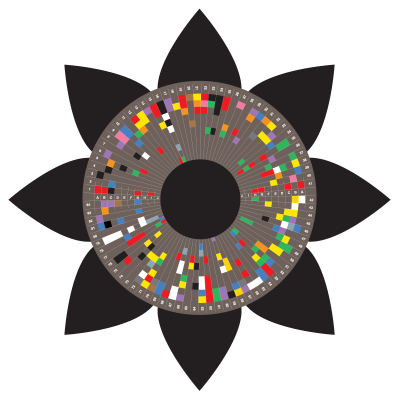
Most common 4-digit PIN numbers - from an analysis of 3.4m leaked from several #databreaches by the late great @DataGenetics
informationisbeautiful.net/v…

ALT A heatmap reveals the most common 4 digit PIN numbers, visualised from the data leaked from several large data breaches. The horizontal axis plots the frequency of the first two digits, the vertical axis the second two digits. Clear (and somewhat predictable) patterns emerge from the dataset. A diagonal line of ‘heat’ from bottom left to top right reveals people choosing double digits (2323, 6868 etc). A strong horizontal line at the 19 point shows people using their birth year as a PIN code (1971, 1998 etc). And a large amount of heat in the bottom left shows how people commonly use their birthdate in a MM/DD or DD/MM format. The most common code in the set is 1234.
Jan Aerts retweeted

Let's learn Svelte + D3 data viz together!
This Post is from an account that no longer exists. Learn more
Jan Aerts retweeted

We are hiring: PhD student - Machine learning in plant regulatory genomics, Ghent VIB-UGent Center for Plant Systems Biology. More info at vandepoelelab.be/Jobs
This Post is from an account that no longer exists. Learn more