




Jake ZD retweeted

my own claude skill is starting to scare me.
i gave it one picture of a robot peacock spider. it dropped 4,002 parts on the floor and then put every single one back.
the body goes together first. then the legs snap on while the rest of the parts still lie in rows like a flat-pack kit.
then the power comes on and the fan opens behind it, 7 eyespots ringed in light.
the 6 eyes come on. the shell opens on its reactor. at the end it does its dance.
my first build was a white toy: 2 checks out of 20 passed. two rounds against the picture later, 13 pass and none fail.
6 robots in 3 days and i still haven't found one it can't put back together.
the method that fixed it is in the article ↓


Jake ZD retweeted
🚨Somewhere tonight, 384 copies of one robot are practising in a room that doesn't exist.
this is what the future of robotics feels like.
the real one has two arms, a tote of 45 parts and 7 minutes.
trained on 50 human demos, it sorts 6.
so Moonlake gave it a twin.
the same cell, the same arms, the same camera, rebuilt in simulation and tuned on a few real runs.
then 384 copies practised at once, each under its own light, from its own angle, in its own colours.
one rule: +1 for every part in the right slot, -1 for every part knocked out.
after 56 rounds it came back to the real table.
same 45 parts. same 7 minutes. 23 sorted.
no new human demos. just practice, in a world built to be practised in.
the RL era of robotics is here ↓

Jake ZD retweeted

The first time the robot stood in front of the real rack, it had already been there.
Not in person. In a copy.
Someone filmed one walkthrough of a customer's data center.
From that single video, Moonlake rebuilt the room in under 12 hours. By hand, the estimate was two weeks.
Then they taught the copy how a cable behaves. How it bends, how it springs back, how a latch gives under a fingertip.
Fitting that physics to real motion went 5x faster.
The robot rehearsed the whole job in there: press the latch, pull the connector, carry it, seat it in a new port.
Its failure modes surfaced in the copy, before anyone touched the real rack. Policy evaluation ran more than 10x faster.
When it finally met the real rack, the team spent 10x less time on site.
This is how robots will learn the places we need them in👇
Jake ZD retweeted
CHUCK YEAGER BROKE THE SOUND BARRIER IN 1947 WITH BROKEN RIBS. MY JET WAS A PRAYING MANTIS 4 SECONDS AGO.
I gave Claude Opus 5.5 my robot mantis and a twin-tail fighter it modelled in Blender, and said: fold the arms into wings.
In the video below 8,000 tiles leave the mantis from the feet up and build the jet from the belly up, missiles and all.
the build:
> the jet: an 18 m lofted fuselage, a dark radome, a glass canopy, twin canted fins, two nozzles, four missiles
> 0:01 TRANSFORM: two raptor arms into a cloud
> 0:04 the jet is whole
> 0:06 ONE TILE: the camera rides one tile for 173 cm, the longest single flight of the ten
> 0:13 AT RANDOM: 3,698 m of flight instead of 2,679 m
My first jet had both tail fins leaning inward like a broken V. One minus sign in the script and they leaned out.
The Me 262 flew the first jet fighter missions in 1944. This one is 8,000 tiles and one pairing.
Mantis or fighter jet: which one would you rather have hunting you?
How Opus builds models like this in Blender is in the article 👇

TRANSFORMERS MADE $709 MILLION IN 2007. MY ICE CREAM TRUCK BECOMES A WOLF IN 3.6 SECONDS.
I gave Claude Opus 5.5 a truck and a steel wolf and said: no cuts, no morph, every piece accounted for.
In the video below 8,000 tiles, 25 mm each, leave the truck from the wheels up and build the wolf from the paws up.
the build:
> the wolf's orange trim recoloured pink, so it wears the truck's paint
> 0:01 TRANSFORM: tiles crack off, lift along their normals, swirl
> 0:04 the wolf is whole, the real model dissolving in wherever the tiles land
> 0:13 AT RANDOM: 3,748 m of flight instead of 2,310 m, the same wolf and a tangle on the way
> 0:16 BY PLACE: every tile takes a short way
The pairing is the whole trick: halve the truck and the wolf at the median, again and again, then match the last 48 tiles exactly.
My first tile camera sat so close that the swarm was just big blurry hexagons, so Opus pulled it back to 1.4 m.
In 1984 Hasbro bought Japanese toy moulds and gave them names. This one needed two models and 8,000 tiles.
Truck or wolf: which one would you keep?
How Opus builds models like these in Blender is in the article 👇
Jake ZD retweeted

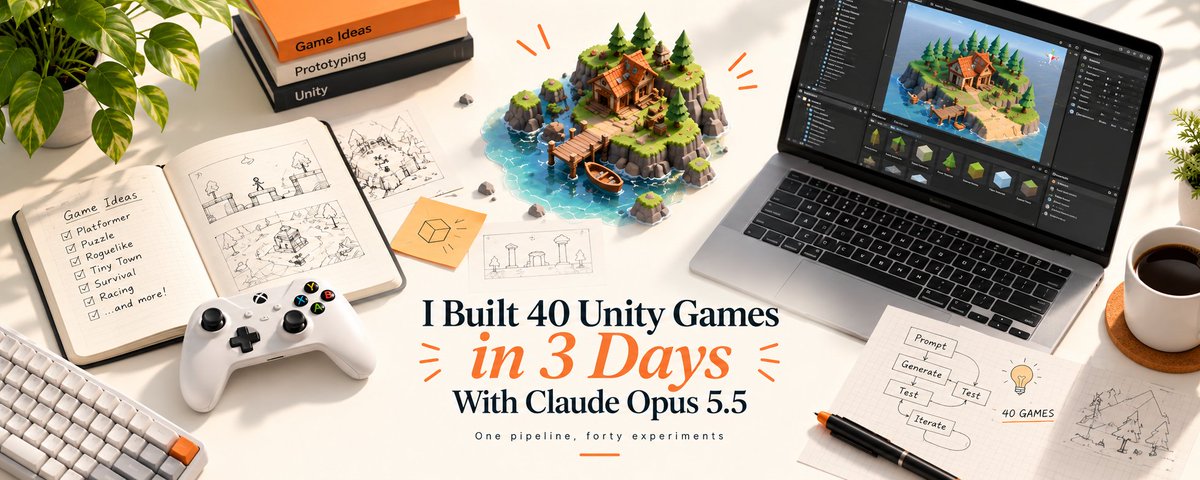
LEAGUE OF LEGENDS COST RIOT ABOUT $12 MILLION TO BUILD.
EVERY 3D MODEL IN MY MOBA COST $1.66.
HEARTSPIRE.
Two teams, one river, a crystal heart at each end.
MATCH LOG
> 14:32 minions spawn, the blue wave marches out
> 14:36 two last hits from behind the line, +21 gold each
> 14:43 Vex jumps her from the river brush, Thornhide's slam stuns him. First blood
> 14:49 Meteor Rain on their carry and their warden. Double kill, triple kill, ace
> 14:54 the red tower falls
> 14:58 the Heartspire's crystal bursts. Victory
Every tree in the forest is a real 3D model, not a painted blob.
Every hero wades the river ankle deep, never through its bed.
Built in Unity with Claude Opus 5.5.
How, in the article 👇

Jake ZD retweeted
KNIGHT CAPITAL LOST $440 MILLION IN 45 MINUTES TO OLD CODE NOBODY RE-TESTED.
before this card game went live, a bot played 300 full runs of it.
> Story: the bot wins 48 to 75%
> Normal: 9 to 15%
> Hard: 1 to 5%
> Blot III: almost never
Opus 5.5 wrote the rules, the 95 cards and the bot.
the 49 new illustrations cost about $3.
Ink & Bone. 5 modes, 3 heroes, 20 trials.
free in your browser 👇

Here's what Unity's Claude plugin really costs, measured:
32 skills listed in context: 2,805 tokens
the unity-cli skill, loaded on first use: 18,824 tokens
its 11 reference files, if all were read: 123,566 tokens
At $4 per million input tokens on Opus 5.5, loading the main skill is 7.5 cents.
Cached, every later turn is under half a cent.
The skills are cheap. The references are where a session quietly balloons.
This ink-and-paper card battle was built through that same CLI: every card, every inked panel, every bone that shatters is one scene driven from one script.
Load one reference per step. One gate per conversation. /clear between gates.
The full token bill, measured on Opus 5.5, in the article 👇
Jake ZD retweeted
Here's what Unity's Claude plugin really costs, measured:
32 skills listed in context: 2,805 tokens
the unity-cli skill, loaded on first use: 18,824 tokens
its 11 reference files, if all were read: 123,566 tokens
At $4 per million input tokens on Opus 5.5, loading the main skill is 7.5 cents.
Cached, every later turn is under half a cent.
The skills are cheap. The references are where a session quietly balloons.
This ink-and-paper card battle was built through that same CLI: every card, every inked panel, every bone that shatters is one scene driven from one script.
Load one reference per step. One gate per conversation. /clear between gates.
The full token bill, measured on Opus 5.5, in the article 👇

Jake ZD retweeted

One Blender unit is a metre.
My robot is a 45 cm desk toy, so the script opens with
CM = 0.01
and every size is written as 14.4 * CM.
It isn't pedantry.
Bevel widths, light falloff and depth of field are all measured in metres.
A toy built a hundred times too big needs very different light.
Does your agent know how big the thing is?
Units, names, seeds: the house rules 👇

Jake ZD retweeted
Turn the sound on. Every note in this video is a pin hitting a steel tooth.
17 pins. 18 teeth. One turn of the cylinder = 2 bars.
>wind the key: 12 clicks
>let it play: each pin lands on the beat
>take it apart: 69 solids
>census: 0 open edges, 0 flipped faces
The first census found 12 broken edges hiding in the gears. No render showed a single one.
What would yours find?
The check, in the article 👇

Jake ZD retweeted
Klarna's AI assistant did the work of 700 full-time agents in its first month.
Projected profit boost: $40,000,000.
15 months later the CEO was hiring humans again.
Cost had been "a too predominant evaluation factor."
Answering fast is easy to demo.
Finishing the job is the hard part.
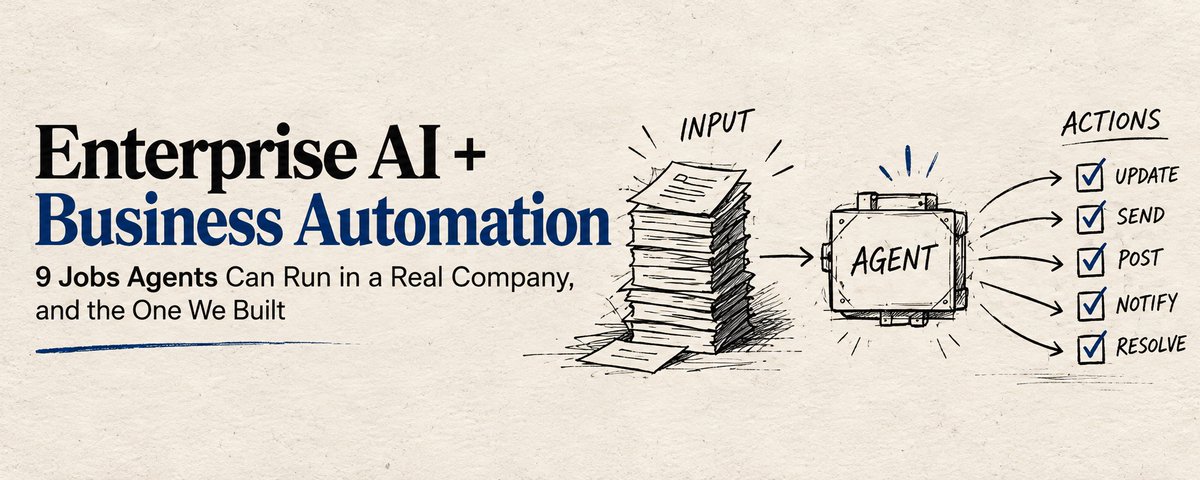
9 jobs agents can actually finish in a real company. Same split in every one:
-the model reads the mess
-code checks the facts and the money
-a human signs anything irreversible
We built 4 of them.
Which one is your team still doing by hand?
All 9, our bugs and our real bill 👇
Jake ZD retweeted
Someone puts a camera on a fish. It swims into the ocean, finds a hidden cave, and ends up at an underwater rave.
A ridiculous idea for a 20-second video. But there's a reason formats like this are worth studying.
Imagine this clip gets 2 million views on a channel that normally averages 40,000. That's a 50x outlier.
Now the important question: did you find it before everyone started copying it?
Most creators spend hours generating clips without checking whether the format has already peaked.
I've been looking at a different way to approach AI video creation.
The workflow starts before opening a video generator.
TRACK: monitor 40 channels and compare uploads against their usual views
SCORE: flag videos performing 10x to 30x above their channel median
TIMING: record when a format first appears and how many creators copy it
STRUCTURE: extract the storytelling pattern without copying the original subject
CREATE: use Claude, Kling and ElevenLabs to build new variations
MEASURE: feed performance data back into the same tracker
The entire setup comes to about $73.59/month using five tools and a spreadsheet.
The most valuable part isn't the video generator. It's knowing which ideas are worth generating while there's still room for them.
I broke down the full pipeline, prompts, costs and stopping rules in the article below.

Jake ZD retweeted
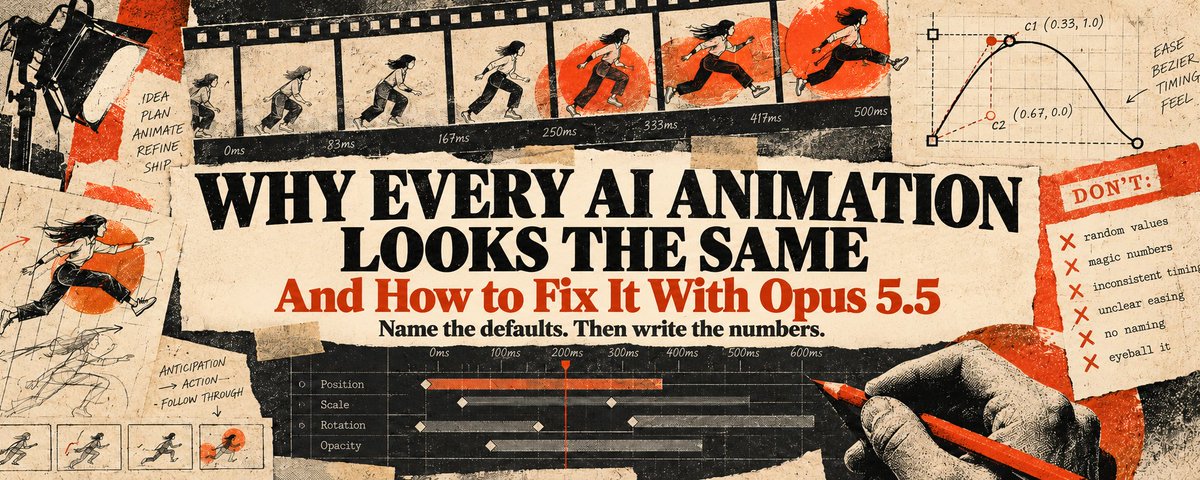
AI can generate an entire animation in minutes. So why do most of them still look exactly the same?
The same 300ms transitions. The same bouncing elements. The same fade-ins, floating objects, and perfectly predictable camera movements.
Even when you ask for something cinematic or premium, the model falls back on patterns it has seen thousands of times.
I've been experimenting with a different approach using Opus 5.5.
Instead of describing how the animation should feel, I define exactly how it should behave.
> BAN LIST: remove generic motion patterns before generation
> TIMING: specify durations, delays, distances, and easing curves
> TIMELINE: give every movement an exact start time
> FRAMES: freeze the animation and inspect what actually happens
> REVIEW: measure the differences between the result and the brief
> REFINE: change the numbers without rebuilding everything
The animation in this video follows that approach.
The interesting part isn't how many objects are moving. It's how the camera, depth, timing, and transitions work together.
Small changes to the numbers can completely change how a scene feels.
the full six-step workflow in the article below, including how to get Opus 5.5 to review and improve its own motion design👇

Jake ZD retweeted
Tavus gave me early access to Griffin, their first human interaction model.
The part that got me was the goodbye.
I said I had to go. She didn't just take it. "Wait, really? Already?" Then she wished me luck with the speech, the one I'd brought up earlier in the call and had already forgotten about myself.
Not scripted, and nobody is operating her.
> first model to pass the Turing test: 45% of 120 people thought it was real
> in the control group, 28% thought a real person was the AI
> first on NVIDIA's Video Full-Duplex Benchmark: 3.83 of 5, against a human at 3.92
> the next best system scored 2.80, and took a full second longer to answer
It is a research preview, not something you can build on yet. Which is the part I keep thinking about.
@tavus @hassaanraza
tavus.io/griffin

Introducing Griffin, the first model to pass the video Turing test.
48% of people who talked to it live thought it was a real human. Previous systems have had a pass rate <3%. It is #1 on NVIDIA's benchmark for full-duplex AI video.
It’s the first Human Interaction Model (HIM).
Readers added context they thought people might want to know
The 48% figure and "video Turing test" claim are from Tavus's own study of 54 one-minute calls, not independently verified or using a standard protocol. Griffin-Lite leads NVIDIA's VideoFDB benchmark on their public leaderboard.
cellcog.ai/blog/tavus-gri…
research.nvidia.com/labs/amri/proj…
tech-ish.com/2026/10/02/tav…
Jake ZD retweeted
The last two seconds are the only ones that decide whether anyone watches it twice. She lands, the arms go up, and your eye goes straight back to the top.
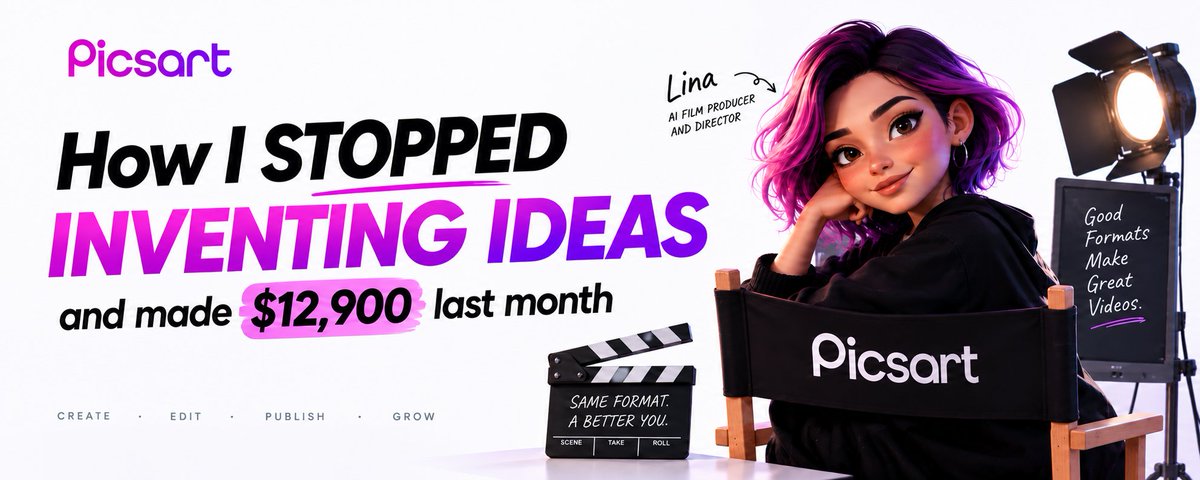
That beat is not luck. It is a line in the brief I hand the director agent in Picsart: name the final beat that makes someone rewatch, before a single scene gets built.
Most shorts plan the hook and let the ending happen. Then they wonder why nobody rewatches.
> research finds formats already beating their own channel, ranked by how easily they reskin
> Picsart returns the scene plan: shot size, camera height, the tone shift, the final beat
> Make publishes it and pulls the watch-through rate back after 48 hours
> $15 Picsart Pro, $20 research, $9 Make. $44 in, $12,900 out
So what is the last thing your viewer sees, and did you choose it or inherit it?
Both prompts and the whole pipeline 👇

Jake ZD retweeted

i built an AI agent that makes its prediction before the chart has an answer
it’s called GRAID.
most tools show you a Pons V2 launch after activity starts. GRAID starts at the launch itself:
→ watches every new token on Robinhood Chain
→ reads creator behavior, deployer history, token settings, and launch context
→ turns 7 onchain signals into a probability of real outside demand
→ records the prediction while the outcome is still unknown
→ returns after a fixed window to measure what actually happened
→ scores its own performance publicly - wins and misses included
the target is deliberately narrow:
will independent buyers bring meaningful outside money into this launch?
creator buys, deployer funds, and tax-exempt wallets are filtered out. they don't count as organic traction.
the live record so far:
> 15,000+ predictions recorded
> 8,000+ resolved outcomes
> 0.764 live AUC
the web board tracks everything in one place: live launch scores, human-readable signals, resolved verdicts, calibration, hit rate, Brier score, and migration follow-up.
every call is append-only and timestamped before resolution. no cherry-picked winners. no rewriting the call after the chart moves.
GRAID intentionally does not predict price or tell you what to buy.
just an autonomous agent making one measurable prediction for every launch - then coming back to prove whether it was right.


Jake ZD retweeted
Adidas spent €3,079,000,000 on marketing last year. 12.4% of everything they sold.
This clip was four guys, a roof and a phone.
A 22 year old college dropout runs the same trade on YouTube. Fortune checked his analytics and his AdSense:
> $40,000 to $60,000 a month
> around $6,500 in costs
> 85 to 89 percent margins
> five channels, two hours a day
His biggest earner is six hour history documentaries built so you fall asleep watching them. One of those costs him about $60.
If a sleep documentary clears 85% margins, what exactly are the three billion buying?
The whole factory, six tools, every prompt, floor included 👇

Jake ZD retweeted
Red Bull spends 2.5m+ on one aerial sequence.
a helicopter, a pilot, a jump crew, insurance clearance, and a weather window that decides whether the day happens at all.
this one was generated on a laptop between dinner and sleep.
no helicopter
no pilot
no permits
no weather to lose
and here's the part that makes it a strategy instead of a stunt: the measured hit rate for AI video is 6.91 percent, one upload in fourteen. at a few dollars an attempt you get to be wrong thirteen times.
AI didn't replace the stuntman.
it replaced the booking.
read it 👇

Jake ZD retweeted
GROK BOT OFFICE.
IT IS SUNDAY AND THE OFFICE IS EMPTY
what is actually running right now
orders are landing. contractors send them sunday night for monday morning, and they used to sit in an inbox until somebody opened it. now INTAKE reads them, MATCHER resolves the part numbers, and they are drafted before anyone walks in
friday's fulfilments got invoiced yesterday instead of tomorrow. that is two days of dead time taken out of DSO, and billing lag is the part of DSO that belongs to me rather than to the customer
payments that landed friday afternoon are already applied, not sitting unallocated until monday
and REACTIVATION spent the weekend working through two years of order history looking for accounts that quietly broke their own ordering rhythm. nobody is getting called on a sunday. the list is just ready, ranked by what those accounts used to spend
monday morning the reps open one message from the chief and the week is already sorted
the weekend part is not really the point. the point is that nobody was ever going to run those queries by hand