

Human population variation mesmerises me! #population #genetics
Joined November 2023
- Tweets368
- Following227
- Followers407
- Likes494




Pinned Tweet
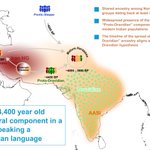
Our article describing the "Proto-Dravidian" ancestry is now peer-reviewed and published in @ejhg_journal There are several updates in the final version. You can read the full article using this link: rdcu.be/eMzZy #protodravidian #dravidian #ancientcivilizations #IVC

Why does India's national research agency, the ANRF, need to request donations from non-governmental sources? Instead, let those sources fund research independently so that even researchers without permanent positions have a chance to secure grants!

𝗔𝗡𝗥𝗙 𝗟𝗮𝘂𝗻𝗰𝗵𝗲𝘀 𝘁𝗵𝗲 𝗗𝗼𝗻𝗮𝘁𝗲 𝘁𝗼 𝗔𝗡𝗥𝗙 𝗣𝗼𝗿𝘁𝗮𝗹!
Listen to Dr. @shivkuma_k as he introduces the Donate to ANRF portal!
🔗 𝗩𝗶𝘀𝗶𝘁 𝘁𝗵𝗲 𝗗𝗼𝗻𝗮𝘁𝗲 𝘁𝗼 𝗔𝗡𝗥𝗙 𝗽𝗼𝗿𝘁𝗮𝗹 — 𝗹𝗶𝗻𝗸 𝗶𝗻 𝗰𝗼𝗺𝗺𝗲𝗻𝘁𝘀.
Jaison J Sequeira retweeted

Paternal lineages in Northwest China changed gradually over time.
Bronze Age Xinjiang populations were largely dominated by Xiaohe-related local lineages or western steppe herder lineages, while Iron Age and later populations showed increasing paternal contributions from East Asian farmers, eastern steppe pastoralists, and Southwest/Central Asian farmers.
Modern Altaic–speaking populations showed strong paternal continuity with Iron Age ancestry, and northwestern Han displayed a west-to-east gradient of paternal lineages.

Jaison J Sequeira retweeted

Some genetic models (qpAdm, qpGraph, and f4-stats) on Australo-Papuan groups (Oceanians); – and its implications for the wider Paleolithic Eurasian demographic patterns...
Broadly speaking, Australo-Papuans derive most of their ancestry from an "eastern non-African" branch:

Jaison J Sequeira retweeted

Almost every paper on polygenic risk scores now reminds us that PRS should be adapted to ancestry. A new @NatureGenet study suggests another important dimension. Age.
The authors studied BMI in 62,276 children across 11 age points from 6 weeks to 8 years. They identified 624 independent signals in the longitudinal analysis. Almost one third did not show the same effect in adults! For 165 signals the association disappeared and for 29 the effect reversed direction.
A striking example is PCSK1. One variant increased BMI at around 8 months but was associated with lower BMI in adults. This fits its biology well because PCSK1 processes multiple hormones and neuropeptides and its role changes across development.
The same pattern was seen with polygenic scores. At 8 to 12 months an age-matched genome-wide PGS explained 10.9% of BMI variance. A PGS trained on adult BMI explained only 1.3%. More than an eightfold difference.
The underlying biology was familiar. The leptin melanocortin pathway was strongly enriched but different genes had different temporal profiles. LEPR and PCSK1 were more important early in life while MC4R POMC and BDNF showed more persistent effects.
Signals were also found near GLP1R and GIPR. Some GLP1R variants acted mainly in early childhood. This is especially interesting because GLP1R is the receptor targeted by semaglutide in Ozempic.
Similar results were seen for rare variants in nearly 480,000 genomes. The authors also found parent-of-origin effects. For example KLF14 acted mainly when the allele was inherited from the mother which fits its known imprinting.
To me, this makes it clear that PRS may need to be adapted not only to ancestry but also to age. The difference can be dramatic. In infancy the right age-specific score explained more BMI variation than score trained in adults. The genome stays the same. Its effects do not.
nature.com/articles/s41588-0…
#GWAS #PRS #adiposity #BMI #snRNA

Jaison J Sequeira retweeted

We’re one step closer to solving the mystery of Arsikuchean (#Tocharians) origins #ancient #dna #indoeuropean #origins
If we look deeper, we might even find cultural and linguistic continuity all the way from the Neolithic and beyond. Fascinating stuff!

Jaison J Sequeira retweeted
This is now published in @MolBioEvol, and includes not only very interesting inference of selection in Neolithic Europe, but also nice benchmarking of various local ancestry inference tools
Link here:
academic.oup.com/mbe/advance…


Local ancestry inference identifies robust evidence of selection in Neolithic Europe
biorxiv.org/content/10.64898…

Jaison J Sequeira retweeted

An opinion:
What if we reimagined STEM education without exams, grades, and GPAs?
Universities enable learning. Students own it. They get a certificate listing the courses; the world decides how good they are.
Why stamp a letter or number on a student?
Does this work?
Jaison J Sequeira retweeted
Ancient DNA unveils distinctive ancestries in the Bronze and Iron Ages of East Tianshan
science.org/doi/10.1126/scie…

Jaison J Sequeira retweeted
Saw @RegevSchweiger give a talk today about this work at #EESHuman
One interesting take away I didnt notice b4 is how the different sizes of the peaks in Chimps/Humans gives information on the "strength" of the structure and thus relative admixture proportions for each species


In this preprint, Regev Schweiger, Richard Durbin and I discuss ancient (>5 million years ago) hominin demography
biorxiv.org/content/10.1101/…

Interesting paper showing very high IVC-like ancestry in one of the Pakistani Roma groups. When it comes to endogamous groups, having at least a few whole genomes (even 5–10x) would be huge. We are missing out on so much info due to low SNP panel overlap.
Genomic reconstruction of the Pakistani Roma reveals dual South Asian ancestry, medieval bottlenecks, and the early dispersal routes of the Romani people
link.springer.com/article/10…

Great work @Shai_Desai ! I have been working along similar lines for a side project; the presence of East Asian ancestry is not limited to the Nilgiris. Many past studies show traces of EA ancestry in their plots, mine does too. Could this be the reason for high DEN in India? 1/2


New preprint 💥
Holocene North Asian gene flow and cryptic substructure in the genome history of Nilgiri tribes.
@gyanc7
@Gyan_Lab
@Anjana_Welikala
@PratikP95933941
@RakeshTamang7
biorxiv.org/content/10.64898…

Jaison J Sequeira retweeted
New review article about identifying natural selection in human history from @pontus_skoglund and @mathiesoniain
Definitely worth a read


Jaison J Sequeira retweeted

A rather special paper for me, for more reasons than one 🐍
Our new work is out in Science Translational Medicine, where we show that a recombinant antivenom made from just five nanobodies can protect against geographically diverse cobra and king cobra venoms from across India

IISc researchers and collaborators have developed a recombinant, nanobody-based antivenom that offers broad protection against venom from geographically diverse cobra and king cobra species in India. @LabVenomics
Read: iisc.ac.in/events/engineered…
#IIScresearch

Jaison J Sequeira retweeted

New study on pottery production at Neolithic Tol-e Sangi (Iran) supports a polycentric model for the emergence of ceramic technology in southwest Asia.
cambridge.org/core/journals/… – at Turin, Piedmont

Jaison J Sequeira retweeted

Cool, its finally out. Base editing in human embryos! nature.com/articles/s41586-0…
