

PhD Student | SLM AI Privacy in Legaltech | Python, FastAPI, LocalAI
Manchester, England
Joined January 2025
- Tweets581
- Following739
- Followers149
- Likes1.8K

Pinned Tweet
Hello,
Jacob from Manchester, uk
I am a Small langue models researcher and solo founder. Looking to connect with more sml, local ai engineers and solo founders
#ai #smalllanguagemodels #localAI #founders


Jacob Sharp retweeted

A great research paper is more than good results.
It tells a clear story:
1. Introduction → Why the study matters
2. Methods → How the study was conducted
3. Results → What was found
4. Discussion → What the findings mean
Strong research isn't just about discovering something new. It's about communicating it clearly so others can understand, evaluate, and build on your work.

Jacob Sharp retweeted

90% of AI Engineer interviews in 2026 are just these 15 concepts repeated:
1/ Transformers & LLM Fundamentals: how LLMs predict the next token, self-attention, multi-head attention, positional encoding, and why transformers replaced RNNs
2/ Tokenization & Embeddings: BPE, how text becomes tokens, and how vectors capture meaning
3/ Prompt Engineering: system prompts, few-shot learning, chain-of-thought, and structured outputs (JSON/schema)
4/ RAG: chunking strategies, retrieval, context injection, context windows, and why RAG beats fine-tuning for fresh data
5/ Vector DBs & Search: vector databases, semantic search, hybrid search , reranking, and HNSW indexes
6/ Function Calling, Tool Calling & MCP: how LLMs trigger APIs, code and databases, and the standard protocol for connecting them
7/ AI Agents & Agentic Workflows: plan, act and observe loops, orchestrated multi-step pipelines, and AI coding agents
8/ Memory & Multi-Agent Systems: short-term and long-term memory, and specialized agents collaborating on a task
9/ Fine-Tuning: full fine-tuning, LoRA, QLoRA, PEFT, and when to fine-tune vs prompt vs RAG
10/ Alignment & Distillation: RLHF, DPO, and knowledge distillation (big model teaches small model)
11/ Quantization & Model Compression: INT8/INT4, pruning, sparsity, and the quality vs speed vs cost tradeoff
12/ Inference & Serving: prefill vs decode, KV cache, speculative decoding, LLM serving, vLLM, batching, and model routing
13/ Multimodal AI & Vision-Language Models: text, image, audio and video in one system, and models that see and reason about images
14/ Evals & Hallucination Detection: LLM evaluation, LLM-as-judge, prompt evaluation, and catching confident but wrong answers
15/ Safety, Observability & Production: guardrails, AI safety, prompt injection, tracing, cost optimization, and production GenAI systems
Know these 15 deeply and you can crack most AI engineer interviews
Nice one

If you want to learn how to build & deploy ML models, this course is for you.
It covers Exploratory Data Analysis, Feature Engineering, Model Validation, & MLOps integration.
By the end you'll be able to manage complex data projects & deploy your models.
freecodecamp.org/news/end-to…

Jacob Sharp retweeted

.@huggingface is being acquired by @nvidia. But!!
GPUs aren't the only option for fine-tuning LLMs!
TRL v1.16 now supports AWS Trainium! 🚀
Fine-tune (vision-)language models with TorchNeuron, and get up to 2× faster training on Trainium2 with smarter sequence-length handling.
Open AI needs hardware choice. 🤗
🔗 huggingface.co/docs/trl/aws_…

Jacob Sharp retweeted

almost 400K people have watched Stanford's CS336 on building language models from scratch.
but if you want to know whether you can actually build one, implement each piece yourself on TensorTonic with provided gpus to fine tune your model
tensortonic.com



Jacob Sharp retweeted

Andrej Karpathy:
"Prompting is going away. Delete everything, keep Graph."
In just 69 minutes, he shows how to build graphs and why they're the only layer that survives in the end
Prompts → Agents → Loops → Graphs
a loop keeps one agent running until the job is done
a graph decides which agents exist and what each one passes to the next
anyone can build an agent, almost nobody builds the graph that runs them
watch it today, then save the full guide on graphs below before everyone starts catching up ↓


Great one

Don't waste 2 years learning to become an AI agentic engineer in 2026.
Andrew Ng, the godfather of AI, gave the complete playbook to become one from scratch.
1 hour course. Free:
• 00:00 - AI agent basics
• 12:12 - AI Agentic workflows & design patterns
• 53:27 - Practical tips for building AI agents
• 1:20:30 - self-improving AI agent loops
• 1:30:19 - multi-agent AI systems
I watched it last night.
Halfway through, I realized I could get into Anthropic in weeks, not years.
Bookmark now. Watch it. Then build your own AI agent
Jacob Sharp retweeted

We launched OSS Scanner, which gives critical open source projects free, periodic vulnerability scans from our strongest models.
Each finding includes a proof-of-concept, and a patch where possible.
red.anthropic.com/oss-scanne…

Jacob Sharp retweeted
More hardware choice for PyTorch developers: TorchNeuron registers @awscloud Trainium as a native device, built on the same extension points the community created to make PyTorch hardware-agnostic.
Open sourcing at PyTorch Conference on Oct. 20. bit.ly/4i3P9Ud


Jacob Sharp retweeted

this is pure f*cking gold for anyone running coding agents
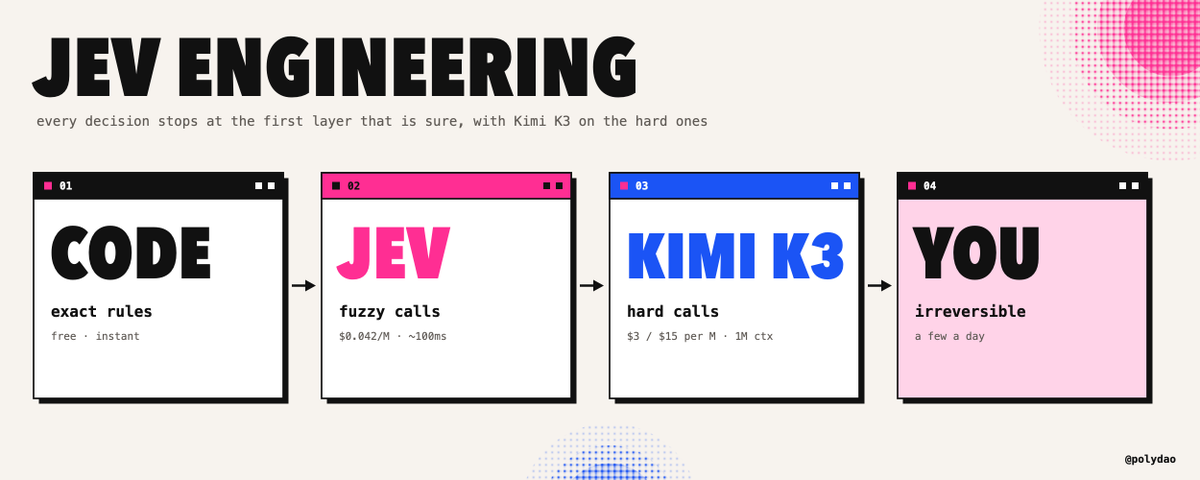
Jev founder Diogo Amogo wrote a PDF on building a Jev harness
the promise:
> 200x faster
> 400x cheaper
the model hasn't been the slow part for a while
the speed and the cost sit in the harness wrapped around it
• how to use it
> drop this PDF and the article below into Claude Code or Codex
> let it rebuild its own setup
one evening of setup
and your agent starts next week on a harness most teams still don't have


Beautiful news

🔍 Search & Fetch APIs are now open to everyone!
Powered by our in-house search engine, serving hundreds of millions of requests daily worldwide.
💰 Each endpoint: $0.75 per 1,000 calls.
📖 Docs: api-docs.deepseek.com/guides…
📌 Search & Fetch calls via server-side tools in DeepSeek Harness, Claude Code, and Codex are currently free for DeepSeek API users. Billing starts Oct 31, 2026, at 16:00 UTC.
3/4

Jacob Sharp retweeted

4 free CUDA resources to learn GPU programming from scratch.
1./ NVIDIA - Modern CUDA C++
Learn GPU programming directly from NVIDIA. Video lectures, slides, and coding notebooks covering parallel algorithms, CUDA streams, and writing your own kernels.
github.com/NVIDIA/accelerate…
2./ freeCodeCamp - CUDA Programming
12 hours with Elliot Arledge. Starts with setup and a C/C++ review, then moves into kernels, memory management, matrix multiplication, and custom PyTorch operations.
freecodecamp.org/news/learn-…
3./ University of Illinois - Applied Parallel Programming
Understand CUDA’s execution and memory models, then work through tiling, reductions, scans, and convolution.
lumetta.web.engr.illinois.ed…
4./ University of Oxford - CUDA Programming on NVIDIA GPUs
Free lecture slides and practical exercises from Mike Giles and Wes Armour. Covers memory, synchronization, libraries, and programming across multiple GPUs.
people.maths.ox.ac.uk/~giles…

Jacob Sharp retweeted

Brilliant paper by NVIDIA.
they found a way to make KV cache transferable between models.
the target model skips prefill entirely, and the conversion runs 2.7 to 25x faster than processing the context again.
let's understand why this is so important today.
LLM APIs are stateless, so every turn sends the entire conversation back to the model. the model reads it again before generating a new token, and all of it is billed as input.
prompt caching lets providers hold the KV cache for a stable prefix and bill cache hits at roughly 10% of the base input rate because that compute was already done.
this 90% reduction is one of the biggest levers in LLM serving.
but the cache only works on the model that produced it. since keys and values depend on that model's weights, another model cannot directly reuse them.
this becomes a problem with LLM routing.
if traffic moves to another model for cost or capability reasons, the accumulated KV cache becomes invalid.
the entire context must be processed again and billed at full rate.
NVIDIA's recent paper treats this as a representation problem.
prefill's main output is the KV cache, so transferring it means converting one model's cache into the representation another model expects.
they first checked whether this conversion had enough structure to exploit.
for Qwen3 14B → 32B, a linear regression from a single source layer reconstructed 56% of the variance in the target model's keys.
because models can have different layer counts, there is no natural one-to-one layer mapping.
so, for every target layer, they rank the source layers by predictive power and use the top eight together.
that pushes reconstruction to 79%.
the mapper has three parts:
> each target layer and head gets its own linear map, solved in closed form instead of with gradient descent.
> cross-layer selection chooses the source layers that best predict each target layer. their ablation shows this contributes the most.
> RoPE adds a position-dependent rotation to keys. they remove it, fit the mapping in position-free space, then apply the target model's rotation again at inference.
across six model pairs from Qwen3, Llama 3.1, and Ministral 3, four retain 73 to 98% of the receiving model's standalone accuracy.
conversion is also 3 to 25x faster than processing the context again.
prior cross-model KV reuse methods either train a neural adapter for every pair or require architecturally identical models.
this approach is closed-form and training-free, but there are still important limitations.
every tested pair belongs to the same model family, such as Qwen → Qwen or Llama → Llama.
cross-family transfer is still future work.
the tested pairs also share KV head count and per-head dimension. mismatched configurations remain untested.
and the work currently covers dense full-attention models only, not sliding-window or attention-recurrent hybrids.
link to the paper: arxiv.org/abs/2608.03893
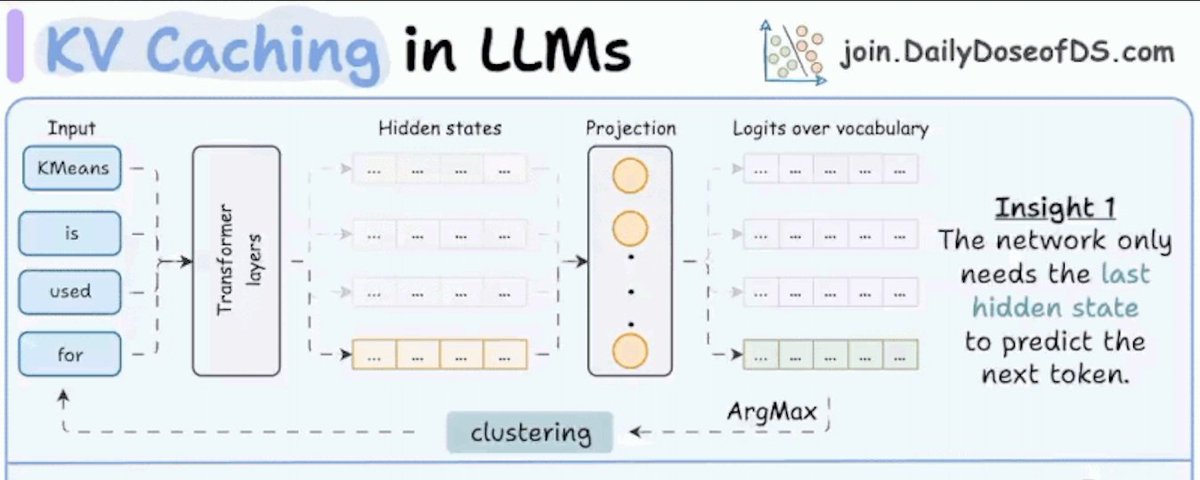
we wrote a first-principles breakdown of how KV caching works
the article is quoted below.


Jacob Sharp retweeted
Must try tool


