

@jacksonfyfe
Account based inAustralia
About this account
- Account based in
- Australia
- Connected via
- Australia App Store
Account-level information from X, not a live location or the device used for a specific post.
I talk about exercise, ageing, and healthspan | Senior Lecturer in Exercise Science @DeakinIPAN | 15+ years in exercise research and education
Join 1.3k+ readers ➡️
Joined May 2011
- Tweets2.3K
- Following424
- Followers8.4K
- Likes5.1K




Pinned Tweet
Exercise is about more than just fitness or aesthetics.
It’s what it means for our ability to stay independent for longer.
Here’s the cardiorespiratory fitness (VO2peak) needed for common daily activities.
Once our fitness drops below these thresholds, we can no longer “afford” the metabolic cost of tasks needed to remain independent.
One of the many reasons to stay active for as long as possible.
pubmed.ncbi.nlm.nih.gov/3821…

What eating less and exercising more have in common:
The "best" diet probably isn't the one that makes you eat the least, but the one that makes eating less easier.
The "best" training program probably isn't the one that makes you do the most, but the one that makes coming back easier.
We tend to have a “muscle-centric” view of the effects of ageing and inactivity on health and physical performance.
But as this great new article by @orssattolucas and colleagues argues, sarcopenia is a disease of the whole motor system, not just our muscles.
Ageing affects the entire system responsible for producing movement - from the brain and spinal cord to motor neurons, peripheral nerves, the neuromuscular junction, and finally - the muscle itself.
This is likely why the loss of muscle mass alone doesn’t always do a great job of accounting for the much larger declines we see muscle function, like strength and power, and physical function with ageing. It's also one reason why modern definitions of sarcopenia place more emphasis on muscle strength and physical function, rather than just muscle mass.
But I think this broader view also helps us understand why resistance training is such a critical intervention here.
Because resistance training already trains the whole motor system.
With every repetition, the brain generates a signal, the spinal cord and motor neurons transmit it, the neuromuscular junction passes it on to the muscle, and the muscle fibres ultimately contract and produce force.
That’s why resistance training is not just about building muscle, but challenging the whole system responsible for creating movement. It’s also why resistance training can produce large (and more rapid) gains in strength, power, and physical function, even without measurable changes in muscle size.
I totally agree with the shift away from a “muscle-centric” view of sarcopenia. But perhaps we should do the same with resistance training too.

Link to paper:
thelancet.com/journals/lanhl…

Absolutely stoked to complete my first half marathon over the weekend.
After always struggling to prioritise my running, it was great to finally achieve something I’d wanted to do since I last ran a 14 km event over 10 years ago.
But this process also helped me realise something important about training.
On one hand, setting a goal like competing in a physical event is a great way to bring some motivation and purpose to your exercise routine.
But these kind of goals can be tricky too - because once they are achieved, we can quickly lose motivation to continue.
So in a lot of ways, training is for more than race day.
I don’t currently have another event in the calendar, but I’m going to keep training like I do anyway. My goal isn’t to train for another race, but to stay in a position where I could run one if I wanted to.
Because life doesn’t announce it’s biggest physical challenges in advance. You don’t always know when you’ll want to go hiking on a holiday, keep up with your kids or grandkids, or need to recover from surgery or an unexpected illness.
So perhaps the biggest benefit of maintaining good physical fitness is to be better prepared for the unexpected things life can throw your way.
Training for events can be a great way to encourage action. But the real goal is to make exercise a part of just what you do, not just because you are training for an event.
Because we should all train for the “events” in life we can’t see coming, too.
It's about adopting a "life-ready" mindset, instead of a race-ready one.

Exercise may slow as many as 14 hallmarks of ageing.
Many of these processes may be considered as part of the body’s maintenance system. As they become less efficient, their ability to repair everyday damage declines, and the risk of disease and loss of function increases.
That's why exercise is not just about treating the consequences of ageing, but helping to maintain the systems that keep us healthy in the first place.
doi.org/10.1016/j.jshs.2025.…

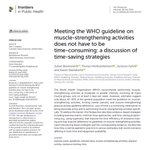
Resistance training can benefit almost every aspect of healthy ageing, yet only 10-30% of adults meet current guidelines of 2+ sessions per week.
In this new perspective article, we show how the WHO guidelines can be achieved with practical, time-efficient strategies, and realistically applied in 3 real-world scenarios (busy working parent, retired older adults, uni student).
Our hope is this might help turn the question from just “why should I resistance train?” to “how can I make this work for me?”.
doi.org/10.3389/fpubh.2026.1…

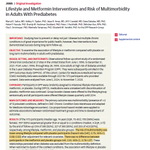
Back in 1999, 3234 adults with prediabetes were enrolled in a 3-year Diabetes Prevention Program.
They were randomly assigned to either lifestyle (exercise + diet + support), medication (metformin), or placebo arms.
21 years later, the lifestyle group had a 21% lower risk of multimorbidity, while the metformin group showed no statistically significant reduction.
How we move, eat, and live now could impact our health for decades.

Data from:
Salive ME, Tjaden AH, Ames JR, Crandall JP, Dabelea D, Hazuda HP, Heckman-Stoddard BM, Huckfeldt PJ, Kuo S, Strotmeyer ES, Temprosa M, Venditti EM; DPP Research Group. Lifestyle and Metformin Interventions and Risk of Multimorbidity in Adults With Prediabetes. JAMA. 2026 Jun 15:e268492.
doi.org/10.1001/jama.2026.84…


6️⃣ You don't need huge amounts of training
Even small amounts of resistance training can produce meaningful benefits.
That’s important for most people including beginners, busy people, older adults, or those returning after injury.
Instead of asking what the "ideal" program is, the better question is: what's the smallest amount someone can do consistently?
For many, that's where progress starts.
7️⃣ The biggest shift is perspective, not programming
We're caring less about optimal programs and more about helping people actually do resistance training.
The challenge with resistance training is participation, not effectiveness.
That's where the biggest opportunity is.
Because the best approach is still the one you can stick with.
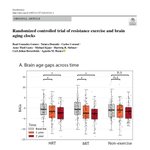
Can lifting weights slow brain ageing?
Here, one year of moderate or heavy resistance training slowed functional brain ageing by ~1-2 years in older adults, based on brain “clock” models derived from resting-state fMRI.
These benefits persisted for 12 months and appeared to reflect global improvements in whole-brain networks rather than isolated regional changes.
What’s good for your muscles is probably good for your brain.

Source:
link.springer.com/article/10…
