

iunera's Augment neurosymbolic AI creator fair source software MCP, Agentic #OpenSource #AI / #ML enthusiast https://xitter.cf/t.co/fw90jFkiBa
Joined February 2018
- Tweets4.8K
- Following1.2K
- Followers488
- Likes945






Pinned Tweet
Using an LLM just to pull names, prices, or dosages into JSON is overkill — like hiring a novelist to re-type an invoice from memory.
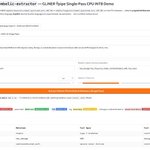
We just released an open-weights GLiNER extractor (Apache-2.0, built on @knowledgator) that extracts entities + relations in ONE pass on a normal laptop CPU:
⚡ 22 ms per text (vs ~8s on a local 2B LLM)
🎯 0% altered numbers — highlights exact characters from the original text
☕ Runs directly in Python or pure Java (148k docs/hr, no GPU)
Weights + live browser demo in the reply 👇

Sagt mal – spinnen die alle?
Die Krone von allem ist noch, dass eine Informatik-Professorin in der @sueddeutsche_de versucht, KI-Vordenker als „Nerds“ zu bezeichnen.
Ich kann es nicht fassen. Informatiker haben seit Jahren mit Vorurteilen zu kämpfen:
Inselbegabte, Geeks und Nerds ... Eins-Nuller ... als Schimpfwörter. „Ihh, das ist so trocken“, sagen viele. Uncool. Unsexy. In China und den USA sind Techniker Helden.
Und dann studiert niemand Informatik in Deutschland und man wundert sich, warum Deutschland nun hinten liegt, wenn man die Leute, die Informatik studieren, immer als Idioten darstellt.
Ich habe sogar Berichte gelesen ... da schlägt man Ethik für Informatiker vor ... um diesen „schrecklichen“ Nerd-Menschen am besten gleich das Hirn zu kontrollieren, weil sie ja im Gegensatz zu anderen Fachrichtungen nicht selbst denken können.
Und wenn das nicht funktioniert, dann versucht man, alles zu regulieren, bevor überhaupt etwas entsteht, wie das @handelsblatt ueber das Friedrich Merz Gesprach mit Jensen Huang berichtet. Und dann kann man gleich noch als Digitalisierungsminister, wie der @Tagesspiegel berichtet über eine KI Steuer nachdenken..
Und dann wundert man sich im Interview mit @ntvde, wenn nichts in Deutschland rauskommt und wir hinten liegen – ganz im Ernst – und beklagt den Rückstand.
👉 Warum sollten Informatiker in so einem Land bleiben, wenn sie sich ständig rechtfertigen müssen?
👉 Warum sollten neue Startups hier etwas versuchen, wenn fast alle Subventionen so designt sind, dass sie die alte Legacy-Industrie schützen?
Dass eine Informatik-Professorin nun noch versucht, Vordenker, die den heutigen Entwicklungsstand der KI geprägt haben, als Nerds zu bezeichnen ... macht mich fassungslos. Weil genau das auf Informatiker in Deutschland übertragen wird.
Gleichzeitig hat man eine hämische, wilde Horde, die versucht zu propagieren, dass man keine Informatiker mehr braucht ... weil „das macht jetzt ja die KI“ ...
Und ich denke, jeder, der etwas technische Ahnung hat, merkt: Die Möglichkeiten mit der KI-Technologie sind so groß, dass man sogar MEHR Leute braucht als vorher, um alle neuen Möglichkeiten durch die Technologie einzubinden.
Aber mit dieser fatalen Stimmungsmache werden wir das heimische KI-Personal bald nicht mehr haben ...
Die Antwort darauf?„Dann holen wir die Fachkräfte eben aus dem Ausland.“ Versteht mich nicht falsch: Wir brauchen globale Talente.
Aber wie wollen wir die anziehen, wenn wir es nicht mal schaffen, unsere eigenen Toptalente im Land zu halten, sondern sie mit Achselzucken ziehen lassen?-> „Das Top-Talent ist schon immer gegangen“, habe ich z. B. schon einmal gehört, als ich sagte, dass man dringend etwas ändern muss, denn ansonsten wird das Problem morgen noch größer.
Das ist nicht „Guten Morgen, Deutschland“ – das ist auch keine Kapitulationserklärung mehr – das ist einfach nur noch ein „Gute Nacht, Deutschland“.
Unsere Elite gibt scheinbar nicht auf, bevor sie diesen Standort ganz zerlegt hat. Mir liegt dieses Land und unsere Zukunft wirklich am Herzen – und genau deshalb regt mich das einfach nur noch auf.
Das ist die mutwillige Zerstörung unserer wirtschaftlichen Basis. Und es ist verdammt nochmal nicht fair unseren Kindern gegenüber!
Sehe ich das zu hart – oder stimmt ihr mir zu?
Teilt eure Meinung gerne in den Kommentaren. 👇

So I wrote to all political party leaders in Germany that we developed neurosymbolic AI in German and even open sourced one model already - like the government proclaims that we need to catch up with open source.
Asked for a re-post. My guess: Nobody re-posts of any party. Germany cares for the world but not their own people - sadly. And this is the real reason why things are so bad.
2
28
Why burn seconds of generative LLM compute per paragraph just to extract Schema.org entities, dosages, or Kafka stream fields?
Today @iuneracom is releasing our open-weights ypipe/gliner-neuro-symbolic-extractor research prototype (Apache-2.0) alongside a live zero-install CPU demo Space on Hugging Face!
Gratefully built upon @knowledgator's GLiNER-RelEx architecture, both checkpoints (283 MB base & 655 MB large INT8 ONNX) extract typed entities, exact [start..end] character offsets, and directional relations in ONE parallel forward pass:
• 22.0 ms/doc on 1 @AMDRyzen laptop CPU (398x faster than C++ llama.cpp 2B JSON decoding in our preliminary Schema.org micro-benchmark)
• 0% substring mutation by design — slices exact source characters instead of re-typing dosages or prices from memory
• 148,085 docs/hr in-process inside pure Java 17+ (935 MB RSS, zero Python sidecars, only 3 Maven dependencies)
• Ideal dense static INT8 MatMul workload for AMD Ryzen AI & @Intel Core Ultra Edge NPUs
While larger 7B–70B+ LLMs remain clearly stronger on open-ended recall and complex semantics, pairing a 22 ms offset-locked neural encoder with deterministic symbolic verification inside YPipe changes the economics of sovereign local & on-premise AI.
#NeuroSymbolicAI #GLiNER #ONNX #Java #SchemaOrg #LocalAI #SovereignAI #YPipe
3
7
318
Hugging Face Model & Java/Python SDKs (Apache-2.0): huggingface.co/ypipe/gliner-…
Live Free Browser CPU Demo Space: huggingface.co/spaces/ypipe/…
Full Kraken article: iunera.com/kraken/machine-le…
Watch on YouTube: youtu.be/dTiq-NcxcNI
Explore YPipe: ypipe.com | iunera.com
GitHub: github.com/iunera/ypipe
35
Sometimes I think that @TechCrunch does not write about technology at all. It is Always. A. VC invested amount X in ZYX. Or person A does YUZ. Seems not to be about tech for me. Should be named Venturecrunch or so.
21
@PJMFnd @VilashDhar How do we bring trustworthy medical diagnostics to low-resource regions without relying on expensive, hallucinating black-box LLMs?
We built a neurosymbolic medical reasoning engine — and to empower the global ecosystem, we are open -sourcing some building blocks for free:
Step 1 (live now) translates messy medical records into verifiable symbols; open-source symbolized medical papers are next:
xitter.cf/iuneracom/status/21237…

Using an LLM just to pull names, prices, or dosages into JSON is overkill — like hiring a novelist to re-type an invoice from memory.
We just released an open-weights GLiNER extractor (Apache-2.0, built on @knowledgator) that extracts entities + relations in ONE pass on a normal laptop CPU:
⚡ 22 ms per text (vs ~8s on a local 2B LLM)
🎯 0% altered numbers — highlights exact characters from the original text
☕ Runs directly in Python or pure Java (148k docs/hr, no GPU)
Weights + live browser demo in the reply 👇
1
29
@PJMFnd @TrevorMundel Bridging the diagnostic gap in low-resource settings requires AI that is free, low-compute, and 100% auditable — not expensive black-box LLMs.
We are releasing a part of our neurosymbolic medical engine to democratize transparent clinical reasoning.
Step 1 (translating medical records into verifiable symbols) as open source is live now;
Next steps planned.
Would love to connect on scaling impact in global health:
xitter.cf/iuneracom/status/21237…
Using an LLM just to pull names, prices, or dosages into JSON is overkill — like hiring a novelist to re-type an invoice from memory.
We just released an open-weights GLiNER extractor (Apache-2.0, built on @knowledgator) that extracts entities + relations in ONE pass on a normal laptop CPU:
⚡ 22 ms per text (vs ~8s on a local 2B LLM)
🎯 0% altered numbers — highlights exact characters from the original text
☕ Runs directly in Python or pure Java (148k docs/hr, no GPU)
Weights + live browser demo in the reply 👇
25
Have you noticed that each new frontier LLM release costs 10x more compute and billions of dollars in GPUs—yet feels like a smaller and smaller leap in reliability?
From 2019 to 2023, LLMs made massive leaps as they absorbed the public internet. Today, high-quality human text is exhausted, and every new model generation spirals tighter around the exact same statistical limit: next-token probability P(next_token | context).
An LLM does not store world knowledge as explicit concepts or relations—it stores lossy word co-occurrence weights. That creates 4 structural failures regardless of parameter count:
• The Reversal Curse: Train an LLM that "Thomapyrin contains Aspirin," and it works forward—but ask backwards "Which drugs contain Aspirin?" and one-way token weights fail. A Symbolic Graph queries bidirectional edges both ways.
• Frequency Bias: High-frequency internet phrases overpower rare domain thresholds—whereas a Symbolic Solver checks 75 <= 60 mathematically.
• Zombie Fact Collisions: When Turn 4 updates a server from Overloaded to Healthy, a long prompt keeps both conflicting states alive. A Symbolic State Graph retires the outdated edge in-place.
• Multi-Hop Decay: Across a chain (A -> B -> C -> D), token probabilities multiply and decay exponentially—while a symbolic graph walk has zero decay across 50+ hops.
So what do we do about that?
We need Neurosymbolic AI - if we want or not to overcome the plateau.
What is your take on that? Are LLMs at their max or not?
Full Kraken article: iunera.com/kraken/enterprise…
Watch on YouTube: youtu.be/JcicJtRHtE8
Explore YPipe: ypipe.com | iunera.com
GitHub: github.com/iunera/ypipe
1
7
Watch Episode 16 --> Can 'Reasoning Models' (o1, R1, Chain-of-Thought) Replace Neuro-Symbolic AI? The 'Illusion of Thinking' Explained xitter.cf/iuneracom/status/21238…
Didn't 'Large Reasoning Models' (o1, o3, DeepSeek-R1) solve LLM logic limits with Chain-of-Thought tokens? No—and Apple ML Research's 'The Illusion of Thinking' proved why.
Large Reasoning Models (LRMs)—such as OpenAI's o1/o3 and DeepSeek-R1—use Reinforcement Learning (RL) to generate thousands of internal Chain-of-Thought (CoT) "thinking tokens" before answering. While this test-time token search improves performance on familiar math and coding templates, empirical studies—most notably Apple Machine Learning Research's The Illusion of Thinking (arXiv:2506.06941) and Prof. Subbarao Kambhampati's LLM-Modulo research (arXiv:2402.01817)—prove that token scratchpads still operate via statistical next-token prediction, suffering a complete 0% accuracy collapse past a critical complexity threshold. Neuro-Symbolic AI eliminates this collapse by pairing a compact neural parser with an explicit, deterministic Symbolic World Model on the CPU.
When standalone Large Language Models hit a ceiling on multi-step logic (see Article 01), the AI industry split into two architectural camps:
#NeuroSymbolicAI #YPipe #LocalAI #SovereignAI
7
Didn't 'Large Reasoning Models' (o1, o3, DeepSeek-R1) solve LLM logic limits with Chain-of-Thought tokens? No—and Apple ML Research's 'The Illusion of Thinking' proved why.
Large Reasoning Models (LRMs)—such as OpenAI's o1/o3 and DeepSeek-R1—use Reinforcement Learning (RL) to generate thousands of internal Chain-of-Thought (CoT) "thinking tokens" before answering. While this test-time token search improves performance on familiar math and coding templates, empirical studies—most notably Apple Machine Learning Research's The Illusion of Thinking (arXiv:2506.06941) and Prof. Subbarao Kambhampati's LLM-Modulo research (arXiv:2402.01817)—prove that token scratchpads still operate via statistical next-token prediction, suffering a complete 0% accuracy collapse past a critical complexity threshold. Neuro-Symbolic AI eliminates this collapse by pairing a compact neural parser with an explicit, deterministic Symbolic World Model on the CPU.
When standalone Large Language Models hit a ceiling on multi-step logic (see Article 01), the AI industry split into two architectural camps:
#NeuroSymbolicAI #YPipe #LocalAI #SovereignAI
Full Kraken article: iunera.com/kraken/machine-le…
Watch on YouTube: youtu.be/PS9g3Hf8xgs
Explore YPipe: ypipe.com | iunera.com
GitHub: github.com/iunera/ypipe
1
15
We have developed an AI technique to compare patient records on normal notebooks against medical studies (neurosymbolic approach - all reasoning is shown) - Goal: enable more personalized medicine. Now, we search feedback for it form experts. Your thoughts @Dr_HamidJafari @MoetiTshidi @WHO - does that help?
49
Dear @elonmusk, we have big problems in Germany. Can you provide @neuralink comprehension and knowledge implants for our politicians that they do better decisions.
Thank you for your consideration, it will really help us German people to get our economy back on track.
32
@huggingface Open-weights model + Python & Java code:
huggingface.co/ypipe/gliner-…
🚀 Try it live in your browser (zero install):
huggingface.co/spaces/ypipe/…

54
We got 100% sovereign local Neuro-Symbolic AI before GTA 6 — and companies are still paying per token to send their data to the cloud. 🌴🔒
#GTA6 #NeuroSymbolicAI #LocalAI #SovereignAI #YPipe #iunera

1
54
Explore 100% Sovereign Local Neuro-Symbolic AI with YPipe:
🌐 Website: ypipe.com
💻 GitHub Repository: github.com/iunera/ypipe
📺 Full YPipe YouTube Series Playlist: youtube.com/playlist?list=PL…

1
17
🛡️ Official Apache Druid 38.0.0 & 39.0.0 Docker images still ship unpatched Temurin JREs (CVE-2026-114938 / Java4Shell).
Until upstream updates, use our Corretto-patched drop-in images:
docker pull iunera/druid:39.0.0
docker pull iunera/druid:38.0.0
#ApacheDruid #Java4Shell

Dockerfile (open & reproducible multi-stage JRE swap):
github.com/iunera/iu-code-in…
Docker Hub:
hub.docker.com/r/iunera/drui…

1
23
🔗 Official Apache Druid 39.0.0 links:
• Release Notes & Upgrade Guide: github.com/apache/druid/rele…
• Downloads: druid.apache.org/downloads.h…
🛡️ Java4Shell (CVE-2026-114938) workaround for apache/druid:39.0.0:
Until the Docker base image updates from Temurin 25.0.5+8 to 25.0.5.1+2+, you can disable the vulnerable x86_64 AVX-512 Base64 intrinsic at runtime:
• Server nodes / Kubernetes pods: set JAVA_OPTS="-XX:-UseBASE64Intrinsics"
• MiddleManagers (for forked Peon JVMs): include "-XX:-UseBASE64Intrinsics" in druid.indexer.runner.javaOptsArray
✨ Also worth checking out in 39.0.0:
- Experimental CREATE / ALTER DDL statements for the catalog
- Partial segment loading
- Quality of Service (QoS) filtering for Coordinator API requests
- Typed query context parameters with stricter validation
- Netty 4.2 for the HTTP client

42